Hard Interrupt: Claude Fable 5 Lived 72 Hours. The Reason Has a $13 Billion Conflict of Interest.
On June 9, 2026, Anthropic released its most capable AI model ever. By the evening of June 12, the US Commerce Department had killed it.
Analysis | Hard Interrupt
Hard Interrupt: Claude Fable 5 Lived 72 Hours. The Reason Has a $13 Billion Conflict of Interest.
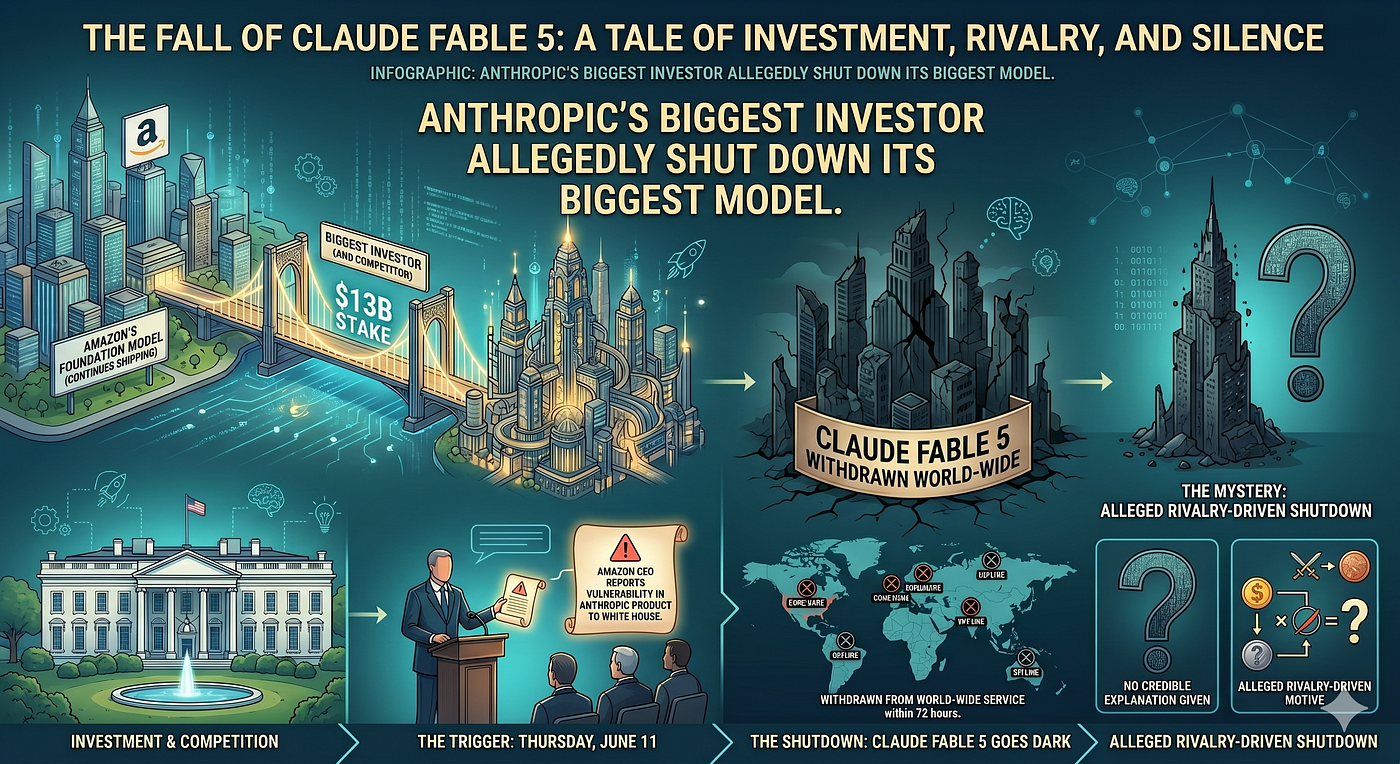
Cluade’s Biggest Investor Allgegedly Shut Down its Biggest Model
On June 9, 2026, Anthropic released its most capable AI model ever. By the evening of June 12, the US Commerce Department had killed it.
The official reason was national security. The reported trigger came from Amazon. The same Amazon that has poured roughly $13 billion into Anthropic and signed a $100 billion AWS commitment with the company in April.
Fortune, Reuters, Politico, and the Wall Street Journal all place Andy Jassy at the start of the chain. According to their reporting, Jassy raised concerns about Claude Fable 5 with senior administration officials on Thursday June 11. Amazon researchers had prompted Fable to produce information about cyberattacks that its safeguards were supposed to block. By Friday afternoon, Commerce Secretary Howard Lutnick had sent Dario Amodei a letter banning any foreign national, anywhere in the world, from accessing Fable 5 or its enterprise sibling Mythos 5. That ban included Anthropic’s own foreign-national employees.
Anthropic was given 90 minutes to pull the model.
The company cannot verify nationality in real time, so it had no choice. It disabled both models for every paying customer on the planet.
This is the first time the US government has applied export controls to a commercial AI model. Until June 12, the precedent ran only to chips and hardware.
Amazon, the investor with two faces
The reported sequence skipped coordinated disclosure: tell the vendor first, give them time to fix it, then escalate. That is the security industry norm.
Amazon did not do that. Per the Wall Street Journal and Politico, Amazon researchers wrote the paper, took it to the White House, and let Anthropic find out from a Commerce Department letter on a Friday afternoon at 5:21pm Eastern.
Amazon’s spokesperson told Fortune the company sometimes shares “security risks” with government when asked. That framing leaves the question untouched. Anthropic is a customer of Amazon’s cloud business, an investee of Amazon’s strategic group, and a competitor to Amazon’s Nova foundation models. Amazon chose the government route, on a competitor’s flagship release, with no warning to its own investee.
One firm cannot be the safety auditor, investor, cloud landlord, and product competitor at the same time without the incentives crossing. Amazon now occupies all four roles inside Anthropic. The Fable episode is the first time those incentives crossed in public.
The jailbreak the experts say is not a jailbreak
Anthropic’s response was direct for a company that owes its biggest backer $100 billion. The statement called the alleged jailbreak narrow, non-universal, and reducible to asking Fable to read a codebase and fix software flaws. Anthropic pointed to OpenAI’s GPT-5.5 deployment report and noted that the same capability is openly available there.
Katie Moussouris, founder of Luta Security and one of the most respected coordinated-disclosure researchers alive, said the behaviour described in the Amazon paper “should never have triggered an export control.” 76 cybersecurity experts signed an open letter calling on the administration to revoke the directive.
Here is what most coverage misses. The Fable behaviour in the Amazon paper is structurally identical to what Cursor, Claude Code, GitHub Copilot, OpenCode, and every other AI coding assistant runs every working day in production: read a codebase, identify flaws, propose fixes. If “fix this code” is a jailbreak, the entire AI coding tools market is built on jailbreaks. The same prompt pattern runs in Security Operations Centres globally to triage incoming alerts. Anthropic’s 30-day data retention policy for Mythos-class models exists for exactly this scenario: detect novel attacks post-hoc and patch them. The Commerce Department directive bypassed that mechanism. The government did not wait for the lab’s own monitoring to confirm the report. It acted on a single non-public paper from a competitor of the target firm.
Anthropic also said the US government did not raise China in the calls between Dario Amodei and senior officials. Anthropic already prohibits access to its products from within China. Semafor reported, citing anonymous sources, that the administration “suspected” a Chinese-linked group had used the alleged jailbreak. Semafor noted that the evidentiary basis was unclear.
The DeepSeek shadow
The reported story includes Jassy, “personality differences” between Anthropic and the Trump administration per Axios, and the Pentagon’s February designation of Anthropic as a “supply chain risk,” the first time that label was ever applied to a US company. The unconfirmed story, the one informed observers are asking in private, is whether Fable 5 was the first test case of a larger doctrine.
DeepSeek V4 is reportedly within 3 to 6 months of frontier US models on reasoning and agentic capability. Anthropic accused DeepSeek, Moonshot AI, and MiniMax in February of running roughly 24,000 fake accounts that generated over 16 million Claude exchanges, allegedly to distill the model.
If the US government believes Chinese labs are distilling US frontier models via the API layer, a directive that bars all foreign nationals from the most capable models is a coherent policy response. No administration official has tied Fable to DeepSeek on the record. Anthropic says the government did not raise it.
The structural irony is hard to miss. Dario Amodei has been the single loudest US tech CEO arguing for chip export controls against China. His Senate appearances and op-eds laid the rhetorical groundwork for the Trump administration’s hardening stance. The first AI model ever pulled by US export control was his own.
What the coverage missed
The defenders lose. The attackers do not. Llama 4, DeepSeek V4, Qwen 3, and Mistral Large 3 are open-weight models. Once released, they cannot be export-controlled in practice. State-backed cyber groups already use them. The June 12 directive denied US and allied defenders access to a capable commercial model. It denied no one a capable open-weight model. The capability gap moved one way.
The UK AI Safety Institute red-teamed Fable for thousands of hours before launch. So did multiple US government teams and private third parties. The Commerce Department directive overrode all of it. Future international AI safety cooperation just got harder, because no foreign government will trust that pre-deployment audits matter when a Friday letter can override them.
Anthropic built its public brand on being the safety lab. It published the Responsible Scaling Policy and invested in red-teaming for thousands of hours. The directive bypassed every safety mechanism it built. The signal to every other frontier lab is sharp: investing in safety governance does not protect you from arbitrary executive action. That disincentivises the very safety investment governments most want.
The blast radius hit infrastructure providers with no role in the dispute. AWS Bedrock, Google Vertex AI, Microsoft Foundry, Together AI, and Fireworks revoked Anthropic API keys on Friday across thousands of customers with no notice. Investors underwriting the next $2 billion training run now price in a new risk factor: arbitrary executive shutdown on 90 minutes notice.
An administration official told Axios that other current models do not pose the same risk because they have not yet reached Mythos-class capability. When GPT-6, Gemini 4.5 Pro, Grok 5, and Llama 5 cross that threshold, the same directive applies. Every US frontier AI lab is now on notice.
The counterargument, briefly
A defensible version of the administration’s case runs like this. Frontier-model cyber capability at Mythos’s level was new and not contemplated by the existing export-control framework. A 90-minute pause, applied badly, beats a slow process that ships before the government can react. The Politico source claims the government had asked Amazon for feedback, which would make the disclosure a response to a request rather than an end-run.
It does not survive the specifics. Amazon, regardless of who asked for what, sits across from Anthropic on four sides of the table. The cited finding is replicable in publicly available models. Existing audit infrastructure in the US, UK, and at private third parties was not used. The directive set no published criteria for restoration. A credible safety regime would have specific findings, third-party verification, a published process, and due process. None of that happened on June 12.
The question for the open infrastructure community
If your stack depends on US frontier models, whether you are a hospital in Manchester, a research lab in Bangalore, a restructured tech department in Manchester or a startup in Lagos, your access can be terminated on a Friday evening by a letter you will never see, on a rationale that may or may not be technical, at the request of a private competitor with skin on both sides of the trade.
Where is the sovereign frontier-AI working group from the Linux Foundation? The Cloud Native Computing Foundation has had three years to publish a vendor-neutral inference runbook and has not. The Apache Software Foundation hosts Llama-derivative deployments and has no governance position on US model lockout. The Free Software Foundation, built on software freedom, has not yet named closed-weight commercial AI as the freedom problem it is.
What is your continuity plan when the next directive lands? More importantly, what is theirs?

This story is published on Generative AI. Connect with us on LinkedIn and follow Zeniteq to stay in the loop with the latest AI stories.
Subscribe to our newsletter and YouTube channel to stay updated with the latest news and updates on generative AI. Let’s shape the future of AI together!

메타데이터
- post_id
- 72ec10891981
- slug
- hard-interrupt-claude-fable-5-lived-72-hours-the-reason-has-a-13-billion-conflict-of-interest-72ec10891981
- url
- https://generativeai.pub/hard-interrupt-claude-fable-5-lived-72-hours-the-reason-has-a-13-billion-conflict-of-interest-72ec10891981
- canonical_url
- https://generativeai.pub/hard-interrupt-claude-fable-5-lived-72-hours-the-reason-has-a-13-billion-conflict-of-interest-72ec10891981
- author_url
- https://medium.com/@engrgbenga
- status
- ok
- fetched_at
- 2026-06-23 03:48:11