Gradient Descent (2025 Edition): The Clearest Explanation + Keras Code You Can Actually Understand
Gradient Descent is the “engine” behind almost every modern AI system — from simple linear regression to giant LLMs like GPT-4 and Gemini…
Gradient Descent (2025 Edition): The Clearest Explanation + Keras Code You Can Actually Understand
Gradient Descent is the “engine” behind almost every modern AI system — from simple linear regression to giant LLMs like GPT-4 and Gemini. Yet most explanations are either overly visual, overly mathematical, or just confusing.
This guide finally explains Gradient Descent in the simplest, clearest, engineer-ready way — but with all the mathematical accuracy intact.
🌄 1. The Real Goal: Reduce Loss
Every machine learning model tries to do one thing:
Find the values of weights that reduce the loss (error) as much as possible
To achieve this, the model adjusts its weights step-by-step during training.
Gradient Descent is the algorithm that tells it:
- how much to change the weights, and
- in which direction
- so that loss goes LOWER
That’s all training really is.
🧭 2. The Intuition
Imagine you’re standing on a landscape.
- If the ground slopes downward to your right → you step right
- If it slopes downward to your left → you step left
- You keep stepping until the ground becomes flat → that’s the minimum
The model does the same thing with its loss function.
📉 3. The Gradient: The Key Insight
This is the most important fact:
The gradient always shows the direction of FASTEST INCREASE of loss.
So if the gradient says:
“Move right and the loss increases a lot”
Then to reduce loss, you simply:
👉 Move left
This is Gradient Descent.
🧮 4. The Actual Update Rule (One Line)
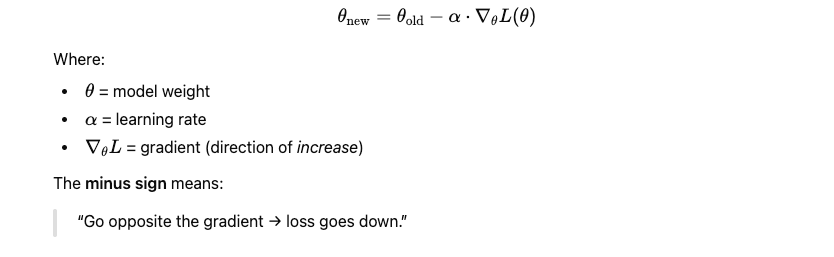
The minus sign means:
“Go opposite the gradient → loss goes down.”
🔧 5. Learning Rate: The Speed of Learning
Learning rate ( alpha ):
- Too small → slow learning
- Too large → skipping over the minimum
- Just right → smooth, fast convergence
Modern optimizers help adjust this automatically.
⚙️ 6. Types of Gradient Descent
Batch GD
- Uses ENTIRE dataset per update
- Accurate but slow
Stochastic GD (SGD)
- Uses ONE sample per update
- Fast but noisy
Mini-Batch GD (standard for deep learning)
- Uses small batches (e.g., 32, 64, 128)
- Fast + stable
- GPU-friendly
Every deep learning framework uses mini-batch.
🚀 7. Modern Optimizers (2025 Standard)
Plain GD is rarely used alone. Advanced optimizers fix its weaknesses.
SGD + Momentum
Keeps moving in the same direction unless gradients strongly oppose it.
Nesterov Momentum
Takes a “look ahead” step for smoother convergence.
RMSProp
Scales learning rate automatically.
Adam
Momentum + RMSProp combined.
AdamW (default in 2025)
Corrects weight-decay issues in Adam. Best for deep learning & LLMs.
🧠 8. A Simple Math Example

🧪 9. Working Keras Example
This example fits a simple linear model using AdamW.
✔ Full Code (Copy–Paste Ready)
import tensorflow as tf
from tensorflow.keras import layers, optimizers, losses
import numpy as np
# -----------------------------
# 1. Generate simple linear data
# -----------------------------
# We create 1000 points: y = 4x + 2 with small noise
X = np.random.rand(1000, 1).astype("float32")  # input column vector
y = 4 * X + 2 + 0.1 * np.random.randn(1000, 1).astype("float32")
# -----------------------------
# 2. Create a simple Keras model
# -----------------------------
# One Dense neuron = y = wx + b
model = tf.keras.Sequential([
    layers.Dense(1)  # linear layer
])
# -----------------------------
# 3. Compile the model with AdamW
# -----------------------------
model.compile(
    optimizer=optimizers.AdamW(learning_rate=0.01),  # modern optimizer
    loss=losses.MeanSquaredError()                    # minimize MSE loss
)
# -----------------------------
# 4. Train the model
# -----------------------------
# batch_size=32 → mini-batch gradient descent
history = model.fit(
    X, y,
    epochs=20,
    batch_size=32,
    verbose=1
)
# -----------------------------
# 5. Print learned weights
# -----------------------------
weights = model.get_weights()
print("Learned weight:", weights[0][0][0])  # should be ~4
print("Learned bias:", weights[1][0])       # should be ~2
🧭 10. Best Practices (2025)
✔ Always use mini-batches (16–256)
Gives best speed + stability.
✔ Use AdamW
Standard in deep learning and LLM training.
✔ Use LR schedulers
Cosine annealing, warm restarts, or reduce-on-plateau.
✔ Use warmup (very important for transformers)
Start LR low → ramp up → decay.
✔ Use gradient clipping
Prevents exploding gradients in deep networks.
✔ Use proper weight initialization
- He initialization → ReLU
- Xavier → Tanh / Sigmoid
✔ Normalize your data
Makes gradients smoother → faster convergence.
🎯 11. Final Summary (Super Clean)
Gradient Descent is:
A simple algorithm that updates weights in the direction that reduces loss fastest by following the negative of the gradient.
And in 2025:
- Mini-batch GD + AdamW
- LR scheduling
- warmup
- weight decay
- gradient clipping
…is the gold standard for training deep neural networks.
Types of Gradient Descent (2025 Edition): Batch, Stochastic & Mini-Batch — The Clearest Explanation
Gradient Descent is the core optimization method behind almost every machine learning model — from linear regression to massive LLMs. But what most learners don’t realize is that there isn’t just one Gradient Descent. There are three major variants, and understanding the differences can dramatically improve training speed, stability, and accuracy.
This article explains all three variants — Batch, Stochastic, and Mini-Batch Gradient Descent — in a clean, intuitive, and interview-ready manner.
🔍 1. Why do we need different types of Gradient Descent?
Modern datasets can range from:
- a few hundred samples → small ML tasks
- millions of samples → deep learning
- billions → large-scale training
Depending on dataset size, memory, compute, and stability requirements, Gradient Descent behaves very differently.
That’s why we have three variants — each optimized for a different situation.
🧠 2. The Basic GD Update Rule

🟩 3. Batch Gradient Descent (BGD)
Uses the entire dataset for every update.
✔ How it works:
- Compute predictions on the full dataset
- Compute gradients using all samples
- Take one update step
✔ Strengths
- Very stable updates
- Smooth convergence
- Best theoretical convergence properties
✔ Weaknesses
- Extremely slow on large datasets
- One update requires going through all samples
- Not ideal for deep learning
✔ When to use
- Datasets < 10,000 samples
- Classical ML (linear regression, logistic regression)
- When you want maximum stability
🟥 4. Stochastic Gradient Descent (SGD)
Updates weights using ONE randomly selected sample at a time.
✔ How it works:
- Pick one sample
- Compute its gradient
- Update immediately
- Repeat for the next sample
✔ Strengths
- Very fast
- Works well for extremely large datasets
- Helps escape local minima due to noise
✔ Weaknesses
- Very noisy updates
- Harder to converge
- Loss curve fluctuates heavily
✔ When to use
- Reinforcement learning
- Online learning systems
- Huge datasets (millions+)
🟦 5. Mini-Batch Gradient Descent (The 2025 Deep Learning Standard)
Uses a small batch (e.g., 32 or 64 samples) per update.
✔ How it works:
- Split dataset into small batches
- For each batch: compute gradient + update weights
✔ Why it’s the default choice today

✔ Strengths
- Fast training
- Stable updates
- Works perfectly on GPUs/TPUs
- Supports advanced optimizers (AdamW, RMSProp, etc.)
✔ Weaknesses
- Requires choosing batch size
- Too large → slow + memory heavy
- Too small → nois
✔ Best batch sizes in 2025
- 32, 64, 128 for typical models
- 256–4096 for large-scale GPU clusters
- Transformers often use AdamW + warmup + batch size scaling
🧭 6. Which Gradient Descent Should YOU Use? (2025 Guide)

Over 95% of all deep learning today uses Mini-Batch Gradient Descent.
🎯 7. Summary (Interview-Ready)
- Batch GD → accurate but slow
- SGD → fast but noisy
- Mini-Batch GD → fast + stable → 2025 gold standard
If you understand these three variants, the rest of deep learning optimization becomes far easier to grasp.
Optimizers in Deep Learning (2025 Edition): Momentum → RMSProp → Adam → AdamW — The Complete Practical Guide
Gradient Descent is powerful, but by itself, it’s slow, unstable, and often gets stuck. This is why modern deep learning depends heavily on optimizers — smarter versions of Gradient Descent that accelerate and stabilize training.
This article explains all major optimizers clearly, intuitively, and practically.
🔍 1. Why do we need optimizers?
Plain GD struggles with:
- slow convergence
- zig-zag motion
- poor learning rate sensitivity
- getting stuck in plateaus/saddles
- exploding or vanishing gradients
Modern optimizers solve these issues.
⚙️ 2. SGD (Baseline Optimizer)

🚀 3. Momentum — Faster, Smoother GD

🔮 4. Nesterov Momentum — Look Ahead

⚡ 5. RMSProp — Adaptive Learning Rate

🔥 6. Adam — Momentum + RMSProp Combined

🏆 7. AdamW — The 2025 Standard Optimizer

🧪 8. Minimal Keras Code Using AdamW
import tensorflow as tf
from tensorflow.keras import layers, optimizers
model = tf.keras.Sequential([
    layers.Dense(64, activation='relu'),
    layers.Dense(1)
])
model.compile(
    optimizer=optimizers.AdamW(learning_rate=0.001, weight_decay=1e-4),
    loss='mse'
)
model.fit(X_train, y_train, batch_size=32, epochs=20)
This is the modern deep learning default.
🧭 9. When to Use Which Optimizer (2025 Guide)

🎯 10. Summary (Interview-Ready)
- SGD → baseline
- Momentum → smoother, faster
- Nesterov → accuracy improvement
- RMSProp → adaptive LR
- Adam → Momentum + RMSProp
- AdamW → Best modern choice
In 2025:
AdamW + Mini-Batch + LR Scheduler = Optimal default for deep learning.
메타데이터
- post_id
- 72f8939ad949
- slug
- gradient-descent-2025-edition-the-clearest-explanation-keras-code-you-can-actually-understand-72f8939ad949
- url
- https://medium.com/@dewasheesh.rana/gradient-descent-2025-edition-the-clearest-explanation-keras-code-you-can-actually-understand-72f8939ad949
- canonical_url
- https://medium.com/@dewasheesh.rana/gradient-descent-2025-edition-the-clearest-explanation-keras-code-you-can-actually-understand-72f8939ad949
- author_url
- https://medium.com/@dewasheesh.rana
- status
- ok
- fetched_at
- 2026-07-18 10:51:19