Homelessness In the Chicagoland Area
How are Chicago’s Homeless People Treated?
Homelessness In the Chicagoland Area
How are Chicago’s Homeless People Treated?
By Gabby Valente and Atzin Anguiano
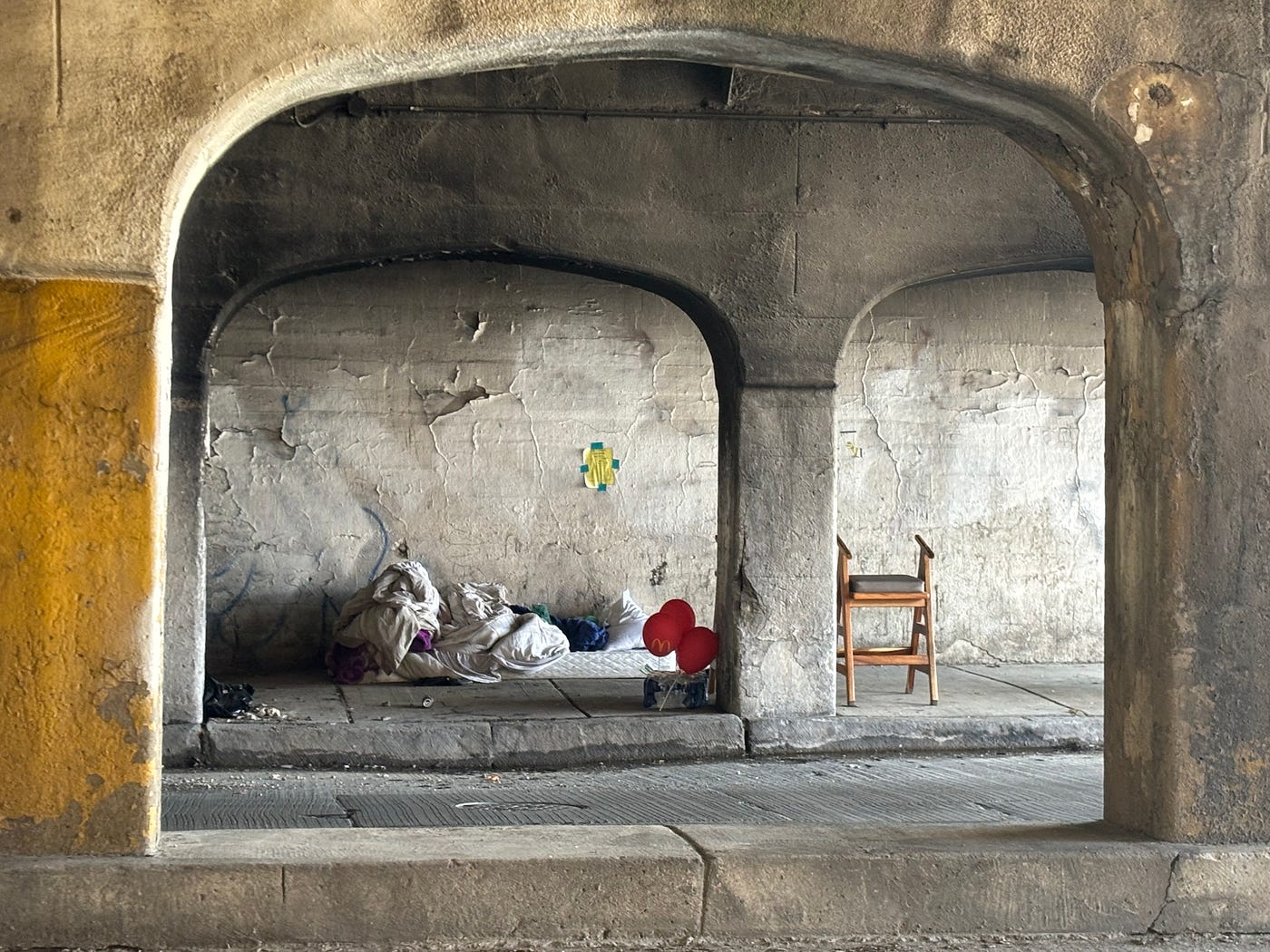
Underneath the bridge by 21st and Western. Photo Credit (Atzin Anguiano)
[embed]This Audio is an AI Generated podcast that reads summaries the article. Directions by Gabby Valente
Erica Wallace, a customer service representative who has dedicated 33 years to CTA, doesn’t need to see the data on Chicago’s homeless crisis. She sees it at work each day.
Wallace recalled the interactions and encounters she had experienced at the UIC Blue Line Station on Halsted.
“It’s daily,” Wallace said, mentioning the times she’s encountered unhoused people at work. “This station in particular, because we have a UIC train that stops here, and goes back toward O’Hare. Everybody has to get off the train; a lot of homeless people are shifted off and so they come up here.”
In 2024, Chicago’s migrant surge relocated thousands of asylum seekers from the southern borders to the Windy City. Since the surge, Chicago’s homeless population tripled and remains an issue today.
The Chicago 2025 Annual Report on Homelessness estimates that, through a PIT Count, a total of 7,452 people are experiencing homelessness. Furthermore, the racial breakdown shows 53% are African American, followed by 35% Hispanic or Latino. This estimate, however, was conducted in late January 2025 and does not account for the number of people currently experiencing homelessness.

Chart Generated by Claude AI | Chart Directions by Atzin Anguiano
Claude Interactive Chart: This link directs you to our interactive chart that displays the information when hovered over the bars.
The report estimated that about 6,136 individuals experiencing homelessness reside in sheltered locations, with 32% being children under the age of 18. Alternatively, the estimated number of unsheltered individuals was noted as 1,316 with the ages ranging from 45 to 64.
Homelessness Reliance on CTA
Many Chicagoans rely on the Chicago Transit Authority, whether it’s the bus or the train. It has also become a heavily relied-on temporary shelter for unhoused individuals.
Wallace said that in all her years of working at CTA, not a day has gone by that she has not seen homeless people using CTA stations and transportation as temporary shelters to sleep or spend their days.
“It’s always been a problem,” Wallace said, “but it has gotten really bad in the last few years. I would say since COVID, it’s been really bad.”
With COVID-19 being one of the biggest national crises, it impacted many residents’ ability to maintain jobs and as a result, many individuals lost their homes. Due to this, many homeless individuals resort to temporary shelters, such as CTA stations and transport.
“We’re not supposed to have loitering,” she said. “It’s not supposed to be riding back and forth but I mean, it’s kind of hard to control because there’s so much right now.”
Wallace claimed desensitization is one of the traits she has had to pick up in order to truly work such an extended period of time at CTA. She recalls the many times she witnessed homeless individuals being removed from UIC trains once they had reached the final destination. She explains the unwell state they are usually in, and how unfortunate it is for them to feel like they have nowhere else to go.
Wallace talked about the CTA’s outreach program to support unsheltered riders. CTA is aware of the reliance homeless individuals have on the transportation system, and partnered with the City’s Department of Family and Support Services (DFSS) to offer services and support to individuals who need assistance.
“It’s important to have compassion. CTA does an outreach program at the end of the line at Forest Park,” Wallace said. “I believe it’s two nights a week. They feed the homeless and give them resources that they can take advantage of.”
[embed]Google Map Created by Google Maps | Directions by Gabby Valente
25th Ward Alderman’s Advancements to End Homelessness
Ald. Byron Sigcho Lopez (25th Ward) is working to help the homeless population in Chicago, specifically in Pilsen. He is an open supporter of the organization Bring Home Chicago, an organization dedicated to helping the homeless population of Chicago gain resources.
“Having shelter is fundamental, in Chicago, at least, we believe this is a human right. In some of the changes that the current federal government is proposing, we can’t get away with housing first, and it’s almost like housing last,” Sigcho Lopez said.
Despite the United States being the wealthiest country in the world, it has one of the highest rates of homelessness across developed nations. Federal laws and policies continue to make housing and resources for the homeless across the United States extremely difficult to access, experts say.
An article from April 2026 from the Center of Budget and Policy Priorities said “the Administration’s approach is at odds with evidence-based solutions — namely, low-barrier affordable housing and customized, community-based services — that are proven to help ensure people have consistent access to safe, stable housing.”
Sigcho Lopez said that on July 15, Little Village will open its first non-congregate, permanent supportive housing program.
“I think that’s an important policy. There are about 100 to 120 basically SROs, like single rooms,” he said.
Lopez is advancing projects to help local homeless people. He and others at the local level are creating more stable options for the unhoused community in Chicago.
Anti-Homeless Architecture is taking over Chicago
Anti-homelessness architecture is all around big cities in America and in Chicago. Though this is more than just making benches and tables with bars across them to prevent people from sleeping on them.
“It’s about aesthetics, and I don’t support that [anti-homeless architecture],” Sigcho-Lopez said. “There have been multiple occasions where we’ve been told, ‘You need to add infrastructure to keep the plaza aesthetically pleasant.’ But in an immigrant community that has long been a point of entry, the real beauty is having open spaces that are welcoming to people.”
This is also an issue in many places as Chicago transitions to a cashless system. Even before COVID-19, many restaurant and retail stores started to become cashless.
An April 2026 Chicago Tribune article, cited some statistics: In Illinois, 7.1 percent of Illinois households do not have bank accounts, which is a bit higher than the national average, according to the Federal Deposit Insurance Corp.”
According to a July 2025 article in the Belleville News Democrat businesses in Illinois are allowed to decide whether or not they are a cashless business or not. It’s up to the business’s discretion what types of payments they take in Illinois. Although some states have laws requiring businesses to accept cash payments.
A September 2025 article from WGN News said, “You’ve likely seen it outside businesses, at bus stops, along sidewalks, and in parks, as it can take many forms. Hostile architecture is ‘hostile’ because it subtly (or sometimes quite plainly) keeps people away.”
Many people walk past a bench with an armrest bar through the middle of it and don’t think anything of it but this is a prime example of anti-homeless architecture hiding in plain sight. Anti-homeless spikes are also very popular in the architecture around Chicago, this is where they add spikes to ledges or otherwise flat areas to spot people from lying down there.
“It’s like bottling stereotypes and stigmas, and unfortunately equating unhoused residents with violence,” Sigcho-Lopez. “It is part of the dehumanization and criminalization of the unhoused residents. We’re seeing that unfortunately, with way too many lawmakers who think that they can address the issue of unhoused residents by just putting people in jail.”

Homeless encampment under the bridge by 21st and Western. Photo Credit (Atzin Anguiano)
Learn more
If you or anyone you know in the Chicagoland area is experiencing homelessness and needs help you can reach out to the Chicago Coalition to End Homelessness ((312) 641–4140) or the city of Chicago also has many trusted resources on their website.
QUIZ: Test Your Knowledge on our Article by taking this interactive Quiz. Quiz created by LM Notebook. Directions for Quiz by Gabby Valente.
메타데이터
- post_id
- 72fce201632d
- slug
- homelessness-in-the-chicagoland-area-72fce201632d
- url
- https://medium.com/@aangu3/homelessness-in-the-chicagoland-area-72fce201632d
- canonical_url
- https://medium.com/@aangu3/homelessness-in-the-chicagoland-area-72fce201632d
- author_url
- https://medium.com/@aangu3
- status
- ok
- fetched_at
- 2026-06-10 18:44:10