The Man Who Saw — and Built — India’s Nuclear Future Before the World Believed It
He never witnessed India’s greatest nuclear milestones. Yet every step toward them carried the blueprint he imagined decades earlier.
The Man Who Saw — and Built — India’s Nuclear Future Before the World Believed It
He never witnessed India’s greatest nuclear milestones. Yet every step toward them carried the blueprint he imagined decades earlier.

The story was never about the bomb. It was about the man who taught a nation to build its own future. (AI-generated Images)
Imagine a man who never ordered a single bomb built.
Yet as India’s atomic programme grew, so did international attention. Diplomatic reports, strategic assessments, and intelligence monitoring became an unavoidable part of the Cold War.
He spoke of power plants. Of thorium. Of pure research. He painted. Collected art. Designed laboratories that looked more like gardens than fortresses.
And still —
when his plane vanished into the white silence of Mont Blanc on a cold January morning in 1966, the questions that followed were not only about weather and navigation.
Who was he, that his absence felt strategic? What had he already set in motion that no single death could stop?
This is not the story of a finished weapon. It is the story of a foundation poured in silence — under the quiet trust of a Prime Minister who believed that scientific independence would one day become national independence — while the rest of the world quietly calculated how far a newly independent nation might go.
The questions never fully disappeared.
The files were never fully closed. The work never stopped. And the question he left behind is still being answered.
And perhaps that is **Homi Jehangir Bhabha’s* greatest legacy: not the technology he built, but the confidence he left behind.*

Young Homi with his parents, TIFR Archives, From the collection of: Tata Institute of Fundamental Research (Homi with his parents, Meherbai Bhabha and Jehangir Bhabha)
Chapter 1: The Boy Who Chose the Stars
History often remembers the moment a nation announces its strength. It rarely remembers the decades spent learning how to build it.
**Homi Jehangir Bhabha was born on 30 October 1909 in Bombay, into a prosperous and cultured Parsi family with close ties to the Tatas**.

Homi with grandfather Hormusji Bhabha, father Jehangir Bhabha, mother Meherbai Bhabha and aunt Meherbai Tata
His father, Jehangir Hormusji Bhabha, was a well-known lawyer. The family expected a practical future for their son.
He studied at Cathedral and John Connon School, then Elphinstone College, and the Royal Institute of Science. At fifteen he passed the Senior Cambridge examination with honours. Too young for Cambridge itself, he stayed in Bombay for a year.
During that time, one public lecture by the American physicist **Arthur Compton** on cosmic rays lodged in his mind. He would later say that was the first time he heard of the subject that would become his own.
Years later, ***Arthur Compton would help lead the* [Manhattan Project](https://www.nps.gov/mapr/learn/manhattan-project.htm).** Homi Bhabha’s journey would take a very different path. One would help usher in the atomic age through wartime research. The other would prepare a newly independent nation to enter it on its own terms.
In 1927 he left for Gonville and Caius College, Cambridge. Family expectation was clear: mechanical engineering, then return to the Tata steel works at Jamshedpur.
He completed the Mechanical Sciences Tripos as expected.
Then something quieter happened.
He fell in love with physics.

Homi Jehangir Bhabha during his early years. Source: TIFR Archives via Google Arts & Culture.
Those who knew him remembered more than an exceptional student. He sketched, admired classical music and European art, and believed that science and beauty belonged in the same conversation. Years later, when he designed research institutions, he would insist they inspire curiosity not only through their laboratories, but through their architecture, gardens, and art as well.
Lectures by Paul Dirac and others. The atmosphere of the Cavendish Laboratory. The sudden beauty of theoretical problems. For Homi, equations were no longer just calculations. They became a way of understanding the hidden laws that governed the universe.
These pulled him away from the engineering future his family had imagined. With some reluctance, permission was given. He moved into pure mathematics and physics. Under Ralph Fowler he completed his doctorate.
His early papers on cosmic rays and electron-positron scattering — still known today as Bhabha scattering — earned him rapid recognition. In collaboration with **Walter Heitler, he developed the cascade theory of cosmic-ray showers (1937). In 1941** he was elected a Fellow of the Royal Society. The Adams Prize followed the next year.
None of this was supposed to matter to India’s industrial future. A brilliant young physicist was useful. An engineer in the steel mills was expected.
When the Second World War broke out in **September 1939**, Bhabha was on holiday in India. The outbreak of war disrupted international travel. Returning to Cambridge became increasingly impractical. He stayed.
At the invitation of C.V. Raman, a special readership in theoretical physics was created for him at the Indian Institute of Science in Bangalore. With a modest grant from the Sir Dorab Tata Trust, he set up a cosmic-ray research unit. Balloon experiments. High-altitude stations. Students.
For the first time, he wasn’t only solving scientific problems. He was helping create a scientific community.
Not through grand speeches, but by giving young Indian physicists something they had long lacked — a place to ask difficult questions without leaving home
He was doing good science. He was also beginning to see a larger absence.
India did not suffer from a shortage of intelligence. It suffered from a shortage of institutions where talent could grow without leaving the country.
Talent existed, scattered. Facilities did not. The institutions that could train a generation of original scientists simply were not there.
That realisation would soon lead him to write a letter that changed more than his own career.
But that letter still lay a few years ahead.
The world believed it had discovered another gifted physicist.
India had quietly found something else.
A builder of institutions. An architect of scientific confidence.
The consequences of that quiet decision would reshape India’s scientific future for generations…
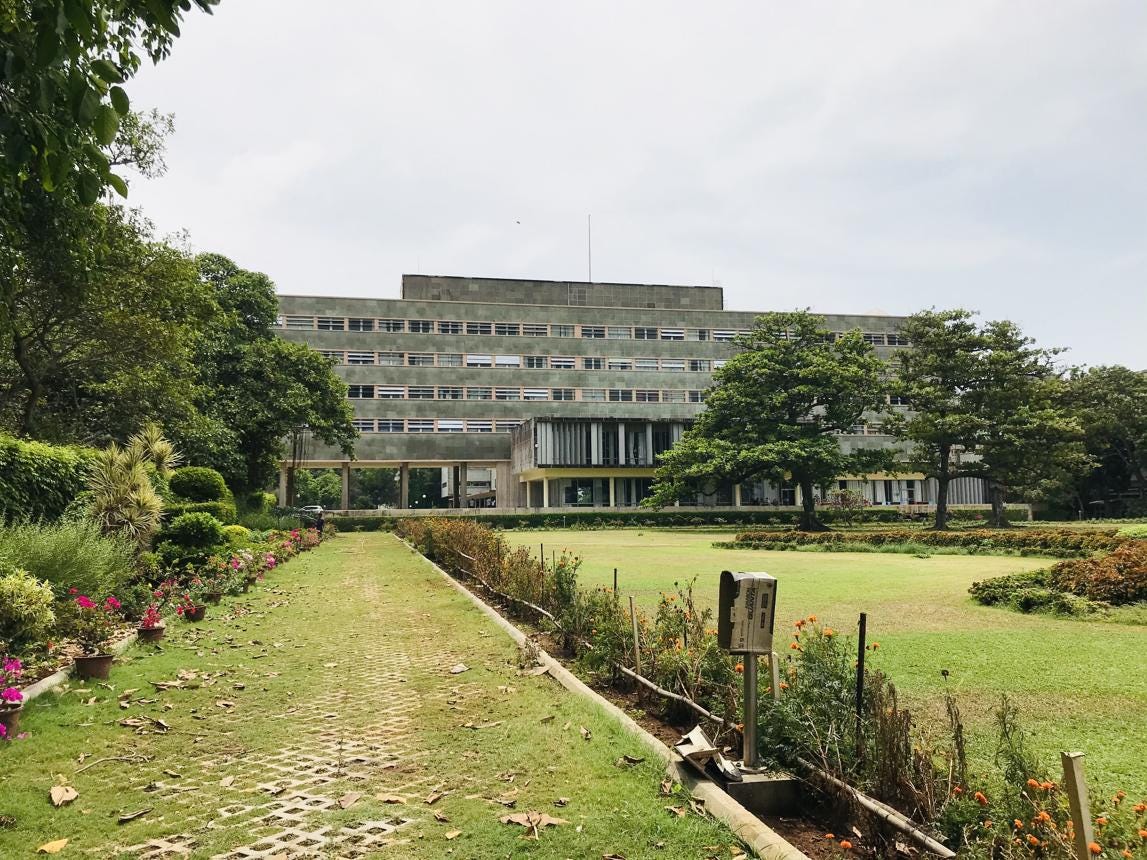

Tata Institute of Fundamental Research (TIFR), Bombay. Founded in 1945 from Homi Bhabha’s vision for advanced scientific research.
Chapter 2: The Letter That Changed Everything
He was doing good science.
He was also becoming restless.
By the early 1940s Homi Bhabha had already earned an international reputation. His papers on cosmic rays and electron-positron scattering were known in the major centres of physics. He had been elected a Fellow of the Royal Society. The Adams Prize had followed.
Yet something larger troubled him.
India had talented scientists. What it did not have was a true school of research in the most advanced branches of physics — a place where original work could be done at the highest level, where young researchers could be trained properly, and where the country would not remain permanently dependent on foreign laboratories.
Talent existed. It was scattered. Facilities did not.
If India was to participate seriously in the coming age of nuclear energy, it would need institutions of its own.
Bhabha began to think beyond individual papers.
In 1943 he wrote to J.R.D. Tata, sharing his concern that the lack of proper conditions and intelligent financial support was holding back Indian science. Tata responded with interest and suggested a formal proposal.
On 12 March 1944, from the Indian Institute of Science in Bangalore, Bhabha wrote the letter that would quietly alter the scientific future of the country.
Addressed to Sir Sorab Saklatvala of the** Sir Dorabji Tata Trust**, the letter was clear and ambitious. There was, he said, no first-class school of research in the fundamental problems of physics — theoretical and experimental — in India. Competent workers existed, but they were scattered and under-supported. He proposed an institute in Bombay.
Then came the sentence that still startles when read today:
“…when nuclear energy has been successfully applied for power production in, say, a couple of decades from now, India will not have to look abroad for its experts but will find them ready at hand.”
— Homi J. Bhabha
The letter was written more than a year before Hiroshima. Nuclear fission had been discovered. The wartime work on the bomb remained secret. Bhabha was already thinking about the civilian future — and about ensuring that India would not be a permanent customer.
The Trust agreed.
On 1 June 1945, the Tata Institute of Fundamental Research (TIFR) began its work. After its initial activities associated with Bangalore, it soon established itself in Bombay, where Bhabha became its founding director and began assembling the scientific talent that would later help shape India’s atomic energy, space, and high-technology programmes.
One letter.
One institutional seed.
Everything that followed — the Atomic Energy Commission, the laboratories at Trombay, the long scientific journey that would one day reach the Rajasthan desert — grew from that soil.
Great nations are not built when the first reactor becomes operational. They are built when someone first decides that knowledge itself must become national infrastructure.
The world still saw a gifted physicist. It had not yet understood that it was watching an architect at work.
The next decision would not come from a scientist alone. It would come from a Prime Minister willing to place extraordinary trust in one man’s vision.


Jawaharlal Nehru and Homi J. Bhabha during the formative years of India’s atomic programme.
Chapter 3: The Prime Minister’s Biggest Scientific Gamble
India had just become independent. But freedom alone could not build the future. Someone still had to decide who would be trusted to build it.
Independence arrived in August 1947. The new nation had almost no industrial base, limited scientific infrastructure, and even fewer people who understood what the atomic age would demand.
Homi Bhabha did not wait.
In early 1948 he wrote directly to Prime Minister Jawaharlal Nehru. The proposal was both modest and radical. He asked that atomic energy be placed in the hands of a very small, high-powered body with real executive authority. This body should report directly to the Prime Minister.
No intervening ministry. No ordinary bureaucratic layers that could slow decisions or dilute secrecy.
For brevity, he suggested it could simply be called the Atomic Energy Commission.
Nehru agreed.
The Atomic Energy Act was passed. On 10 August 1948 the Atomic Energy Commission was established with Homi Bhabha as its first Chairman. Later the Department of Atomic Energy was placed under the Prime Minister’s direct charge. Within the budget limits approved by Parliament, the Commission received administrative and financial powers that bypassed normal government procedures for recruitment, construction, and procurement.
Secrecy was deliberate.
Nehru argued it was necessary both to protect Indian research and to make cooperation possible with countries that demanded confidentiality.
What emerged was not a conventional ministry.
It was a parallel structure designed for speed, continuity, and control.
Two men now held extraordinary authority over one of the most sensitive scientific programmes a young nation could attempt.
Private letters between them show familiarity and quiet trust. Public statements remained carefully limited to peaceful uses. The dual-use nature of the science was understood by those who needed to understand it — and left unspoken by those who did not.
One led the government. The other quietly began building the scientific machinery that future governments would inherit. Neither man could know how many decades that partnership would influence India’s scientific future.
Nehru’s decision was a calculated risk.
He was placing unusual power in the hands of a single scientist at a time when India still struggled with basic industrial capacity. Many countries would have chosen a larger committee, a heavier bureaucracy, or greater political oversight.
Nehru chose concentration and trust instead.
The gamble was simple and profound:
that one man, given enough autonomy and political cover, could build something the country would need long after both of them were gone.
The laboratories at Trombay had not yet risen. The three-stage plan had not yet been fully drawn. Foreign attention had not yet hardened into sustained scrutiny.
But the architecture of power was already in place.
“A scientist who thought in decades. A Prime Minister willing to protect that thinking. And a scientific foundation designed to outlast any individual.”
The foundation was no longer only scientific. It had become political.
And once political protection was secured, the real work of building could begin — quietly, patiently, and far from the world’s full understanding.
The reactors had not yet been built. The fuel cycle had not yet been mastered. The world had not yet begun watching closely. But something far more important had already happened.
India no longer had only a scientist.
It had a protected vision.
And history was about to discover what that meant.
The next step would no longer be about vision. It would be about building.
Chapter 4: The Blueprint India Is Still Following
Most nations plan for the next election. Some plan for the next decade.
Homi Bhabha was already planning for the next half-century.
India had a quiet but serious problem. It possessed very little high-quality uranium of the kind most nuclear programmes were built upon. What it did possess in abundance was thorium — locked in the black monazite sands that stretched along parts of its coastline.
Most of the world was designing its nuclear future around uranium. Bhabha looked at India’s actual geological reality and drew a different map.
In the 1950s he began articulating what would become known as the three-stage nuclear power programme. Decades later, it remains the official long-term roadmap of India’s nuclear energy policy.

India’s Three-Stage Nuclear Programme — the long-term roadmap envisioned by Homi J. Bhabha, designed to transform limited uranium resources into sustainable energy through thorium-based nuclear technology. (AI-generated Images)
Stage One Pressurised heavy-water reactors running on natural uranium. These would generate electricity for a power-starved country — and, as a quiet by-product, produce plutonium.
Stage Two Fast-breeder reactors. These would take the plutonium from the first stage and use it to generate more energy while converting thorium into a new fissile material: uranium-233.
Stage Three Advanced reactors that could eventually run primarily on thorium and uranium-233. The long-term aim was not simply more power. It was energy independence based on a resource India already owned in large quantities.
The thinking was unusual for its time. It was not designed for quick political credit. It was designed for a country that might one day have to stand on its own scientific feet.
Bhabha understood something many of his contemporaries preferred not to dwell on:
True scientific strength could not depend forever on the willingness of other nations to supply technology, fuel, or expertise.
If the easy options ever closed, India would need a path that began from its own soil.
Progress across the three stages has never been even. The first stage matured and became the backbone of India’s nuclear power programme. The second has moved more slowly than originally hoped. The third remains a distant but still-active destination.
Yet the framework itself has never been abandoned.
While other countries adjusted their nuclear plans according to changing politics, available technology, or external pressure, India continued walking a path first drawn when the country still had almost no nuclear infrastructure of its own.
Bhabha was not only designing reactors. He was trying to design a future in which India would not remain a permanent customer of other nations’ knowledge.
The plan was quiet. It was patient. And it was unusually far-sighted.
Most people outside a small circle of scientists and policymakers did not yet understand what was being set in motion.
But some were beginning to notice.
And once the world started watching more closely, the quiet work of building a long-term scientific capability would no longer remain entirely private.
The blueprint had been drawn. It would take decades to build. But beyond India’s borders, more people were beginning to ask the same question:
What exactly was Homi Bhabha preparing India for?
Chapter 5: When the World Began Paying Attention
For years, India’s nuclear programme had grown almost unnoticed outside scientific circles.
That silence would not last.
From the mid-1950s, the quiet work inside India’s laboratories began to attract a different kind of attention.


The laboratories were building science. The world was beginning to calculate its consequences. Bhabha Atomic Research Centre (BARC) in Trombay, Mumbai, is India’s premier nuclear research facility.
What had started as a scientific and energy programme was now being observed more carefully from outside. As India’s atomic programme expanded, it quietly began drawing the attention of governments, diplomats, and strategic observers around the world. Reactor construction, heavy-water facilities, institutional growth, and public statements increasingly became subjects of international interest.
Civilian cooperation was still possible — and Bhabha used it.
The CIRUS reactor at Trombay was built with Canadian assistance. The United States supplied heavy water under arrangements linked to the Atoms for Peace era. Technology and materials moved across borders under international agreements.
On the surface, it looked like a developing country participating in the global promise of nuclear energy for peaceful purposes. But those who understood the science could already see further.
A research reactor could produce isotopes for medicine and industry. It could also produce plutonium.
Bhabha spoke of power plants and self-reliance. At the same time, he steadily built the indigenous capabilities that would gradually reduce India’s dependence on outside technology.
Cold War pressures made every nuclear programme a matter of interest. A large newly independent nation steadily mastering advanced nuclear technology made that interest sharper.
Inside India, the work continued under the political protection secured years earlier. The parallel structure created in 1948 still shielded the programme from ordinary bureaucratic interference. Progress remained measured in years, not headlines.
Most of the world still saw a civilian energy effort. A smaller circle of observers saw something more complex: a country patiently assembling the full range of capabilities that nuclear technology made possible.
For several years, the balance held.
Then the balance broke.
On 16 October 1964, China conducted its first nuclear test at Lop Nur.
The political and psychological impact on India was immediate. Public debate intensified. Parliamentary questions multiplied. The strategic environment of the subcontinent changed in a single afternoon.
What had been a long-term scientific and energy programme now carried an unmistakable strategic shadow.
The scientific question had quietly become a strategic one.
And the man who had spent two decades building its foundations would soon face a question that had become impossible to ignore:
How quickly could India respond if it ever chose that path?

From China’s first nuclear test in 1964 to the unanswered questions surrounding Air India Flight 101, this was the period when India’s peaceful atomic programme entered an era of strategic scrutiny.
Chapter 6: Before the Desert Answered
**On 16 October 1964, at 15:00 hours, China exploded its first nuclear device at Lop Nur.**
Within hours, the strategic landscape of Asia had changed.
Public debate intensified. Parliamentary questions multiplied. Newspapers filled with arguments. For the first time, the quiet scientific programme that Homi Bhabha had spent nearly two decades building stepped fully into the strategic light.
Bhabha responded with characteristic clarity.
In public statements and a widely noted All India Radio broadcast, he declared that India could produce a nuclear device within eighteen months if a decision were taken — and at a relatively modest cost. He argued that India needed to be in a position to respond if necessary. He also continued to speak of “peaceful nuclear explosions” and of preserving options rather than rushing into a full weapons programme
The language was careful. The implication was unmistakable.
**Prime Minister Lal Bahadur Shastri’s** government did not authorise a weapons programme. Security guarantees were sought from existing nuclear powers. The underlying technical work continued. The option was kept open. The decision was deferred.
What had been a long-term scientific and energy programme now carried an unmistakable strategic shadow.
Bhabha had spent years building institutions that could outlast any individual. Now those institutions faced their first real test of political pressure.
He would not live to see how that test was resolved. History would answer it without him.

On 24 January 1966, Air India Flight 101 crashed into Mont Blanc, claiming the life of Homi Jehangir Bhabha. His death ended a remarkable life — but not the institutions and scientific vision he had created.
The Plane That Never Landed
24 January 1966.
Air India Flight 101, the Boeing 707 named Kanchenjunga, left Bombay for London with intermediate stops. Homi Jehangir Bhabha was on board, travelling to a nuclear meeting in Vienna.
Near Mont Blanc the aircraft struck the mountain. All 117 people aboard were killed. Bhabha was fifty-six.
The official French inquiry, completed in 1967, concluded that a combination of navigational error, an unserviceable VOR receiver, communication misunderstanding, and white-out conditions caused the aircraft to strike the mountain.
Indian authorities accepted the findings.
Conspiracy theories later circulated — claims of sabotage, interception, or involvement by foreign intelligence agencies. These rest on secondary accounts, alleged private conversations published decades later, and recovered debris whose interpretation remains contested.
No conclusive public evidence has overturned the official navigational-error conclusion.
History is left with the official record — and with questions that have never completely disappeared.
What is not in dispute is the immediate consequence.
The man was gone.
The institutions remained.
The programme he had designed did not collapse. Research continued the next morning. Young scientists still asked difficult questions. The parallel structure created in 1948 still shielded the work.
A scientist who had thought in decades had left behind something stronger than any single personality.
His chair was empty.
His laboratories were not.
The blueprint no longer belonged to one man.
The world had lost one of its finest physicists.
India had not lost the institutions he had spent two decades building.
History would soon reveal the difference between losing a man… and losing a vision.
Eight years later, beneath the quiet sands of Rajasthan, the answer would emerge from the desert.
Chapter 7: The Day They Realised What He Had Built
The world did not fully understand what Homi Bhabha had built while he was alive. It understood only after he was gone.

The Vision That Outlived Its Creator January 1966 did not end India’s nuclear story. The architect was gone, but the institutions, the scientists, and the confidence he had built continued the journey — quietly preparing for the day the world would finally notice.
When Homi Jehangir Bhabha died in January 1966, many outside India quietly asked the same question:
Would the programme survive without the man who had designed it?
History is full of ambitious scientific efforts that faded the moment their central figure disappeared. Personality had often been the only real structure.
Inside the laboratories the next morning, something quieter happened.
Work continued. Experiments were not cancelled. Young researchers still asked difficult questions.
That continuity was not an accident. It was design.
For nearly two decades Bhabha had insisted that a scientific programme must never depend on a single personality. Knowledge had to be distributed. The vision had to survive beyond the person who created it. The next generation had to be trained while the previous one was still working.
The responsibility now passed into different hands.
Homi Sethna strengthened nuclear engineering and industrial capacity. **Raja Ramanna advanced the research that would later become central to the first test. [P.K. Iyengar ](https://www.thehindu.com/news/He-played-a-key-role-in-Indias-first-Peaceful-Nuclear-Explosion-in-1974/article13435673.ece)**& others carried critical technical work forward.
None of them tried to become another Homi Bhabha. They did not need to. The institutions he had built gave them room to become themselves.
Around the same time the international environment hardened. The Nuclear Non-Proliferation Treaty opened for signature in 1968. India declined to join, arguing that the treaty created permanent nuclear “haves” and “have-nots.” Whatever one thinks of that position, it reflected a principle Bhabha had lived by: a nation should keep the ability to make its own strategic choices.
Outside India, analysts kept watching. Inside India, scientists kept working.
Progress would be measured in years. Sometimes decades. That patience had become part of the culture — one of Homi’s quietest and most durable gifts.
Before India built reactors, Homi Bhabha built something harder to create: scientific confidence.
That mindset was about to face its first public examination.
The Desert Finally Answered

The true measure of a visionary is not what survives with him — but what survives without him.
18 May 1974.
Beneath the quiet sand of Pokhran, Rajasthan, India conducted its first nuclear test.
The operation carried the codename:
Smiling Buddha.
For the small core team of roughly seventy-five scientists and engineers, it was the result of years of careful work under extreme compartmentalisation. Political knowledge was restricted to a handful of people. For the government under Prime Minister Indira Gandhi, it was a decision with immediate strategic and diplomatic consequences. For the rest of the world, it arrived as a surprise.
The explosion lasted only seconds. Its effects lasted far longer.
Headlines appeared within hours. Governments demanded explanations. Diplomatic channels tensed. Questions multiplied: Why now? How had the capability been developed? What would follow?

Prime Minister Indira Gandhi visiting the Pokhran test site after India’s first nuclear test in May 1974.
Amid all the headlines, one truth mattered more than every political debate.
The achievement had not appeared overnight. It rested on decades of scientific work whose foundations had been laid while Homi Bhabha was still alive.
He never saw the desert that morning. He never watched a countdown. He never heard the coded message that the Buddha had finally smiled.
Yet many of the laboratories, the research traditions, the institutional habits, and the culture of patient self-reliance that made the test possible had grown from the vision he first put on paper in the 1940s.
The desert revealed the result. The real work had begun decades earlier.

The subsidence crater left by India’s first underground nuclear test at Pokhran.
The test immediately changed India’s relationship with the outside world. Technology transfers grew more difficult. Export controls tightened. In the years that followed, nuclear supplier countries began coordinating stricter guidelines — an effort that later formalised into the Nuclear Suppliers Group.
The path ahead would be harder. Advanced equipment would be more difficult to obtain. Critical technologies would increasingly be restricted.
To some observers the restrictions looked like setbacks. To many Indian scientists they became motivation.
If important technologies were no longer easily available, India would have to develop more of them itself.
It was not the easiest path. It was often the slowest. But it was a path Homi Bhabha had anticipated decades earlier when he argued that true scientific strength could never depend on permanent access to foreign technology.
The headlines were about explosions. For India, they were the first public proof that decades of scientific preparation had survived. Homi Bhabha would probably have seen something else: not the end of a journey, only the beginning of a more difficult one.
Homi Bhabha’s greatest achievement was not building reactors. It was building institutions that continued to shape India’s scientific future long after he was gone.
Proving capability once is one challenge. Sustaining it under sustained international pressure is another.
After Pokhran, many doors began to close.
Sometimes closed doors teach a nation how to build its own keys.
Chapter 8 When the Doors Closed, the Dream Changed Hands
Every nation faces a moment when the world says: You cannot have this technology.
The real question is never whether the doors close. The real question is what a country chooses to build after they do.
The morning after 18 May 1974 felt different.
Inside India, scientists returned to their laboratories. Outside India, governments returned to their meeting rooms.
The conversations had changed.
Pokhran had lasted only seconds. Its consequences would last decades.
India’s first nuclear test was no longer treated only as a scientific event. It had become a strategic question that demanded a response. Within months, access to advanced nuclear technologies grew more restricted. Sensitive equipment became harder to purchase. Certain scientific collaborations turned cautious. Export controls tightened sharply.
In 1975, a group of nuclear supplier countries began coordinating stricter guidelines on the transfer of nuclear materials and dual-use technology. That effort later formalised into the Nuclear Suppliers Group. Canada, which had earlier cooperated on the CIRUS reactor, and several other nations reassessed their nuclear relationships with India. Technology that had once moved under civilian arrangements now faced new barriers.
For a country still building its scientific infrastructure, these restrictions created real difficulties. India could no longer assume that every important technology would be available for purchase.
Many nations might have slowed for decades under similar isolation. India responded differently — not because the situation was easy, but because there was little alternative.
Scientists began solving problems one by one. A missing component became an engineering challenge. A restricted technology became a reason to innovate. A closed door became a question India had to answer on its own.

Indian scientists increasingly relied on indigenous engineering as access to foreign technology became more restricted.
Progress became slower. It also became more self-reliant.
None of this would have surprised the people who had worked closest to Homi Bhabha. He had spent decades preparing India for exactly this possibility. He had argued, again and again, that scientific strength was not only about possessing advanced technology. It was about having the confidence to solve problems when no ready-made answers existed.
His greatest contribution had never been a single reactor. It had been a mindset.
The laboratories he founded continued producing scientists. The foundations he laid continued producing new generations of scientists and thinkers. New generations entered those buildings without ever meeting the man who had imagined them. Yet they worked inside structures shaped by his philosophy:

The institutions Homi Bhabha built continued training the next generation of scientists.
Think independently. Question everything. Build patiently. Depend on your own capability whenever possible.
Restrictions may have been intended to slow momentum. Instead they strengthened something harder to restrict: confidence that difficult problems could eventually be solved through persistence.
The world believed the sanctions would slow India.
Instead, they changed the kind of nation India was becoming…
Homi Bhabha never built India’s future alone. He built the people who would continue building it
A new generation was now stepping forward. One of them would later become one of the most recognisable faces of Indian science.

A new generation of scientists — including A.P.J. Abdul Kalam — carried India’s technological ambitions into a new era.
He did not begin inside a nuclear laboratory.
He began with rockets.
Among the young engineers shaped by that culture was a quiet man from Tamil Nadu. His name was A.P.J. Abdul Kalam. Unlike Bhabha, Kalam was not a theoretical physicist. His world was rockets rather than reactors. Yet both men believed that a nation could never become truly independent if its most important technologies depended on others. In time, the young engineer would become one of India’s most admired scientific leaders. Avul Pakir Jainulabdeen Abdul Kalam would later serve as the President of India from 2002 to 2007.
In the early 1960s, while working in India’s fledgling space programme under **Vikram Sarabhai**, Kalam travelled to the United States for professional training.
Kalam did not return carrying classified files or secret formulas. He returned with experience: how advanced organisations planned missions, tested systems, recovered from failure, and built teams.
That experience could not be confiscated. It became part of his thinking.
Back in India, he worked within a scientific ecosystem that Bhabha had helped build. Different laboratories. Different missions. The same philosophy:
*Build. Learn. Improve. Repeat*. Failure was not the opposite of progress. It was often part of it.**

Ideas were shared, challenged, and refined across institutions that had grown from the scientific culture Bhabha helped create.
Over the years, Kalam became one of the leading figures behind India’s indigenous aerospace and missile programmes, helping transform technological ambition into engineering capability. Every success echoed an idea Bhabha had championed decades earlier: scientific confidence grows only when a nation learns to solve its own difficult problems.
Bhabha built institutions. Sarabhai expanded India’s space vision. Kalam inspired a generation to believe that technological self-reliance was achievable.
Kalam later wrote, “Dream is not that which you see while sleeping, it is something that does not let you sleep.”**
If anyone understood that dream, it was Homi Bhabha. He had simply started dreaming decades earlier.

Scientific leadership and political resolve together shaped India’s next technological chapter.
The scientists had built the capability. Only one question remained: who would dare to use it?

Every revolution begins long before the world notices. Sometimes, it begins with a single family that dares to dream differently.
Chapter 9: The Day Decades Became Seconds
“Scientists can prepare a nation. Only elected leaders can decide when history should move.”
By the late 1990s India stood at a strategic crossroads.
Nearly five decades had passed since Homi Jehangir Bhabha first imagined an India capable of mastering advanced atomic science. Generations of scientists had carried the work forward. Research had continued through changing governments. Institutions had survived. Technology had advanced under conditions of increasing isolation.
One question remained open.
Would India openly demonstrate the capability it had spent decades building?
In March 1998, Atal Bihari Vajpayee became Prime Minister. Within weeks, discussions that had remained highly restricted for years entered their final stage.
The decision before the government was not only scientific. It was political, diplomatic, economic, and strategic. The consequences would reach far beyond India’s borders.
Planning involved an exceptionally small circle of civilian leaders, scientists, and military officials. Confidentiality was essential — not because secrecy was unusual, but because the world had changed dramatically since 1974. Satellite imagery was far more capable. International attention toward nuclear activities was constant. Operational security demanded extraordinary discipline.
Scientists travelled quietly. Movements were carefully timed. Engineering work was blended into routine military activity whenever possible. Teams minimised visibility, aware that foreign governments routinely observed strategic regions through satellite imagery and other intelligence methods.
The challenge was never to become invisible. The challenge was to appear ordinary.
At the centre of the scientific effort were *R. Chidambaram, Chairman of the Atomic Energy Commission, and *A.P.J. Abdul Kalam, then Scientific Adviser to the Defence Minister and head of DRDO**. They represented a generation that had inherited institutions first imagined by Homi Bhabha. Neither claimed personal ownership of the achievement. They were continuing a national programme built across decades by hundreds of scientists, engineers, technicians, and administrators.
History often remembers a single face. Real scientific progress is almost never the work of a single person.
Prime Minister Vajpayee approved the operation, accepting that the decision would likely bring international criticism, economic sanctions, and diplomatic pressure. Leadership sometimes requires choosing between comfort and consequence.
Looking back, a single thread connects the political side of the story.
Nehru had trusted Homi Bhabha’s vision. Indira Gandhi had authorised the first test built upon that foundation. Vajpayee would oversee the moment when India publicly declared a capability decades in the making.
Different leaders. Different eras. One long scientific journey.
Across the Rajasthan desert everything still appeared ordinary. The sand was silent. The wind carried no warning. High above, satellites continued their passes, searching for signs of unusual activity.
What they did not see beneath that ordinary landscape would soon become one of the most closely examined strategic operations in modern history.
By the spring of 1998, the preparations had entered their final stage. Nothing about Pokhran looked extraordinary. That was exactly the plan.
Each team knew only what it needed to know. Years of quiet planning had reduced a dream from 1944 into a reality waiting beneath the desert sand.
Among those coordinating the mission were Kalam and Chidambaram. Years of preparation had brought them to this point. Yet neither had started the journey. They were walking a path first imagined decades earlier — a path that began not in the Rajasthan desert, but inside a research proposal written in 1944.
On 11 May 1998 the silence ended. India conducted three underground nuclear tests.
Two days later, on 13 May, two more followed.
The world reacted almost at once. Governments issued statements. Diplomatic channels activated. Economic sanctions followed from several countries. Newsrooms rushed to understand how the operation had remained concealed until the final hours.
For strategic analysts, one question remained unanswered: How had such a complex operation remained hidden until the final moment?
The answer was never a single secret.
It involved planning, timing, operational discipline, institutional experience, and the ability of hundreds of individuals to protect a common objective without seeking personal recognition.
When Prime Minister Vajpayee announced the successful tests, history recorded a national milestone. Television cameras captured the present. History quietly remembered the past.


Pokhran-II (May 1998): The scientists who carried decades of preparation into history. Prime Minister Atal Bihari Vajpayee and defence minister’s scientific adviser APJ Abdul Kalam waves for the newsmen at the nuclear test site in Pokhran, in the northern desert state of Rajasthan, on May 20, 1998.
Every institution involved, every laboratory, every generation of scientists could trace part of its lineage back to one man who never lived to see that day.
Homi Jehangir Bhabha.
He had imagined scientific self-reliance when India was still struggling to become politically independent. More than fifty years later that idea had survived wars, changing governments, international pressure, technology restrictions, and even his own death.
Ideas rarely receive applause. Their results do.
The world saw five explosions beneath the desert. History saw something else: a promise written in the 1940s finally echoing through the sands of Rajasthan.
Chapter 10: The Man Who Stayed Behind
Homi Jehangir Bhabha never saw the moment his dream reached the desert. He never heard the countdown. Never watched the world react.

Yet, decades after his death, the foundations he created were still visible in one of India’s most important scientific moments.
“Some people leave the stage. Their work never does.”
The most important part of his life cannot be measured only by the years he lived. It must be measured by the years that continued after he was gone.
When people hear the words Father of India’s Nuclear Programme, they often picture reactors, laboratories, explosions, scientific breakthroughs. Those achievements matter. They are not the deepest part of the legacy.

His greatest achievement was less visible.
He convinced a newly independent nation that world-class science was not a privilege reserved for already powerful countries. It was a choice — difficult, expensive, sometimes lonely, but still a choice.
India’s journey was never the easiest path. It learned from the world, as every scientific nation does. But when technology restrictions tightened and doors began to close, India had to discover something more difficult than acquiring knowledge — how to create and protect its own.
That distinction became one of the defining characteristics of the programme.
Perhaps that is why Homi Bhabha’s story still feels unfinished.
Not because the dates are unknown. Not because the work stopped — it continued growing through the generations that followed. Not even because questions remain around certain moments of his life and death. History often lives comfortably beside unanswered questions.
His story feels unfinished because the question he asked has never stopped being relevant:
Can a nation remain truly independent if it depends on others for its most important knowledge?
That question is no longer limited to nuclear science.
Today it reaches into artificial intelligence, semiconductors, quantum computing, biotechnology, and space exploration. The names of the technologies change. The principle does not.
Homi Jehangir Bhabha once looked at a country with limited resources and imagined laboratories that did not yet exist. Today those laboratories exist. New scientists walk their corridors. New discoveries wait beyond their doors. New challenges are already appearing.
Somewhere another young student is probably asking the same kind of impractical questions he once asked — questions that seem unrealistic today, until history quietly decides otherwise.
Perhaps the real legacy is not that he built India’s nuclear future, but that he taught India to imagine one before it was visible.
The rest was built by generations willing to carry that imagination forward.
“The future is not inherited. It is designed — often by people who never live long enough to see it.”
The story ends here. The question does not. Because every generation must answer what Homi Bhabha answered decades earlier:
Will we wait for the future to arrive?
Or will we build it before the world believes it can exist?

A person does their best work only in what they truly care about and believe in.
A Note to the Reader
This article draws on publicly available historical records, official publications, archival material, biographies, and reliable research. Where evidence is incomplete or historians hold different views, those differences are presented as historical debate rather than as proven fact.
The purpose of this article is not to promote conspiracy theories or political viewpoints, but to explore how Homi J. Bhabha’s vision helped lay the foundations of India’s scientific and technological future…
Thank you for reading.
— Silent Pages
© 2026 Silent Pages. All Rights Reserved.
메타데이터
- post_id
- 72fd150d87e1
- slug
- the-man-who-saw-and-built-indias-nuclear-future-before-the-world-believed-it-72fd150d87e1
- url
- https://medium.com/the-pillionaire-diaries/the-man-who-saw-and-built-indias-nuclear-future-before-the-world-believed-it-72fd150d87e1
- canonical_url
- https://medium.com/the-pillionaire-diaries/the-man-who-saw-and-built-indias-nuclear-future-before-the-world-believed-it-72fd150d87e1
- author_url
- https://medium.com/@nandapiya24
- status
- ok
- fetched_at
- 2026-08-10 02:12:04