Stereolab’s Dots and Loops
Notes for Album of the Month Club
MUSIC
Stereolab’s Dots and Loops
Notes for Album of the Month Club
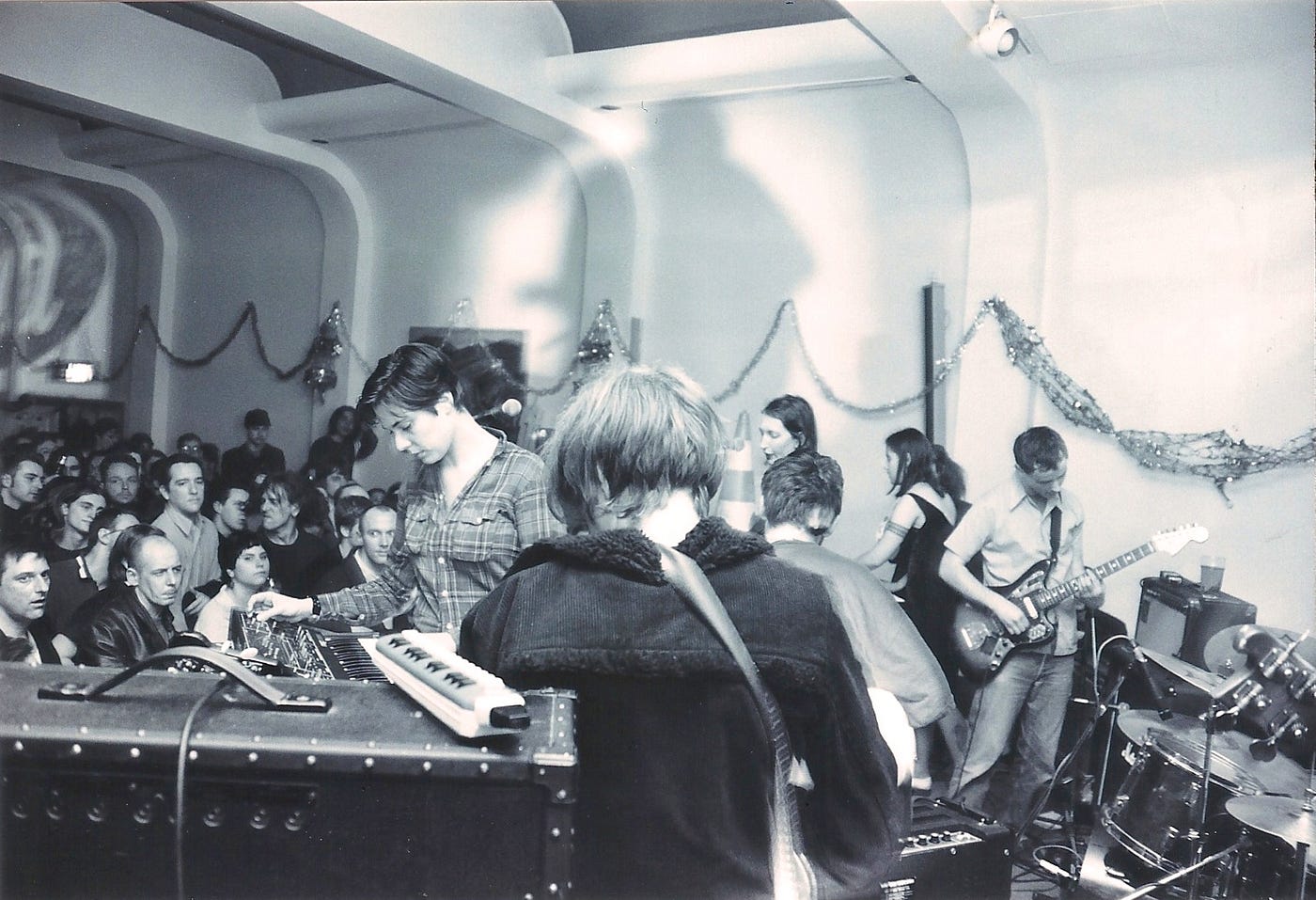
Stereolab, the Lizard / Sausage Machine Christmas Party Camden Irish Centre London 1994 by Greg Neate on Wikimedia Commons
When revisiting our past, are the emotional threads too tenuous to be safely investigated? And why does it have to be so sad looking back? Is it because we are not in the future we naively imagined then?
These are the leading questions when I go back to the ethos of 1997. It is a questioning I apply to 1997’s Dots and Loops arrangement of tracks, sinewed with the ebullient, yet forlorn vibraphone. The tracks are so integrated in Stereolab’s drone of harmonic grammar that they form a continuum of experiences that are hard to separate. They take us somewhere, but not to a time. The Quietus best places Stereolab “at the beginnings of a crate digger culture intersecting with the onset of an interest in ‘lost futures’ that would crystalise into hauntology…”.
When I go back to Dots and Loops, I enter what Bjork’s “Joga” calls an “emotional landscape”, the opening track to Homogenic, released the same year and equally textured with urgent, haunted psychology. But Stereolab take the idea of lost futures in Dots and Loops to a place of frothy pop and recursive intellectual coolness with the overall feeling of pastoral warmth that is driving, yet supple.
Dots and Loops is Stereolab’s first departure from analog and they took a risk that paid off. Contrary to the cool, inert, and hollow cadence of electronic music, however, Stereolab create a romanticism of electronic music (à la Kraftwerk) in the very self-referentiality of their moniker for Vanguard Records’ hi-fi experimentations. The name Stereolab is an ars poetica of electronic music.
But they were not idealizing the era from where there retro library originates. *Audiofemme* importantly points out:
‘Retrofuturism’ has been a word used to describe Stereolab often, but, now, it’s clear how inaccurate that description has been. The implication was that Stereolab was mining a vision of the future imagined in the middle of the 20th century. While there are certainly echoes of that era’s music and design throughout their work, Stereolab was also offering a critique of the political and economic systems that would drive the illusions of progress in the middle decades of the 1900s and lead to growing hardships as the century neared its end.
Stereolab harnesses the clashing of the past viewed through the present in their sound and message. Dots and Loops — the bands’s most retro-pop album — recreates a third space of negotiating past and present aesthetics and politics. The band recently told The Guardian that in their brand of art pop, they:
“were trying to make what I called juxtaposition: a montage, or collage, to see how one thing influenced another,” says Gane, who wrote all the music. Sadier agrees. “We were quite informed by Dada. They were about putting one thing against another and seeing what happens, and maybe you find a deeper truth in that collision.
In October 2019 — a few months before the pandemic — I saw Stereolab in Vancouver’s beloved Commodore Ballroom and they were faithful to not only their sound but Sadier’s lyrics prove even more aligned with today’s challenging of systems that create such inequity. And more than ever we are disillusioned by the numbing of mass culture, the lies that create inequity, and the frail state of democracy. We want to dream and we want to escape. But we also want to rage against the hegemony. At least I still do.
Dots and Loops breaks through those memories we thought were fixed in time and speaks to today, farther down the postmodern continuum of sorting out collisions.
And Stereolab just announced they are back on tour (for which I have just secured tickets). And we get to talk about it all this Sunday. I have liner notes, raw video, and probably too many notes of my own. Some questions I will be asking are: Where does this album take you? Is it more relevant now? More prescient about the spectacle of late capitalism? Can you aurally place it within 90s music?
[embed]March Album of the Month Club Serge Gainsbourg on acidmedium.com
Meeting details:
Riff March 6th Album of the Month Meeting
When: Sun 6 Mar 2022 16:00–18:00 Eastern Time
Join Zoom Meeting: us02web.zoom.us/j/83683711581?pw… (ID: 83683711581, passcode: FNP32+ck)
Join by phone(US) +1 346–248–7799 (passcode: 07045128) Joining instructions
Meeting host: gtbarr@presby.edu
Please invite your friends!
There are a lot of new names and I am working on a book, so please forgive any omissions: Terry Barr Nicole Brown Kevin Alexander Rob Janicke David Acaster If Ever You’re Listening GONGENHUM Soundclub Mag Alexander Briseño Keith R. Higgons Alan Asnen Pedro B. Gorman Pierce McIntyre Christopher Robin Jeffrey Harvey Steven Hale Bonnie Barton S.W. Lauden Zsófia Vera Danielle Loewen Frank Mastropolo Paul Combs Kathryn Dillon Gary Chapin Alex Markham JP Timko JL Matthews AJ Wiseman Nelson George Sude Hammal Jeffrey Harvey Chris Zappa Sarah Paris Reuben Salsa Critical Country
[embed]
*Jessica Lee McMillan © 2022*
메타데이터
- post_id
- 730056701a01
- slug
- stereolabs-dots-and-loops-730056701a01
- url
- https://medium.com/the-riff/stereolabs-dots-and-loops-730056701a01
- canonical_url
- https://medium.com/the-riff/stereolabs-dots-and-loops-730056701a01
- author_url
- https://medium.com/@jessicaleemcmillan
- status
- ok
- fetched_at
- 2026-07-21 08:44:55