The Rise of a Multipolar Financial Architecture: BRICS, CIPS, and the Future of Global Power
1. Introduction: A Paradigm Shift in the Global Financial Order
The Rise of a Multipolar Financial Architecture: BRICS, CIPS, and the Future of Global Power
1. Introduction: A Paradigm Shift in the Global Financial Order
The global financial system, a cornerstone of the post-World War II international order established at Bretton Woods, is undergoing a profound structural transformation. The long-standing hegemony of the U.S. dollar is facing an unprecedented challenge, driven by a confluence of escalating geopolitical tensions, shifting economic power balances, and disruptive technological innovations. At the heart of this transformation lies the expanded BRICS bloc (Brazil, Russia, India, China, South Africa, and its new 2024 members) and its strategic development of alternative financial infrastructures.
Leading this charge is China’s Cross-Border Interbank Payment System (CIPS), which has emerged as a viable alternative to the Western-dominated SWIFT (Society for Worldwide Interbank Financial Telecommunication) network. The rise of CIPS is more than a technical development; it represents the financial frontier of a broader quest for a multipolar world order. As noted in this article, ‘’BRICS’s anti-dollarization movement symbolizes a significant shift away from the hegemony of American finance, and this shift is vital for strengthening freedom movements in the Global South.’’ [1].
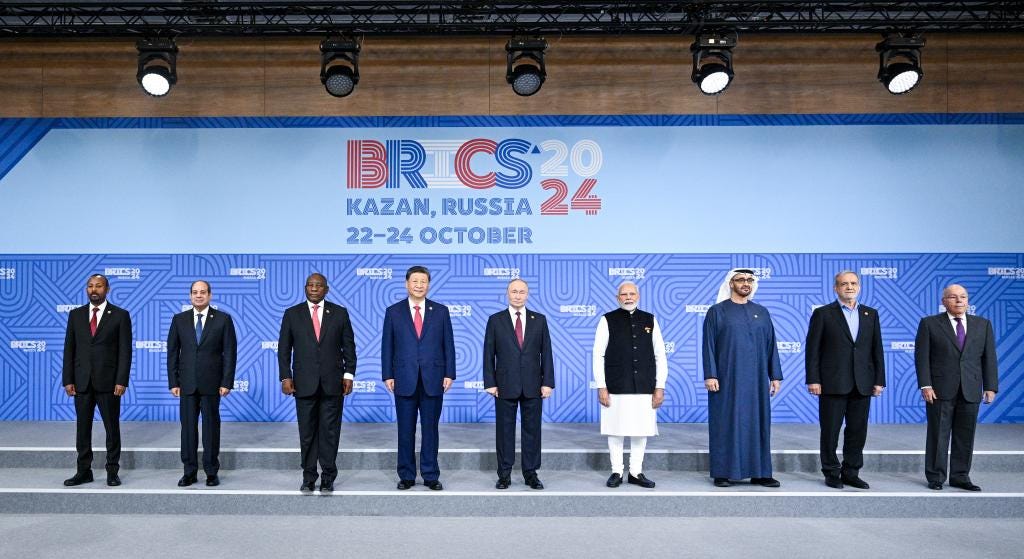
BRICS leaders adopt joint declaration following summit in Kazan Source: CGTN
This report provides an in-depth analysis of the rise of CIPS and parallel payment systems, examining the catalysts for this shift, particularly the weaponization of SWIFT. It assesses the growth of trade in local currencies, evaluates the persistent structural advantages of the U.S. dollar, and contextualizes these developments within recent academic literature and the latest data from international financial institutions. The analysis demonstrates that while the dollar’s dominance is not on the verge of imminent collapse, the foundational elements of a more fragmented and multipolar financial architecture are now being systematically and irreversibly constructed.
2. The Weaponization of Finance: SWIFT Sanctions as a Catalyst for Change
For decades, SWIFT has served as the backbone of global financial communication, widely regarded as a neutral, technical utility. However, this perception of neutrality has been irrevocably shattered as the platform has been increasingly leveraged as a tool of geopolitical coercion. The most salient demonstration of this was the exclusion of several major Russian banks from the network following the 2022 invasion of Ukraine, a move that built upon more limited sanctions imposed after the 2014 annexation of Crimea [2].
This action, often described as the “weaponization of finance” [3], sent a powerful shockwave through the international community. It unequivocally proved that access to the arteries of global commerce could be severed by political decree. For nations in the Global South and others wary of Western sanctions, this was a critical wake-up call. The risk of being similarly disconnected from the global financial system created a powerful incentive to develop and adopt alternative financial infrastructures that operate beyond the direct control and influence of the United States and its allies. The quest for “financial sovereignty” ceased to be a theoretical concept and became a strategic imperative [1]. This geopolitical catalyst dramatically accelerated the development and adoption of systems like CIPS, transforming them from national projects into cornerstones of a new, emerging financial paradigm.
3. The Rise of CIPS: An Alternative in the Making
In this environment of heightened geopolitical risk, China’s CIPS has gained significant strategic importance. Launched in 2015, its initial goal was to promote the international use of the renminbi (RMB). However, it has since evolved into a key piece of infrastructure for nations seeking to circumvent the dollar-centric financial system. CIPS provides an integrated platform for clearing and settling cross-border RMB transactions, offering a more efficient and potentially lower-cost alternative to the traditional correspondent banking system.
The recent growth trajectory of CIPS demonstrates its increasing relevance. It has moved beyond being a symbolic project to become a platform handling substantial trade flows, particularly among BRICS nations and countries participating in the Belt and Road Initiative (BRI).
“In 2024, total annual volume passing through CIPS rose 43% to ¥175.49tn ($24.45tn), driven by a 24% increase to 8.2 million transactions. Both volume and the number of transactions have more than tripled since 2020.” [4]
This surge in activity is mirrored by the expansion of its network. As of May 2025, CIPS reported 1,683 participants, a 10% year-over-year increase. The geographical distribution of these participants underscores the system’s strong foothold in Asia, which accounts for the vast majority of its user base.
![Table 1: Regional Distribution of CIPS Indirect Participants (May 2025). Source: FXCintelligence [4]](https://miro.medium.com/v2/resize:fit:370/1*0CMOvtSyJEnyhoanQS9F7w.png)
Table 1: Regional Distribution of CIPS Indirect Participants (May 2025). Source: FXCintelligence [4]
A Reality Check: CIPS vs. SWIFT
Despite its impressive growth, it is crucial to contextualize the scale of CIPS relative to SWIFT. The two systems are not directly comparable in function or scale. SWIFT is a global messaging network with over 11,500 institutions in more than 235 countries, facilitating transactions in nearly every major currency. CIPS, in contrast, is a clearing and settlement system focused exclusively on the RMB.
Data from the Federal Reserve and SWIFT itself highlight the ongoing dominance of the U.S. dollar. As of 2024, the dollar still accounted for 58% of global foreign exchange reserves [5]. In the foreign exchange market, the dollar was on one side of 88% of all trades in 2022, a share that has remained remarkably stable for decades [5]. Furthermore, the RMB’s share of global payments via SWIFT remained modest at just 3% in June 2025, compared to 48% for the U.S. dollar and 24% for the euro [4].
Significantly, CIPS still relies on the SWIFT network for messaging for a large proportion of its transactions, particularly those involving banks not directly connected to its system. This codependence was formalized in March 2025 when SWIFT and CIPS signed a memorandum of understanding to work together, suggesting that SWIFT views CIPS more as a partner for integrating the RMB into the existing framework than as a direct rival. This indicates that the de-dollarization process is not a zero-sum game but a complex evolution of the existing financial architecture.
4. Building an Alternative Order: BRICS Expansion and New Financial Institutions
The shift in financial infrastructure is occurring in parallel with a significant geopolitical realignment. The expansion of the BRICS bloc is a primary driver of this change, creating a political and economic counterweight to the G7 and other Western-led forums. In January 2024, the bloc officially welcomed Egypt, Ethiopia, Iran, and the United Arab Emirates as full members, significantly increasing its economic heft and geostrategic footprint [6]. This expansion, which followed the 16th BRICS Summit in Kazan, Russia, in October 2024, underscores the bloc’s ambition to become a leading voice for the Global South.

Central to this ambition is the creation of a parallel financial architecture that operates independently of the Bretton Woods institutions — namely, the IMF and the World Bank. The BRICS have established two key institutions to serve this purpose: the New Development Bank (NDB) and the Contingent Reserve Arrangement (CRA).
The New Development Bank (NDB)
Established in 2015 with headquarters in Shanghai, the NDB, under the presidency of former Brazilian President Dilma Rousseff, aims to mobilize resources for infrastructure and sustainable development projects. It explicitly serves BRICS members, emerging economies, and developing countries, positioning itself as “a bank made by and for the Global South” [7].
A key strategic goal of the NDB is to reduce reliance on the U.S. dollar in development finance. The bank has set a target to allocate 30% of its financing in the local currencies of its member countries [8]. This strategy serves two purposes: it shields borrowing nations from the currency risk associated with dollar-denominated debt and simultaneously helps to develop and deepen local capital markets. As of July 2025, the NDB had approved a project portfolio of $40 billion across 122 initiatives, demonstrating its growing capacity as a significant development financier [9].
The Contingent Reserve Arrangement (CRA)
The CRA, with a total committed capital of $100 billion, functions as a financial safety net for its members. It provides a framework for providing liquidity and precautionary instruments during balance of payments crises [10]. The CRA is a direct alternative to the emergency lending facilities of the IMF. Crucially, its support is not tied to the stringent policy conditionalities and structural adjustment programs often imposed by the IMF, which have been criticized by scholars like Joseph Stiglitz for their one-size-fits-all approach that can undermine national sovereignty [1]. The CRA thus offers member countries a crucial buffer against external financial shocks without forcing them to cede policy autonomy, a feature that scholars have identified as a “subversive power against the IMF’s conditionality” [11].
Together, the NDB and CRA represent a foundational challenge to the Western-dominated global financial order. As one academic study notes, these institutions “provide alternative sources of financing independent of traditional Western-dominated institutions, thereby reducing the dollar’s influence in BRICS economies and promoting financial sovereignty among member countries” [1]. While their scale remains modest compared to the IMF and World Bank, their existence provides a credible alternative and strengthens the bargaining power of the Global South.
5. Structural Hurdles: The Enduring Dominance of the Dollar
Despite the clear political momentum towards a multipolar currency system, the de-dollarization process faces formidable structural obstacles. The U.S. dollar’s entrenched position in the global financial system is not merely a matter of policy or prestige; it is deeply embedded in the operational mechanics of international trade and finance. This “exorbitant privilege” is sustained by unparalleled market depth, liquidity, and a self-reinforcing network effect.
Data from the U.S. Federal Reserve and the Bank for International Settlements (BIS) starkly illustrate this reality. The dollar’s role as the world’s primary vehicle currency for foreign exchange transactions is nearly absolute.
“The U.S. dollar was on one side of about 88 percent of global FX transactions in April 2022. This share has remained stable over the past 20 years. In contrast, the euro was bought or sold in 31 percent of FX transactions, a decline from its peak of 39 percent in 2010.” [5]
This dominance extends to international trade invoicing. Outside of Europe, where the euro is the regional anchor, the dollar is the default currency for pricing and settling trade, even when the United States is not a party to the transaction. Research cited by the Federal Reserve shows that from 1999–2019, the dollar accounted for 96% of trade invoicing in the Americas and 74% in the Asia-Pacific region [5]. This inertia creates significant friction for any currency seeking to displace it. A 2023 analysis by the Carnegie Endowment for International Peace highlights this by pointing out that 86% of India’s exports were dollar-denominated, even though only 15% of its exports were destined for the United States [12].
Furthermore, while the dollar’s share of global foreign exchange reserves has been gradually declining — falling to 58% by the end of 2024 [5] — this erosion is slow and does not signal an imminent collapse. The IMF notes that while the dollar is ceding ground to “non-traditional” reserve currencies, it remains the preeminent reserve asset by a wide margin [13]. A 2025 study introduced the “BRICSIZATION index” to measure dollar independence, finding that while progress has been made (averaging 72% independence), economic and geopolitical instability tends to hinder the process, underscoring the dollar’s role as a safe-haven asset [14]. Therefore, any discussion of de-dollarization must acknowledge that it is a long-term, generational process, not an overnight revolution.
6. China’s Grand Strategy: The Digital Yuan and the Belt and Road Initiative
The rise of CIPS and the broader de-dollarization movement cannot be understood outside the context of China’s long-term, integrated geoeconomic strategy. This strategy is not reactive but a patiently executed plan to reshape the global financial landscape. Two core pillars of this strategy are the Digital Yuan (e-CNY) and the Belt and Road Initiative (BRI).
The Digital Yuan (e-CNY): A Technological Frontier
China is leading the world in the development of a central bank digital currency (CBDC). The e-CNY is not a cryptocurrency like Bitcoin; it is a digital form of the country’s sovereign currency, issued and backed by the People’s Bank of China. Its potential to disrupt the current financial order is immense. By design, the e-CNY can facilitate peer-to-peer cross-border payments without needing to pass through the SWIFT messaging system or U.S.-based correspondent banks [15].
As the world’s largest CBDC pilot, the e-CNY has already processed a significant volume of transactions, reaching a cumulative total of 7 trillion e-CNY (approximately $986 billion) by June 2024 [16]. The establishment of an e-yuan international operation center in Shanghai in September 2025 signals China’s intent to promote its use in cross-border scenarios, particularly with ASEAN nations and partners in the Middle East [17]. This technology offers the promise of faster, cheaper, and more direct international payments, creating a powerful incentive for other countries to adopt the infrastructure and, by extension, increase their use of the RMB.
The Belt and Road Initiative (BRI): A Captive Economic Ecosystem
The BRI, China’s sprawling global infrastructure development strategy, provides the physical and economic scaffolding upon which a new financial architecture can be built. The initiative is more than just roads, ports, and railways; it is creating a vast economic ecosystem where the RMB can function as the primary currency for trade, investment, and debt settlement.
By providing financing for BRI projects in RMB and encouraging trade settlement in its own currency, China creates a closed-loop system. Countries participating in the BRI can service their RMB-denominated debt using the RMB they earn from exporting goods to China. This integration of physical, digital (via the “Digital Silk Road”), and financial infrastructure allows participating nations to reduce their exposure to currency fluctuations and the policy decisions of the U.S. Federal Reserve. It also makes them less vulnerable to U.S. sanctions, as their economic activity can increasingly be conducted outside the purview of the dollar system [18]. This integrated approach is a core component of China’s long-term strategy to elevate the RMB’s international status and secure its own economic resilience.
7. Conclusion: The Irreversible Path to a Multipolar Financial System
The emergence of the expanded BRICS bloc and the rise of alternative financial infrastructures like CIPS are not merely a challenge to the U.S. dollar; they represent a fundamental reshaping of the global financial order. This transformation is not a sudden event but a gradual, systemic, and irreversible process. It is a direct response to the weaponization of the existing financial architecture and a broader desire among Global South nations to reclaim their financial sovereignty.
While the U.S. dollar’s deep-rooted structural advantages ensure its continued dominance for the foreseeable future, the foundations of a multipolar currency system are now firmly in place. The combination of political will from the BRICS, the development of alternative institutions like the NDB and CRA, and technological innovation in the form of CBDCs like the e-CNY are creating a viable alternative to the post-Bretton Woods consensus.
We are not witnessing the end of the dollar, but the end of its uncontested hegemony. The world is moving towards a more fragmented and multipolar financial landscape, where multiple currency blocs and payment systems will coexist. Understanding this new architecture is no longer a theoretical exercise; it is essential for navigating the complex geopolitical and geoeconomic realities of the 21st century. The stones of this new order are being laid today, and their arrangement will define the future of international trade, finance, and power.
Update: 21 Oct 2025 17:14 Russia’s State Duma ratifies new investment protection agreement with China -> https://interfax.com/newsroom/top-stories/114422/
References
[1] Arnold, T. D. (2025). De-dollarization and global sovereignty: BRICS’ quest for a new financial paradigm. Human Geography. https://journals.sagepub.com/doi/10.1177/19427786241266896
[2] European Council. (2022, March 2). Council Decision (CFSP) 2022/346. Official Journal of the European Union.
[3] Tooze, A. (2023). The Weaponization of Interdependence. Foreign Affairs.
[4] FXCintelligence. (2025, July 4). Is China’s cross-border payments network on the rise? https://www.fxcintel.com/research/analysis/cips-growth-may-2025
[5] Bertaut, C., von Beschwitz, B., & Curcuru, S. (2025, July 18). The International Role of the U.S. Dollar — 2025 Edition. FEDS Notes, Federal Reserve Board. https://www.federalreserve.gov/econres/notes/feds-notes/the-international-role-of-the-u-s-dollar-2025-edition-20250718.html
[6] Wikipedia. (2025). BRICS. https://en.wikipedia.org/wiki/BRICS
[7] Brasil de Fato. (2025, July 7). ‘NDB is a bank made by and for the Global South’, says Dilma about IMF comparison. https://www.brasildefato.com.br/2025/07/07/ndb-is-a-bank-made-by-and-for-the-global-south-says-dilma-about-imf-comparison
[8] India Foundation. (2024). BRICS 2024: Paving the Path for Economic Growth and Trade Cooperation. https://indiafoundation.in/articles-and-commentaries/brics-2024-paving-the-path-for-economic-growth-and-trade-cooperation/
[9] New Development Bank. (2025, July 6). New Development Bank consolidates strategic expansion and reinforces commitment to sustainable development in the Global South. https://brics.br/en/news/new-development-bank-consolidates-strategic-expansion-and-reinforces-commitment-to-sustainable-development-in-the-global-south
[10] BRICS Information Centre. (2014). Treaty for the Establishment of a BRICS Contingent Reserve Arrangement. University of Toronto.
[11] Würdemann, A. I. (2018). The BRICS Contingent Reserve Arrangement: A subversive power against the IMF’s conditionality? The Journal of World Investment & Trade, 19(3), 570–590.
[12] Carnegie Endowment for International Peace. (2023, December 5). The Difficult Realities of the BRICS’ Dedollarization Efforts — and the Renminbi’s Role. https://carnegieendowment.org/research/2023/12/the-difficult-realities-of-the-brics-dedollarization-effortsand-the-renminbis-role
[13] IMF. (2024, June 11). Dollar Dominance in the International Reserve System: An Update. IMF Blog. https://www.imf.org/en/Blogs/Articles/2024/06/11/dollar-dominance-in-the-international-reserve-system-an-update
[14] Bastanifar, I., Khan, K. H., & Koch, H. (2025). Understanding BRICSIZATION through an economic geopolitical model. Journal of Open Innovation: Technology, Market, and Complexity, 11(1), 100440. https://doi.org/10.1016/j.joitmc.2024.100440
[15] Positive Money. (2024, December 10). New report outlines how new money and payment systems could end dollar’s strangle. https://positivemoney.org/uk-global/press-release/new-report-outlines-how-new-money-and-payment-systems-could-end-dollar-s-strangle/
[16] Atlantic Council. (2025). Central Bank Digital Currency Tracker. https://www.atlanticcouncil.org/cbdctracker/
[17] Yicai Global. (2025, September 26). China’s E-Yuan Int’l Operation Center in Shanghai Begins Operations. https://www.yicaiglobal.com/news/chinas-e-yuan-intl-operation-center-in-shanghai-begins-operations
[18] CSIS. (2022). Sanctions, SWIFT, and China’s Cross-Border Interbank Payments System. https://www.csis.org/analysis/sanctions-swift-and-chinas-cross-border-interbank-payments-system
메타데이터
- post_id
- 7319fc2a2a0b
- slug
- the-rise-of-a-multipolar-financial-architecture-brics-cips-and-the-future-of-global-power-7319fc2a2a0b
- url
- https://medium.com/@muratkgirgin/the-rise-of-a-multipolar-financial-architecture-brics-cips-and-the-future-of-global-power-7319fc2a2a0b
- canonical_url
- https://medium.com/@muratkgirgin/the-rise-of-a-multipolar-financial-architecture-brics-cips-and-the-future-of-global-power-7319fc2a2a0b
- author_url
- https://medium.com/@muratkgirgin
- status
- ok
- fetched_at
- 2026-06-10 15:53:41