Why Food Manufacturers Struggle with Inventory Management (And How ERP Solves It)
Food manufacturers operate in one of the most complex production environments. Unlike many industries, they must manage perishable raw…
Why Food Manufacturers Struggle with Inventory Management (And How ERP Solves It)
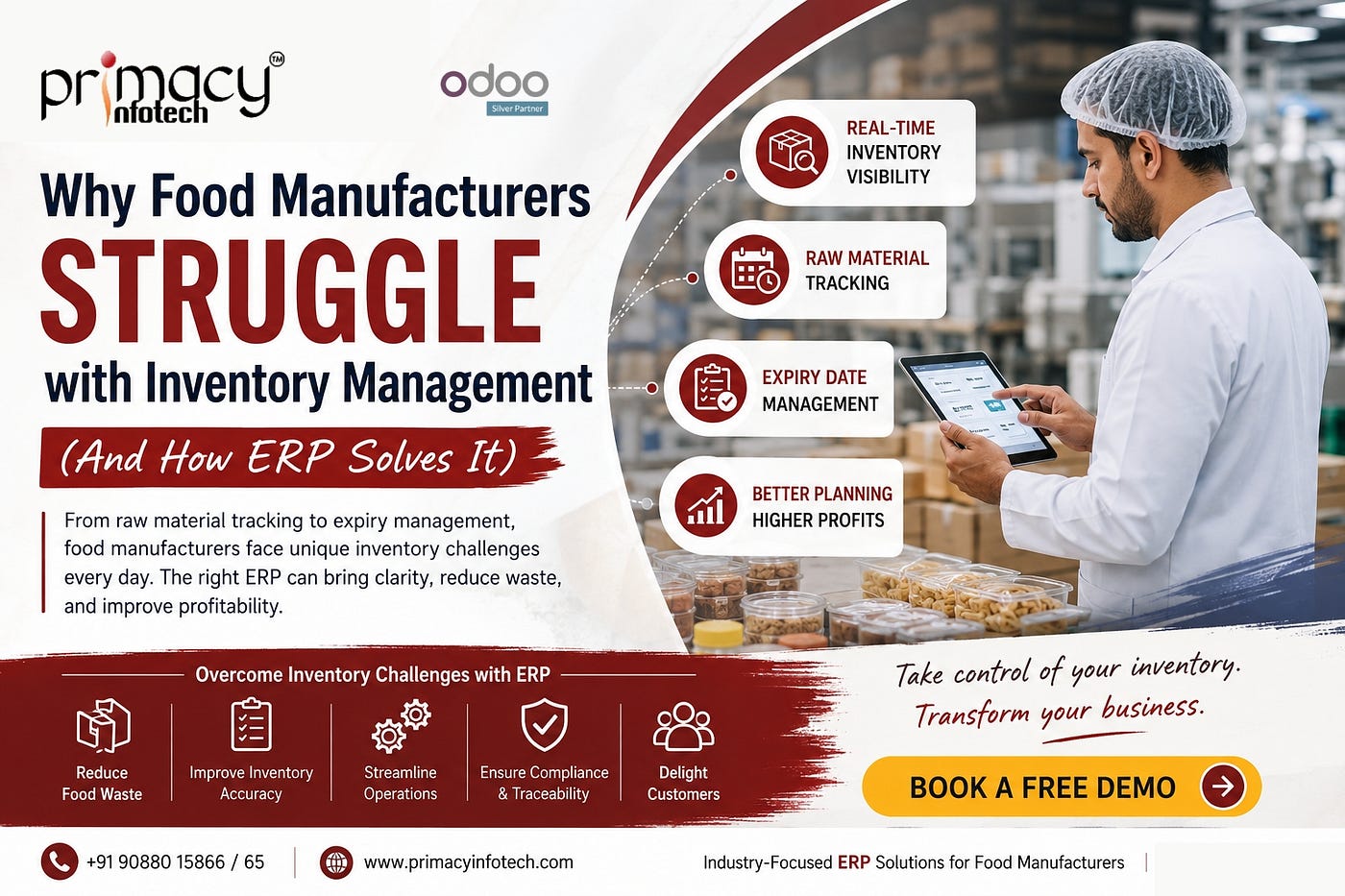
Food manufacturers operate in one of the most complex production environments. Unlike many industries, they must manage perishable raw materials, fluctuating customer demand, strict quality standards, batch traceability, and tight production schedules — all while maintaining profitability.
Yet inventory remains one of the biggest challenges for food manufacturers worldwide.
Many businesses still rely on spreadsheets, manual stock counts, and disconnected software systems. As production scales, these outdated methods often create inventory inaccuracies, food waste, stock shortages, and operational inefficiencies.
The reality is simple: poor Inventory Management in Food Manufacturing can directly impact profitability, customer satisfaction, and long-term business growth.
In this article, we’ll explore the most common inventory management problems in food manufacturing, their business impact, and how modern Food Manufacturing ERP solutions help manufacturers gain complete control over inventory and operations.
Why Inventory Management Is Critical for Food Manufacturers
Inventory is the backbone of every food manufacturing operation. It affects purchasing, production planning, warehouse management, sales fulfillment, and customer satisfaction.
Unlike other industries, food manufacturers face unique inventory challenges such as:
- Limited shelf life of products
- Batch and lot traceability requirements
- Strict food safety regulations
- Seasonal demand fluctuations
- Multiple suppliers and raw materials
- Quality control requirements
When inventory data is inaccurate or delayed, businesses struggle to make informed decisions.
Effective Inventory Control for Food Manufacturers ensures that the right materials are available at the right time, in the right quantity, without creating excessive stock or waste.
Top Inventory Challenges Faced by Food Manufacturing Companies
1. Lack of Real-Time Inventory Visibility
One of the most common inventory management problems in food manufacturing is the inability to see accurate stock levels in real time.
Many manufacturers still use spreadsheets or disconnected software systems. As a result:
- Inventory records become outdated.
- Stock discrepancies increase.
- Production planning becomes difficult.
- Emergency purchases become more frequent.
Without real-time visibility, managers often make decisions based on inaccurate information.
2. Poor Raw Material Inventory Management
Raw materials represent a significant investment for food manufacturers.
Managing ingredients, packaging materials, additives, and supplier deliveries manually often leads to:
- Overstocking
- Understocking
- Material wastage
- Delayed production
Effective Raw Material Inventory Management is essential for maintaining smooth production workflows and reducing unnecessary costs.
3. Expiry Date and Shelf-Life Management Issues
Food products and ingredients have expiration dates.
Without proper monitoring, businesses risk:
- Product spoilage
- Inventory write-offs
- Food safety concerns
- Regulatory compliance issues
Expired inventory directly affects profitability and customer trust.
4. Demand Forecasting Challenges
Customer demand in the food industry can change rapidly due to:
- Seasonal trends
- Promotional campaigns
- Market conditions
- Consumer preferences
Poor forecasting often causes inventory imbalances, resulting in excess stock or stock shortages.
5. Disconnected Departments and Systems
Many businesses use separate software for:
- Purchasing
- Inventory
- Production
- Sales
- Finance
When these systems don’t communicate, information becomes fragmented and decision-making slows down.
These remain some of the biggest inventory management challenges in food processing industry operations today.
How Poor Inventory Management Impacts Profitability
Inventory issues affect far more than warehouse operations.
Poor inventory management often leads to:
Increased Food Waste
Excess inventory frequently expires before use, resulting in unnecessary losses.
Higher Storage Costs
Overstocked warehouses require more storage space, labor, and operational expenses.
Production Delays
Missing ingredients or packaging materials can halt production and delay customer deliveries.
Lost Sales Opportunities
Stock shortages can prevent businesses from fulfilling orders, leading customers to seek alternative suppliers.
Reduced Profit Margins
Inventory inaccuracies increase operational costs and negatively impact profitability.
For growing manufacturers, these challenges can become major barriers to scaling operations.
Common Signs Your Food Manufacturing Business Has Inventory Problems
If your organization experiences any of the following issues, it may be time to review your inventory management strategy:
- Frequent stock shortages
- Excess inventory and spoilage
- Inaccurate inventory records
- Production delays
- Difficulty tracking batches and lots
- High warehouse costs
- Manual inventory processes
- Lack of real-time reporting
These are clear indicators that inventory processes require modernization.
Spreadsheet vs ERP: Which Is Better for Food Inventory Management?
Many food manufacturers begin with spreadsheets because they are inexpensive and easy to implement.
However, as operations grow, spreadsheets become difficult to manage.
Spreadsheet Limitations
- Manual data entry errors
- No real-time inventory updates
- Limited reporting capabilities
- Poor scalability
- Lack of integration between departments
ERP Advantages
A modern Food Manufacturing ERP provides:
- Real-time inventory visibility
- Automated stock updates
- Batch and lot tracking
- Expiry date monitoring
- Production planning integration
- Procurement automation
- Advanced reporting and analytics
This is why many manufacturers are replacing spreadsheets with integrated ERP systems.
How ERP Software Solves Inventory Management Problems
Modern ERP systems are designed to address the challenges food manufacturers face every day.
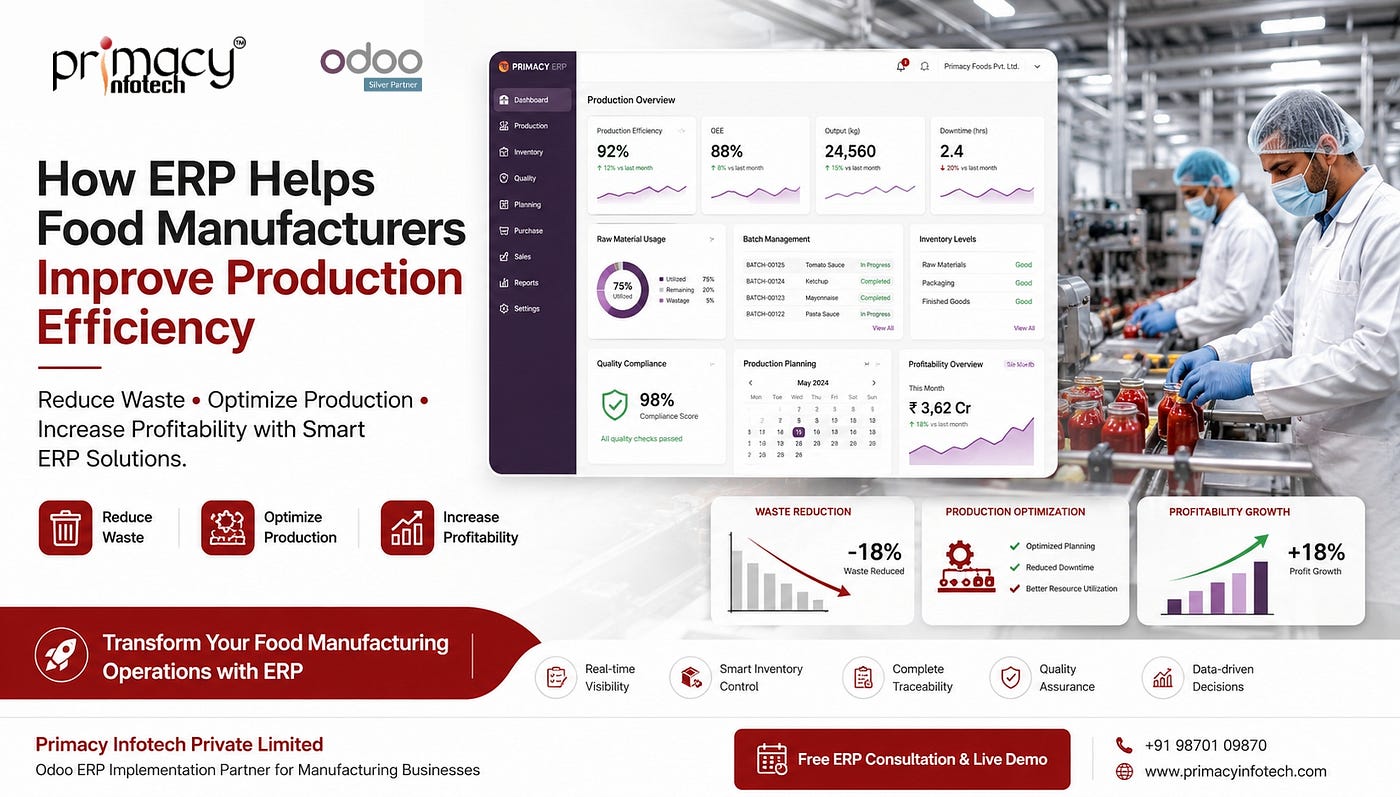
Real-Time Inventory Tracking
Advanced Inventory Tracking Software enables businesses to monitor inventory levels across multiple warehouses and production facilities instantly.
Managers can view:
- Available stock
- Reserved inventory
- Incoming materials
- Production requirements
- Finished goods
This improves planning accuracy and operational efficiency.
Better Raw Material Control
ERP systems improve Raw Material Inventory Management by tracking materials from procurement through production.
This helps reduce waste while ensuring material availability.
Automated Replenishment
ERP solutions can automatically trigger purchase recommendations when stock reaches predefined levels.
This reduces manual effort and prevents stock shortages.
Batch and Lot Traceability
Food manufacturers must maintain complete product traceability.
ERP systems provide end-to-end tracking for:
- Ingredients
- Production batches
- Finished products
- Customer shipments
This improves compliance and simplifies recalls when necessary.
Accurate Demand Forecasting
ERP software analyzes historical sales and production data to improve forecasting accuracy.
Businesses can maintain optimal stock levels and avoid unnecessary inventory costs.
Key Features to Look for in the Best Inventory Management Software for Food Manufacturers
When evaluating solutions, look for:
- Real-time inventory tracking
- Batch and lot management
- Expiry date tracking
- Warehouse management
- Procurement automation
- Production planning
- Quality control integration
- Supply chain visibility
- Mobile accessibility
- Business intelligence dashboards
The best inventory management software for food manufacturers should support both operational efficiency and long-term business growth.
Why Growing Food Manufacturers Are Switching to ERP Systems
As operations expand, inventory complexity increases.
More products, suppliers, customers, and warehouses require a centralized system capable of managing business processes efficiently.
This is why many organizations are investing in ERP for Food Manufacturers.
Benefits include:
- Reduced food waste
- Improved inventory accuracy
- Better production planning
- Enhanced customer satisfaction
- Faster decision-making
- Increased profitability
- Improved regulatory compliance
By integrating inventory, production, procurement, sales, and finance into a single platform, ERP helps manufacturers operate more efficiently and scale confidently.
How Primacy Infotech Helps Food Manufacturers Improve Inventory Control
At Primacy Infotech, we help food manufacturing businesses transform operations through industry-focused ERP solutions powered by Odoo.
Our Food Manufacturing ERP solutions enable businesses to:
- Track inventory in real time
- Manage raw materials effectively
- Monitor batch and lot traceability
- Reduce food waste
- Improve production planning
- Gain complete operational visibility
With expert implementation, customization, and support, we help manufacturers build a smarter and more efficient inventory management strategy.
Building a Smarter Inventory Strategy
Inventory challenges are among the biggest obstacles to growth in the food manufacturing sector. From stock shortages and expired products to inaccurate forecasting and disconnected systems, poor inventory practices can significantly impact profitability.
The good news is that these challenges can be solved.
Modern Inventory Management in Food Manufacturing requires more thaFood manufacturers operate in one of the most complex production environments. Unlike many industries, they must manage perishable raw materials, fluctuating customer demand, strict quality standards, batch traceability, and tight production schedules — all while maintaining profitability.
Yet inventory remains one of the biggest challenges for food manufacturers worldwide.
Many businesses still rely on spreadsheets, manual stock counts, and disconnected software systems. As production scales, these outdated methods often create inventory inaccuracies, food waste, stock shortages, and operational inefficiencies.
The reality is simple: poor Inventory Management in Food Manufacturing can directly impact profitability, customer satisfaction, and long-term business growth.
In this article, we’ll explore the most common inventory management problems in food manufacturing, their business impact, and how modern Food Manufacturing ERP solutions help manufacturers gain complete control over inventory and operations.
Why Inventory Management Is Critical for Food Manufacturers
Inventory is the backbone of every food manufacturing operation. It affects purchasing, production planning, warehouse management, sales fulfillment, and customer satisfaction.
Unlike other industries, food manufacturers face unique inventory challenges such as:
- Limited shelf life of products
- Batch and lot traceability requirements
- Strict food safety regulations
- Seasonal demand fluctuations
- Multiple suppliers and raw materials
- Quality control requirements
When inventory data is inaccurate or delayed, businesses struggle to make informed decisions.
Effective Inventory Control for Food Manufacturers ensures that the right materials are available at the right time, in the right quantity, without creating excessive stock or waste.
Top Inventory Challenges Faced by Food Manufacturing Companies
1. Lack of Real-Time Inventory Visibility
One of the most common inventory management problems in food manufacturing is the inability to see accurate stock levels in real time.
Many manufacturers still use spreadsheets or disconnected software systems. As a result:
- Inventory records become outdated.
- Stock discrepancies increase.
- Production planning becomes difficult.
- Emergency purchases become more frequent.
Without real-time visibility, managers often make decisions based on inaccurate information.
2. Poor Raw Material Inventory Management
Raw materials represent a significant investment for food manufacturers.
Managing ingredients, packaging materials, additives, and supplier deliveries manually often leads to:
- Overstocking
- Understocking
- Material wastage
- Delayed production
Effective Raw Material Inventory Management is essential for maintaining smooth production workflows and reducing unnecessary costs.
3. Expiry Date and Shelf-Life Management Issues
Food products and ingredients have expiration dates.
Without proper monitoring, businesses risk:
- Product spoilage
- Inventory write-offs
- Food safety concerns
- Regulatory compliance issues
Expired inventory directly affects profitability and customer trust.
4. Demand Forecasting Challenges
Customer demand in the food industry can change rapidly due to:
- Seasonal trends
- Promotional campaigns
- Market conditions
- Consumer preferences
Poor forecasting often causes inventory imbalances, resulting in excess stock or stock shortages.
5. Disconnected Departments and Systems
Many businesses use separate software for:
- Purchasing
- Inventory
- Production
- Sales
- Finance
When these systems don’t communicate, information becomes fragmented and decision-making slows down.
These remain some of the biggest inventory management challenges in food processing industry operations today.
How Poor Inventory Management Impacts Profitability
Inventory issues affect far more than warehouse operations.
Poor inventory management often leads to:
Increased Food Waste
Excess inventory frequently expires before use, resulting in unnecessary losses.
Higher Storage Costs
Overstocked warehouses require more storage space, labor, and operational expenses.
Production Delays
Missing ingredients or packaging materials can halt production and delay customer deliveries.
Lost Sales Opportunities
Stock shortages can prevent businesses from fulfilling orders, leading customers to seek alternative suppliers.
Reduced Profit Margins
Inventory inaccuracies increase operational costs and negatively impact profitability.
For growing manufacturers, these challenges can become major barriers to scaling operations.
Common Signs Your Food Manufacturing Business Has Inventory Problems
If your organization experiences any of the following issues, it may be time to review your inventory management strategy:
- Frequent stock shortages
- Excess inventory and spoilage
- Inaccurate inventory records
- Production delays
- Difficulty tracking batches and lots
- High warehouse costs
- Manual inventory processes
- Lack of real-time reporting
These are clear indicators that inventory processes require modernization.
Spreadsheet vs ERP: Which Is Better for Food Inventory Management?
Many food manufacturers begin with spreadsheets because they are inexpensive and easy to implement.
However, as operations grow, spreadsheets become difficult to manage.
Spreadsheet Limitations
- Manual data entry errors
- No real-time inventory updates
- Limited reporting capabilities
- Poor scalability
- Lack of integration between departments
ERP Advantages
A modern Food Manufacturing ERP provides:
- Real-time inventory visibility
- Automated stock updates
- Batch and lot tracking
- Expiry date monitoring
- Production planning integration
- Procurement automation
- Advanced reporting and analytics
This is why many manufacturers are replacing spreadsheets with integrated ERP systems.
How ERP Software Solves Inventory Management Problems
Modern ERP systems are designed to address the challenges food manufacturers face every day.
Real-Time Inventory Tracking
Advanced Inventory Tracking Software enables businesses to monitor inventory levels across multiple warehouses and production facilities instantly.
Managers can view:
- Available stock
- Reserved inventory
- Incoming materials
- Production requirements
- Finished goods
This improves planning accuracy and operational efficiency.
Better Raw Material Control
ERP systems improve Raw Material Inventory Management by tracking materials from procurement through production.
This helps reduce waste while ensuring material availability.
Automated Replenishment
ERP solutions can automatically trigger purchase recommendations when stock reaches predefined levels.
This reduces manual effort and prevents stock shortages.
Batch and Lot Traceability
Food manufacturers must maintain complete product traceability.
ERP systems provide end-to-end tracking for:
- Ingredients
- Production batches
- Finished products
- Customer shipments
This improves compliance and simplifies recalls when necessary.
Accurate Demand Forecasting
ERP software analyzes historical sales and production data to improve forecasting accuracy.
Businesses can maintain optimal stock levels and avoid unnecessary inventory costs.
Key Features to Look for in the Best Inventory Management Software for Food Manufacturers
When evaluating solutions, look for:
- Real-time inventory tracking
- Batch and lot management
- Expiry date tracking
- Warehouse management
- Procurement automation
- Production planning
- Quality control integration
- Supply chain visibility
- Mobile accessibility
- Business intelligence dashboards
The best inventory management software for food manufacturers should support both operational efficiency and long-term business growth.
Why Growing Food Manufacturers Are Switching to ERP Systems
As operations expand, inventory complexity increases.
More products, suppliers, customers, and warehouses require a centralized system capable of managing business processes efficiently.
This is why many organizations are investing in ERP for Food Manufacturers.
Benefits include:
- Reduced food waste
- Improved inventory accuracy
- Better production planning
- Enhanced customer satisfaction
- Faster decision-making
- Increased profitability
- Improved regulatory compliance
By integrating inventory, production, procurement, sales, and finance into a single platform, ERP helps manufacturers operate more efficiently and scale confidently.
How Primacy Infotech Helps Food Manufacturers Improve Inventory Control
At Primacy Infotech, we help food manufacturing businesses transform operations through industry-focused ERP solutions powered by Odoo.
Our Food Manufacturing ERP solutions enable businesses to:
- Track inventory in real time
- Manage raw materials effectively
- Monitor batch and lot traceability
- Reduce food waste
- Improve production planning
- Gain complete operational visibility
With expert implementation, customization, and support, we help manufacturers build a smarter and more efficient inventory management strategy.
Building a Smarter Inventory Strategy
Inventory challenges are among the biggest obstacles to growth in the food manufacturing sector. From stock shortages and expired products to inaccurate forecasting and disconnected systems, poor inventory practices can significantly impact profitability.
The good news is that these challenges can be solved.
Modern Inventory Management in Food Manufacturing requires more than spreadsheets and manual processes. Businesses that adopt advanced Food Manufacturing ERP solutions and intelligent Inventory Tracking Software gain greater control, improved efficiency, and stronger profitability.
As the industry becomes more competitive, manufacturers that invest in smarter inventory management today will be better positioned to achieve sustainable growth tomorrow.n spreadsheets and manual processes. Businesses that adopt advanced Food Manufacturing ERP solutions and intelligent Inventory Tracking Software gain greater control, improved efficiency, and stronger profitability.
As the industry becomes more competitive, manufacturers that invest in smarter inventory management today will be better positioned to achieve sustainable growth tomorrow.
메타데이터
- post_id
- 731cfeaf34d2
- slug
- why-food-manufacturers-struggle-with-inventory-management-and-how-erp-solves-it-731cfeaf34d2
- url
- https://medium.com/@dm_78409/why-food-manufacturers-struggle-with-inventory-management-and-how-erp-solves-it-731cfeaf34d2
- canonical_url
- https://medium.com/@dm_78409/why-food-manufacturers-struggle-with-inventory-management-and-how-erp-solves-it-731cfeaf34d2
- author_url
- https://medium.com/@dm_78409
- status
- ok
- fetched_at
- 2026-06-20 20:29:01