A Post-Mortem of WWDC 2026: Apple’s Three Trillion Dollar Mid-Life Crisis
From ideation yurt to keynote flop: how Apple lost the plot on stage.
A Post-Mortem of WWDC 2026: Apple’s Three Trillion Dollar Mid-Life Crisis
From ideation yurt to keynote flop: how Apple lost the plot on stage.
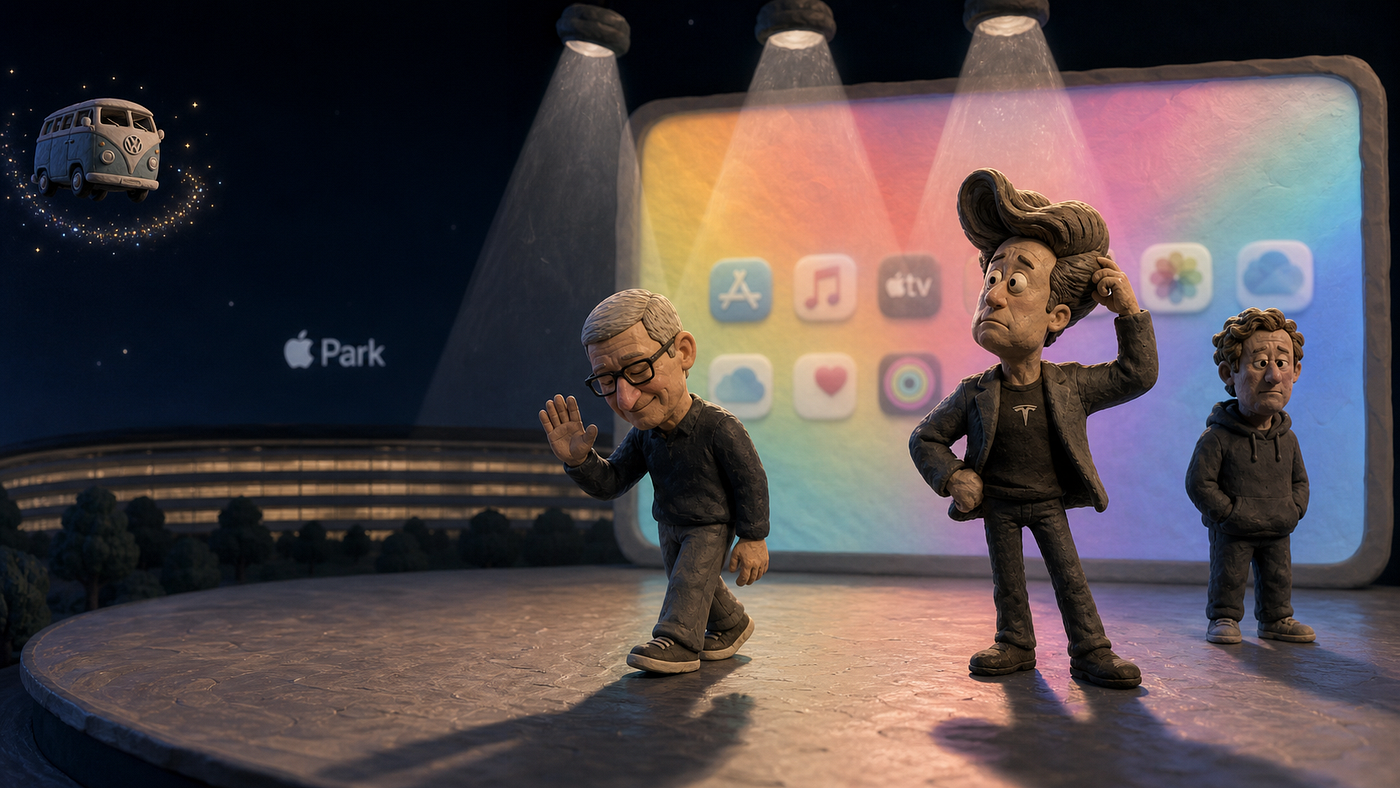
Welcome to WWDC: World Wide Deadpan
The Opening: A View from the Ideation Yurt
If you’ve been haunting the halls of Cupertino’s software architecture since the era when Steve Jobs treated a file system like a liturgical text, WWDC 2026 felt less like a developer conference and more like a fever dream staged by a retreat-weary marketing department in desperate need of a reality check.
The keynote opened with Craig Federighi — still the world’s most charismatic dad-jock — recounting the “exploits” of a marketing team that apparently spilled out of an “experiential ideation yurt” at Apple Park and fled in a microbus toward a northern “Summer of Love.” He read a note claiming their “chakra alignment” had set a compass toward “infinite seas” where “corporeal forms know no earthly tether.”
It was a rich, if unintentional, metaphor for a company at a terminal crossroads: Tim Cook taking his final, scripted bow while the actual technical substance felt thinner than the profile of an iPad Air. Despite the desperate boast of “1,000 apps per hour” flooding the App Store — mostly LLM-generated slop, one assumes — the atmosphere was one of corporate whimsy masking a profound lack of direction.
Siri’s New Wardrobe: Gemini in a Blue Shirt
The centerpiece of the event was “Siri AI,” or as anyone with a functioning BS detector and a senior-level understanding of transformer models might call it: Gemini in a blue shirt.
After years of promising an in-house LLM breakthrough that would justify the “Apple” in Apple Intelligence, the company effectively admitted it is renting its brain from Mountain View. This “deep collaboration” with Google is essentially a licensing deal for Gemini, dressed up in a dress of “Private Cloud Compute” and marketing hyperbole. The features showcased — calculating a tip via “Visual Intelligence” or planning a watch party menu — felt like a belated game of catch-up.
As a software engineer, the irony is delicious: Apple is touting a “re-architected” search index and a “new” CPU scheduler backported to the iPhone 11 to make a seven-year-old phone feel “responsive,” yet they’ve gated the “most advanced” capabilities behind a $1,200 paywall.
To get “expressive voices” and advanced dictation, you’ll need an iPhone 17 Pro, 17 Pro Max, or the newly minted “iPhone Air.” Finally, a Siri that actually just Googles things for you — provided you’re holding a device expensive enough to trigger a 2% drop in the stock price as Wall Street realized there is no M5 Mac Studio or Mac mini coming to save the quarter.
The Slider of Shame: Retooling Liquid Glass
Apple rarely admits to an aesthetic catastrophe, but the unceremonious rollback of “Liquid Glass” was as close to a formal apology as we’ll get. After the initial release of Liquid Glass led to a hockey-stick jump in Google searches for “How to switch to Android,” the design team has spent the last year in a state of high-alert recalcitrance.
The “fix” for this UI debacle? A transparency slider. Users can now adjust the UI from “ultra clear to fully tinted,” though “off” is the presumed preference for anyone with eyes. The “bulbous” shapes and inconsistent corner radii have been “squeegeed” at the last minute.
The result is a design that looks like a version of the classic Aqua design if it had been slammed with a belt sander — too subtle, too pale, and still fundamentally flawed. We are left with 1px grey lines on 20% grey backgrounds, a “minimalism” so slavish it borders on the unusable. It’s the “butterfly keyboard” of software design: a brave failure that took years of user screaming to partially reverse.
Cinematic Jitters and Robotic Rhythms
For a company that treats its keynotes like Oscar-contending cinema, the production quality of WWDC 2026 was in the “uncanny valley.” Professional observers noted a startling drop in standards: “clipping highlights,” uncontrolled outdoor lighting, and bizarre “micro-jitters” resulting from what looked like panicked gimbal reframing.
The presenters mirrored this technical decay. The corporate-speak has officially metastasized into something cult-like, characterized by “zero dynamic range” and robotic hand gestures.
Every feature was “legendary,” yet the delivery was so sterile it felt like an AI hallucination. Between the “Mother Earth” style corporate whimsy and the flying VW bus, the event felt detached from the people it’s meant to serve.
It was a polished performance of “authenticity” that felt entirely fake, a “Summer of Love” posture for a company that hasn’t seen a real summer since 2011.
The Ghost of CEOs Future: Where in the World is John Ternus?
The leadership disconnect was perhaps the most baffling strategic move of the hour. We know John Ternus is slated to take over the throne in September 2026, making this Tim Cook’s “long goodbye.” And yet, Ternus was a ghost.
To leave the future CEO in the wings during the most critical AI roadmap reveal in the company’s history — an event that was essentially a one-hour advertisement for Google’s intelligence — is a head-scratcher of epic proportions.
It left investors feeling the narrative is disconnected. It’s the perfect event for anyone who loves waiting until “later this year” for a beta that won’t work in their country anyway, led by a man who seems more excited about basis points than the actual Settings app.
Geographic Heartbreak: The “Digital Markets Act” Wall
If you reside in the European Union or China, this keynote was a work of science fiction. Due to the Digital Markets Act (DMA) and regulatory hurdles in China, Siri AI is indefinitely delayed in those regions.
The irony is rich: Apple preaches “privacy-first” while the EU suggests their model is a gatekeeping violation. Meanwhile, Siri AI will launch “strictly in English,” treating the rest of the world as the stepchildren of the AI revolution.
We are told this is for “security,” but it feels more like a GEO-brokerage tantrum. It’s a “privacy-focused” AI that requires you to send your data to a server because the local hardware isn’t quite up to the task — unless the lawyers in your jurisdiction haven’t cleared the data transfer yet.
[embed]Listen to the full Podcat episode
Historical & Strategic Footnote: The exile of Jony Ive
The deepest structural irony of Apple’s current reactive software panic is playing out just a few miles away from Apple Park, orchestrated by the ghost of its own design lineage: Sir Jony Ive.
Following OpenAI’s massive $6.5 billion acquisition of Ive’s stealth hardware venture, io Products, the legendary designer has effectively constructed an elite Apple shadow cabinet in San Francisco. By aggressively poaching more than 40 of Apple’s absolute top-tier veteran hardware engineers and industrial design leads (including Evans Hankey and Tang Tan), Ive is executing a highly capitalized, multi-year plan to correct the smartphone-addicted paradigm he spent twenty years building.
While Apple’s current management team remains hopelessly trapped in a legacy, hardware-first mental model — trying to figure out how to parse a bloated chatbot through an app store wrapper — OpenAI and Ive are engineering an ecosystem explicitly designed to render the iPhone completely obsolete.
Their upcoming product roadmap, spearheaded by screenless, ultra-low-latency audio wearables codenamed “Sweetpea” and ambient spatial hubs, focuses entirely on “calm computing.”
By moving the primary computing interface entirely to a highly conversational, context-aware audio and vision layer powered by OpenAI’s raw model capability, they aim to bypass the App Store entirely.
If an elegant, screenless device can seamlessly orchestrate your life, manage your correspondence, and book your travel via native, ambient agents, the necessity of the mobile screen disappears.
Apple’s management may currently be worried about shielding incoming CEO John Ternus from the immediate software rollout mess, but the real threat isn’t a temporary developer waitlist — it is the prospect of their entire hardware empire being quietly designed out of existence by the very man who drew the original blueprints.
Conclusion: Snow Leopard II or Just a Cold Cat?
As we circle back to the yurt and the “Summer of Love,” we must ask: was this a “Snow Leopard” year of refinement, or just a catastrophe? Under the hood, there are welcome fixes — faster app launches, Foundation Models framework updates, and App Intents. But the overarching theme is one of profound fakeness.
Look no further than the “Clean Up” demo in Photos. Alok, with a smile that didn’t reach his eyes, showed us how to remove “distractions” from a photo. The “distractions” in question? Two girls juggling and having fun in the background. In the Apple utopia of 2026, human connection and spontaneous joy are “noise” to be “cleaned up” by generative fill.
We are rapidly approaching a future where the phone plans the party, invites itself, and then removes your friends from the photos for better composition. Tim Cook said his goodbyes with a rainbow background — a cynical bit of virtue signaling before his exit — but the product he leaves behind is one that views the world through a belt-sander.
It’s a brave new world, provided you have an iPhone Air and a very high tolerance for blue shirts.
메타데이터
- post_id
- 7321694e5a86
- slug
- a-post-mortem-of-wwdc-2026-apples-three-trillion-dollar-mid-life-crisis-7321694e5a86
- url
- https://medium.com/the-deepdive/a-post-mortem-of-wwdc-2026-apples-three-trillion-dollar-mid-life-crisis-7321694e5a86
- canonical_url
- https://medium.com/the-deepdive/a-post-mortem-of-wwdc-2026-apples-three-trillion-dollar-mid-life-crisis-7321694e5a86
- author_url
- https://medium.com/@allanandida
- status
- ok
- fetched_at
- 2026-06-12 07:40:50






