Bumble BFF: A Product Teardown From Someone Who Actually Made Friends on It
Making friends was never supposed to be hard until it was.
Bumble BFF: A Product Teardown From Someone Who Actually Made Friends on It
Making friends was never supposed to be hard until it was.
I finished my Master’s at Northeastern University in August 2025, left Boston, and moved to Madison, Wisconsin. New city. No job yet. Zero friends. Just me, my brother’s apartment, and a job search that was slowly eating my sanity.
Here’s the thing nobody tells you about post-grad life: making friends was effortless when the system did the work for you. You sit next to someone in class. You join a club. You bond over a bad professor. Done. Friendship unlocked.
But in a new city with no office, no campus, no reason to leave the house? Suddenly, making friends becomes a project. And as an extrovert running on fumes from job rejections, I didn’t just want friends. I needed them. My mental health depended on it.
So I downloaded Bumble BFF.
And honestly? It worked. Within weeks, I was going to line dancing, karaoke nights, Coffee meetups, and even a Bridgerton watch party with people I’d never have met otherwise. I moved those conversations to iMessage and Instagram, and I’m still in touch with them today.
So here’s my honest take on what BFF gets right, where it breaks, and what I’d build next.
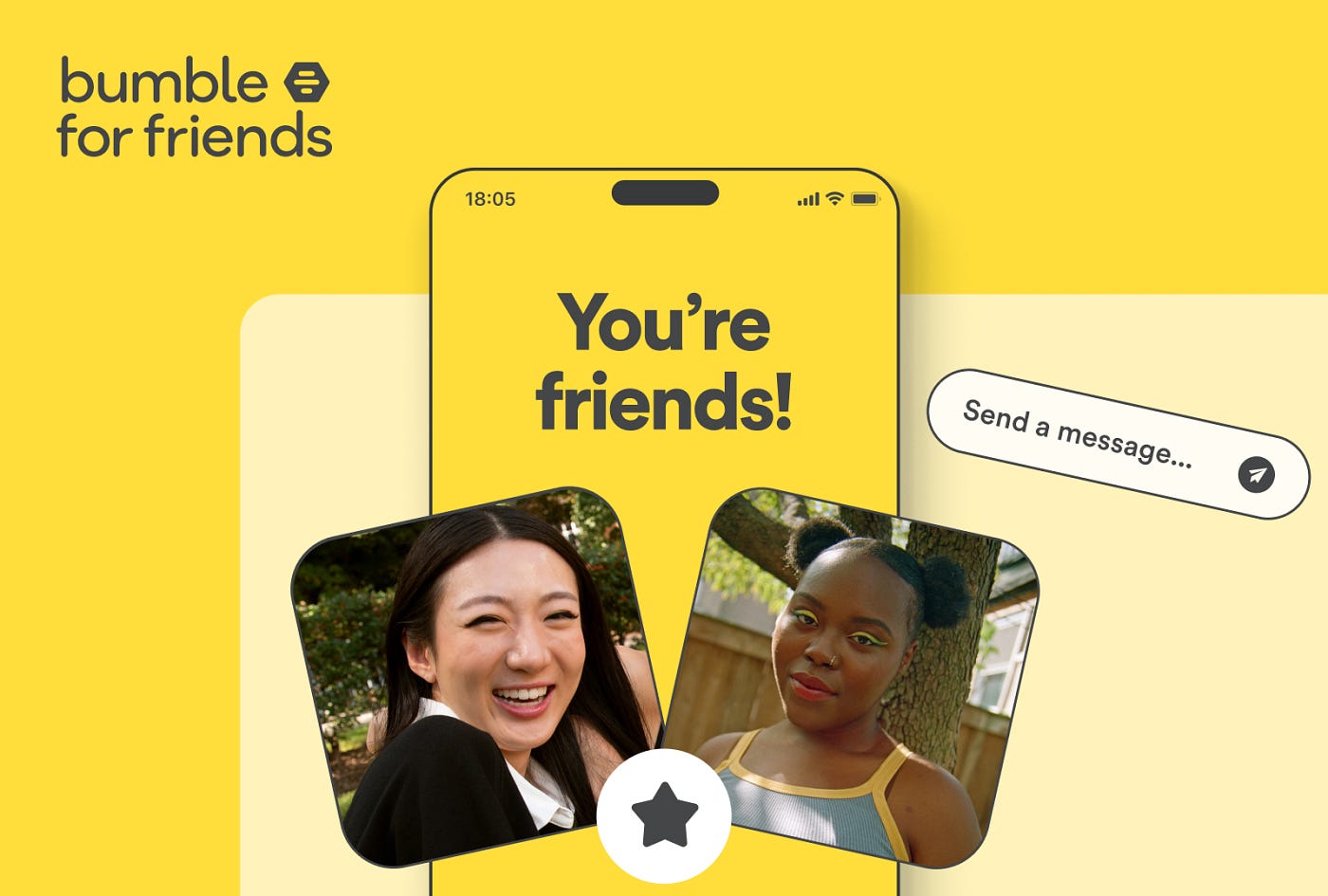
So What Even Is Bumble BFF?
Quick backstory. Bumble launched BFF mode within the dating app in 2016. It was fine, but users kept complaining: the connections felt shallow, the one-on-one matching felt too much like dating, and the whole vibe was off for platonic friendships.
So Bumble did something bold. They acquired Geneva, a community-focused social platform, and rebuilt the whole thing from scratch as a standalone app called BFF. It launched in late 2025, with the biggest feature drop, Groups, landing in February 2026.
The thesis? If you can swipe for love, you should be able to swipe for friendship. But the real shift is deeper than that. BFF moved from “find one friend” to “find your people.” That’s a fundamentally different product.
One catch, though: BFF is only available in about 17 countries. US, UK, Canada, Australia, Germany, and a handful of others. India? Not on the list. My friends back home can’t even download it. For a company trying to solve a global loneliness problem, that’s a big chunk of the world left out.
My User Journey (Not a Hypothetical. I Actually Did This.)
Onboarding was refreshingly painless. Profile photo, location, age, interests, photo prompts, education, work, pronouns, social media links. Nothing excessive. No 40-question personality quiz. I was up and running in minutes.
The Discover feed is a vertical scroll, not a swipe. This surprised me. You don’t left-swipe or right-swipe. You scroll through profiles and hit a yellow “hi” wave button if someone seems interesting. If you’re not feeling it, you just keep scrolling. It removes the binary pressure of swipe culture. Feels more like browsing than judging.
The “Says Hi” tab shows people who have already waved at you. So you can wave back and start chatting. This is the mutual matching piece, no awkward one-sided messaging.
And then there are Groups. This is where the magic is. I’ll be honest, I stumbled into Groups by accident. I was clicking on people’s profiles, noticed they were in groups, and started joining those. Bike Madison. Madison Weekly Drinks. Girlies in Madison. The Wholesome Collective. Desis in Madison. Read & Roam Collective.
Each group has its own rooms, events, and member lists. You can browse members, send friend requests to people who aren’t even on your Discover feed, and RSVP to events. I got notifications about who was coming to which event, which made showing up in person way less scary.
The Groups feature is only two months old, but it’s already the most compelling part of the app. Because here’s the insight: making one friend is hard. Finding a group is easier. You show up to an event, meet five people at once, and suddenly you have a crew.
The user personas I met were all over the place. People who relocated from other cities (like me). Short-term interns. Married people are looking for their own social circle. Long-time Madison residents who still wanted new connections. Grad students. Undergrads. Everyone had a different reason for being there, but the same core need: human connection.
Privacy controls are surprisingly thoughtful. I can control which groups appear on my profile, whether non-members can see me in a group’s member list, whether people with my contact info can find me, and whether I even show up on the People discovery tab at all. For a social app, that’s a level of control that builds real trust.
What’s Working
Groups + Events = the real product. The one-on-one matching is fine. But Groups is what actually converts app activity into real-life friendships. I went from scrolling profiles alone on my couch to dancing at a karaoke bar in under three weeks. That’s a product success story.
Low-friction onboarding. No paywall before value. No forced personality quizzes. You’re in, you’re browsing, you’re joining groups within minutes.
The “hi” mechanic removes rejection anxiety. Unlike dating apps where a left-swipe feels personal, here you just scroll past. And knowing someone already said hi to you makes reciprocating feel safe.
It actually works in smaller cities. Madison isn’t NYC or LA. The fact that I found active groups with recent activity timestamps (“last active 1 hour ago”) means BFF has enough density even outside major metros. That’s not easy to pull off.
What’s Not Working (The Friction Points)
The location picker is painful. When you go to change your location in filters, there’s no search bar. No way to type “Austin.” You get a map, and you have to pinch, zoom, and pan your way to wherever you want to go. Picture this: I know I’m moving to Austin for a job. I want to start meeting people before I get there. But to browse Austin profiles, I have to manually navigate across an entire map of the United States? That’s not a minor UX annoyance. That’s a broken use case for one of the app’s core personas, people who are relocating.
Filters are embarrassingly thin. Right now, you get exactly two: age range (slider) and distance (1 mile to 50+ miles). That’s it. No interest-based filtering. No life-stage filter. No “I’m looking for hiking buddies” or “I just moved here” filter. For a friendship app where compatibility matters, this is a massive gap.
No gender preference option. This is a widely discussed pain point. The older BFF experience only showed same-gender matches, which frustrated people who wanted to make friends across genders. But now there’s no way to set any gender preferences at all, and users across social media are vocal about wanting that control back. Some people only want female friends. Some want to befriend anyone. A simple preference toggle would let users decide for themselves instead of the app deciding for them.
Conversations fizzle. This is the number one complaint across every review platform I looked at. People match, say hi, exchange a couple of messages… and then nothing. The app doesn’t do enough to bridge the gap between “matched” and “met in person.” There’s no nudge to suggest a meetup, no icebreaker prompts after matching, no “you’re both free Saturday, here’s an event near you” push.
The photo-first format feels borrowed from dating. You’re still judging people primarily on how they look. For platonic friendship, that creates a weird dynamic. Interests, vibe, and life context matter more than selfies when you’re looking for friends, not dates.
What I’d Ship If I Were the PM
- Smart Location Search
Let users type a city name to browse people and groups there. Support a “Moving to…” tag on profiles so relocators can connect before they arrive. This unlocks a huge use case: pre-move friend-finding.
Success metric: Increase in cross-city profile views and matches initiated before a user’s location actually changes.
2. Interest and Life-Stage Filters
Add filters for interests (hiking, food, gaming, books), life stage (new to city, new parent, grad student, working professional), and friendship intent (activity buddy, deep friendships, just exploring). These exist as profile tags already. Surface them as filters.
Success metric: Improvement in message response rate and first-meetup conversion rate after matching.
Tradeoff: Too many filters could shrink the pool in smaller cities. Solution: make them soft preferences that boost ranking rather than hard cutoffs.
3. Match-to-Meetup Nudges
After two people match and exchange a few messages, prompt them with a suggested event nearby, or an icebreaker activity (“You both like coffee. Here are three cafes between you.”). Reduce the friction between “we matched” and “we actually hung out.”
Success metric: Percentage of matches that convert to an in-person meetup within 14 days.
This is where most friendship apps lose users. The biggest drop-off isn’t matching. It’s the dead zone between matching and meeting. Whoever solves this wins.
The Bigger Picture
Bumble is making a real bet here. A Bumble survey found that 56% of Gen-Z and millennials are actively seeking new friendships, and 52% want tools to help build their friend circles. The loneliness epidemic isn’t a buzzword. It’s a product opportunity.
BFF’s shift from one-on-one swiping to community-based Groups is the right strategic move. The product went from feeling like “dating app but for friends” to something that actually maps to how friendships form in real life: through shared spaces, repeated interactions, and group dynamics.
But the app is still early. The filters need work. The location UX is clunky. The match-to-meetup gap is bleeding users. And the geographic limitation means millions of people who need this product can’t access it yet.
The foundation is there. I’m living proof it works. Now they need to sand down the rough edges before someone else builds a better version.
Key Takeaways
What it is: A standalone friendship app from Bumble, rebuilt on Geneva’s community platform, with Groups, Events, and one-on-one matching.
What it nails: Groups and events that actually lead to IRL friendships, simple onboarding, solid privacy controls, works even in smaller cities.
What it misses: Clunky location picker, bare-minimum filters, no match-to-meetup bridge, photo-first format that feels awkward for friendships.
What I’d build: Smart location search with a “moving to” tag, interest and life-stage filters, and match-to-meetup nudges that close the gap between swiping and showing up.
The bet: Loneliness is a product problem. Groups are the answer. BFF just needs to nail the last mile.
If Bumble ever needs a PM who already did the user research by living it, they know where to find me.
By Shweta Shinde
LinkedIn — https://www.linkedin.com/in/shweta-shinde-/
Portfolio — https://shwetashinde.info/
메타데이터
- post_id
- 7330bf71d4f2
- slug
- bumble-bff-a-product-teardown-from-someone-who-actually-made-friends-on-it-7330bf71d4f2
- url
- https://medium.com/@shwetz521998/bumble-bff-a-product-teardown-from-someone-who-actually-made-friends-on-it-7330bf71d4f2
- canonical_url
- https://medium.com/@shwetz521998/bumble-bff-a-product-teardown-from-someone-who-actually-made-friends-on-it-7330bf71d4f2
- author_url
- https://medium.com/@shwetz521998
- status
- ok
- fetched_at
- 2026-07-11 13:37:47