Georgia O’Keeffe Painted the Same View From Her Window for Years
But the buildings refused to sit still.
Georgia O’Keeffe Painted the Same View From Her Window for Years
But the buildings refused to sit still.
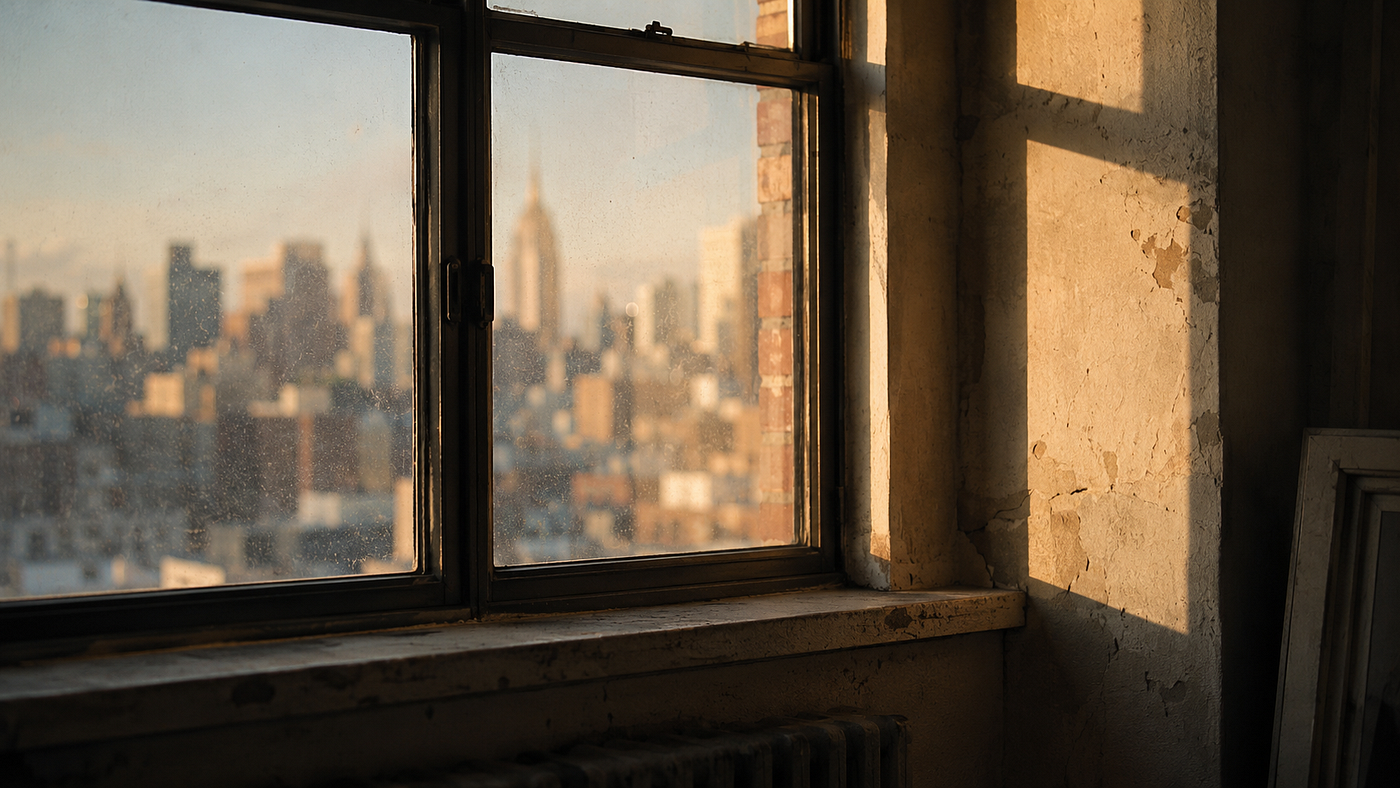
Visual by Liquid Canvas
There is a quiet power in a window that never moves. Anchored firmly into plaster and wood, it frames the exact same boundary of sky and steel every single morning. When you stand before it, you have no choice but to confront that singular, unchanging slice of the world.
Georgia O’Keeffe understood this deeply. For years, she painted the exact same view from her apartment window. We tend to assume that fixing your gaze on a single subject results in a stagnant perspective, but her work revealed the exact opposite.
As she painted, the city outside was in a constant state of flux, continuously dismantling and rebuilding its own geometry. New steel skeletons rose up and blocked old horizons. The buildings in her frame actually changed faster than she did. Because her vantage point never wavered, the obvious, everyday details faded away, leaving only the differences. By looking at the exact same coordinates day after day, her window became an instrument for measuring instability.
For most of us, however, a domestic window eventually fades into background noise. We might admire the view when we first move in, but by the second month, the eye simply stops registering the street outside.
Familiarity acts as a heavy filter. Our brains decide that nothing new is happening and quietly file the view away as known information. The physical frame stays right where it was built, yet we stop seeing what is actually there. The view becomes little more than wallpaper.
We walk right past our windows without breaking stride, assuming we already know what sits on the other side of the glass. The architectural frame of a home outlasts the attention span of the people living inside it. We are surrounded by these beautiful, permanent views that we entirely ignore. In doing so, we turn our own windows into blind spots.
A fixed frame of reference does not freeze time. In fact, it does the exact opposite. Holding one angle perfectly still might just be the only way to make slow, subtle change visible.
When we are constantly on the move, the world blurs into a generalized impression. It is only when we refuse to move that the tiny, daily alterations in light and structure become undeniable. A static frame is not a limitation; it is a highly sensitive measuring device for an environment that never truly rests.
Familiarity does not have to breed blindness. If you look at one space long enough, the illusion of stillness shatters. Often, the quietest rooms contain the most profound evidence of time passing.

Visual by Liquid Canvas
O’Keeffe anchored herself in one room and allowed the city to mutate outside her glass. She was not just documenting architecture. Instead, she was using a single rectangle to trap the passage of time.
It takes immense patience for a fixed window to reveal anything worth recording. She provided the stillness, and the environment provided the motion. Ultimately, the person who refuses to look away is the one who eventually sees everything.
You likely already have a blank rectangle commanding the attention of your room. Perhaps tonight, with **Liquid Canvas** it could offer a view worth measuring time against.
If you enjoyed this piece, you can **follow us **for more stories like this.
메타데이터
- post_id
- 733eeaee462d
- slug
- georgia-okeeffe-painted-the-same-view-from-her-window-for-years-733eeaee462d
- url
- https://medium.com/the-gravity/georgia-okeeffe-painted-the-same-view-from-her-window-for-years-733eeaee462d
- canonical_url
- https://medium.com/the-gravity/georgia-okeeffe-painted-the-same-view-from-her-window-for-years-733eeaee462d
- author_url
- https://medium.com/@jeremiah_61141
- status
- ok
- fetched_at
- 2026-07-08 19:15:55