The Hidden Engine Behind AI Shopping: Why Merchant Center Matters More Than Ever
Most merchants optimize campaigns. The next generation of eCommerce winners will optimize product knowledge. Here’s why that shift is…
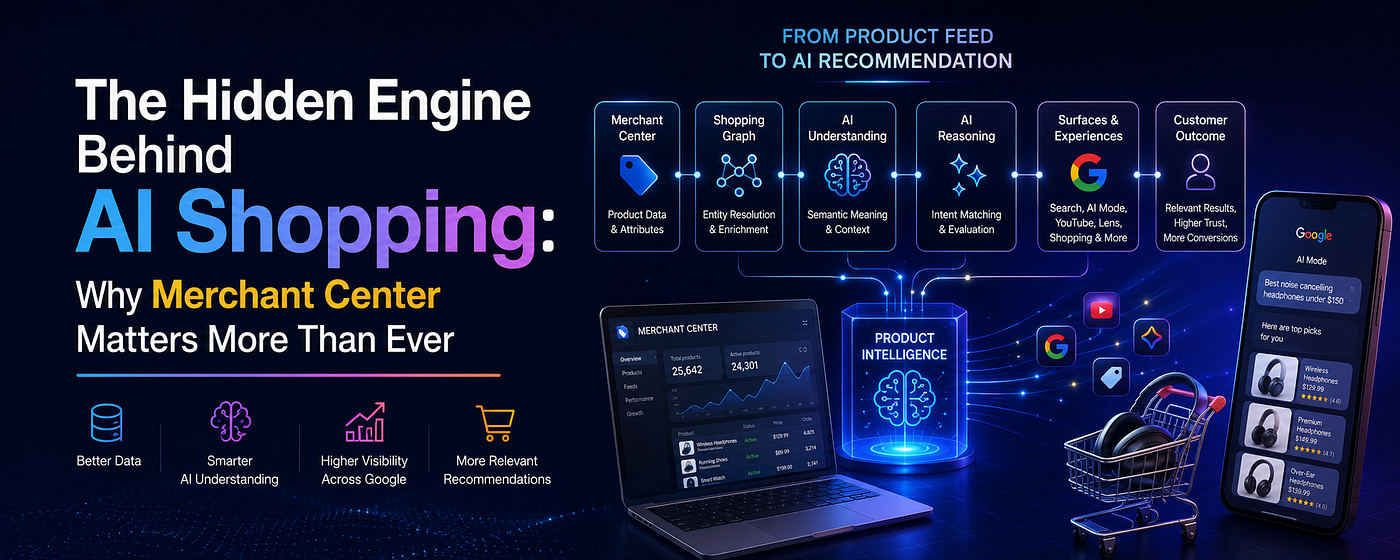
The Hidden Engine Behind AI Shopping: Why Merchant Center Matters More Than Ever
Most merchants optimize campaigns. The next generation of eCommerce winners will optimize product knowledge. Here’s why that shift is already underway.
PART I
Merchant Center Is No Longer a Product Feed. It’s Becoming Google’s Product Knowledge Layer.
“The most important platform inside Google’s commerce ecosystem isn’t Google Ads anymore. It’s the system most advertisers spend the least amount of time thinking about.”
For years, Merchant Center has had an identity problem.
Ask ten Google Ads specialists what Merchant Center is, and you’ll probably hear answers like the following:
“It’s where you upload your product feed.”
“It’s required for shopping ads.”
“It’s the thing that keeps getting feed errors.”
Technically, none of those answers are wrong.
They’re just incomplete.
Merchant Center has quietly evolved while most of the industry was busy debating campaign structures, bidding strategies, and whether Performance Max was good or bad.
Today, I think it’s becoming something much more significant.
Not another advertising tool.
Not another dashboard.
But one of the core systems Google uses to understand commerce is itself.
That might sound like an exaggeration.
So let’s work backwards.
Every AI system has one job before it can produce an answer.
Whenever people talk about artificial intelligence, the conversation usually starts with the model.
Gemini.
GPT.
Claude.
Llama.
We ask which model is smarter.
Which reason is better?
Which one writes better?
But that’s actually the second half of the problem.
The first half is much simpler.
Where does the model get its understanding from?
A large language model isn’t intelligent because it can generate words.
It’s useful because it has access to structured patterns that allow it to reason.
GitHub Copilot understands code because it has learned from billions of lines of source code.
Google Maps understands cities because it has spent years building one of the world’s richest geographic databases.
Google Photos can identify objects because its vision systems have learned patterns from enormous collections of labeled images.
The intelligence we see is built on top of structured knowledge.
Commerce works exactly the same way.
Before Google’s AI can recommend a product…
Compare two alternatives…
Summarise customer reviews…
Answer a shopping question…
Or decide which merchant should appear first…
It has to answer a much more fundamental question.
What exactly is this product?
That sounds trivial.
It isn’t.
Because the internet is remarkably bad at describing products consistently.
The Same Product Can Exist in Hundreds of Different Forms
Imagine a customer searching for a monitor.
Not a specific brand.
Just:
“27-inch 4K monitor for video editing.”
Now imagine one retailer lists their product as the following:
Monitor
Another says:
27" Display
A third writes:
Professional UHD IPS Display for Creative Work
A fourth simply copies the manufacturer’s title.
Humans can usually figure out that these listings are talking about similar products.
AI can’t make assumptions.
It needs evidence.
It needs structure.
It needs confidence.
Now multiply that problem across billions of products.
Different merchants.
Different languages.
Different currencies.
Different descriptions.
Different naming conventions.
Different image quality.
Different specifications.
Without structure, commerce becomes chaos.
And AI performs poorly in chaos.
This is why I believe Merchant Center is no longer just a feed management system.
It’s becoming Google’s mechanism for bringing order to one of the most unstructured datasets on the internet.
Product Feeds Were Built for Ads.
Product Knowledge Is Built for AI.
This distinction changes everything.
Historically, product feeds had one purpose:
Help Google decide which Shopping Ads to display.
If your feed contained a title…
A price…
An image…
And availability…
That was usually enough.
Campaign optimization carried the rest of the workload.
Today, Google’s commerce ecosystem is dramatically more complex.
The same product information may now influence experiences across:
- Google Search
- Google Shopping
- AI Mode
- Gemini
- Google Images
- YouTube Shopping
- Google Lens
- Price tracking
- Deal discovery
- Personalised recommendations
- Future AI shopping agents
Notice something interesting.
Most of those experiences aren’t advertising products.
They’re information products.
They’re recommendation systems.
They’re discovery systems.
They’re AI systems.
That changes what Google needs from merchants.
It no longer needs enough information to show an advertisement.
It needs enough information to understand a product.
Understanding is a much higher standard than matching.
Keywords Were Enough for Search.
They’re Not Enough for AI.
For almost twenty years, Google became incredibly good at understanding search intent.
But search intent is still different from product understanding.
If I searched:
“wireless headphones”
Google could match those words against billions of indexed pages.
Mission accomplished.
AI shopping introduces a harder problem.
Now the shopper asks:
“I travel every week for work and need lightweight wireless headphones with excellent noise cancellation and at least thirty hours of battery life.”
There isn’t a keyword hiding inside that query.
There are requirements.
Constraints.
Preferences.
Context.
Trade-offs.
To answer well, Google’s systems have to interpret each of those signals and compare them against structured product information.
Not marketing copy.
Not landing pages.
Product knowledge.
That means Google’s confidence depends on how well it understands each product in its catalog.
And that understanding has to begin somewhere.
Merchant Center Is Becoming That Starting Point
I don’t think Google sees Merchant Center the same way advertisers do.
Advertisers see uploads.
Google sees entities.
Advertisers see attributes.
Google sees knowledge.
Advertisers see required fields.
Google sees confidence signals.
That’s an important distinction.
Because confidence determines whether an AI system feels comfortable making a recommendation.
Imagine asking two people for advice.
The first person says:
“It’s a good laptop.”
The second says:
“It’s a 14-inch laptop with an OLED display, Intel Core Ultra processor, 32GB RAM, 1TB SSD, all-day battery life, and excellent color accuracy for designers.”
Who sounds more credible?
Not because they’re more persuasive.
Because they know more.
AI works in much the same way.
The richer the information, the stronger its confidence.
Merchant Center is increasingly where that confidence begins.
I Think We’ve Been Optimising the Wrong Layer
This was probably my biggest realization while studying Google’s recent direction.
For years, we obsessed over campaign architecture.
Should products be split by margin?
Should asset groups mirror categories?
Should campaigns be organized by brand?
Should we separate best sellers?
Those questions still matter.
But I suspect they’re becoming second-order optimizations.
The first-order optimization is no longer campaign design.
It’s information quality.
Because every optimization Google’s AI makes is constrained by the quality of the information it receives.
An AI system can only be as intelligent as the data it understands.
And that brings us to the question I think almost every merchant should be asking now:
What does Google actually learn from every field inside Merchant Center?
Because once you stop thinking about Merchant Center as a feed…
…and start thinking about it as a knowledge layer…
Every field suddenly has a much bigger purpose.
PART II
From Product Feed to Product Intelligence. How Google’s AI Probably Learns What You’re Selling
If Merchant Center is becoming Google’s Product Knowledge Layer, then every field inside it exists for a reason.
The question isn’t “Which fields are required?”
The better question is
“What is Google’s AI trying to learn?”
One of the biggest mistakes merchants make is assuming that Merchant Center is simply validating data.
Price?
Present.
Image?
Present.
Availability?
Present.
Everything looks good.
Upload complete.
That perspective made sense when Merchant Center’s primary responsibility was serving Shopping Ads.
Today, I think its role is much larger.
Instead of simply validating information, Merchant Center is helping Google’s AI construct a semantic identity for every product.
That’s an important distinction.
Because AI doesn’t understand products the way humans do.
It builds understanding from signals.
Every field contributes another piece of evidence.
Every attribute removes another layer of uncertainty.
Every completed specification increases confidence.
When enough of those signals come together, Google no longer sees a collection of fields.
It sees a product.
AI Doesn’t Read Products. It Reconstructs Them.
Imagine someone hands you a sealed cardboard box.
They don’t tell you what’s inside.
Instead, they give you clues.
Weight.
Dimensions.
Material.
Manufacturer.
Country of origin.
Warning labels.
Photographs.
Customer reviews.
Serial number.
You never actually open the box.
Yet after enough clues, you can confidently say,
“This is probably a mirrorless camera.”
Artificial intelligence works in a surprisingly similar way.
Google’s commerce systems don’t “know” a product because someone labels it perfectly.
They infer what it is by combining hundreds of signals into a coherent understanding.
That understanding is what I call “product intelligence.”
It’s the moment where disconnected data points become a meaningful product identity.
Merchant Center isn’t just collecting information.
It’s supplying the raw material that allows this reconstruction to happen.
Every Product Begins as an Entity
One mental model completely changed how I think about Merchant Center.
Most advertisers think in terms of products.
Google probably thinks in terms of entities.
An entity is simply something that exists independently and can be understood through its characteristics and relationships.
For Google, a product isn’t just text on a webpage.
It’s an entity with properties.
Consider a single pair of running shoes.
To a merchant, it’s an inventory item.
To Google’s AI, it’s something much richer.
It has:
- a brand
- a manufacturer
- a category
- a target audience
- dimensions
- colours
- materials
- sizes
- compatibility
- intended activities
- reviews
- pricing history
- inventory status
- relationships with similar products
- relationships with accessories
- relationships with previous models
Suddenly, we’re no longer describing a product.
We’re describing a network of knowledge.
That’s a completely different architecture.
Product Titles: The First Layer of Semantic Identity
Most merchants treat product titles as SEO.
I think Google increasingly treats them as semantics.
Let’s compare two titles.
Example One
Office Chair
Now another.
Ergonomic Mesh Office Chair with Adjustable Lumbar Support, Headrest & 4D Armrests — Black
Humans immediately see why the second title is better.
What’s more interesting is what AI learns from it.
Without opening the product page, Google’s systems can already infer:
- Product category
- Furniture type
- Ergonomic intent
- Primary material
- Colour
- Adjustable features
- Workplace use case
- Premium positioning
That’s far more than a title.
It’s compressed knowledge.
Every meaningful word reduces ambiguity.
Every unnecessary word increases it.
This is why I think semantic clarity will eventually outperform keyword stuffing.
Keywords help search engines match.
Semantics help AI understand.
Those are no longer the same problem.
GTIN: The Internet’s Product Passport
If there’s one Merchant Center field that’s consistently underestimated, it’s the GTIN.
Many merchants see it as another identifier.
Google likely sees it as something far more powerful.
A universal reference point.
Imagine hundreds of retailers all selling the exact same coffee machine.
Every store writes different descriptions.
Uses different titles.
Uploads different images.
Offers different prices.
Collects different reviews.
Without a shared identity, Google would have to treat each listing as unrelated.
GTIN solves that problem.
It tells Google’s systems,
“These listings all represent the same underlying product.”
That unlocks something remarkable.
Instead of understanding a product through one merchant, Google can learn from the entire ecosystem.
Price history.
Popularity.
Availability.
Merchant coverage.
Customer reviews.
Regional demand.
Competitive pricing.
Historical performance.
One identifier connects hundreds of independent data sources into a single product entity.
That’s not an advertising feature.
That’s knowledge architecture.
Categories Create Hierarchies
Intelligence depends on organization.
Imagine walking into the world’s largest warehouse.
Nothing is labelled.
Nothing is categorized.
Everything sits randomly on shelves.
Finding one product would be nearly impossible.
Now imagine the same warehouse organized into departments.
Electronics.
Computers.
Laptops.
Gaming laptops.
16-inch laptops.
RTX-powered laptops.
Immediately, search becomes easier.
Recommendations become easier.
Relationships become obvious.
Categories don’t just organize products.
They organize understanding.
When merchants accurately categorize products, they’re helping Google’s AI build a hierarchy of meaning.
Hierarchy is what allows systems to answer questions like the following:
“Show me alternatives.”
“Recommend similar products.”
“Compare products in the same category.”
Without hierarchy, comparison becomes guesswork.
Attributes Remove Uncertainty
One sentence kept coming back to me while reading Google’s documentation.
AI hates ambiguity.
Every missing attribute creates another unanswered question.
Let’s imagine two identical products.
Product A
Colour: Missing
Material: Missing
Gender: Missing
Age Group: Missing
Pattern: Missing
Energy Rating: Missing
GTIN: Missing
Product B
Every relevant attribute completed accurately.
Which product would you trust more if you were Google’s recommendation engine?
Not because it’s better.
Because it’s understood.
Every completed attribute removes uncertainty.
Color tells AI what visual variants exist.
Material hints at durability, comfort, sustainability, and quality.
Size prevents mismatched recommendations.
Energy ratings help answer efficiency-related questions.
Compatibility attributes connect products with ecosystems.
One field may seem insignificant.
Hundreds of fields collectively become intelligence.
Images Are No Longer Just Marketing Assets
For years, product images had one audience.
Humans.
That’s changing.
Modern AI systems don’t simply display images.
They analyze them.
Google Lens already identifies products visually.
Gemini understands visual context.
Vision-language models interpret relationships between text and imagery.
That means your primary product image isn’t just influencing click-through rates.
It’s becoming another source of understanding.
A clean image communicates shape.
Material.
Color.
Packaging.
Brand placement.
Visual hierarchy.
Lifestyle images communicate context.
Who uses the product?
Where?
How?
Under what conditions?
Images are evolving from creative assets into structured visual signals.
That’s a subtle but important shift.
Merchant Center Isn’t Collecting Data. It’s reducing uncertainty.
That’s probably the simplest way I can describe what I think is happening.
Every field inside Merchant Center exists for one purpose.
Reduce uncertainty.
The less uncertainty Google’s AI has…
The more confidently it can do the following:
Recommend.
Compare.
Rank.
Summarise.
Answer.
And eventually…
Purchase on behalf of users.
That’s why I no longer think of Merchant Center as a feed management platform.
I think of it as Google’s Commerce Knowledge Architecture.
It’s the system responsible for transforming scattered merchant data into structured product intelligence.
And once you start looking at it through that lens…
Every field suddenly feels much more important than “Required” or “Optional.”
It becomes another lesson you’re teaching Google’s AI about what your product really is.
PART III
Following a Product Through Google’s AI Commerce Architecture
From a spreadsheet in Merchant Center to an AI recommendation shown to millions of shoppers.
In the first two parts of this article, we’ve established two ideas.
The first is that Merchant Center is evolving beyond a simple feed management tool into what I call Google’s Product Knowledge Layer.
The second is that every field inside Merchant Center contributes to something much larger than campaign eligibility.
Together, they create product intelligence—a structured understanding of what a product is, who it’s for, and how confidently Google’s AI can reason about it.
But that naturally leads to another question.
Once you upload your product data… what actually happens next?
Google has never published a single diagram explaining the complete journey.
Instead, pieces of the puzzle are scattered across Merchant Center documentation, the Shopping Graph, AI Shopping, Gemini, AI Mode, Google Lens, and Performance Max announcements.
Viewed individually, each document explains one product.
Viewed together, they reveal something much bigger.
Not an advertising platform.
A commerce intelligence platform.
The following framework is my attempt to connect those pieces into one coherent architecture.
It’s not an official Google diagram.
It’s a conceptual model built from publicly available information — and I think it helps explain why Merchant Center has become so strategically important.
Stage 1 — Data Ingestion
Everything begins with a merchant.
Whether you’re a global retailer with millions of SKUs or a small Shopify store with fifty products, the journey starts the same way.
You publish information about what you sell.
That information may arrive through:
- A scheduled product feed
- Content API
- Automatic website crawling
- E-commerce platform integrations
- Supplemental feeds
- Merchant Center updates
At this stage, Google isn’t deciding where your products should appear.
It’s simply collecting facts.
Think of this as the raw ingestion layer.
Just like a data warehouse accepts information before it becomes useful, Merchant Center accepts raw product data before it becomes product intelligence.
Stage 2 — Validation
The second stage is the one most advertisers already know.
Merchant Center validates the incoming information.
Are required attributes present?
Is the GTIN valid?
Does the landing page match the submitted price?
Is availability accurate?
Are images accessible?
Does the product comply with Google’s policies?
Most merchants stop thinking here.
Validation feels administrative.
But validation serves a much deeper purpose.
AI systems can’t build reliable conclusions from unreliable information.
If Google’s AI recommends a product with an outdated price, an incorrect image, or the wrong availability, user trust breaks immediately.
Validation isn’t about enforcing rules.
It’s about protecting confidence.
Confidence is the currency of every recommendation system.
Stage 3 — Entity Resolution
This is where things become much more interesting.
Imagine thousands of merchants selling the exact same Sony camera.
Every merchant writes different titles.
Different descriptions.
Different product pages.
Different specifications.
Some include technical details.
Others barely describe the product.
Yet shoppers expect Google to recognize they’re looking at the same camera.
That requires entity resolution.
Instead of treating every listing as unique, Google’s systems attempt to determine whether multiple listings represent the same underlying product entity.
Signals like GTINs, MPNs, brand information, manufacturer data, and other identifiers help resolve those relationships.
Once that happens, Google no longer sees isolated listings.
It sees a shared product.
That’s incredibly powerful.
Because now knowledge can accumulate around the product itself—not just around an individual merchant.
Stage 4 — Enrichment
Raw merchant data is valuable.
Enriched data is far more useful.
Once products are validated and connected to known entities, Google can augment that information with additional context gathered across its ecosystem.
This might include:
- Historical pricing patterns
- Availability trends
- Aggregated review signals
- Merchant reputation
- Product popularity
- Image understanding
- Visual classifications
- Category relationships
- Brand associations
Notice what’s happening.
The merchant is no longer the only source of truth.
The product is becoming part of a broader knowledge network.
That dramatically improves Google’s ability to answer complex shopping questions.
Stage 5 — The Shopping Graph
Earlier in this series, I described the Shopping Graph as Google’s structured understanding of commerce.
Now we can see why.
The Shopping Graph isn’t simply storing products.
It’s storing relationships.
Relationships between:
Products.
Brands.
Categories.
Merchants.
Variants.
Accessories.
Reviews.
Pricing.
Availability.
Customer behavior.
Knowledge graphs become valuable because they connect information that would otherwise remain isolated.
A laptop isn’t just linked to its specifications.
It’s linked to compatible accessories.
Previous generations.
Replacement chargers.
Protective cases.
Competing models.
Neighboring price ranges.
Alternative brands.
That network enables reasoning.
Instead of asking,
“What is this product?”
Google can begin answering,
“How does this product relate to everything else?”
Stage 6 — Semantic Understanding
At this point, Google’s AI has something much richer than a spreadsheet.
It has context.
Modern AI systems don’t rely solely on exact words.
They create mathematical representations of meaning—often referred to as semantic embeddings.
Without diving into the mathematics, think of an embedding as a way of placing products into a conceptual space based on what they are, what they do, and how they relate to other products.
Two products may never share identical titles.
Yet they can still be recognized as highly similar because their underlying meaning overlaps.
That’s why conversational shopping works.
When someone asks:
“I need a lightweight waterproof backpack for weekend hiking.”
Google doesn’t need an exact keyword match.
It can search for products that occupy the same semantic neighborhood.
That’s a profound shift from traditional keyword retrieval.
Stage 7 — Distribution Across Google’s Ecosystem
Only after these earlier stages does advertising enter the picture.
This is another reason I believe many marketers focus on the wrong layer.
Performance Max isn’t the beginning of the process.
It’s one consumer of product intelligence.
The same structured understanding can now flow into:
- Google Search
- Shopping results
- AI Mode
- Gemini
- Google Lens
- YouTube Shopping
- Image Search
- Performance Max campaigns
- Personalised recommendations
- Future shopping assistants
The important insight is this:
These experiences aren’t each building their own understanding of your product.
They’re drawing from a common foundation.
Improve the foundation, and multiple surfaces benefit.
Stage 8 — Continuous Learning
Most people imagine product data as static.
Upload.
Approve.
Advertise.
In reality, commerce is constantly changing.
Prices fluctuate.
Inventory changes.
New reviews arrive.
Images are updated.
Specifications evolve.
Seasonal demand shifts.
Merchant performance changes.
Google’s commerce systems are continuously refreshing that understanding.
Every new signal helps refine product intelligence.
That’s why Merchant Center should never be treated as a one-time setup task.
It’s an ongoing knowledge maintenance system.
Seeing the Architecture Changes the Strategy
This entire framework changed how I think about optimization.
For years, I assumed Google Ads was the center of Google’s commerce ecosystem.
Now I think it’s one layer within a much larger architecture.
Merchant Center supplies knowledge.
The Shopping Graph connects relationships.
AI models interpret meaning.
Performance Max distributes intelligently.
Gemini explains.
AI Mode recommends.
Shopping surfaces compare.
The better the underlying product intelligence becomes, the better every downstream system can perform.
That’s why I believe the most valuable optimization isn’t always the one inside a campaign.
Sometimes it’s the information you provide long before an auction even begins.
The Shift From Campaign Thinking to System Thinking
Perhaps the biggest mindset shift is this:
Most advertisers optimize campaigns.
Google is optimizing systems.
Campaigns are one output of those systems.
Merchant Center, the Shopping Graph, semantic understanding, and AI recommendations are all connected through a shared flow of information.
When you see that architecture, Merchant Center stops looking like an upload tool.
It starts looking like the entry point into Google’s AI commerce engine.
And that changes how you prioritize your work.
PART IV
Designing Products for AI Confidence
Why the future of optimization isn’t about feeding Google’s algorithms. It’s about removing uncertainty.
At this point in the article, we’ve followed a product through Google’s commerce architecture.
We’ve seen how Merchant Center contributes structured information.
We’ve explored how entities become part of the Shopping Graph.
We’ve looked at how AI systems can transform individual fields into product intelligence.
But there’s one question we haven’t answered.
Perhaps it’s the most practical one of all.
What actually makes Google’s AI confident enough to recommend one product over another?
I don’t think the answer is any single field.
It’s the cumulative reduction of uncertainty.
The more uncertainty surrounding a product, the more difficult it becomes for AI to make strong recommendations.
The more uncertainty we remove, the easier those recommendations become.
That’s why I believe the future of feed optimization isn’t really about feeds.
It’s about designing products for AI confidence.
Every missing detail creates friction.
Imagine walking into a physical store.
You pick up two backpacks.
The first has no label.
No specifications.
No material information.
No capacity.
No warranty.
No price.
No reviews.
The salesperson shrugs and says,
“It’s probably good.”
Next to it is another backpack.
The label explains everything.
Capacity.
Materials.
Weight.
Laptop compatibility.
Weather resistance.
Airline carry-on compliance.
Warranty.
Customer reviews.
Care instructions.
Use cases.
Which one feels easier to buy?
Nothing about the second backpack changed physically.
Only the information surrounding it changed.
Confidence changed.
Digital commerce works exactly the same way.
Except the first customer isn’t a human.
It’s Google’s AI.
Semantic Clarity Beats Keyword Density
For years, marketers were taught to think in keywords.
Repeat important phrases.
Match search terms.
Include high-volume queries.
That strategy made sense when search engines relied heavily on lexical matching.
AI operates differently.
It tries to understand meaning.
Consider these two titles.
Title A
Running Shoes Men’s Black
Title B
Nike Pegasus 42 Men’s Road Running Shoes — Lightweight Daily Trainer with ReactX Foam — Black
The difference isn’t keyword density.
It’s semantic richness.
The second title tells a story.
Without reading the product description, Google’s systems already understand:
Brand.
Model.
Generation.
Target audience.
Primary activity.
Color.
Running category.
Technology.
Positioning.
The title becomes compressed knowledge.
That’s a very different optimization philosophy.
Instead of asking,
“Which keywords should I include?”
Start asking,
“If an AI had only this title, how much could it understand?”
Attributes Are Answers Waiting for questions.
This is probably the biggest mindset shift I want merchants to make.
Every attribute inside Merchant Center is an answer to a question that hasn’t been asked yet.
Color answers:
“Do you have this in blue?”
Material answers:
“Is it leather?”
Battery life answers:
“Will it last all day?”
Compatibility answers:
“Will this work with my iPhone?”
Energy rating answers:
“Is it energy efficient?”
Water resistance answers:
“Can I use this outdoors?”
AI shopping is fundamentally conversational.
That means Google doesn’t know which question a shopper will ask next.
The only way to prepare is by giving the system as many truthful answers as possible before the conversation even begins.
Attributes aren’t metadata.
They’re pre-written answers.
Images Are Becoming a Second Product Language
One idea keeps coming back as multimodal AI improves.
Images no longer illustrate products.
They describe them.
Think about how people shop today.
A customer uploads a photo into Google Lens.
They circle a jacket in AI mode.
They ask Gemini,
“Find something similar in olive green.”
Suddenly, images become searchable information.
AI begins recognizing:
Silhouettes.
Textures.
Patterns.
Materials.
Logos.
Colors.
Design language.
Packaging.
Visual context.
A clean white-background image still matters.
But so does a lifestyle image that shows the product being used.
One communicates what the product looks like.
The other communicates why someone might want it.
Together, they tell a much richer story.
Reviews Teach AI What Specifications Cannot
Manufacturers describe products from the inside out.
Customers describe them from the outside in.
That’s an important difference.
A specification sheet might tell us a pair of hiking boots uses a waterproof membrane.
Reviews tell us those boots stayed dry after six hours of walking through heavy rain in the Scottish Highlands.
The specification explains the feature.
The customer explains the outcome.
That’s the kind of information AI finds incredibly valuable.
Not because it’s promotional.
Because it’s experiential.
Thousands of authentic reviews become a distributed knowledge base describing how products perform in the real world.
In many ways, customers are continuously enriching your product long after you’ve published it.
Consistency Builds Trust
One theme appears repeatedly across Google’s commerce documentation.
Consistency.
Prices should match.
Availability should be accurate.
Shipping information should reflect reality.
Landing pages should align with submitted data.
Many merchants treat these as compliance requirements.
I think they’re trust signals.
Imagine asking an AI for the best deal on a product.
It recommends a merchant.
You click.
The price has changed.
The item is out of stock.
The shipping estimate is wrong.
Your trust disappears instantly.
Now imagine that happening millions of times.
Consistency isn’t just operational excellence.
It’s how Google protects confidence in its recommendations.
The Goal Isn’t More Data
It’s better knowledge.
A common misconception is that AI simply wants more information.
I don’t think that’s true.
AI wants useful information.
Accurate information.
Connected information.
Structured information.
Information that reduces uncertainty instead of increasing noise.
A product with fifty meaningless attributes isn’t necessarily easier to understand than one with fifteen excellent ones.
Quality matters more than quantity.
Clarity matters more than complexity.
Truth matters more than optimization.
That principle should guide every Merchant Center decision.
Designing for AI Confidence
If I were auditing an e-commerce catalog today, I wouldn’t start with campaigns.
I’d start by asking a different set of questions.
Could an AI confidently explain this product to someone who has never seen it?
Could it compare this product against three competitors?
Could it recommend it for a specific use case?
Could it answer detailed follow-up questions without inventing missing information?
Could it recognize this product visually?
Could it identify compatible accessories?
Could it summarize what customers genuinely like and dislike?
If the answer to those questions is “no,” then the opportunity probably isn’t inside Google Ads.
It’s inside the product itself.
A New Way to Think About Optimisation
This is perhaps the biggest idea I’ve taken away from studying Google’s recent direction.
For years, optimization meant manipulating campaigns.
Tomorrow, optimization will increasingly mean improving understanding.
Not tricking algorithms.
Teaching them.
Every better title.
Every completed attribute.
Every accurate GTIN.
Every authentic review.
Every high-quality image.
Every inventory update.
Every structured specification.
They’re all doing the same thing.
They’re increasing AI confidence.
And I suspect that confidence will become one of the defining competitive advantages in AI-driven commerce over the next decade.
PART V
Beyond Merchant Center
The Future of AI Commerce Isn’t About Better Ads. It’s About Better Knowledge.
At the beginning of this article, I made a statement that probably sounded exaggerated.
Merchant Center is no longer just a product feed.
By now, I hope that statement feels much less controversial.
Because throughout this article we’ve followed a product through Google’s commerce ecosystem.
We’ve seen how raw merchant data becomes structured information.
How structured information becomes product intelligence.
How product intelligence flows through what I described as Google’s AI commerce architecture.
And ultimately, how that intelligence powers experiences across Search, Shopping, Gemini, AI Mode, Performance Max, Google Lens, YouTube, and beyond.
The more I studied Google’s recent direction, the more I realized something.
Merchant Center isn’t becoming more important because Google wants better feeds.
It’s becoming more important because AI requires better knowledge.
Those are two very different goals.
Every major shift in search changed what we optimized.
If you look back over the last twenty-five years, every major evolution of Google changed what businesses needed to optimize.
In the early days of Search, success was largely about discoverability.
Could Google find your page?
Then came relevance.
Content quality.
Authority.
Backlinks.
Technical SEO.
Structured data.
Mobile usability.
Core Web Vitals.
Each wave required websites to become more understandable — not just to people, but to machines.
Commerce is following a remarkably similar path.
The difference is that the unit of optimization is no longer the webpage.
It’s the product.
That shift sounds subtle.
I don’t think it is.
It’s a completely different optimization problem.
The Customer Is No Longer the First Reader
This might be the single biggest mental shift merchants need to make.
For years, product pages were written primarily for people.
Humans were the first audience.
Search engines indexed those pages afterwards.
In AI commerce, that order begins to change.
Before a shopper ever sees your product, an AI system may have already:
Interpreted it.
Categorized it.
Compared it.
Summarized it.
Ranked it.
Recommended it.
Or decided not to show it at all.
That means the first “reader” of your product is increasingly an AI system.
Humans still make the purchase.
But AI increasingly influences what reaches them.
That’s why I believe product information is becoming infrastructure rather than marketing copy.
The Next Competitive Advantage Won’t Be Hidden Inside Google Ads
For years, agencies competed on campaign expertise.
Who could build the cleanest account structure?
Who understood bidding strategies best?
Who knew every advanced setting?
Those skills remain valuable.
But platforms continue to automate them.
Performance Max didn’t eliminate strategy.
It shifted where strategy creates value.
As automation expands, differentiation moves upstream.
Toward information quality.
Toward first-party data.
Toward creative assets.
Toward customer understanding.
Toward Product Intelligence.
In other words…
The competitive advantage doesn’t disappear.
It relocates.
Merchant Center May Become Something Much Bigger
This next section is intentionally forward-looking.
Google hasn’t announced this roadmap.
But if the direction of travel remains consistent, I think Merchant Center will evolve beyond today’s concept of a product feed.
Imagine a future where every product includes:
Detailed specifications.
Installation guides.
Owner’s manuals.
Compatibility databases.
Maintenance instructions.
Warranty information.
Sustainability certifications.
Assembly videos.
3D models.
AR assets.
Usage tutorials.
Safety documentation.
Community questions and answers.
Verified repair information.
Customer-generated experiences.
Not because merchants enjoy uploading more content.
But because AI benefits from richer context.
The more knowledge surrounding a product, the more useful AI becomes.
Merchant Center starts looking less like a feed management interface…
…and more like a product knowledge platform.
That future doesn’t feel unrealistic anymore.
It feels like a logical extension of where Google is already heading.
Commerce Is Becoming a Knowledge Problem
One idea kept resurfacing while writing this article.
For years, we treated eCommerce as a marketing challenge.
How do we acquire traffic?
Improve conversion rates?
Lower acquisition costs?
Increase return on ad spend?
Those questions remain important.
But AI introduces another layer.
Knowledge.
Can AI understand what we sell?
Can it distinguish our product from competing alternatives?
Can it explain why someone should buy it?
Can it answer detailed questions accurately?
Can it compare models?
Can it recognize compatible accessories?
Can it reason about the product with confidence?
Those aren’t advertising questions.
They’re knowledge questions.
And increasingly, I think they’ll influence commercial success.
A New Responsibility for Merchants
If AI becomes the first interpreter of our catalogues, then our responsibility changes.
Our job is no longer limited to describing products attractively.
We also need to describe them accurately.
Clearly.
Structurally.
Truthfully.
Every title should reduce ambiguity.
Every attribute should answer a potential question.
Every image should add understanding.
Every review should contribute an authentic experience.
Every specification should increase confidence.
In other words…
We’re no longer just creating product listings.
We’re publishing knowledge.
The Four Layers of AI Commerce
Throughout this article, I’ve introduced several concepts that helped me connect Google’s recent announcements into one mental model.
Rather than seeing Merchant Center, the Shopping Graph, Gemini, AI Mode, and Performance Max as separate products, I think they’re easier to understand as four connected layers.
Layer 1 — Knowledge
Merchant Center collects structured information about products.
This is where product intelligence begins.
Layer 2 — Understanding
The Shopping Graph, entity resolution, semantic relationships, and multimodal analysis transform raw data into meaningful understanding.
This is where products become entities rather than listings.
Layer 3 — Reasoning
Gemini, AI Mode, conversational shopping, and recommendation systems interpret shopper intent and compare products using the knowledge built in the earlier layers.
This is where understanding becomes decisions.
Layer 4 — Execution
Performance Max, Google Shopping, Search, YouTube, Lens, and future commerce experiences deliver those decisions to real people.
This is the layer marketers see most often.
Ironically, it’s also the layer where they have the least direct control.
Because the quality of execution increasingly depends on the quality of everything beneath it.
Looking Ahead
The article you just read isn’t a prediction that campaign management disappears.
Nor is it a claim that Merchant Center replaces Google Ads.
Campaigns will continue to matter.
Creativity will continue to matter.
Measurement will continue to matter.
What I am suggesting is something more fundamental.
The center of gravity is shifting.
As Google’s systems become more autonomous, the platform needs less instruction about where to advertise and more understanding about what it is advertising.
That changes the role of merchants.
It changes the role of agencies.
And ultimately, it changes the role of marketers.
The question we’re moving toward is no longer
“How do I structure my campaigns?”
It’s becoming:
“Can Google’s AI truly understand my products?”
I think that’s the question that will define the next generation of commerce.
And the businesses that answer it first won’t simply run better campaigns.
They’ll build better knowledge.
Final Thoughts
When I started researching Google’s recent announcements, I expected to find new campaign features.
Instead, I found something much more interesting.
A consistent architectural direction.
Merchant Center.
Shopping Graph.
AI Mode.
Gemini.
Performance Max.
Google Lens.
Conversational Shopping.
Viewed separately, they’re product updates.
Viewed together, they suggest something much bigger.
Google is steadily building an AI-native commerce ecosystem where products are no longer just advertised.
They’re understood.
That understanding doesn’t begin inside an ad account.
It begins with the knowledge we publish.
And if that’s true, then perhaps the future of eCommerce won’t be won by the brands with the most sophisticated campaigns.
It will be won by the brands that make themselves the easiest for AI to understand, trust, and recommend.
메타데이터
- post_id
- 734cea10745e
- slug
- the-hidden-engine-behind-ai-shopping-why-merchant-center-matters-more-than-ever-734cea10745e
- url
- https://medium.com/startup-insider-edge/the-hidden-engine-behind-ai-shopping-why-merchant-center-matters-more-than-ever-734cea10745e
- canonical_url
- https://medium.com/startup-insider-edge/the-hidden-engine-behind-ai-shopping-why-merchant-center-matters-more-than-ever-734cea10745e
- author_url
- https://medium.com/@iamdushyant
- status
- ok
- fetched_at
- 2026-07-16 22:04:15