Dreezle Draw! Returns
It’s a testament to the serendipity of forward-thinking software engineering and…sorry to tell you…AI. Claude Opus 4.6, to be precise.
Dreezle Draw! Returns
It’s a testament to the serendipity of forward-thinking software engineering and…sorry to tell you…AI. Claude Opus 4.6, to be precise.
Way back in late ’97 (yah last century) I was scrounging around in my brain for a new idea. Something on the web. Something graphical. VRML had happened (and VRML 97) but my own work in that area, creating the first VRML plug-in for the Mac using QuickDraw 3D (with my buddy John Louch), was coming to a close. I wanted to demo my Java chops and work on something fun, on my own, to keep my brain entertained while my day job kind of sucked the life out of me (tell me you haven’t been there). At that time, my son frequently used a very popular children’s painting program. The idea solidified: current technology, specifically a Java Applet, might have the processing capability needed to do raster math fast enough to do a kind of painting that could keep up with mouse event processing. Inside a browser. On any personal computer. Research that. Can it be done?
This idea was exciting to me and would challenge me to learn a lot of new things. Pen replication. Raster techniques for lines, for circles. Interpolating the pen movements. After a lot of experimentation and nights curling up with “Foley, van Dam” I figured it out. And I figured out that I could do it all fast enough to blend colors using bitwise operations on the ARGB image data backing the canvas. Inside a browser. On any personal computer. The color blending and the line, circle and stamp features were going to make the program stand out.
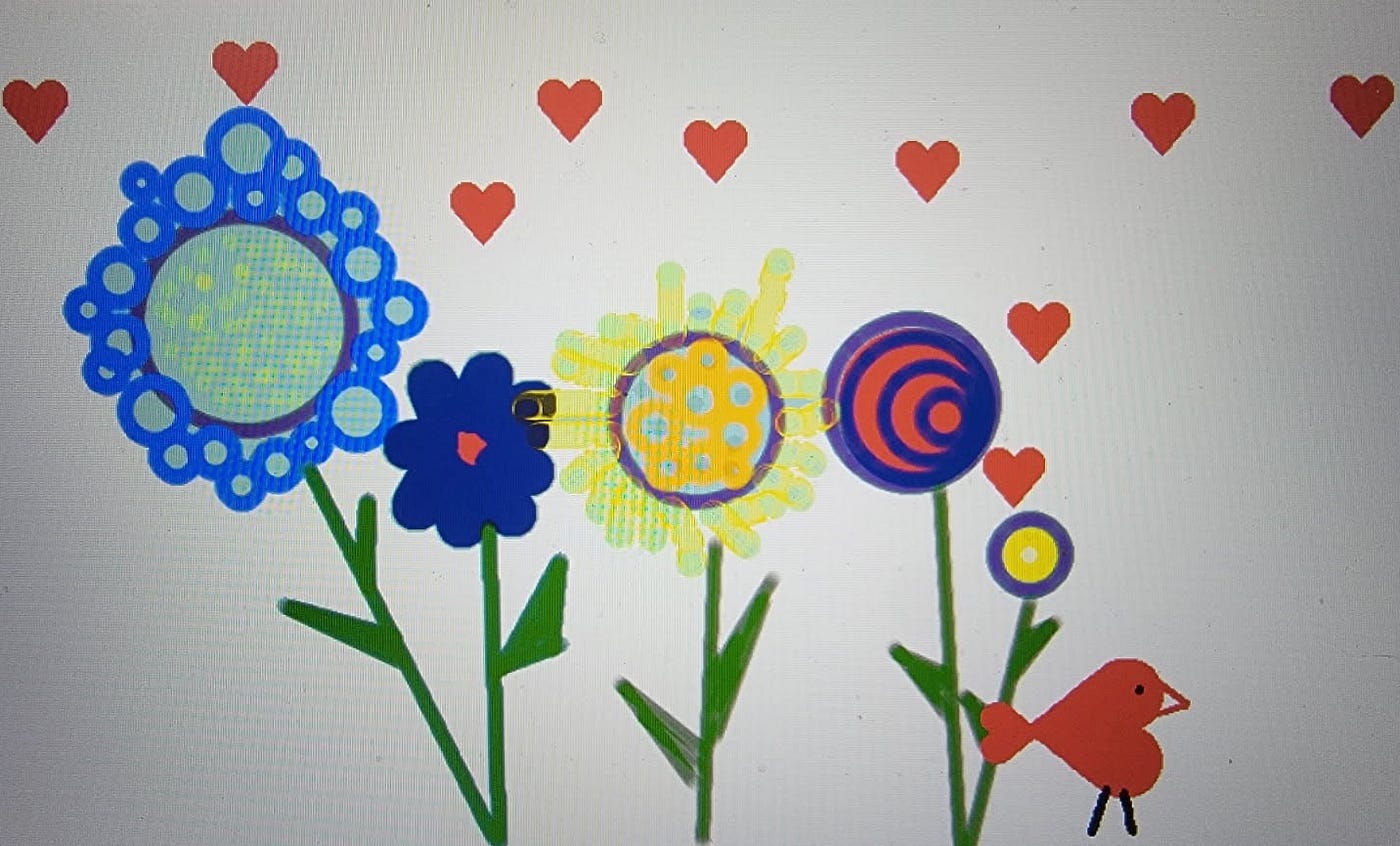
There were a lot of late nights (like I said, there was a day job, right?) with IBM Visual Age for Java as I figured out how I wanted to design and architect around tools, toolbars, options, layout, GUIBundles (ugh) as a factory pattern for UI layouts (wasn’t that supposed to be for localization? sure…but…look!).
Long story shorter. Dreezle Draw! was on the web in 2000. The name “Dreezle” was created by my late wife, Cindy Schaub, who said, “Drawing…Easel…Dreezle.” Later on I forgot that she invented the name, not me. Don’t worry she corrected me.
Most interesting to me was that the program was very popular in South Korea! I remember reading a Harvard Business Review article that proclaimed, “all markets are local.” I would add to that: and you don’t know what they are, so write the thing and be open to finding out where your market is! From my point of view, Dreezle Draw! was a significant success. I ran Google ads on it and made a little money. It didn’t last.
Why not? What happened? Somebody or somebodies killed Java in the browser. Why would they do such a thing? Control, I figure. There are always other arguments because we like to hide behind arguments. But if a browser is enabling an execution environment on your platform, and you’re a company like Apple, or a company like Microsoft and you see that the browser will become the most important execution environment on your platform and you think you own your platform and you think you need to own that execution environment…you’re probably gonna do what you’re gonna do and get away with it. You’ll find all sorts of reasons to explain why that is best. Dreezle Draw! was just collateral damage. Goodness knows what else was lost in the intentional destruction of Applets. And Flash. Sad. Long live Homestar Runner!
So I was discouraged, needless to say. And over intervening years I’ve looked at various ways to revive that code (Java to Javascript conversion mechanisms) and get the website to host Dreezle Draw! “modern browser-native”. These techniques all failed because the drawing code is very low level and the UI was built with AWT. But, like I said, I’ve got a day job. And…was doing other things in my copious spare time.
I’d done enough work with Canvas element in Javascript (particularly game-related stuff with my buddy Manu Jain) to know that browser technology and the platforms they run on became fast enough for drawing programs. But I was daunted by the immense task of converting the Java code and the raster techniques of Dreezle Draw! AI was on the horizon, however, and I hoped for a solution to come from our LLM friends. A number of times over the past two years I’ve tried using AI tools to convert the code. Those times failed miserably. The most recent (and, sorry, humorous) failure was Claude Opus 4.5 exclaiming “all successfully converted, check out the web page and draw on the canvas” and, of course, nada. But it’s important not to get discouraged. Especially if you are in it for the long haul. Kudos to Anthropic for the long haul because…
…the world changed February 2026. I’d seen a post by Nate B. Jones talking about the latest Claude Opus 4.6 release. He mentioned a context window that was far larger than the previous release — a context window of many thousands of lines of code. When I heard that, I thought: that is finally enough for Opus 4.6 to keep all of the Java code of Dreezle Draw! in its head. It was time to try again.
Long short again. I pointed Claude Cowork at the Java code. I explained what it all did. We had a conversation about what kinds of things needed to be done to successfully convert it. We talked about what images meant, what toolbars were. We talked about having a unique color mixer palette. We talked about the idea of manipulating image data in a format native to the display (interestingly, the HTML Canvas element image, when represented as integers, is ABGR (huh? okay…) and, interestingly, the bit-wise manipulation code could be easily converted to keep the pixel manipulation at the lowest — and fastest — level…a win for fluid freehand drawing).
Then I said, go do it. After a bit of work it said, ok, it’s done. And it was all working far better than I had any right to expect. Of course there were still days worth of work to do — but only days. Not months. Not years.

I consulted Claude Cowork for how to set up a Claude Code project for continued development. I simply asked it to create the markdown file to tell the Claude Code project what to do. And another project for deployment (an NGINX front end on a Digital Ocean Droplet). All dutifully done. So now I’ve got an ongoing conversation that oversees the work (and we talk about the business plan) and two Claude Code projects for the application development and the deployment.
Dreezle Draw! has returned to dreezle.com after many, many years. Ready and at your service to doodle, draw and have fun. No tracking. COPPA compliant. Free painting tools for kids. A real history. Frankly, a labor of love. Share it with your kids and your friends.
메타데이터
- post_id
- 734e08cc1acb
- slug
- dreezle-draw-returns-734e08cc1acb
- url
- https://medium.com/@bill_10274/dreezle-draw-returns-734e08cc1acb
- canonical_url
- https://medium.com/@bill_10274/dreezle-draw-returns-734e08cc1acb
- author_url
- https://medium.com/@bill_10274
- status
- ok
- fetched_at
- 2026-06-09 15:37:30