The Road to Snack Supremacy: How Herman Lay Turned a Traveling Side Hustle into a Global Food…
Herman Lay’s journey, beginning from a quiet middle-class background and culminating in the formation of one of history’s most dominant…
The Road to Snack Supremacy: How Herman Lay Turned a Traveling Side Hustle into a Global Food Behemoth
The Entrepreneurial Genesis of Lay’s Chips and Frito-Lay
Herman Lay’s journey, beginning from a quiet middle-class background and culminating in the formation of one of history’s most dominant food companies, Lay’s chips, serves as a testament to entrepreneurial instinct and strategic business merging. Lay, born in Charlotte, North Carolina in 1909, showed an aptitude for sales early on, successfully operating a soda stand and even hiring employees. Despite having a fully funded athletic scholarship, Lay dropped out of college, favouring involvement in the world of business over study.
The Great Depression and the Rise of the Traveling Salesman
Lay’s initial foray into the food industry was with Sunshine Biscuits, a company manufacturing cookies, crackers, and cereal. However, the Great Depression struck in 1929 when Lay was just 20, leading to him being suddenly out of a job. This experience was crucial, teaching him the importance of diversifying income and building independence.
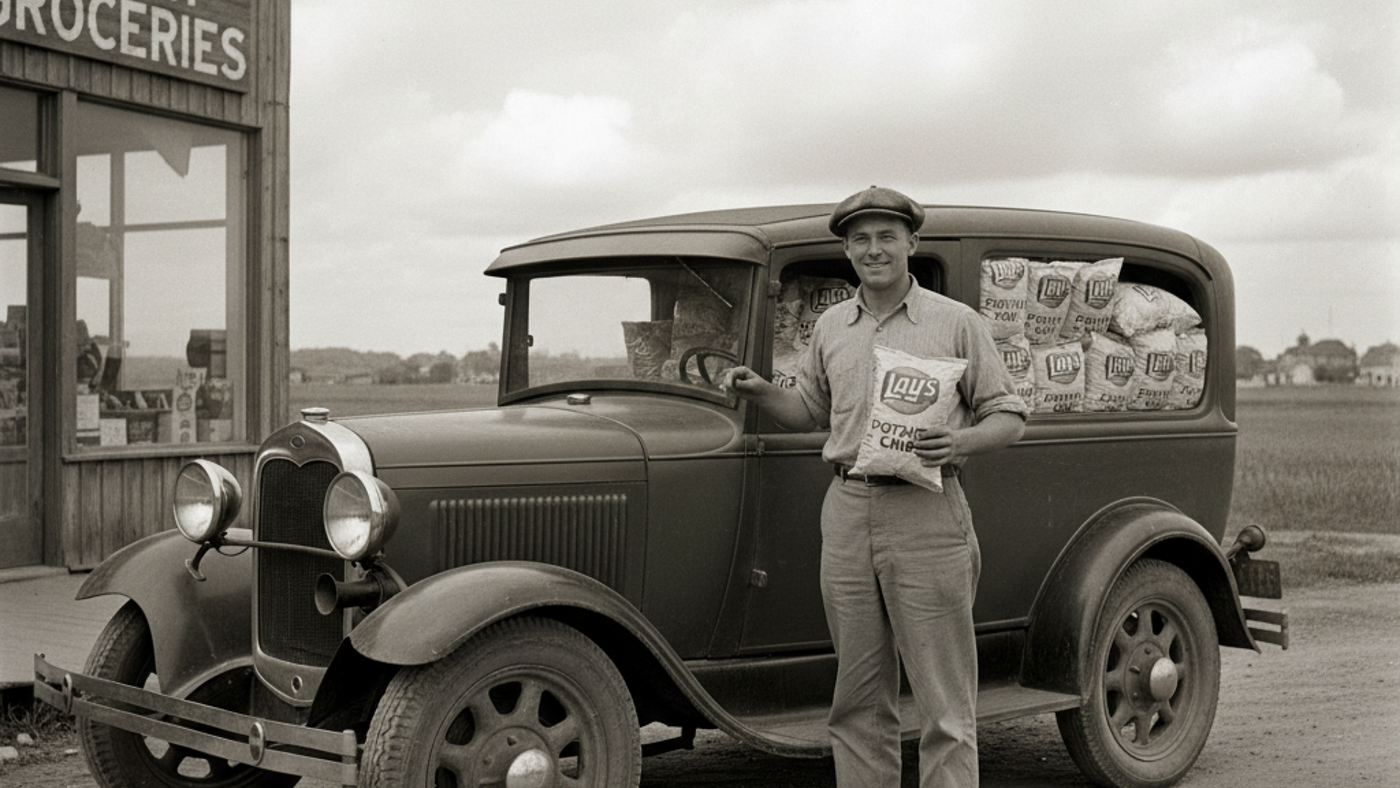
His path to market dominance began while working for the Bartlett food company in Nashville, Tennessee. This environment fostered the start of a side hustle that was destined to transform the U.S. Food Market. Lay became a travelling salesman, making it his trademark to deliver bags of potato chips to customers, stocking them in the back of his Ford Model A.
While potato chips (originally the “Saratoga chip”) had existed since the 1850s, a vital innovation in 1926 allowed them to become a truly portable snack: the development of a method for sealing potato chips in wax paper bags to keep them fresh. Herman Lay quickly capitalised on this innovation, seeing the immense potential for the product.
HW Lay Distribution Co and the Marketing Genius
After gaining over a decade of experience in the food industry, Lay decided to gamble on himself. He took out a bank loan to purchase a dealership from his former employer, renaming the venture HW Lay distribution Co. Within a few years, Lay demonstrated his ambition by raising forty thousand dollars in a stock sale to purchase the entire Barrett food company. This move, which involved the life savings of one of his biggest investors, was viewed as a massive risk, but Lay was determined to create an affordable potato chip brand for the average American.

Lay’s understanding of marketing was truly ahead of its time for the snack food industry.
The first Lay’s chips sold for 10 cents a packet. To maintain growth amid competition, Lay employed genius marketing strategies. In 1944, Lay’s became the first snack food company to advertise on television. Later, they hired the actor who played the Cowardly Lion in The Wizard of Oz as a celebrity spokesperson, utilising a popular TV campaign that included the memorable line, “betcha can eat just one”.
Another key ingredient in their success was product innovation. Lay’s was the first to offer crinkle-cut ruffled chips, designed to be less likely to break inside the package. By 1950, Lay’s led the market for potato chips.
The Flavour Revolution
A pivotal move that future-proofed the company was securing the rights to a patented cooking technique developed by Joe Spud Murphy, the owner of the Irish potato chip manufacturer Tato. This technique enabled the addition of seasoning during the cooking process, allowing the retention of flavour on a mass-production scale. This innovation helped Lay’s catapult the company to a new level. The first two flavours released using this method were cheese and onion and salt and vinegar, which would become some of Lay’s most in-demand products.
Consolidation: Frito-Lay and PepsiCo
By the early 1960s, HW Layin company was generating $45 million in annual sales (equivalent to half a billion dollars in 2023). However, the Frito company, a corn chip manufacturer, stood in the way of total market dominance, outselling Lay’s by 30 percent. The Frito company also had a similar origin story; founder C.E Doolin baked corn chips from his mother’s kitchen and sold them from his Ford car.
Instead of waging competition, Herman Lay orchestrated a merger between the two companies, creating Frito-Lay in 1961, which instantly became the First National American brand. Testament to his business genius, Lay ensured he remained in power as CEO of the new company. Following the merger, Frito-Lay quickly released a range of new, now-iconic chips, including Doritos, Funyuns, munchos, and Pringles.
The stage was set for a second, even larger business move in 1965 when Lay met with Don Kendall, the CEO of Pepsi Cola. Lay recognised that joining Frito-Lay with a beverage company would consolidate power over the American market and allow for aggressive international expansion. Kendall accepted Lay’s proposal, which Lay famously wrote on the back of a napkin. At the time, Pepsi Cola (which had developed Mountain Dew, Diet Pepsi, and 7UP since 1868) was seeking an edge against its chief competitor, Coca-Cola.
A Global Behemoth
Frito-Lay continued to function as a subsidiary of PepsiCo. The extra backing allowed Frito-Lay to expand internationally, transforming it into the global Behemoth it is today. As of 2021, PepsiCo’s annual revenue reached $85.5 billion.
Frito-Lay’s dominance is undeniable: Lay’s accounts for a staggering 41 percent of the potato chip market, and combined with Ruffles and Pringles (also Frito-Lay owned), its products occupy as much as 80 percent of shelf space in convenience stores. The company employs 55,000 people and produces enough potatoes to reach the moon and back.

the strategic merger with the Frito Company to form Frito-Lay and the subsequent acquisition by PepsiCo.
Current success relies heavily on innovation in flavour, with the company catering to local tastes through country-specific and region-specific varieties. There are now over 200 varieties of Lay’s chips, including unique items like Nori seaweed and baked scallop. Internationally, Lay’s chips operate under different names, such as Walkers in the United Kingdom, Smiths in Australia, Sabritas in Mexico, and Gypsy in Egypt.
Herman Lay converted a two thousand dollar loan into a global empire. He remained on the PepsiCo executive council until his death in 1982. Lay has been described as a “mastermind in the food that built America,” and his legacy continues to influence almost every supermarket and convenience store worldwide.
메타데이터
- post_id
- 7350fa6bf2a0
- slug
- the-road-to-snack-supremacy-how-herman-lay-turned-a-traveling-side-hustle-into-a-global-food-7350fa6bf2a0
- url
- https://medium.com/@uab971/the-road-to-snack-supremacy-how-herman-lay-turned-a-traveling-side-hustle-into-a-global-food-7350fa6bf2a0
- canonical_url
- https://medium.com/@uab971/the-road-to-snack-supremacy-how-herman-lay-turned-a-traveling-side-hustle-into-a-global-food-7350fa6bf2a0
- author_url
- https://medium.com/@uab971
- status
- ok
- fetched_at
- 2026-06-18 00:10:23