America’s National Game: 1888, redux
Ninth in the series; who deserves the credit for “Casey”?
America’s National Game: 1888, redux
Ninth in the series; who deserves the credit for “Casey”?
Happy Birthday, US (or us!)
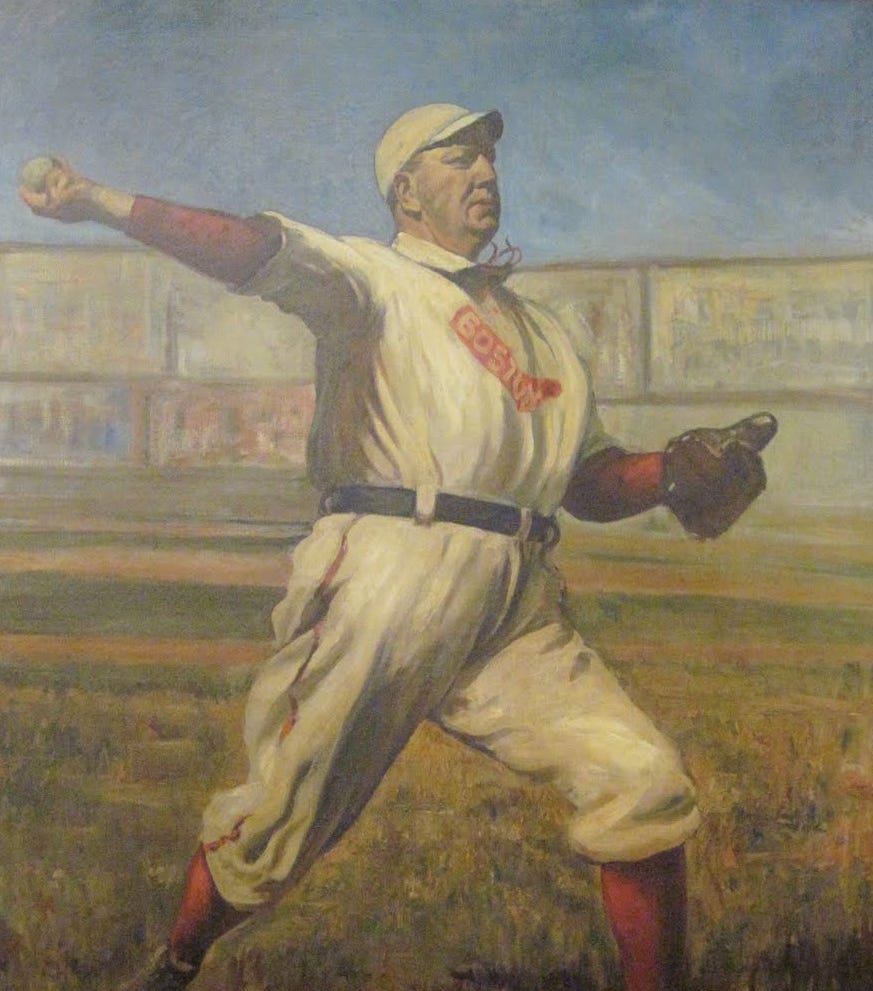
The outlook wasn’t brilliant for the Mudville nine that day … you know the rest, don’t you?
Last week we revisited 1908, the year of The Merkle Game, to write about “Take Me Out to the Ball Game.” Oddly — for like Merkle and all his confrères, “Casey at the Bat” commemorates failure — this week we return to 1888. That was the year of Spalding’s Tour, which registered hope for the American game to be played worldwide.
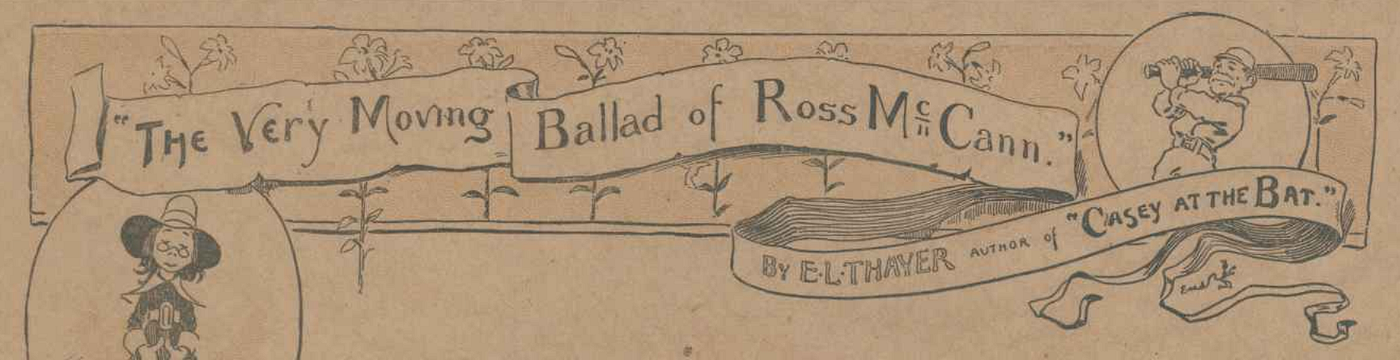
Thayer was credited with “Casey” in the Sunday supplement to Hearst’s New York Journal, November 1, 1896
Casey is the poem’s hero and anti-hero, the “champion” for our aspirations who — like us, most of the time — fails. It struck me this week what a rich, layered word that is, tracing back to the Latin campus, which meant a flat plain or field.
“Champion” came to mean a “field of battle” then, as in campio, a combatant in the field. This evolved into a sort of gladiatorial combat, then a solo fighter on behalf of another person or cause. All these senses of “champion” link to hope, to a vicarious struggle, and to a happy return home. As with Odysseus, if we take respite at the bases — bays or byes, as bases were known in the early game — then the sea voyage may proceed.
On repeated hearings we mock Casey’s vainglory and bluster and, in the poet’s genius twist upon the classical paean, delight in his comeuppance. At first this ending comes as a surprise, as it did for the ballplayers in the audience when the ballad was first recited publicly, two months after its publication, on August 14, 1888. In later years Casey would be redeemed in parodies because America loves comeback stories, even for blowhards.
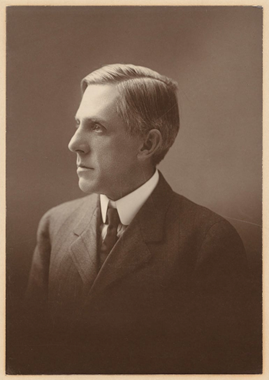
E.L. Thayer (“Phin”), ca. 1900
The poet was Ernest Lawrence Thayer, born into a prosperous family in Lawrence, Massachusetts; his father owned a woolens mill in Worcester County to which his son, after traversing the globe, would return. He had studied philosophy at Harvard, graduated magna cum laude, and served as editor of the Lampoon, whose business manager was, until his expulsion, William Randolph Hearst.
The junior Hearst was then given the ownership of a newspaper, the San Francisco Examiner, by his father who, with his Senatorial campaign over, no longer had need of it. Young Hearst invited three members of the Lampoon staff to help: Eugene “Genie” Lent, F. H. “Fatty” Briggs, and Ernest L. “Phinnie” Thayer. Thayer contributed a humor column and wrote ditties.
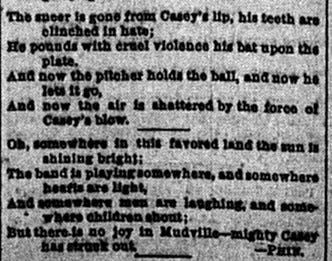
From the San Francisco Examiner, June 3, 1888
Returning east because of illness, Thayer mailed in “Casey at the Bat: A Ballad of the Republic, Sung in the Year 1888”; it ran in the Examiner on June 3. Hearst paid him the usual five bucks and the poem vanished … except that it had been clipped by the novelist Archibald Clavering Gunter, who kept it in his billfold as he — like Thayer, whose name he did not know — returned east.
Credit is not solely to Thayer who, despite decades of challenge to his authorship, wrote it; nor to DeWolf Hopper, who first recited it, breaking into Prince Methusalem, a “Hopperretta,” as it was then dubbed. It is to Gunter, who that morning as he read his newspaper for August 14, saw that the New York and Chicago baseball clubs were to be at Wallack’s Theater that night as Hopper’s guests. He gave the poem to his friend with the suggestion that he orate it. Hopper mastered the ballad in a couple of hours; as a baseball devotee he could visualize every line.
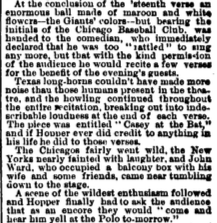
Casey Makes a Debut, New York Evening World, August 15, 1888
The two teams, headed by Cap Anson and Buck Ewing, were in the boxes, and during the show Hopper “pulled Casey on them,” in his own words and, as the Evening World reported: “The piece was entitled ‘Casey at the Bat,’ and if Hopper ever did credit to anything in his life he did to those verses.”
Let Hopper tell the story, from his 1927 autobiography, Once a Clown, Always a Clown:
Hopper chose his role in “Wang” for the dust jacket of his memoir
I interpolated Casey in a scene in the second act…. It was, I presume, the first time the poem was recited in public…. On his debut Casey lifted this audience, composed largely of baseball players and fans, out of their seats. When I dropped my voice to B flat, below low C, at “the multitude was awed” [the poem in fact reads “the audience was awed”], I remember seeing Buck Ewing’s gallant mustachios give a single nervous twitch. And as the house, after a moment of startled silence, grasped the anticlimactic denouement, it shouted its glee…. They had expected, as anyone does upon hearing Casey for the first time, that the mighty batsman would slam the ball out of the lot, and a lesser bard would have had him do so, and thereby written merely a good sporting-page filler.
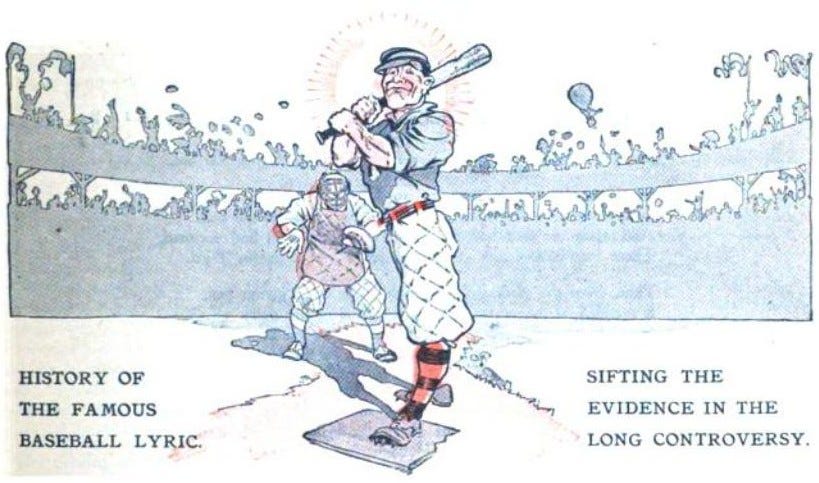
Harry Thurston Peck, “Who Wrote Casey at the Bat?” from The Scrap Book, 1908
By 1889, King Kelly was taking to the boards to recite the poem (unsurprisingly renamed Kelly at the Bat, with Boston replacing Mudville), and many thought the poem had been written not only for him but also about him … if not by him. No poet came forth to dismiss such notions. Thayer was so shy that he kept quiet while deluded poets claimed to be the author or, like one-time Phillies pitcher Dan Casey, its inspiration.
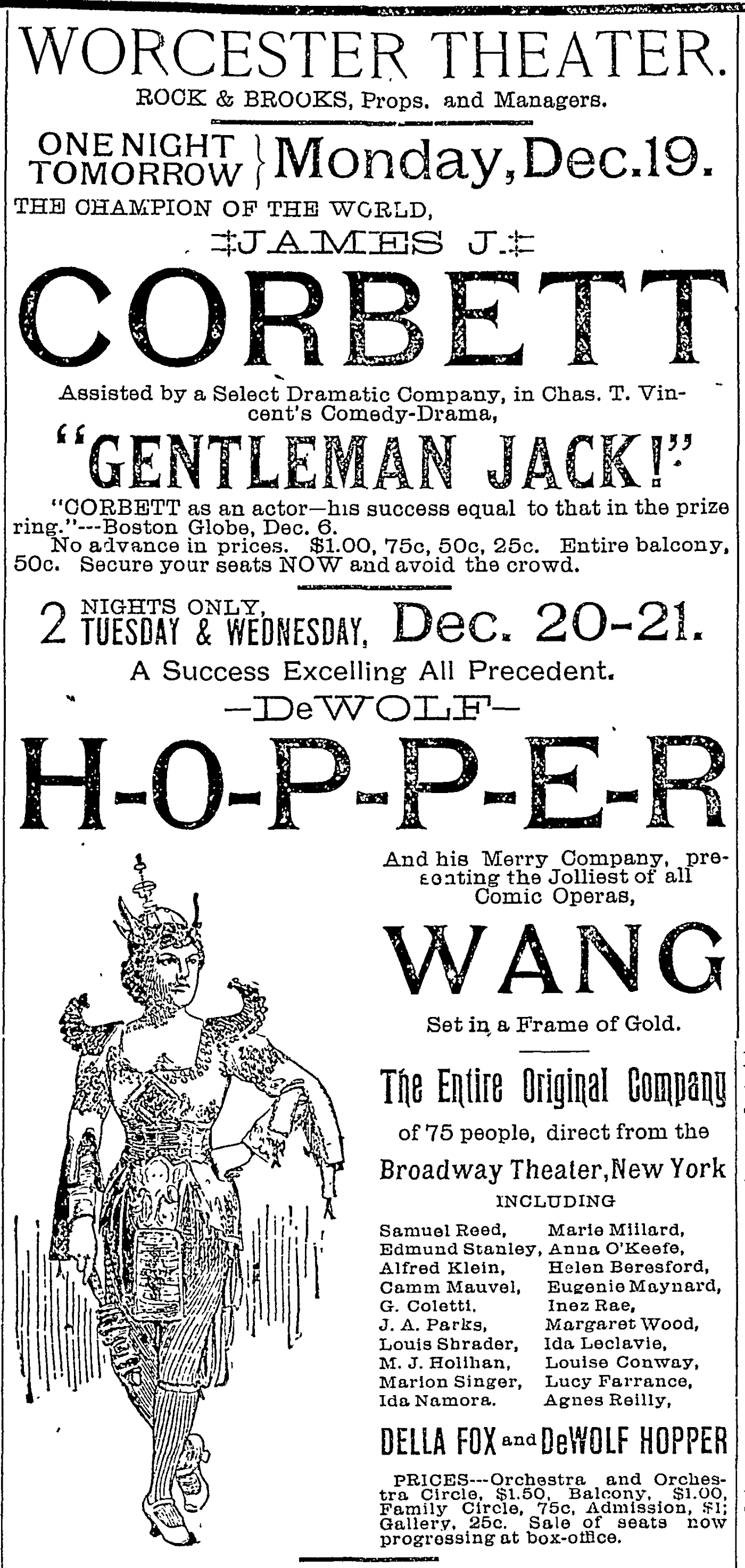
Hopper Meets Thayer in Worcester, 1892
It was not until December 1892, after Hopper had recited the poem during a performance of Wang at Worcester, that a note came to him asking him to come around to a club and meet the author of “Casey,” as yet unknown. Of course Hopper went, and was introduced to mill magnate Ernest L. Thayer. When the latter revived his poetical career with a few ditties in the New York Journal of 1896 — owned by his Harvard pal Hearst — he was identified as the man behind “Casey at the Bat.” He signed his name as “Phin.”
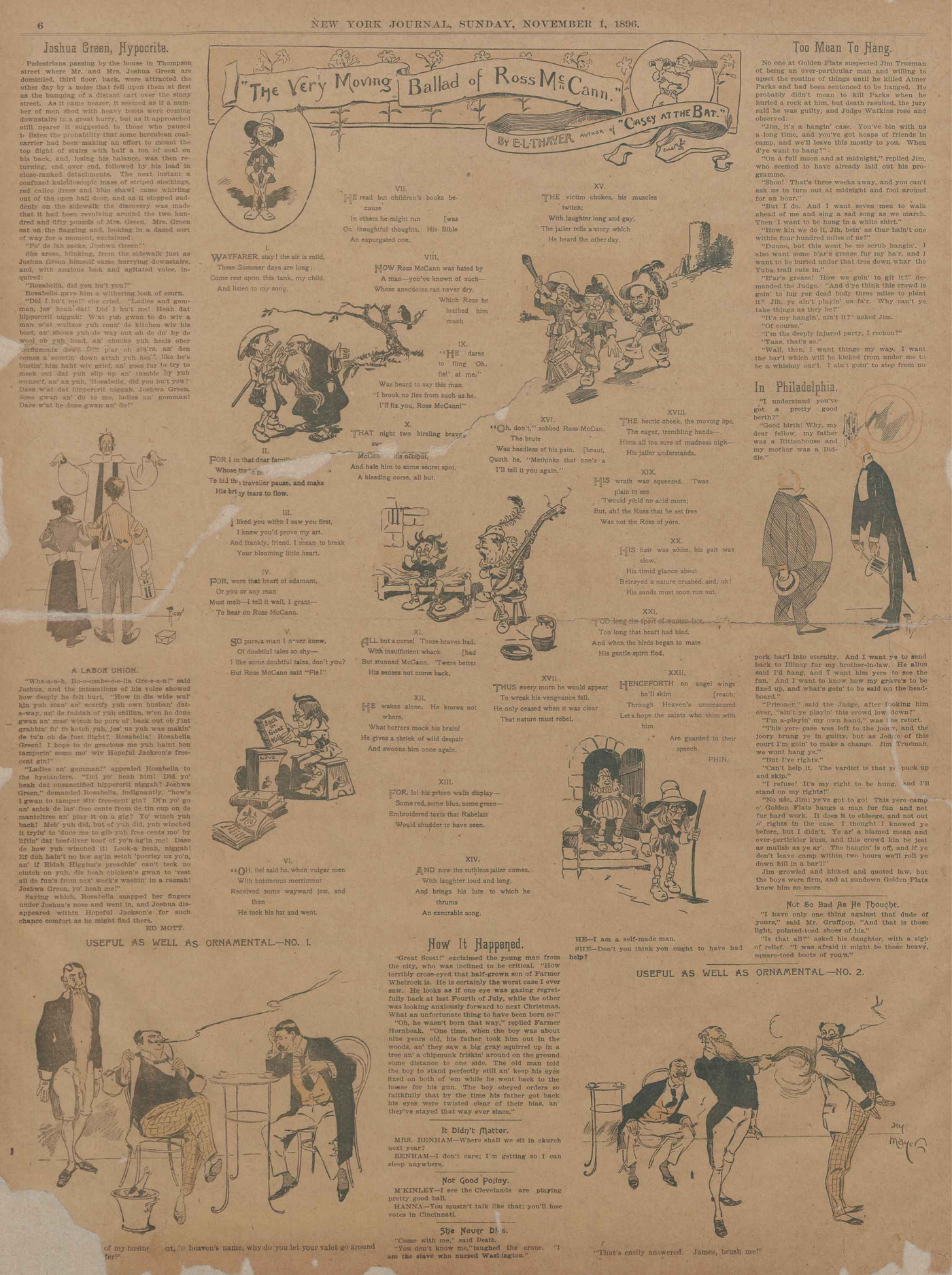
E.L. Thayer, “The Very Moving Ballad of Ross McCann,” an execrable poem in the New York Journal, November 1, 1896
And yet, like so many fugitive poems such as Clement Moore’s “Twas the Night Before Christmas,” proprietary wrangles persisted. In 1902 Frederic Lawrence Knowles edited A Treasury of Humorous Poetry, including a version of “Casey at the Bat” which the anthologist credited to Joseph Quinlan Murphy. In 1904, Frank Wilstach, Hopper’s former press agent, began to circulate a story that in 1887, a year before Thayer, his roommate in Sioux City, Iowa, Will Valentine (conveniently dead in 1897), had written the poem.
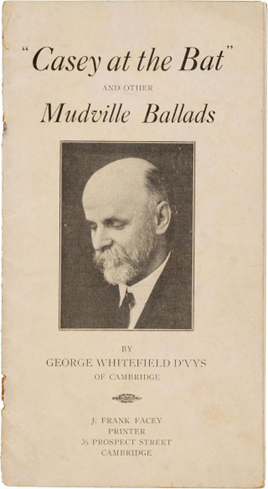
D’Vys self-published this pamphlet in 1929
Most persistent yet preposterous of the claimants was George Whitefield D’Vys, who claimed that his “Casey” had somehow been delivered to the editor of New York’s Sporting Times in the year before that publication commenced. As for his writing other poems in the stentorian style of “Casey,” well, Thayer’s schoolboy model (and that for D’Vys) was probably Macaulay’s “Horatius at the Bridge,” written in the same iambic heptameter.
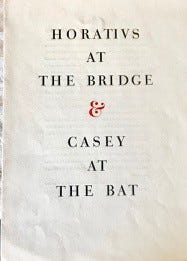
Horatius at the Bridge & Casey at the Bat, Grabhorn Press 1954
I could go on, but let the true poet’s comment suffice: “The constant wrangling about the authorship, from which I have tried to keep aloof, has certainly filled me with disgust.”
Despite Thayer’s evident satire of not only baseball but also would-be heroes (and the Irish, who were kept out of Harvard), Donald Hall wrote: “When a few fans go home in the ninth inning, they depart not in discouragement but ‘in deep despair.’ The remaining five thousand illustrate a learned illusion: In his Essay on Man, Alexander Pope wrote that, ‘Hope springs eternal in the human breast….’”
메타데이터
- post_id
- 737b879c2b06
- slug
- americas-national-game-1888-redux-737b879c2b06
- url
- https://ourgame.mlblogs.com/americas-national-game-1888-redux-737b879c2b06
- canonical_url
- https://ourgame.mlblogs.com/americas-national-game-1888-redux-737b879c2b06
- author_url
- https://medium.com/@thorn_john_87223
- status
- ok
- fetched_at
- 2026-06-10 09:45:17