1.2 Conspectus on the Prison Notebooks: On Education (pp. 24–43)
Having established Gramsci’s explicit theory of the intellectuals (organic and traditional), as well as his implicit theory of the…
1.2 Conspectus on the Prison Notebooks: On Education (pp. 24–43)

One Hundred Boys (detail); unknown artist; Qing dynasty, 18th century.
Having established Gramsci’s explicit theory of the intellectuals (organic and traditional), as well as his implicit theory of the intellect as a fundamental social substance, we may now turn to his theorising of education.
His analysis breaks down into several components:
- Different modes of schooling and their implications.
- Education in general, and its professional and political variations; broken down into (A) instilling particular intellectual capacities and characteristics in those entering the field, and (B) intellectually developing and transforming the fields themselves, their expanded reproduction — within the confines of intellectual and cultural hegemony, of course.
- The fundamental social processes of education. In particular, Gramsci identifies work as the “principle of education”. By considering the work of societal transformation as a theoretical and practical process, he thereby derives a further principle for future modes of schooling, as befitting historical transformation and the abolition of class.
All of these principles come together in his propositions of the “common school”.
As we have seen in Part 1.1, a given period of social history (and its corresponding mode of production) organically demands a corresponding ensemble of intellectual capacities, processes, and characteristics. In particular, these correspond to the divisions of that population into social groups and classes — and, crucially, the social relations between them.
In analysing how this intellectual substance is reproduced in the population, Gramsci first breaks education down into two modes of schooling, each corresponding to phases of social history and arrangements of class. He compares the two in order to develop a preliminary theory of education as is. He then prescribes a third mode of his own devising as the form of schooling adequate to his historical moment. This latter category directly informs Gramsci’s primary concern in studying intellectuals: figuring out how to nurture the intellectual forces necessary to advance social revolution — the organic intellectuals of the proletariat.
Much like Marx, Gramsci’s theorisation is at all times enmeshed with politics: the burning questions of what is needed for mass progressive politics, embedded in a world-system that it seeks to abolish. That he had to navigate fascist censorship and brutal incarceration complicates the extraction of these subtle intrigues — but this is all the more necessary for Gramsci’s ultimate concern. His account of education is a sophisticated account of the intellect and the broad social form of its production.
Modes of schooling
Firstly there is what Gramsci identifies as the classical school. This was the “humanistic” curriculum that sought to develop each pupil into the social and cultural order; either as a member of the ruling class or as an intellectual of the ruling class. This was the traditional form that education in Europe took, as a “humanistic programme of general culture based on the Greco-Roman tradition.”
The main thing that sticks out about the classical school is its scope. Rather than merely training its students into specific functions, or simply instructing them in the rudimentary necessities of public life and the sciences (reading, writing, arithmetic, civics, law, and so on), the classical school as Gramsci sees it was also dedicated to the formation of personality, and the integration of people into the dominant culture. This was not only a matter of forming individuals with particular intellectual capacities, but also “the fundamental power to think and to find one’s way in life” — an adaptable, self-conscious, creative intellect. The task of the classical school was to make its pupils the most complete human beings possible for their given stage of civilisation; teaching as many of the cultural and intellectual capacities as could possibly be endowed.

The Official Career of Xu Xianqing; Yu Ren, Wu Yue; 1590
Gramsci does not make this especially explicit, except where he asserts that it was ultimately correct to struggle against this mode of schooling (see below), but innate to this form of education was the fundamental stratification of society — traditional distinctions not of class per se, but of caste. Elitism was inherent to the classical mode of schooling. On the one hand, there were those that could have the right to be fully human, and thereby access the full scope of the dominant culture: civilisation, its philosophy, the sublime and the splendid, and so on. The classical school and its curriculum of humanist individual development was built for them.
On the other hand, there were the great masses of society excluded from this process of intellectual formation, mostly illiterate and rigidly embedded in their ancestral social position. Their intellectual development, almost always presumed as external to this mode of schooling, was to be conducted primarily by institutions such as the family and village life. As such, education was overall organised such that you would likely die in the same intellectual milieu that you were born into — in line with all other aspects of life.
With the historical development of modern public education, part and parcel with the rising liberal-bourgeois class society that advanced (1) formal equality, (2) the radical expansion of intellectual functions in our time (as in 1.1), and (3) the necessity of industrial labour that could take on many roles in production — hence positing some kind of universal education and language. The classical mode of schooling and its exclusive humanistic programme could not survive in the same form. Gramsci takes careful note of its vulnerability; that its very existence depended on the “unquestioned prestige of a particular form of civilisation”. Without the underpinning of the strictly hierarchical structure of feudal and/or seigniorial class society and the ideologies that adhered to it, the classical school could not remain the dominant formation for long, and would be supplanted by new modes attuned to the bourgeois epoch.
As such, the industrial revolution and the rise of bourgeois civilisation radically intervened into education’s classical form, in the establishment of vocational or technical schools: for those new urban intellectuals required for the new phase of civilisation to function. Ultimately, these were based on the clear tendency alluded to in (2) above; that in modern times:
all practical activities have become so complex, and the sciences so interwoven with everyday life, that each practical activity tends to create a new type of school for its own executives and specialists… (pg 26)
Bourgeois civilisation increasingly necessitates the creation of a great apparatus of education — specialised schools, vocational schools, dedicated study for professions: legal, management, civic/political, engineering, and so on. In his day, Gramsci observed that the state was inclined “to abolish every type of schooling that is disinterested (not serving immediate interests) or formative” — with the exception of the élite of course, who could afford to expend their time appreciating the cultural and philosophical gifts of human history.
On the very basis that they seek to augment mass society with a universal education process, the bourgeois state implicitly rejects the notion of integrating students or prospective intellectuals universally into the dominant culture. Rather, bourgeois governments of various sorts collapsed education into specific technical functions for pupils to be allotted into, ultimately designed to generate a narrow intellectual destiny for most citizens. Education is here defined by instruction in basic social and legal principles, and by training into certain roles as workers; the talented into “specialist intellectuals”, chosen by a mechanical societal judgment of what is needed. A universal education system arises with a fundamental presumption of non-universal principles: to create individuals with intellectual scope limited to particular atomised functions.

Reviewing the Examination Results (detail); Qiu Ying (1494–1552); circa. 1540
The dyad introduced in 1.1, of traditional and organic intellectuals, re-emerges here: traditional intellectual forms associated with the classical school relative to modern society, and the organic forms as generated by the diversifying professional and vocational education systems.
Gramsci does not deny the need to specialise intellectual capacities, neither in his day nor in a postulated communist future. However, the transition from the classical to the vocational curriculum, concurrent with the transition from a semi-feudal oligarchy to a mass or democratic one ruled by the capitalist bourgeoisie, assuredly loses an indispensable component of the prior mode of schooling. The practice of education not only as forming future social functionaries or workers but as developing personality to its fullest possible degree has been scrubbed from the field. In seeking to develop a liberal-democratic mode of schooling available to all, the State abolished the central role of cultural-intellectual integration for pupils.
For his own vision of schooling, Gramsci draws upon these abolished aspects of the classical school, prescribing that:
…[schooling] should aim to insert young men and women into social activity after bringing them to a certain level of maturity, of capacity for intellectual and practical activity, and of autonomy of orientation and initiative (pg 29)…
…capacities that are traditionally the exclusive purview of the aristocratic classes: creative capacities innate to possessing the command of one’s own conditions, to a social position as personally actualised and empowered.
The traditional school was oligarchic because it was intended for the new generation of the ruling class, destined to rule in its turn: but it was not oligarchic in its mode of teaching (pg 40).
Naturally, Gramsci supports the abolition of the aristocratic schooling system — but he nonetheless endorses on principle the virtue of “humanistic formation (taking the term “humanism” in a broad sense rather than simply in the traditional one)” (pg 29). He seems to see the problem of education in the new society as a matter of transforming this principle to a means of actualising personhood across all of society, especially the working class. Clearly, this is not a vision of a school that can exist in an epoch of top-heavy class societies — it necessarily posits communism, both as a movement to abolish the existing state of things, and as a new democratic society based on the common power of the people.
With this in mind, Gramsci embarks on outlining some schema of how education operates as an organic social force. In doing so, he obliquely approaches the question of what education should look like for new social epochs.
Basis of education in social activity
Intellectual reproduction in professions. Gramsci here analyses education in terms of intellectual development supporting practical or vocational activities — that is, once they have become sufficiently complex and indispensable to a given society. Each practical activity has its educational elements broken down into two organic parts. Firstly, (A) the actual activity in a technical sense, and thus the specialised schooling that trains its practitioners. Secondly, (B) the cultural associations created by the intellectuals of that activity — the expanded administration of that activity, involving the sciences and new developments in the field. In the former case, it is individuals entering the vocation that are educated; in the latter, it is the collective vocation as a whole that is educated, intellectually and culturally — rather like an “editorial committee”. This in itself demands a whole new field of auxiliary intellectual processes and operatives — the scientists, scholars, and critics of that vocation’s intellectual regime, who can wage:
…an unyielding struggle against habits of dilettantism, of improvisation, of “rhetorical” solutions or those proposed for effect. (…)
This type of intellectual work is necessary in order to impart to autodidacts the discipline in study which an orthodox scholastic career provides…
Hence… the usefulness of a certain “stratification” of capabilities and attitudes, and of the formation of work groups under the guidance of the most highly-skilled and highly-developed… (pg 29).
Hence, Gramsci’s dialectic of education, as intellectual development: parallel and interrelated processes of development for both (A) the subject being educated in a field of activity, and (B) the field itself.
As far as I can tell, Gramsci fails to anticipate the rise of the twenty-first century “experts” and the plying of their trade in public anxiety: those who are often lacking in formal qualification in their field, and tend to function in the culture of the media, rather than that which arises upon a field of technical activity. Doubtless, this is an avenue for future study.
Intellectual reproduction in politics. This organic division applies also to the political activity governing society — the “deliberative bodies” organising the culture as a whole. On the one hand, there is (A) the essential process of deliberation, implementing policy and programmes — the activity governing society, broadly constituting the State. However, this immediately posits a necessary complement to political activity: (B) the preliminary “technical-cultural” analysis of material to deliberate upon…
…in which the questions upon which they have to make decisions are first examined by experts and analysed scientifically. This latter activity has already created a whole bureaucratic body, with a new structure…
What is involved is a necessary, organic development which tends to integrate the personnel specialised in the technique of politics with personnel specialised in the concrete problems of administering the essential practical activities of the great and complex national societies of today (pp. 27–28).
Aside from the simple technical functionaries of the state that prepare political or legislative material (the basic state bureaucracy), a “second body of functionaries is created”, populated by intellectuals and “volunteers” from whatever is judged as the most relevant strata of society and culture for the deliberation process. Such a judgment, of course, fundamentally derives from the moral and cultural conditions that society has already erected upon itself. Consequently, once posed and established, this regulating apparatus is inevitably populated by representatives of the dominant class.
As such, political material even in the most democratic state formation is regulated by dominant intellectual and cultural interpretations of society, which stand as irreplaceable consultants for the construction (and indeed reconstruction) of any given social order. This apparatus structurally embodies the stances of dominant social groups — which continually educate and re-educate those entering government, within the very process of political deliberation that they participate in.
Indeed, Gramsci notes the inevitability of these auxiliary cultural-intellectual functions absorbing the “great specialists of private enterprise”, and thus how capital organically comes to direct the state in its interests — by integrating itself with the internal culture of politics, its intellectual procedures. Class hegemony thus stands as deeply embedded in the most basic processes of governance. Leaders in such conditions, distinct from the strict hierarchy of dictatorship or absolute authority, must have…
that minimum of general technical culture which will permit him, if not to “create” autonomously the correct solution, at least to know how to adjudicate between the solutions put forward… and hence choose the correct one from the “synthetic” viewpoint of political technique (pg 28).
Leaders are here better understood as mediators of an a priori intellectual consensus, rather than agents of societal change. We must be careful to note that this apparatus shaping the political intellect is not inherently a corrosive or unjustifiable formation. Much like the labour of critique Gramsci outlines above, these processes correspond to the organic complexity of the modern ensemble of social, technical, and productive activities embedded within it. Specifically, it corresponds with politics within such a context; just as necessary for a revolutionary or socialised mode of governance. It is really a question of whom this bureaucracy serves, not the service as a matter of principle; class rule in its concrete totality, rather than a simple “occupation” of political institutions.

Palace Examination at Kaifeng, Song Dynasty, China; circa. 17th or 18th century
In this way, the capitalist bourgeoisie generates intellectual and cultural conditions of bourgeois society: both for the intellect of its citizenry and for the processes of political governance. This fundamentally derives from the mere fact of performing activity within the capitalist mode of production and the bourgeois society that rests upon it. State and civil society together educate and re-educate its functionaries, wherever they may be operating. The unwavering dedication of most substantial political parties to certain core principles of governance and social organisation (a source of much frustration for many of us), is rooted in this process in which certain principles are instilled within the State as a capitalist formation: in the New Zealand government, for example, we have political fundamentals like growth, building/maintaining a competitive advantage on the world-market, and opening up public institutions for capitalisation.
Crucially, the outsized role played by certain classes in forming legislation is not a deviation from principle, nor a fundamental axiom of the state in itself: it is rather a necessary property of the state as a constituent part of class society. Furthermore, Gramsci implies that both aspects (A) and (B) of intellectual development in the political sphere must be understood for revolutionary social transformation.
In Search of the Educational Principle: Work, Humanities, Class
Gramsci understands educational institutions as intimately tied to the complex of social relations that surround and condition them. Ultimately, he finds work or labour (best understood as human activity in the conditions established by nature, society, and the state) as the fundamental basis of education. It is with this principle that he outlines an expansive potential for the work of education itself; for forming new generations equipped with a revolutionary and consciously empowered intellectual character.
Education for work as society-nature relations. Consciousness and subjectivity are neither individual nor “individuated” for Gramsci. As with the strata of the intellect outlined in Part 1.1, consciousness is fundamentally integrated with society and the partitions of society that people must participate in. In class society:
…the individual consciousness of the overwhelming majority of children reflects social and cultural relations which are different from and antagonistic to those which are represented in the school curricula… (pg 35)
In this vein:
It was right to struggle against the old school, but reforming it was not so simple as it seemed. The problem was not one of model curricula but of men, and not just of the men who are actually teachers themselves but of the entire social complex which they express (pg 36).
Gramsci initially characterises the societal tasks of education in the old primary school as a twofold concern: (i) the “rudiments of natural science”, and (ii) “civic rights and duties”. Scientific ideas were implemented into the minds of pupils in order to “insert the child into the societas rerum, the world of things”. Civics inserted them into civil and political society as citizen/subject. Right from childhood, the educational institutions were erected to combat “folklore” and traditional cultural understandings of the world. Fundamentally, Gramsci holds that the underlying principle was that of labour or work, meaning:
…the specific mode by which man actively participates in natural life in order to transform and socialise it more and more deeply and extensively (pg 34).
In these processes, people must know (i) the natural laws that must be adapted to in order to “master” them, and (ii) social and state laws established by people “in the interests of their collective development”. This latter category understands the fundamentally malleable sphere of state and society as inclined towards best “facilitating” work (or the mode of production): “organically regulating men’s life in common” so as best to utilise the forces of nature as a social whole. Furthermore:
Men must respect this legal order through spontaneous assent, and not merely as an external imposition — it must be a necessity recognised and proposed to themselves as freedom… (pg 34)
Village Schoolroom; Zhāng Hóng (1577–1668); 1649.
It is quite striking that Gramsci immediately finds implicit ecological and political principles within the sphere of education. Underpinning the traditional mode of schooling in this context is thus a form of work posed as (i) the domination of nature by production, and (ii) the society-wide facilitation of those productive capacities. Each orbit around work, the process of production; by implication, the role of the worker employed by capital. Clearly the early capitalist mode of production, especially its relations to nature and the social relations of the working class to their labour, is directly implicated here.
Nonetheless, Gramsci is sure to identify the historic merit of this mode of schooling, with its “real basis” in work — once the notion of work is itself conceptually developed beyond simple productive roles or jobs:
The discovery that the relations between the social and natural orders are mediated by work, by man’s theoretical and practical activity, creates the first elements of an intuition of the world free from all magic and superstition. It provides a basis for the subsequent development of an historical, dialectical conception of the world, which understands movement and change… and which conceives the contemporary world as a synthesis of the past, of all past generations, which projects itself into the future (pp. 34–35).
In other words, an education rooted in work and thus the relation to nature fundamentally proposes the ability to change those relations.
The great potential power of education based on work is that it could endow students with an understanding of both (i) the constant motion of our relation to the world, and (ii) our active participatory or political role in making and remaking that motion: that is, the principles of historical and dialectical materialism. Under given national and historical conditions, the primary school probably does not achieve this task, if its teachers are even conscious of it, but highlighting this failure misses the point. For Gramsci, this is a valuable tendency embedded in education’s historical trajectory, that must be drawn out and built upon.
Intellectual depth posited by classics and humanities. Gramsci identifies an intriguing organ for a deeper social education in the grammatical study of “dead languages” like Latin and Ancient Greek, and their corresponding literatures and history — “classical studies” in the modern New Zealand curriculum. Deceptively antiquated, these components of the curriculum granted valuable intellectual capacities to traditional aristocratic attendants, and establish grounds for a potential proletarian alternative. Specifically, they presented another dimension to the educational principle:
for the humanistic ideal, symbolised by Athens and Rome… diffused throughout society… an essential element of the national life and culture…
…the real interest was the interior development of personality, the formation of character by means of the absorption and assimilation of the whole cultural past of modern European civilisation (pg 37).
In other words, the classics played one role as a process of cultural integration. But it goes deeper than this — taking the example of Latin, studying a dead language requires breaking it down to its parts, reconstituting it in the imagination, and then bringing it to life in the literature of a lost culture. Gramsci argues that this accustoms children to studying with a certain analytical abilities; to think abstractly, with discipline and logic, breaking down concepts and words; to consider a historical perspective, in the movement of that language through time; to use these abstract capacities to understand ancient cultures as mediated by their own texts. The abstraction of grammar is a central pillar about which a prodigious ensemble of intellectual capacities are erected.
The point of the whole affair is not the language itself. Rather, it is the scholarly process of studying it, of thinking historically, analytically, dialectically; and then using it to interpret and understand a world completely intangible to the immediate senses.
Logical, artistic, psychological experience was gained unawares… Above all a profound “synthetic”, philosophical experience was gained, of an actual historical development (pg 39).
This question of supporting the development of personhood in the public curriculum is not confined to the classics. Much the same may be seen in the classrooms of history, literature, media, world philosophy, and other studies broadly and appropriately described as “humanities” — their purpose is to acquire a more complete cultural and intellectual personhood; depth and strata, and capacities beyond the immediate needs of society. We shall consider this further in the case of modern Aotearoa New Zealand, in the fourth section of this article.
Cultural struggle in the schooling system. These studies of education highlights the vital role of culture and cultural distinctions in the composition of society. For Gramsci, culture is not a periphery matter merely reflecting underlying material conditions, but a series of material forces in their own right, emergent from social life. Moral and intellectual worldviews respond to social conditions and reproduce the fundamental characteristics of society through general adherence and participation; the real practice of those worldviews. Public education, at the juncture between the dominant forces of the state and itsinstitutions on the one hand and the social peripheries or frontiers on the other, is thus a field of cultural and social struggle. Teachers, put in place by the schooling system and the dominant culture that it derives from, present a curriculum that tends to be antagonistic to the consciousness of many children of the masses — which is, in contrast, initially drawn from the lived culture of their families, neighbourhoods, villages, social classes, and so on:
a certain “baggage” or “equipment” (according to taste) of concrete facts (pg 36).
Consequently:
…the “certain” of an advanced culture becomes “true” in the framework of a fossilised and anachronistic culture (pg 35).
In other words, the material solidity of certainty in educational content, subject to change in the course of society’s intellectual development (see the sections above on how intellectual fields reproduce and transform themselves) is in practice understood as absolute truth, immutable and static. As Gramsci argues, this can only lead to “rhetorical” schooling, where truth is identified only with words rather than reality — nominal rather than substantial. I think that this is a succinct critique that could equally apply to the institutions of learning we have today.

Skeleton Fantasy Show; Li Song; 1210.
Institutions that are ostensibly designed to elevate people into the culture and social intellect merely instill abstract principles and facts into the students, abstracted from their real living conditions — instruction, rather than education. This is because they do not challenge the stratified forms and substance of the actual society they are implementing the citizenry into. The world presented at school and the living world experienced by the pupils are structurally distinct, held apart by the divisions implicit to class society. Instruction and education are not inherently distinct: indeed, Gramsci argues against some reformers of education, that a certain degree of dogmatic instruction is necessary to properly build intellectual fundamentals. The two are only distinct within the conditions of a class society that does not endeavour to abolish its fundamental antagonisms. It is the work of the teacher to bring together these two variations of intellectual development in the teaching process, to a greater or lesser extent depending on the conditions of the teaching profession and those who choose to undertake it.
Neither of the modes of schooling presented above escape the structuring of class society; the classical because they were never meant to, the vocational because the struggle of the classes itself was not addressed. Assuredly, vocational schooling can endow people with greater intellectual and practical capacities individually. But a mode of schooling that would support a democratic society would not just mean that individuals can ascend through the social strata by building their intellectual and practical abilities.
[D]emocracy, by definition, cannot mean merely that an unskilled worker can become skilled. It must mean that every “citizen” can “govern” and that society places him, even if only abstractly, in a general condition to achieve this (pg 40).
By abolishing the curriculum that prepared students to rule their societies and become integrated into the dominant culture, as in the classical mode of schooling — even though this was inexorably bound up with traditional hierarchies — public education also abolished the intellectual formation of these capacities for the general public, for pupils to understand their societies as governable and to possess the cultural and intellectual will to do so. Being designed to satisfy “immediate, practical interests” at the expense of equipping students with the detail and personality of an expansive humanistic education (politics, philosophy, culture, et cetera), it serves instead to “perpetuate” and “crystallise” the classes. It diversifies the ruling class on a personal or individual level, giving an impression of democratic society — but it cannot uproot the divisions of class, and actualise a substantial democracy. Indeed, when considering the professionalisation of politics and other powerful social roles:
[Schooling] is organised ever more fully in such a way as to restrict recruitment to the technically qualified governing stratum, in a social and political context which makes it increasingly difficult for “personal initiative” to acquire such skills and technical-political preparation (pg 41).
As is, the school remains a domain of class forces. Many children of traditional intellectual or bourgeois families enter school having inherited personal capacities and attitudes from their lived social environment — advantaged over other pupils for intellectual and cultural development. This may be interpreted by other demographics and their families as some kind of “trick” of the upper classes, or, worse, that they are “stupid by nature”. Interestingly, Gramsci chooses to conclude his essay with this point; to highlight both the urgent need to break away from these occult understandings of the ruling class, and the clear difficulties of actually doing so.
More broadly, Gramsci opens the potential here for work on a historic scale as the principle of mass public education: breaking the patterns of class society by developing new (implicitly proletarian) strata of intellectuals. Alongside the revolutionary reconstruction of society, this work necessitates the progressive re-integration of schooling and life on very different terms. Gramsci holds that the original rupture of these two fields lay in the progressive separation of the lives actually lived by the students, and that which was presumed of them by the old structure and curriculum — the latter being…
…the expression of a traditional mode of intellectual and moral life, of a cultural climate diffused throughout Italian society by ancient tradition. It was the fact that this climate and way of life were in their death-throes, and that the school had become cut off from life, which brought about the crisis in education… Thus we come back to the truly active participation of the pupil… which can only exist if the school is related to life (pp. 36–37).

One Hundred Children in the Long Spring (detail); Su Hanchen; Song Dynasty, 12th century.
Education and Revolutionary Personhood: the Common Mode of Schooling
We should recall that Gramsci’s implicit goal here is to study what is necessary for the working class to establish class hegemony, through its own the organic intellectuals — in communism, as actualised politics of the revolutionary proletariat. His thesis of the common school is an application of his theory in the interests of a new mode of intellectual and moral life: oriented towards abolishing class society.
The basic components of Gramsci’s prescription follow the theoretical lines outlined above:
- That educational processes must be rooted in the principles of (i) training/instruction for work and (ii) integration into a mass democratic culture, in “humanistic formation”. Each draws upon different dimensions of the modes of schooling outlined above. Crucially, however, both are developed so as to suit radical social and cultural emancipation.
- Work (i) is posed not only in economic or technical terms, as in courses of the old vocational school, but in terms of work with a historical scope— the work of changing social conditions. Education in this sense is thus underpinned by the greatest possible extent of work itself. We may see here a reemergence of the structure of intellectual development Gramsci established before: (A) bringing people into an intellectual and practical field, and (B) developing that field to new levels.
- This in turn relates strongly to (ii) so-called humanistic formation — Gramsci’s ideal of the common school is integrated with technical schooling, but is structured beyond mere vocation. Together, they provide fertile ground for organic intellectual development (thinkers of the future), forming citizens that are both informed and critical, by drawing on educational processes formerly possessed and defined by the archaic oligarchy: culture, humanities, classics, et cetera, for intellectual personhood and political ability for the masses.
- Reintegration of life and schooling: on the one hand through the reconstruction of education as a public function. On the other hand, the common school is clearly devised as a lived institution that must be organised as conditions of life, demanding a complex ensemble of facilities for living and learning. Expenditure and infrastructure is taken on by the State, eliminating the burden on the pupil’s family and facilitating socialised processes of moral and intellectual development. This also allows for the generalisation of cultural or social advantages that would otherwise be held exclusively by privileged strata of the student body. Gramsci proposes that it should be:
…organised like a college, with a collective life by day and by night, freed from the present forms of hypocritical and mechanical discipline… (pg 31)
- Overall, the common school is obliged with the intellectual and moral task of introducing youth into social activity: considering matters of (i) maturity and the corresponding organisation of the student body, (ii) instrumental intellectual and practical abilities for social needs, and (iii) “autonomy of orientation and initiative” — with a strong foundation in primary school learning of the matters of society and state, often neglected:
…”rights and duties”, with the first notions of the State and society as primordial elements of a new conception of the world which challenges the conceptions that are imparted by the various traditional social environments… (pg 30)
It seems that on this basis, social life itself can be posed as a subject to be educated.
For the transition to higher education, Gramsci prescribes the need for students to develop through a disciplined learning process as subject to authority and disciplined (with “dogma” as an instrumental necessity for the initial phases of education), so as to advance out of the schools with intellectual self-discipline and moral independence. He also advocates for the crucial role of* creativity being instilled before leaving the common school. This applies both for scientific study in the universities and *for “immediately practical-productive” vocations in industry, the civil service, et cetera. Learning must become the spontaneous and autonomous effort of the pupil, and so too must individual responsibility for their work. But this is impossible in practice without building a notion of personhood being propagated throughout mass society.
Gramsci finds this last element of creativity in embryo within the so-called “active school”. He critiques the “libertarian” ideologies that are associated with this type of education — which he associates with Dalton (who advocated for university-style methods of education for children, a development of the theories of Montessori);
The active school is still in its romantic phase, in which the elements of the struggle against the mechanical and Jesuitical [Catholic] school have become unhealthily exaggerated — through a desire to distinguish themselves sharply from the latter, and for polemical reasons (pp. 32–33).
He argues that this mode of schooling needs to move into a “rational phase”, in which the actual purpose of schooling — his Educational Principle — may be allowed to actualise itself fully.
Importantly, Gramsci recognises the importance of both partial phases of education represented in the modes of schooling here outlined:
- Instilling technical, intellectual, and moral discipline, whilst also directly tackling social stratification. He intriguingly identifies this as a “dynamic” form of conformism; a new form of the intellect committed to the principles of change inherent to social life. This seems to correspond with the (A) phase of intellectual reproduction, albeit on a universal public scale.
- The specific expansion of “personality” corresponding to a new democratic society; cultivating a revolutionary intellectual autonomy and responsibility. Gramsci identifies the independent discovery of truths as a specifically creative act, a mastery of method that may underpin the student’s capacity to find new truths and, by implication, change their world, intellectually and in practice. Consider the (B) phase of intellectual reproduction outlined above. It is here that the question of professional orientation for individuals can be posed.
The advent of the common school means the beginning of new relations between intellectual and industrial work, not only in the school but in the whole of social life. The comprehensive principle will therefore be reflected in all the organisms of culture, transforming them and giving them a new content (pg 33).
Underpinning all of this is certainly the question of social revolution. It is not only that the masses can acquire new abilities in a reconstructed educational curriculum; Gramsci implies that the education process has immense consequences for revolutionary politics. This sort of radical universal education forms a basis for (i) political technique for a revolutionary party and (ii) the political process of mass expertise necessary to govern and transform vast social formations; for the intellectual grasp and comprehension of society as the fundamental material for politics (see the intellectual reproduction process of political activity above). Social questions and understanding thereof cannot be conjured into being by political agents — it comes from the breadth and depth of society itself. Intimately entwined with the need for mass society to gain greater personhood is that the revolutionary proletariat must learn how to govern.
It is important to note that many of these fields are yet to properly form — given the absence of real activities to underpin them. We see only the preludes and embryos of them in our present historical continuity.
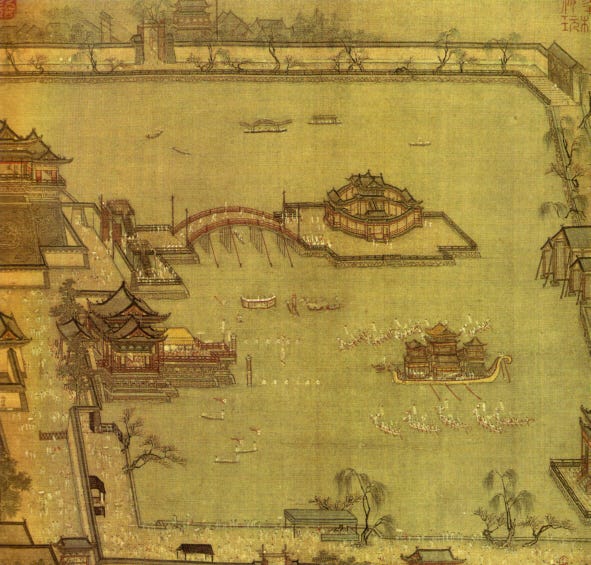
Games in the Jinming Pool; Zhang Zeduan; Northern Song Dynasty, 11th to 12th century.
Case Study: Three Points on Education in Aotearoa New Zealand
For our present conditions in Aotearoa New Zealand, in the dawn of the twenty-first century, the social conditioning of educationand its apparatus is notably different from those that Gramsci analysed in turn of the century Italy. Yet, his method of study retains some merit, as I hope to establish here; in making three observations/analyses on the state of the education system through the cultural and social frameworks recommended by Gramsci:
(1) Modern curriculum and its socio-economic conditioning. Public education has now resided alongside settler-bourgeois class society in Aotearoa for upwards of two hundred years. Legally, its origins can be traced to the Educational Ordinance of 1847, established under Governor Grey to propagate British rule and implement the capitalist mode of production. The question of the tools, practices, and infrastructure for teaching is highly pertinent — and has been so for many decades. The understanding of education as being a matter of family rather than a broader social matter has, if anything, been reinforced in recent years under neoliberal reform.
Generally, education continues to be subservient to the interests of capitalist production. In an immediate sense, this is perfectly reasonable — as it would be for any epoch of social history; to reproduce subjects for their particular time and place. That being said, certain aspects of the former vocational model for public education have been dissolved by the course of history. If we consider the latest Strategic Intentions document published by Te Tāhuhu o te Mātauranga, the Ministry of Education, we can see that a number of Gramsci’s prescriptions for schooling have organically developed into norms for modern education. There is a strong sense that both the intellectual capacities for the national system of production and cultural and social integration for the new generation is imperative. To some extent, we should celebrate this less instrumental approach to education. Yet at the same time we must recognise the limited emancipatory outcomes demonstrated by these modes of schooling in practice. In so far as Gramsci’s vision of the school curriculum has been realised to a very modest extent, it has if anything only strengthened bourgeois hegemony — perhaps demonstrating the potential power of this formulation.
The conditions of work in Aotearoa New Zealand, still firmly embedded in a now deeply globalised capitalist mode of production, notably correspond to what is outlined in the modern curriculum. Eight key learning areas are currently mandatory up until the tenth year of public education: English, Physical Health, Mathematics and Statistics, Natural Sciences, Social Sciences, Technology (as in practical skills, design, information technology, and so on), and the Arts (visual, drama, music, and so on). Interestingly, the latter two are covered fully only up until Year 8 — afterwards, they are only prescribed “according to minimal requirements”. The general shift towards a globalised commercial and financial economy, with a strong focus on the export of so-called “advanced services”, has notably increased the theoretical demand for alienable intellectual labour. The ideal output of the schooling system is a complete intellectual basis to build valuable service labour upon, familiar with fundamental concepts and able to utilise them as a productive agent — an automatic theoriser, as opposed to a creature of both thought and practice. As such, the population of this country is generally being instructed in highly reproducible intellectual processes — whereas instruction in action, processes of embodiment and creativity, are notably confined. They are siloed into an retrograde category.
It is hard to imagine that an authentic creative spirit, one that could aspire to independence from existing conditions and have the experience to articulate and embody such ambitions, could be nurtured in this environment. The schism of intellectual labour and active or practical labour is embedded in schooling from the very start; and indeed, class and the foundations of socialisation in the family continue to shape individual potential. Most blatantly, this may be seen in the steady development of charter schooling since 2024 — likely reiterating traditional caste schisms in the institutional autonomy of élite schools (though this is certainly not how it is represented, supposedly advancing either “choice” for the bourgeois or semi-bourgeois family, or the interests of divergent needs in education). Regardless, schooling is everywhere stood apart from the emerging generations and their conditions of life. Early employment is acquired by family or personal initiative outside of schooling. Work experience is mediated by layers of privation. Under normal conditions, a student is unlikely to have any substantial contact with the general or particular conditions of work that they shall experience throughout the rest of their life until they leave school. Assuredly, this is to the organic advantage of the present governing class forces — segmenting experience and capacities of labour to limited phases in the personal growth of each pupil. National productivity in accordance with the role of Aotearoa New Zealand in the global system leads, and the people are obliged to follow.
We should also recognise a consolidation of personhood into the education system here — the obligation to learn some degree of humanities in English and the Social Sciences. Integration into national cultural life has been established as a key strain of education in Aotearoa New Zealand, mediated through a range of texts and media forms, both traditional and contemporary. Gramsci strongly advocates for this more complete mode of schooling, though he assuredly envisioned a culture that is more social or mass-democratic. The continuing role of nationalism and national cultural life over modern capitalist production in many Western countries is vital here, rarely understood in its concrete complexity. However, it is notable where this curriculum of cultural and social personhood (for a liberal-national morality) begins and ends…
(2) Te Reo and the formation of social critique. Language is the best medium for understanding these confines. Anglo-Atlantic hegemony has insulated Aotearoa New Zealand from the necessity of teaching foreign languages, in stark contrast with most other countries in this epoch of globalisation. We should note here that Te Reo Māori is effectively treated as a foreign tongue in its own land — “encouraged” rather than mandated, alongside curricula in European, Polynesian, and East Asian languages.
When Gramsci speaks on the role of the “classical” languages (Latin and Greek) in building the capacity for critical, historical, and dialectical understanding, he recognises that the languages themselves are not the point. Depending on historical conditions, the study of many different languages may plausibly underpin critical thought. Indeed, dogmatically adhering to these classics on the authority of tradition disrupts the very purpose that Gramsci attributes to them — as a method of comprehensive instruction in the processes of abstraction, dialectical analysis, and historical understanding. The fundamental conditions of a given national or social situation must inform what could underpin an educational programme; such that this sort of study can adequately illuminate these conditions and theorise their actual transformation.
For Aotearoa New Zealand, the study of Te Reo Māori is an obvious candidate. Where the “dead languages” of Greek and Latin underpinned Gramsci’s Italian context as historical or cultural intellectual foundations (entwined by a traditionally asserted continuity between ancient ideals and modern nationhood, regardless of the truth of this), Te Reo is a defiantly living language; one undergoing persistent resurrection and development by the will and action of its people. Classical languages serve as the levees on intellectual history, channeling an ideological claim by modernity upon a supposedly glorious history — an aesthetic and cultural pillar. Te Reo, by comparison, stands in contradiction to the real colonial forces that make up modernity in this country.
Where the strength of Greek and Latin in theoretical instruction lies in their abstract dissection and reconstitution in classical literature, Te Reo as a subject of study poses a comprehensive historical struggle, with both immediate and historical implications. Understanding it in the context of the decolonial struggle essential to life in this country lays groundwork for an understanding of how we may actualise social change — both as an epistemological framework of knowledge-creation (as all languages are, effectively) and as a taonga that was in itself attacked and repressed by colonial force. One cannot really learn Te Reo without learning about the history of Aotearoa, its cultures and its peoples. But perhaps more importantly, one cannot utilise Te Reo once learnt without engaging with the literature and discourses of mana whenua, old and new, and the rejuvenation of their nation. As a language, it not only uncovers the past, but illuminates the present and future. It poses a fundamental reintegration of schooling with social life and history as a living organic reality.
As such, Te Reo provides grammatical vessels for articulating a new humanities in Aotearoa, for a new society. We see the challenge that it presents for the existing system quite clearly in the politics and practice of Te Reo and its education, here and now. How controversial is the prospect that a colonised nation ought to be able to speak its language to the forces of the settler-state that continues to occupy their land and life? It seems that for the bourgeoisie and their cadres it presents an imminent threat — and it is easy to see why. For any sensible or responsible analysis of our given situation, with any ambitions for a better society to blossom from our present stagnant rut, Te Reo presents a clear avenue forwards for our curriculum — regardless of the hot air and venom that is blown at its renaissance.
(3) Tertiary education. Perhaps the most edifying developments in modern education have taken place in the tertiary sector — universities, polytechnics, and so on. In an epoch of monetarist political economy and neoliberal ideology, with social and public goods increasingly organised through Public-Private Partnerships, formerly public higher educational institutions have increasingly converged towards capitalised enterprises.
The ever-developing complexity of social tasks and intellectual needs for modern production and reproduction — not to mention the class struggle over social mobility within the capitalist system — has greatly expanded the scope of higher education among the general populace. Throughout the twentieth century core bourgeois countries and their mass democratic formations (Europe and Aotearoa New Zealand included) established higher education as a social good based on individual merit. Anyone who could acquire initial scholastic achievements, and secure some living costs could (for the most part) enter tertiary education. Theoretically, this would help abolish traditional class distinctions, and secure more democratic intellectual strata. In practice, quite the opposite occurred.
Rather than repopulating or reconstructing the intellectual strata of bourgeois society, the fundamental forces constituting bourgeois society at large served instead to ossify and deepen class divides — the very fact of society’s permeability, that anyone could move in and out of stations in the social hierarchy, set in stone the legitimacy and rigidity of those social stations in themselves.
This transition is instrumental to the century-long movement of private property from the hands of the private bourgeois family to the modern corporate structure. Just as Gramsci observed with the new modes of schooling in his day, educational practices are endogenous to the broad social strata that they exist within — in his case, he observed that pupils of élite or urban families would retain their station or cultural context to an intellectual advantage over their humble or rural equivalents. Today, we must recognise that where higher education may develop individual capacities, it nonetheless does so through limited channels; that social mobility remains conditional on capitalist terms overall, an inexorably rigid class society. Corporate capital of the present day may be staffed by anyone, but it nonetheless demands that most of the population dwell in relatively immiserated conditions. Indeed, I would hypothesise that this principle of permeable rigidity has greatly contributed to the endurance of capitalist class relations during the twentieth century.
Concentric to this partial universalisation of the tertiary sector (that is, theoretically accessible to all, either through public funding or student loans), higher education has also converged on the narrow principles of instrumentality that Gramsci observed in the new foundational schooling systems of his day. Assuredly, this has been intensified by the neoliberal restoration — both of accumulation and the radical contraction of social mobility — in which education has been reconstituted as an object of exchange, a commodity that can be capitalised. Student loans now finance alienable courses, paid through a protracted transaction.
Where the university has been transformed from a semi-autonomous social institution into a vendor or producer of value, the constraints of necessarily acquiring returns on investment fundamentally reshape educational output. Rather than pursuing a complete or semi-complete intellectual ensemble, the purpose of the tertiary academy converges to reproducing intellectual roles and vocations, for fulfiling certain intellectual functions and little else. Courses may be diverse, but they are siloed and contingent on a limited vocational destiny. Here, education is an alienable thing, that in being so must become alienated from complete intellectual personhood. Under such conditions, a political horizon for society as a whole or a critical inclination is unlikely to survive.
The scholars created by this sort of institution are ill-equipped to face the social, political, and inter-vocational problems that modern life increasingly demands — especially given the escalating historic crises of today. Indeed, they are structurally discouraged from becoming acquainted with them. Inter-disciplinary procedures, often touted as a means of addressing these corrosive fissures, cannot hope to avail us of the active social alienation between intellectual strata, of each from all. Until political and civil society at large begin to diverge from their present stagnation, fundamental crises of higher education wreaking havoc on scholars young and old cannot hope to be resolved.
메타데이터
- post_id
- 7395e4bfa0ba
- slug
- 1-2-conspectus-on-the-prison-notebooks-on-education-pp-24-43-7395e4bfa0ba
- url
- https://medium.com/@forthemodernprince/1-2-conspectus-on-the-prison-notebooks-on-education-pp-24-43-7395e4bfa0ba
- canonical_url
- https://medium.com/@forthemodernprince/1-2-conspectus-on-the-prison-notebooks-on-education-pp-24-43-7395e4bfa0ba
- author_url
- https://medium.com/@forthemodernprince
- status
- ok
- fetched_at
- 2026-07-13 16:21:41






