The Donkey Satsang — Hans Yoganand
Home / The blog yoga-originel / The Révélation
The Donkey Satsang — Hans Yoganand
**Home / The blog yoga-originel / The Révélation**
Hans Yoganand spent several years in India, in an ashram, before returning to France with a deep spiritual practice and a name given to him by his guru. This text, written in 2016, is an autobiographical account of his time in the Berry region — communal life, intense meditation, woodcutting — and of a singular encounter that speaks, better than any discourse, to the presence of the divine in all things.
When I was living among a community of potters near Bourges (the potters of la Borne), in the late seventies, after coming back from India, I spent ten hours a day in deep, seated meditation. The rest of the day I spent in service — a form of meditation in action.
Up in the attic of the old potters’ house, I had found a kind of platform, a fleet ¹ of planks, suspended between two sets of heavy beams, mid-air, like a mezzanine.
The attic was in no way finished or insulated: looking up, you could see the underside of the roof tiles, and all around, the timber frame like an upturned boat. Here and there, gaps let in both air and light.
To get up onto the platform, you had to climb a ladder, and once you did, you found yourself halfway up the attic, perched like a lookout in a crow’s nest. The floor was fair-sized — about two hundred square feet — hanging in the air between several beams, like something set in place and forgotten.
I was in my early twenties, and the place had won me over. I hung light Indian fabrics — thin as Benares scarves — all around the platform, between the heavy beams that marked its edges, to carve out a slightly sheltered space. That spot had become my meditation room, outside of space and time, like some kind of special vessel.
I would go up to meditate from five to nine in the morning, then again from twelve-thirty to two-thirty in the afternoon, and in the evening I’d settle in from eight to midnight — every single day, no exceptions. That kind of schedule isn’t required on The Path ², but I had a thing about meditation — a full-blown obsession, really.
I’ve always been drawn to meditation, since I was a little kid. As a pre-teen, I’d lie flat on my bed and stay completely still, hoping to leave my body — good old Lobsang Rampa, what a character! — or I’d stretch out under a flowering bush and watch the bees that couldn’t see me, so completely had I melted into my surroundings.
I’d come out of those meditations with my heart like a sail filled with the wind of God, happy as a kid on Christmas Eve! Each day I spent in service, floating on a cloud.
I paid for my room and board by cutting the wood needed to fire the pottery. Every month, the potters fired their work in a large brick kiln, fitted with two open fireboxes, one on each side. The wood was laid across the top of each firebox, and the fire, burning from below, enclosed in the brick chamber, would consume it by licking up through the openings. The firing took twelve hours, and the cooling just as long.
It took about twelve cubic yards of wood to feed the beast. My job was to turn three dry oak trunks into small, uniform pieces of wood — all the same length, all the same thickness. Too short, and the pieces wouldn’t straddle the open firebox; too long, and you’d end up with unburned wood. Everything had to burn, and the combustion rate had to be steady — not too fast, not too slow. You can imagine what a challenge that was!
I’d chainsaw rounds from the oak trunks, cut to the length of the firing sticks, then split them into rough chunks with a maul, before finishing them to the right thickness with a hatchet.
You see — demanding work, where mental chatter wasn’t much use. That was my joy! It was service in its purest form: I practiced the Holy Name ³, just as I had learned it in India, at the ashram where I had lived, and I stayed with it from morning till night.
Meeting the Three Donkeys
Every day I walked to the neighboring village — Menetou-Salon — to pick up bread. I went on foot, along a sunken lane dug into the earth, running between hedgerows set high on earthen banks. The path wound through the bocage like a hobbit trail, invisible to anyone who didn’t know to look.
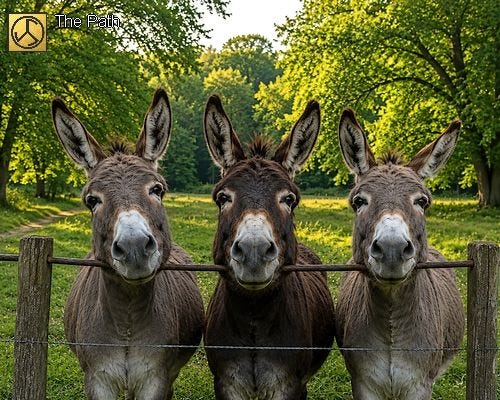
It ran along a meadow where three donkeys lived. One day, when my heart could no longer hold its peace and the need to give satsang ⁴ had become irresistible, I walked up to the barbed wire fence to try to pet them. I made that clicking sound you make for horses, and one of the donkeys came over — then the other two followed.
I don’t know why I started talking to them about meditation, about God present in all things, in them as in me — but there it was: I gave them satsang. I could feel that current running through my words. The Holy Name was buzzing intensely in my chest. The three donkeys rested their heads on the top strand of barbed wire and listened closely, their beautiful, dark-lined eyes half closed.
From that day on, every time I walked past their meadow, the three donkeys would trot over and line up side by side to receive satsang. Every time, I gave it to them — and every time, I felt the connection with the Holy Name and a sense of brotherly love for those three donkeys.
I was certain that the satsang was speeding up their samsaric ⁵ evolution, and that they knew it. I have a deep love for Saint Francis of Assisi, and in this I followed his example. I offer you this story as it happened — no justification needed beyond its own truth.
¹ Fleet: from the English verb “to fleet” (to float), referring to a temporary floor or lightweight platform suspended within a timber frame.
² The Path: the sadhana of Original Yoga, the spiritual practice taught by Hans Yoganand.
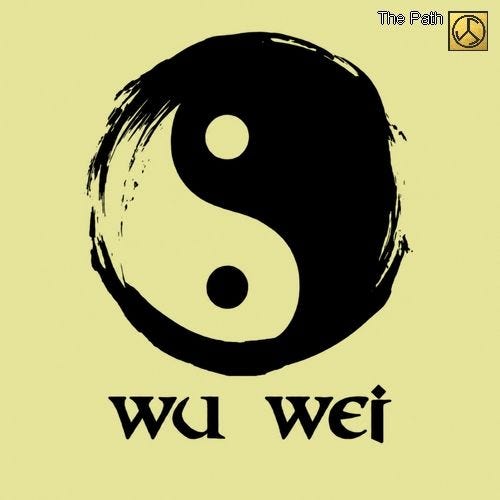
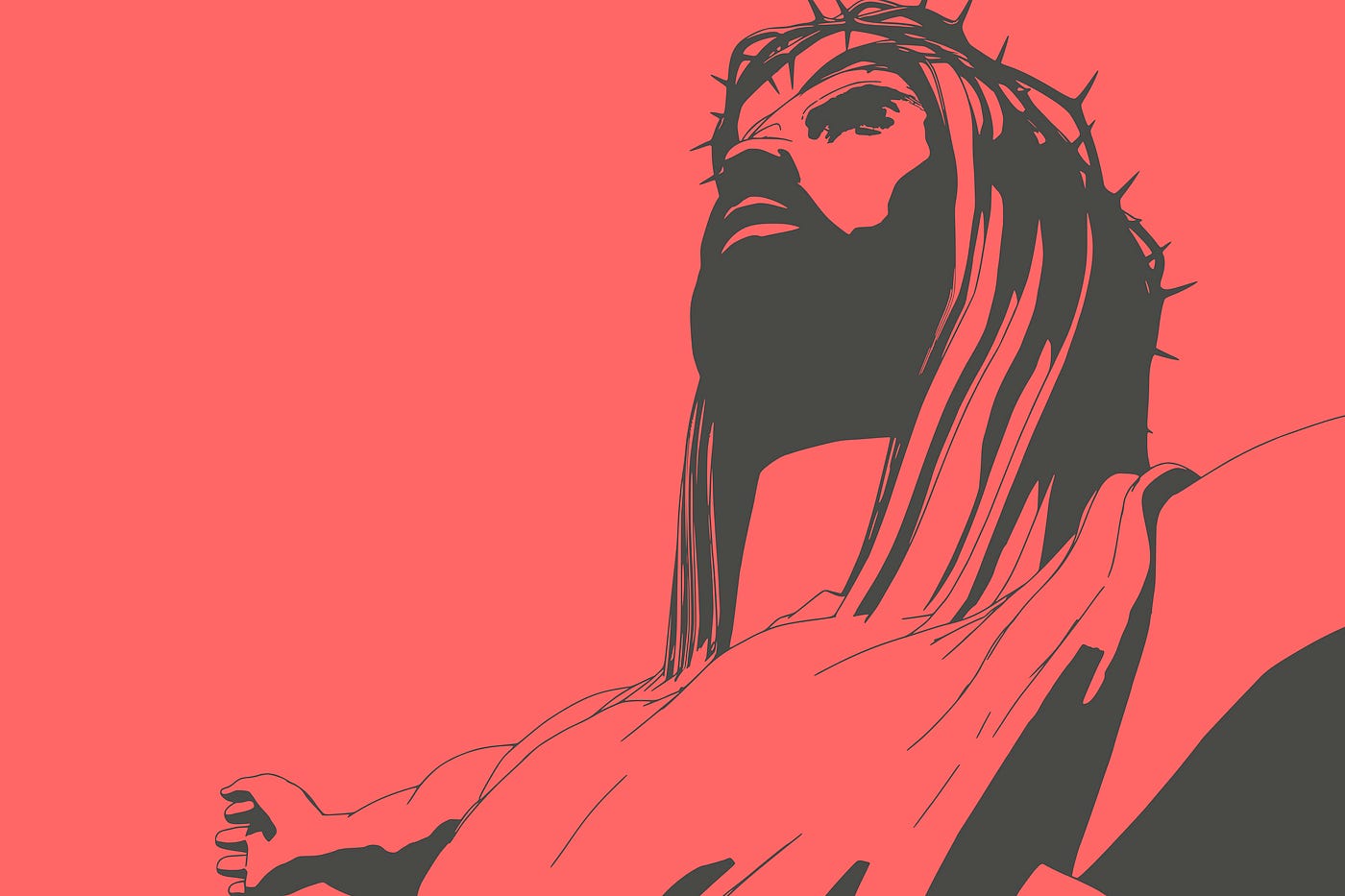
³ The Holy Name: one of the four meditation techniques taught by Hans Yoganand during the “Revelation.” It corresponds to the shabda-Brahman of the Vedic tradition — the divine principle that manifests within material reality and connects it to the spiritual. Christians know it as the Holy Spirit; Lao-Tzu called it “the virtue of the Tao.”
⁴ Satsang: a spiritual sharing that is part of the sadhana — see the pinned post on this blog for a full introduction.
⁵ Samsaric: relating to samsara, the Hindu cycle of successive reincarnations of the soul toward its final liberation.
Originally published at https://observance.over-blog.com on June 6, 2026.
메타데이터
- post_id
- 739977d72b4c
- slug
- the-donkey-satsang-hans-yoganand-739977d72b4c
- url
- https://medium.com/@lavoie.eu/the-donkey-satsang-hans-yoganand-739977d72b4c
- canonical_url
- https://medium.com/@lavoie.eu/the-donkey-satsang-hans-yoganand-739977d72b4c
- author_url
- https://medium.com/@lavoie.eu
- status
- ok
- fetched_at
- 2026-07-09 04:10:03