Shift
Every Tuesday, a ritual of guilt for the shift a brother covered — a story from Samuel Kozah
Shift
Every Tuesday, a ritual of guilt for the shift a brother covered — a story from Samuel Kozah
I missed a Tuesday once. February 2003. Malaria fever. The house collapsed.
The real house was already gone. Demolished in 1987 when the Peugeot plant shut down and the workers’ quarters in Sabon Tasha came with the fence. Number Twelve, Ungwan Rimi. Carted away in four days. The house I lost in 2003 was the one in my head. When I surfaced from three days of chloroquine, sweating on a mat in Abuja, I tried to reconstruct the compound courtyard. Twenty-two feet long, fifteen feet wide. Then the grinding stone. Granite, three legs, worn smooth. It should have been there against the wall. North side or south side.
I reached for the image. Nothing came.
The courtyard existed in my mind with a blank space where the grinding stone should have been.
Six months to rebuild that detail. I found a photograph in a biscuit tin my mother left. A snapshot from Easter 1970. The grinding stone visible in the background, north wall, beneath the raffia basket hooks.
I have not missed a Tuesday since.
This afternoon, leaving the Teaching Hospital, I passed a gateman asleep in his chair outside the main entrance. His shoes were beside him on the ground. Black canvas, the toes worn through. I stepped around them. The gate swung shut behind me.
Every Tuesday. nine forty-seven P.M. I close my eyes in Abuja and open them in Ungwan Rimi. The reconstruction takes forty-three minutes. I have timed it.
I keep a pencil in my right hand during the walk-through. The grip has shifted from forty years ago, the knuckle of the ring finger carrying more weight since the joint thickened. Muscle memory from four decades rendering anatomical drawings at Ahmadu Bello University Teaching Hospital. Spleens bisected. Livers layered. Femurs fractured and labeled. The hand moves without instruction. Most nights I take the sketches to the bathroom sink afterward and burn them. Watch the lines dissolve under running water. The kitchen drawer is where the others are.
The ceiling fan hums. Twenty-eight degrees constant.
I begin.
Step height on the compound entrance: six inches. The red earth packed hard, mixed with clay and cow dung, smoothed every rainy season. The third step cracked in August 1964 when the rains came too hard. The crack runs diagonal, northwest to southeast. Gwamna stepped on it barefoot and cut his heel. He picked out the stone chip with his fingernail, left a divot where the clay gave.
I run my mental finger over that divot every Tuesday. The texture holds.
The kitchen stands in the northeast corner of the compound. I enter through the doorway, twenty-eight inches wide. Just a curtain of sewn flour bags, Mama Cass and Golden Penny labels still visible.
There is a nail driven into the left doorframe at shoulder height, the head worn smooth. Gwamna used to hang his cap there when he came in from the yard. I have no clear memory of his face without the cap above it.
The cupboard. Unpainted wood, termite holes at the base, the handles carved from mango branches. Top shelf holds the enamel plates. Middle shelf, the aluminum pots stacked inside each other. Bottom shelf, the provisions.
My mother kept the school fees money in an old Peak milk tin behind the salt container. Three hundred naira every term, folded tight, wrapped in newspaper. Gwamna used to joke that if thieves broke in, they would take the salt and leave the money because who keeps money behind salt.
He was thirteen when he said that. I was ten. I thought he was the cleverest person in Kaduna.
I open the cupboard. Reconstruct the garri bag on the left, five kilos, the coarse yellow type from Benue. The groundnut oil in the plastic jerry can on the right, the kind that leaves sediment at the bottom.
I reach for the top shelf where the prayer timetable should be.
In my blueprint, this space is undefined. Empty. A structural gap I never filled because I never needed to. Fifty-three years of Tuesdays and the top shelf has always been void.
Tonight: a union card. National Union of Textile, Garment and Tailoring Workers. Green cardstock, standard size. Embossed seal in the corner. Fanta stain spreading across the bottom edge, the orange seeping into the fiber.
My right hand moves back from the shelf before I have decided to pull it back. The card is not new information.
I try to close the cupboard but it stays open. The hinges refuse to swing.
I try to erase the card. Smooth the space back to nothing.
The stain spreads and the seal embosses higher.
The kitchen is colder than it should be. Goosebumps rise on my real arms in Abuja. The fan dial says twenty-eight. The mental kitchen registers something lower. Twenty-five, maybe twenty-four. I notice the difference in my lungs when I breathe.
My right hand moves. The pencil scratches paper.
I do not look down.
The parlour is next. I move through the doorway. The frame is iroko wood, stained dark, splintered near the hinge where Gwamna carried the new radiogram through in 1968 and misjudged the width.
The Grundig sits on the sideboard. Wood cabinet, 1955 model, the veneer peeling at the corners. In my reconstructions it is always silent.
Tonight: the speaker hisses.
I stop as the hiss continues. White noise between frequencies.
Then a voice. Male. Hausa accent heavy, the cadence of FRCN Kaduna.
“Accident for factory. One person don die. Man, age twenty-one. Name we never release because family never know.”
The compound gate rattled at eleven forty-seven P.M. on August 11, 1972. I was still awake, door open, kerosene lamp low. Waiting for Danlami to come tell me about the film at Minere Cinema. Cowboys from America. He said he would stop by. He did not come.
The gate rattled. My mother went outside. I heard her voice call out “Who is it?” Then I heard the sound a voice makes when it folds.
She came back inside. Slow. Came to my room, stood in the doorway. Told me to get dressed. There had been an accident at the textile mill.
I asked which shift.
Three seconds of silence while she stood there backlit. Looking at me.
My hand went to the kerosene lamp. It was still burning. I was in my room. My body registered its own safety before the mind could follow, and for three seconds the lamp burned and I was safe.
Then she was still looking at me.
Gwamna was covering my shift because I begged him to trade. I wanted to see cowboys with Danlami Choji. Danlami had a gap between his front teeth and when he smiled at me outside St. John’s I thought I understood what the older girls meant when they said “my heart is doing me.”
That is all I remember about Danlami now, just the gap in those teeth when he smiled.
Danlami’s family left our church two weeks after the funeral. His mother said I had “heavy spirit” on me.
In Abuja, my hand cramps. The pencil falls to the cement floor. I lean down, pick it up. Keep going.
The parlour is colder. Twenty-two degrees. I see my breath in the mental room, small clouds that dissolve against the mud walls. The walls came in layers. New mud on top, smoothed every year. Then older layers beneath, darker. The original laterite bricks from when my grandfather built the compound in 1949.
I try to leave the house. Walk to the compound gate, step outside, end the reconstruction early. Return to Abuja where it is warm and I do not have to think about Danlami’s teeth or Gwamna’s heel or the way my mother looked at me when I asked which shift.
The gate is gone.
The compound wall is solid mud where the gate should be.
The only exit is the ladder to the boys’ room.
I have never gone up the ladder in fifty-three years of Tuesdays.
The boys’ room is a void in my mental map. I reconstruct the kitchen, the parlour, the courtyard down to the quarter-inch, then I exit. The boys’ room is not structurally necessary.
Tonight the architecture forces me.
I climb.
The ladder is steep. Rough-hewn wood, rungs spaced twelve inches apart. Original 1950s construction, built when boys were expected to climb fast and lumber was borrowed from the sawmill. Each rung presses into my palms.
My thumbnail has pressed through the skin of my thigh.
Six rungs. The ladder sways.
Seven rungs. The air is colder. Twenty degrees. My breath is visible.
Eight rungs.
The foreman’s hand is on my shoulder. His palm is damp. He speaks Hausa. He is trying to be gentle. He does not know how.
Nine rungs. The corridor at Barau Dikko Hospital. The smell of disinfectant and something underneath it. They brought me because my mother could not stand. One hundred twelve beats per minute. I count them. Try to slow them.
Ten rungs. The platform.
The boys’ room has no door. Just a raffia mat nailed across the opening. I push it aside.
The sleeping mat is unrolled. Thin foam, covered in ankara print, the pattern faded to ghosts of color. In my reconstructions, the few times I attempted this room before I learned to avoid it, I always pictured the mat rolled up and tied. Neat. Stored properly.
Gwamna never rolled his mat. My mother used to stand at the bottom of the ladder and call his name in that tone that meant disappointment without discussion. He would lean over the edge and grin down at her, teeth showing, the whole face open, shameless about it. She would press her lips together to hold something in, and when she turned away her shoulders were shaking.
The wooden trunk is against the wall. Scratched surface, padlock broken since 1970. A piece of paper sits on top.
I approach. The floor creaks. Bamboo slats. Second slat from the entrance. Fourth slat.
The shift schedule. Textile Workers United, week of August 7, 1972. Mimeographed blue ink on foolscap.
The foolscap has a particular weight. My palms know it. I have held this paper before.
My handwriting in biro. “Danjuma Hannatu” crossed out. “Danjuma Gwamna” written in pencil beside it. His handwriting. All capitals, the way they taught in primary school.
I grab the paper.
In Abuja, my hands are empty. In the mental room, the schedule crumples in my fist.
I try to tear the paper. My mental fingers will not obey.
The room has no tap. In 1972 I used the outdoor tap behind the kitchen, washed the ash into the gutter.
The house will not let me erase it again.
I open my hand. Beneath the schedule: the union card. The Fanta stain marks both pieces now, spreading. Gwamna always drank Fanta before the night shift. My mother bought it from Mai Shayi¹ down the road, the bottle sweating cold from the ice block cooler. He drank it in three long swallows, returned the bottle for deposit.
I drop to my knees. The floor is cold. Eighteen degrees.
Under the trunk: work shoes. Black canvas, Chinese make, size ten. The toes worn through from kneeling at the weaving machines. Bata knockoffs from Kano market. He saved four months of apprentice wages to buy them. The laces are sisal rope, one broken and reknotted. He broke it three weeks before he died. Meant to get new laces from the cobbler at Railway Station.
Red mud cakes the soles. Kaduna mud, specific to the factory yard near the River Kaduna where the waste pipes emptied.
The mud is wet.
I reach out. My hand shakes.
I touch the mud.
The stain spreads to my fingers, palm, wrist. Red laterite, red clay. There is no water to wash it away.
The day Gwamna got the scar on his chin, I was riding his bicycle. The Chinese Forever brand with the curved frame. He was fixing the chain because I jammed it trying to shift gears climbing the hill past Baptist Church. The chain snapped and whipped back. Caught his face below the lip.
I saw the skin split. The blood well up, run down to his neck.
He did not even cry. He pressed his wrapper to the wound. Said, “Go call Mama. But don’t tell her it was you.”
Thirteen years old. I was ten.
Even then he was covering for me.
A pattern sixty-two years long if I count from the bicycle chain.
Danlami Choji. Gap-toothed smile. I do not even remember his father’s village. I remember the gap. The shadow in it when he smiled. I traded Gwamna’s life for that shadow.
The red mud will not wash off. The schedule will not tear. I stay on my knees. The shoes are six inches from my face.
The house holds. I hold.
I open my eyes.
Abuja. Ten twenty-three P.M. The ceiling fan hum resumes. Twenty-eight degrees constant.
I look down at the paper in my lap. Old newspaper, torn from Daily Times, flipped over. The back is covered in pencil marks.
I have drawn the shoes.
The sketch is incomplete. The laces are missing.
My thumbnail has punctured the skin of my thigh. A small crescent of blood wells in the indentation. My hands are spotted with age, veined, the skin thin as tissue paper.
They still know how to draw.
I fold the sketch and place it in the kitchen drawer where I keep the others I have not yet burned.
Next Tuesday I will go back. I will sit in the cold room with the muddy shoes and the Fanta-stained paper and I will let the house be true.
The habit continues.
Penance.
Next Tuesday is six days away.
- Mai Shayi: tea seller
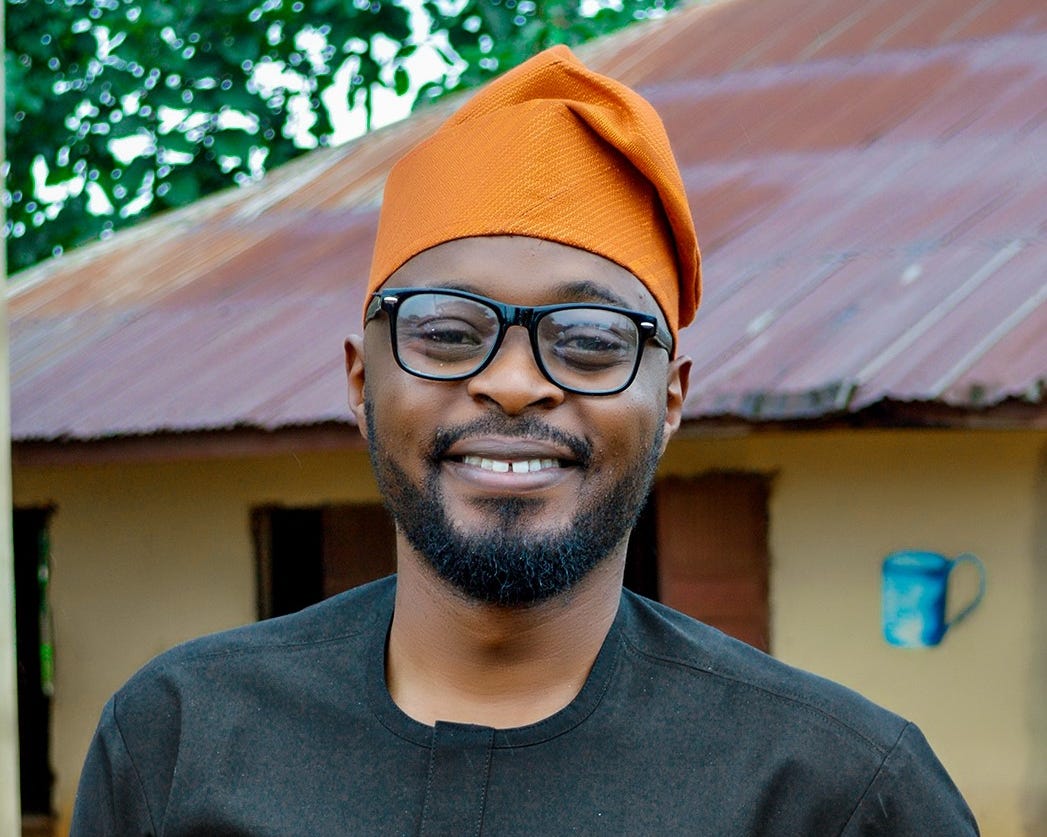
Samuel Kozah is a pharmacist and writer based in Kaduna, Nigeria. His fiction is rooted in the landscapes and communities of northern Nigeria. His work has appeared in Brittle Paper, Altered Reality, Neither Fish Nor Foul, and Horrific Scribes, with upcoming work in Amethyst Review, Lost Blonde Lit, and Night Shades Magazine. See read of his work on his Substack samuelkozah.
메타데이터
- post_id
- 73bdb89ec106
- slug
- shift-73bdb89ec106
- url
- https://kalaharireview.com/shift-73bdb89ec106
- canonical_url
- https://kalaharireview.com/shift-73bdb89ec106
- author_url
- https://medium.com/@kalaharireview
- status
- ok
- fetched_at
- 2026-07-07 23:07:08