15 Everyday Objects That Changed the World by Pure Accident: The Incredible Stories Behind…
History often celebrates brilliant inventors who transformed the world through careful planning, years of experimentation, and unwavering…
15 Everyday Objects That Changed the World by Pure Accident: The Incredible Stories Behind History’s Most Unexpected Inventions
History often celebrates brilliant inventors who transformed the world through careful planning, years of experimentation, and unwavering determination. While countless groundbreaking discoveries have indeed emerged from meticulous research, some of humanity’s most useful everyday objects owe their existence to something far less predictable: pure accident. In laboratories, kitchens, workshops, and factories, moments of curiosity combined with unexpected mistakes have repeatedly changed the course of history.
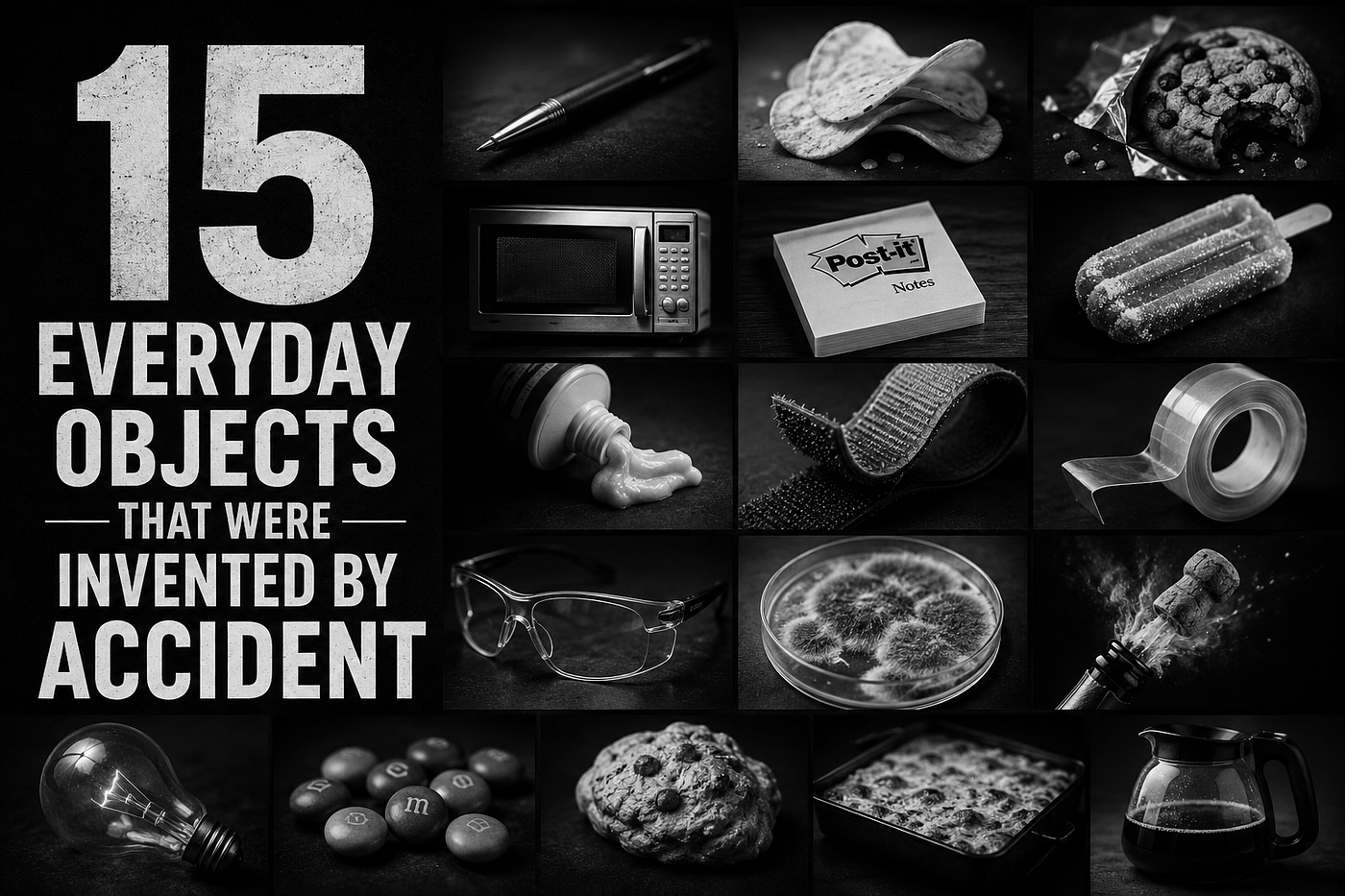
History often celebrates brilliant inventors who transformed the world through careful planning, years of experimentation, and unwavering determination.
The phrase “happy accident” may sound simplistic, but many revolutionary inventions began as complete failures. Scientists searching for one solution stumbled upon another. Engineers attempting to solve a technical problem uncovered an entirely different breakthrough. Even ordinary cooks and craftsmen have unintentionally created products that eventually became household essentials used by millions of people every day.
What separates these accidental discoveries from ordinary mistakes is not luck alone. Equally important was the willingness of inventors to recognize unexpected potential. Instead of discarding unusual results, they asked questions, investigated further, and imagined new possibilities. Their curiosity transformed failures into innovations that continue to influence modern life.
Today, we rarely stop to consider how common objects around us came into existence. The sticky notes attached to office walls, the microwave warming yesterday’s dinner, the potato chips served at family gatherings, and even the safety glass protecting drivers all have remarkable origin stories filled with surprises, persistence, and fortunate coincidences.
These inventions remind us that progress is rarely a straight line. Many of the greatest advancements in science, technology, medicine, and everyday convenience emerged because someone noticed an unexpected outcome and chose to explore it rather than ignore it. In many cases, these discoveries created entirely new industries, generated billions of dollars in economic value, and permanently changed the way people live and work.
The stories behind accidental inventions are also deeply human. They reveal frustration, curiosity, creativity, and resilience. Inventors frequently experienced disappointment before realizing they had discovered something far more valuable than their original objective. Their experiences demonstrate that innovation often depends less on avoiding mistakes than on learning how to recognize opportunity when it appears in disguise.
In this article, we’ll explore fifteen everyday objects that were invented by accident. Each story reveals how chance encounters, laboratory mishaps, unexpected chemical reactions, and even moments of irritation gave rise to products that have become indispensable parts of modern life. From office supplies to kitchen appliances, these remarkable inventions prove that sometimes the biggest breakthroughs happen when things don’t go according to plan.
1. Post-it Notes
Today, it is almost impossible to imagine offices, classrooms, libraries, and homes without Post-it Notes. Their bright colors and reusable adhesive have made them indispensable tools for organizing ideas, leaving reminders, and collaborating on projects. Yet one of the world’s most recognizable office supplies began as what appeared to be a complete scientific failure.
In 1968, chemist Spencer Silver was working at the 3M Company in the United States. His assignment was to develop an exceptionally strong adhesive for industrial applications. Instead of creating a powerful glue, Silver accidentally produced one that was surprisingly weak. Rather than bonding permanently, the adhesive stuck lightly to surfaces and could be removed without leaving residue.
From the perspective of his original project, the experiment had failed. Strong adhesives were valuable; weak ones were not. For years, Silver promoted his unusual invention within the company, believing it must have some practical use. However, no one could identify a compelling application for an adhesive that intentionally refused to stick permanently.
The breakthrough arrived several years later when another 3M scientist, Art Fry, encountered an entirely different problem. Fry sang in his church choir and frequently placed paper bookmarks inside his hymn book. Unfortunately, the bookmarks constantly slipped out during rehearsals, forcing him to search for the correct page repeatedly.
One day, Fry remembered Silver’s unusual adhesive. What if the weak glue could hold paper securely without damaging the pages? He applied the adhesive to small pieces of paper, creating bookmarks that stayed in place yet could be removed effortlessly.
The concept quickly expanded beyond bookmarks. Colleagues began using the sticky pieces of paper to leave messages, organize documents, and record reminders. After extensive product testing and consumer feedback, 3M officially launched Post-it Notes nationwide in 1980.
Initially, sales were slow because many customers did not immediately understand why they needed the product. Once free samples were distributed, however, demand exploded. People quickly discovered countless uses for removable notes, transforming them into one of the most successful office products ever created.
Today, billions of Post-it Notes are manufactured annually in dozens of colors, sizes, and shapes. Their success demonstrates that an invention originally considered useless became a global phenomenon simply because two scientists recognized the hidden value of an accidental discovery.
2. The Microwave Oven
The microwave oven revolutionized home cooking by allowing meals to be heated in minutes rather than hours. Millions of households now depend on this convenient appliance every day, but its invention began with a melted candy bar.
In 1945, engineer Percy Spencer was working for the Raytheon Company, where he specialized in radar technology during the years following World War II. One day, while testing a device called a magnetron — which generated powerful microwave radiation used in radar systems — he noticed something unusual.
A chocolate bar in his pocket had completely melted.
Rather than dismissing the incident as a simple curiosity, Spencer wondered whether microwave energy could intentionally heat food. To investigate, he conducted additional experiments. He placed popcorn kernels near the magnetron, and they burst into fluffy popcorn. Next, he experimented with an egg, which rapidly exploded after heating unevenly.
These surprising observations confirmed that microwaves could efficiently transfer energy into food by causing water molecules to vibrate rapidly, generating heat from within instead of relying solely on external heating.
Recognizing the commercial possibilities, Raytheon developed the first microwave oven in 1947. The early machines were enormous, standing nearly six feet tall and weighing more than 700 pounds. They were also extremely expensive, limiting their use to restaurants, ships, and industrial kitchens.
As electronics improved over the following decades, microwave ovens became smaller, safer, and dramatically more affordable. By the late twentieth century, they had become common household appliances around the world.
The microwave oven fundamentally changed cooking habits. Busy families could prepare meals quickly, leftovers became easier to reheat, and entirely new categories of frozen foods emerged to meet consumer demand.
What began as an engineer noticing a melted candy bar ultimately transformed kitchens across the globe, illustrating how careful observation can convert an unexpected accident into one of history’s most influential household inventions.
3. Potato Chips
Potato chips are among the world’s most beloved snack foods, enjoyed at picnics, parties, sporting events, and family dinners. Ironically, they were never intended to exist. Their creation resulted from frustration in a restaurant kitchen.
The story dates back to 1853 in Saratoga Springs, New York, where chef George Crum worked at the Moon’s Lake House restaurant. According to the widely accepted account, a customer repeatedly complained that the restaurant’s fried potatoes were too thick and soggy.
Growing increasingly irritated, Crum decided to make the potatoes impossibly thin. He sliced them paper-thin, fried them until they became exceptionally crisp, and added an unusually generous amount of salt. Expecting the customer to reject them, he served the crispy slices as something of a joke.
To everyone’s surprise, the customer loved them.
Other diners soon began requesting the same crispy potatoes, which quickly became known as Saratoga Chips. Their popularity spread beyond the restaurant, eventually inspiring commercial production across the United States.
By the early twentieth century, advances in food packaging allowed potato chips to remain fresh for longer periods, enabling nationwide distribution. Entrepreneurs established companies dedicated exclusively to producing chips in large quantities, and the snack rapidly became a staple in grocery stores.
Today, potato chips are available in hundreds of flavors, from classic salted varieties to barbecue, sour cream and onion, cheese, spicy chili, and countless regional specialties. Billions of bags are sold every year worldwide.
Although historians continue to debate certain details of the original story, the legend of George Crum remains one of the most famous examples of accidental culinary innovation. A chef attempting to satisfy a difficult customer inadvertently created one of the world’s favorite snack foods.
4. Safety Glass
Modern life would be significantly more dangerous without safety glass. It protects drivers during automobile accidents, strengthens building windows, safeguards smartphone screens, and reduces injuries in countless public spaces. Yet this lifesaving invention originated from a laboratory accident involving a broken glass flask.
In 1903, French chemist Édouard Bénédictus was working in his laboratory when he accidentally knocked a glass flask off a shelf. Expecting it to shatter into hundreds of dangerous fragments, he was surprised to find that the flask cracked but largely retained its shape.
Curious about this unusual result, Bénédictus examined the flask more closely. He discovered that it had previously contained a solution of cellulose nitrate, a type of liquid plastic. Although the liquid had evaporated, it had left behind an extremely thin transparent film coating the inside of the glass. When the flask fell, this invisible layer held the broken pieces together instead of allowing them to scatter across the floor.
The incident remained in the chemist’s mind for several years. Around the same time, the number of automobiles on European roads was increasing rapidly, and accidents involving shattered windshields frequently caused severe injuries. Drivers and passengers were often cut by razor-sharp shards of broken glass, making crashes even more deadly.
Recognizing the potential of his accidental discovery, Bénédictus developed laminated safety glass by bonding two sheets of glass together with a transparent plastic layer between them. When struck, the glass might crack, but the plastic layer would hold the fragments in place, dramatically reducing the risk of injury.
He patented the invention in 1909, and although manufacturers were initially slow to adopt the technology because of its higher cost, its advantages soon became undeniable. During World War I, laminated glass found applications in protective equipment, further demonstrating its value. By the 1920s and 1930s, automobile manufacturers increasingly began installing safety glass in vehicle windshields.
Today, laminated and tempered safety glass are used in skyscrapers, schools, hospitals, airports, storefronts, and countless vehicles. Building regulations in many countries require safety glass in locations where ordinary glass would present a significant hazard.
A simple accident in a chemistry laboratory ultimately saved millions of lives, proving that careful observation can transform an unexpected mishap into an innovation with enormous social impact.
5. Velcro
Anyone who has fastened a pair of shoes, secured luggage, or adjusted a medical brace has likely used Velcro. This remarkably simple fastening system has become an essential part of daily life, appearing in clothing, sports equipment, aerospace technology, and healthcare. Its invention, however, began during an ordinary walk through the countryside.
In 1941, Swiss engineer George de Mestral returned home after hiking with his dog through the Alps. As he removed the burrs that had stubbornly attached themselves to his clothing and his dog’s fur, he wondered why they clung so effectively.
Rather than simply throwing the burrs away, de Mestral examined them under a microscope. He discovered that each tiny burr was covered with hundreds of microscopic hooks. These hooks easily caught onto the loops found in fabric and animal fur, creating a surprisingly secure attachment.
Nature had already solved a fastening problem that engineers had never fully mastered.
Inspired by this natural design, de Mestral spent years trying to recreate the hook-and-loop mechanism using synthetic materials. The task proved far more difficult than he had expected. Early prototypes failed repeatedly because the hooks either broke too easily or failed to grip the loops effectively.
After nearly a decade of experimentation, he finally developed a durable nylon version that could withstand repeated use. The invention was patented in 1955 under the name “Velcro,” a combination of the French words “velours,” meaning velvet, and “crochet,” meaning hook.
At first, many clothing manufacturers dismissed Velcro as unattractive and impractical compared to traditional buttons and zippers. However, other industries quickly recognized its advantages. Hospitals appreciated its ability to be fastened and unfastened quickly. Sports manufacturers used it to create adjustable equipment. Most famously, NASA adopted Velcro during the space program, where astronauts needed a reliable method for securing tools and supplies in zero gravity.
As consumers became familiar with the product through these applications, acceptance grew rapidly. Today, Velcro is found on children’s shoes, backpacks, military uniforms, orthopedic braces, camping equipment, and countless household products.
The invention demonstrates that inspiration can often come directly from observing the natural world. A routine walk with a dog led to one of the most versatile fastening systems ever created.
6. Super Glue
Super Glue is famous for its extraordinary bonding strength. It can repair broken ceramics, fix household objects, and even play an important role in certain medical procedures. Ironically, this incredibly useful adhesive was originally considered a nuisance.
The story began in 1942 when American chemist Harry Coover was working for Eastman Kodak. During World War II, researchers were attempting to develop clear plastic materials suitable for military gun sights and precision equipment. While experimenting with a family of chemicals known as cyanoacrylates, Coover encountered a frustrating problem.
The substance stuck to nearly everything it touched.
Glassware became permanently attached to laboratory benches. Instruments bonded together unexpectedly, and researchers found the material difficult to handle because it adhered so aggressively to surfaces. Since the objective was to create optical materials rather than adhesives, the chemical was rejected and largely forgotten.
Several years later, in 1951, Coover encountered cyanoacrylates again while working on a different research project. This time, instead of viewing the extreme stickiness as a defect, he realized it was actually the material’s greatest strength.
The team developed the adhesive into a commercial product that could create incredibly strong bonds within seconds without requiring heat or complicated preparation. Eastman Kodak introduced the product to the public in 1958 under the name Super Glue.
Demonstrations of the adhesive’s remarkable strength quickly captured public attention. One famous television demonstration showed two metal cylinders bonded together with Super Glue supporting the weight of a grown man suspended in midair.
Beyond household repairs, doctors discovered that specially formulated medical-grade cyanoacrylates could safely close certain wounds, reducing the need for stitches. Military medics also found emergency applications for the adhesive in treating battlefield injuries before patients could receive full surgical care.
Today, Super Glue remains one of the world’s most widely used adhesives. Its journey from rejected laboratory material to indispensable household product illustrates how changing one’s perspective can reveal hidden value in an apparent failure.
7. Teflon
Few materials have had as broad an impact on modern manufacturing as Teflon. Best known for its use in non-stick cookware, it is also employed in aerospace engineering, medical devices, electrical insulation, chemical processing equipment, and countless industrial applications. Remarkably, this versatile material was discovered entirely by accident.
In 1938, chemist Roy Plunkett was conducting research for DuPont. His goal was to develop new refrigerant gases that would be safer and more effective than existing chemicals. During one experiment, he stored tetrafluoroethylene gas inside pressurized cylinders for later use.
When Plunkett attempted to release the gas from one of the cylinders, nothing happened. Assuming the cylinder’s valve had malfunctioned, he cut the container open to investigate.
Instead of finding compressed gas, he discovered a strange white powder coating the interior of the cylinder.
Further analysis revealed that the gas had unexpectedly polymerized into an entirely new substance. The material possessed extraordinary properties. It was highly resistant to heat, virtually unaffected by most chemicals, remarkably slippery, and extremely durable.
DuPont recognized the discovery’s enormous commercial potential and patented the material under the trademark Teflon.
Initially, Teflon found specialized industrial applications because of its resistance to corrosion and extreme temperatures. Engineers used it in equipment exposed to harsh chemicals, while manufacturers incorporated it into electrical insulation because of its excellent nonconductive properties.
The material gained worldwide recognition in the 1960s when manufacturers began coating cookware with Teflon to create non-stick frying pans. For home cooks, the innovation transformed food preparation by reducing sticking, simplifying cleanup, and decreasing the need for cooking oils and fats.
Today, Teflon is used far beyond the kitchen. It appears in medical implants, automotive components, aerospace systems, waterproof clothing, plumbing materials, and sophisticated electronic devices.
What began as a failed refrigerant experiment evolved into one of the most versatile synthetic materials ever created, demonstrating once again that scientific accidents can reshape entire industries.
8. The Slinky
The Slinky has entertained generations of children with its mesmerizing ability to “walk” down stairs and stretch into long, shimmering coils. Despite becoming one of the world’s most iconic toys, it was never intended to be a toy at all.
In the early 1940s, mechanical engineer Richard James was working on naval equipment designed for the United States Navy. His assignment involved developing springs that could stabilize sensitive instruments aboard ships, preventing them from being damaged by the constant motion of the ocean.
One day, while experimenting with various spring designs, James accidentally knocked one of the long steel springs off his workbench.
Instead of falling straight to the floor, the spring continued flipping gracefully from one end to the other, appearing almost alive as it “walked” across nearby objects before finally coming to rest.
James immediately recognized that the unusual movement was fascinating to watch. He took the spring home, where he and his wife Betty began experimenting with different sizes, wire thicknesses, and materials to perfect its motion.
Betty suggested the name “Slinky,” inspired by a dictionary definition describing something graceful and sinuous in movement.
The couple introduced the toy to the public in 1945 at the Gimbels department store in Philadelphia. Although they were uncertain how customers would react, the demonstration proved an immediate success. Hundreds of Slinkys sold within minutes as children and adults alike became captivated by the toy’s unique motion.
The Slinky soon became an international sensation. Unlike many expensive toys of the era, it was affordable, durable, and surprisingly simple. Its appeal crossed generations, making it equally enjoyable for children, teachers, scientists, and engineers.
Over the decades, the Slinky has even been used in classrooms to demonstrate scientific concepts such as gravity, wave motion, momentum, and mechanical energy. Its simple design has remained largely unchanged for more than seventy years, a testament to the brilliance of its accidental discovery.
From a spring intended for naval engineering to one of the best-selling toys in history, the Slinky reminds us that even the simplest accidents can inspire joy for generations.
9. Saccharin
For millions of people looking to reduce their sugar intake, artificial sweeteners have become an everyday part of life. Among the first and most influential of these sweeteners was saccharin, a substance that has been used for well over a century in beverages, desserts, medicines, and sugar-free foods. Its discovery, however, came about because one scientist forgot to wash his hands.
In 1879, Russian chemist Constantin Fahlberg was conducting research at Johns Hopkins University under the supervision of Ira Remsen. The pair were studying compounds derived from coal tar, hoping to better understand their chemical properties. After a long day in the laboratory, Fahlberg returned home for dinner without thoroughly washing his hands.
As he began eating, he noticed that his bread tasted unusually sweet. At first, he assumed the sweetness came from the food itself, but every item he touched seemed to carry the same sugary flavor. Curious rather than alarmed, he realized that a chemical residue from the laboratory had remained on his fingers.
The following day, Fahlberg returned to the laboratory and systematically tested the compounds he had been working with until he identified the substance responsible for the sweetness. That compound became known as saccharin.
Remarkably, saccharin was hundreds of times sweeter than ordinary sugar while containing virtually no calories. Although it could not replace sugar in every culinary application, it offered an attractive alternative for people seeking sweetness without the energy content of traditional sugar.
Initially, saccharin attracted limited attention. However, during periods when sugar became scarce or expensive, particularly during World War I and World War II, demand increased dramatically. Later, it became especially popular among people managing diabetes and those attempting to lose weight.
Over the decades, saccharin has occasionally been the subject of scientific debate regarding its safety. Extensive research and regulatory reviews eventually concluded that it can be safely consumed within established guidelines, allowing it to remain available in many countries.
Today, although newer sweeteners have entered the market, saccharin continues to be used in numerous products around the world. Its discovery serves as a reminder that even routine laboratory habits can unexpectedly lead to breakthroughs with lasting global significance.
10. Stainless Steel
Knives, forks, kitchen sinks, medical instruments, surgical equipment, skyscrapers, and countless household appliances rely on stainless steel for their durability and resistance to rust. Before its invention, however, corrosion posed a constant problem for manufacturers. The solution emerged from an unexpected result during weapons research.
In 1913, English metallurgist Harry Brearley was working in Sheffield, a city renowned for its steel production. His assignment involved developing stronger steel alloys for rifle barrels, which were subjected to intense heat and pressure during firing.
Brearley experimented by adding different amounts of chromium to steel, hoping to increase its durability. Many of the experimental samples failed to meet the performance requirements for military use and were discarded in a pile outside the laboratory.
Some time later, Brearley noticed something unusual. While the ordinary steel samples had begun rusting after exposure to the weather, several of the chromium-containing pieces remained bright and shiny.
Intrigued, he investigated further and discovered that adding sufficient chromium created an invisible protective layer of chromium oxide on the metal’s surface. This thin film prevented oxygen and moisture from reaching the underlying steel, dramatically reducing corrosion.
Brearley immediately recognized that the alloy’s greatest value was not in weapons but in everyday applications where rust resistance was highly desirable. One of the first suggested uses was cutlery, which frequently stained or corroded after repeated contact with food and water.
Although convincing manufacturers to adopt the new material took time, stainless steel eventually transformed numerous industries. Hospitals appreciated its hygienic properties because the smooth surface could be sterilized easily. Architects embraced its durability for buildings and bridges. Food manufacturers valued its resistance to corrosion and contamination.
Today, stainless steel is found almost everywhere. Modern kitchens depend on it for cookware, appliances, sinks, and utensils. Medical professionals rely on it for surgical instruments and implants. Engineers use it in aircraft, ships, chemical plants, and public infrastructure.
An alloy originally dismissed during weapons research ultimately became one of the most important engineering materials ever developed, illustrating once again that failed experiments often conceal remarkable opportunities.
11. Play-Doh
Few childhood toys are as instantly recognizable as Play-Doh. Its bright colors, soft texture, and endless creative possibilities have entertained generations of children. Surprisingly, the colorful modeling compound began life not as a toy but as a household cleaning product.
During the early twentieth century, many homes were heated by coal-burning furnaces. Coal fires produced soot that settled on walls covered with paper wallpaper. Cleaning the delicate wallpaper without damaging it was difficult, prompting the Kutol Products Company to develop a soft, pliable compound that could lift soot from the surface.
The cleaning product worked remarkably well and became a steady seller for many years.
Everything changed after World War II. Homes increasingly switched to cleaner heating systems powered by natural gas and electricity, greatly reducing soot accumulation. At the same time, washable vinyl wallpaper became more common, making the cleaning compound largely unnecessary.
Faced with declining sales, the company searched desperately for a new purpose for its product.
The breakthrough came through an unexpected suggestion. A nursery school teacher discovered that the soft cleaning compound was perfect for children’s arts and crafts. Unlike ordinary clay, it was easy to shape, non-toxic, reusable, and did not stain hands or furniture.
Recognizing the opportunity, the company removed the cleaning agents, added pleasant fragrances and bright colors, and renamed the product Play-Doh.
The toy debuted nationally in the 1950s and quickly became a favorite among educators and parents. Children loved its flexibility, while teachers appreciated how it encouraged creativity, imagination, and fine motor skills.
Over the following decades, Play-Doh expanded into an entire product line featuring molds, tools, themed playsets, and dozens of colors. Hundreds of millions of cans have been sold worldwide, making it one of the most successful creative toys in history.
The transformation of an obsolete wallpaper cleaner into a beloved children’s toy demonstrates that accidental innovation sometimes involves discovering an entirely new purpose for an existing product rather than inventing something completely new.
12. Coca-Cola
One of the world’s most recognizable beverages also traces its origins to an unexpected turn of events. Although Coca-Cola was intentionally formulated, it became the sparkling soft drink known today because of an accidental mixing error.
In 1886, pharmacist Dr. John Stith Pemberton developed a flavored syrup intended to be sold as a medicinal tonic. At the time, many pharmacies offered beverages that were believed to relieve headaches, fatigue, and digestive discomfort.
Customers typically purchased the syrup by mixing it with plain water.
According to the widely accepted account, a pharmacist accidentally combined the syrup with carbonated water instead of still water. The resulting drink produced a refreshing fizz that customers found far more enjoyable than the original mixture.
The sparkling beverage quickly proved more popular than the medicinal tonic Pemberton had intended to create.
As demand increased, Coca-Cola gradually shifted away from its pharmaceutical origins and became a refreshing soft drink marketed for enjoyment rather than medicine. Its distinctive taste, memorable branding, and widespread advertising helped it become one of the world’s best-known consumer products.
Throughout the twentieth century, Coca-Cola expanded internationally, establishing bottling operations across the globe and becoming closely associated with popular culture, sporting events, holidays, and entertainment.
Today, billions of servings of Coca-Cola products are consumed annually in countries around the world. While the beverage itself resulted from deliberate experimentation, its defining feature — the carbonation that transformed it into a refreshing soft drink — became popular because of an unexpected mistake at a pharmacy soda fountain.
This story illustrates that accidental innovation can sometimes arise not from creating a new product but from presenting an existing one in a completely different way.
13. Corn Flakes
Breakfast cereal has become a morning staple for millions of households, but one of its earliest and most influential varieties was born from an overlooked batch of wheat.
In the late nineteenth century, Dr. John Harvey Kellogg and his brother Will Keith Kellogg worked at the Battle Creek Sanitarium in Michigan, where they promoted healthy diets based largely on grains, fruits, and vegetables.
The brothers experimented extensively with methods of preparing grain-based foods that would be nutritious, digestible, and appealing to patients.
One day, they accidentally left a batch of cooked wheat sitting for much longer than intended. Rather than throwing it away, they decided to process it anyway by running it through rollers.
Instead of producing a continuous sheet of dough as expected, each grain separated into thin individual flakes.
The brothers toasted the flakes and served them to patients, who enjoyed both the flavor and crisp texture. Recognizing the commercial potential, they continued refining the process and later applied the technique to corn, producing what eventually became Corn Flakes.
The cereal proved enormously successful because it was convenient, shelf-stable, and easy to prepare. Families appreciated having a quick breakfast option that required little cooking.
Will Keith Kellogg later established the Kellogg Company, helping transform breakfast cereal into a major global industry. Today, supermarkets offer hundreds of cereal varieties, many of which trace their origins directly to the accidental flaking process discovered by the Kellogg brothers.
A forgotten batch of cooked grain ultimately reshaped breakfast habits around the world, demonstrating that even simple kitchen oversights can inspire enduring innovations.
14. Vulcanized Rubber
Rubber is so deeply woven into modern life that it is difficult to imagine a world without it. Car tires, shoe soles, industrial machinery, medical equipment, electrical insulation, sports gear, and countless household products all rely on rubber’s remarkable flexibility and durability. Yet before the nineteenth century, natural rubber had one major flaw: it was highly unreliable.
Raw rubber behaved unpredictably depending on the weather. During hot summers, it became sticky, soft, and foul-smelling. In cold winters, it turned hard and brittle, often cracking under pressure. Manufacturers recognized rubber’s enormous potential but struggled to find a way to make it suitable for widespread commercial use.
American inventor Charles Goodyear became obsessed with solving this problem. Throughout the 1830s, he devoted nearly all his time and resources to experimenting with rubber, often working under extremely difficult financial circumstances. His relentless pursuit strained his family finances and led to repeated failures, yet he refused to abandon the challenge.
According to the most widely accepted account, the breakthrough occurred by accident in 1839. While experimenting with mixtures of rubber and sulfur, Goodyear accidentally dropped a piece of the material onto a hot stove.
Instead of melting into a sticky mess as expected, the heated rubber charred slightly on the surface but retained its elasticity. Even after cooling, it remained flexible, durable, and resistant to changes in temperature.
Intrigued, Goodyear conducted further experiments and discovered that heating rubber with sulfur fundamentally altered its molecular structure. The process created strong chemical bonds between the rubber molecules, making the material far more stable and resilient than untreated natural rubber.
This revolutionary process became known as vulcanization, named after Vulcan, the Roman god of fire.
Vulcanized rubber rapidly transformed manufacturing. It allowed engineers to produce reliable belts for factory machinery, waterproof footwear, durable hoses, seals, and countless industrial components. As bicycles and automobiles became increasingly popular, vulcanized rubber proved essential for producing strong, long-lasting tires capable of withstanding constant wear.
The invention also opened the door to innovations in medicine, telecommunications, transportation, and electrical engineering. Rubber insulation made electrical wiring safer, while durable seals improved the performance of engines and mechanical equipment.
Ironically, although Goodyear’s name became synonymous with rubber technology, he earned relatively little financial reward from his discovery during his lifetime. Nevertheless, his accidental breakthrough fundamentally changed modern industry and laid the foundation for technologies that continue to shape everyday life.
15. Ice Cream Cones
Ice cream is one of the world’s most beloved desserts, and for many people, enjoying it from a crispy cone is simply part of the experience. Surprisingly, the cone itself owes its existence to an unexpected shortage during a busy public event.
The story most commonly associated with the invention takes place at the 1904 World’s Fair in St. Louis, Missouri. The fair attracted millions of visitors from around the world and featured hundreds of food vendors eager to introduce new products.
One ice cream vendor found himself facing an unexpected problem. Business was booming, and he quickly ran out of the small glass dishes used to serve customers. Without containers, he risked losing sales despite having plenty of ice cream remaining.
Nearby, a waffle vendor named Ernest Hamwi was selling thin, crisp pastries known as zalabia. Seeing his neighbor’s predicament, Hamwi rolled one of the warm waffles into the shape of a cone and offered it as a temporary solution.
The idea worked immediately.
Customers loved the edible container because it eliminated the need to return dishes, reduced waiting times, and added a delicious crunchy texture that complemented the creamy ice cream. Instead of viewing the cone as merely a practical substitute, visitors embraced it as an improvement over traditional serving methods.
Although historians continue to debate whether Hamwi was truly the first person to create an ice cream cone — similar ideas may have existed earlier — the 1904 World’s Fair undeniably popularized the concept on a massive scale.
As the popularity of ice cream expanded throughout the twentieth century, manufacturers developed machines capable of producing cones in enormous quantities. Today, sugar cones, waffle cones, cake cones, chocolate-coated cones, and countless specialty varieties are enjoyed worldwide.
The edible cone not only improved convenience but also enhanced the overall dessert experience. It reduced waste, eliminated the need for washing serving dishes, and gave customers something delicious to enjoy after finishing the ice cream itself.
What began as an improvised response to a shortage of serving containers became one of the most recognizable features of a classic dessert.
Conclusion
The history of invention is often portrayed as a series of carefully planned breakthroughs achieved through years of systematic research. While dedication, intelligence, and perseverance undoubtedly play essential roles in innovation, the stories behind these fifteen everyday objects reveal another equally important truth: some of humanity’s greatest discoveries happen when things go unexpectedly wrong.
A weak adhesive became Post-it Notes. A melted chocolate bar led to the microwave oven. A chef’s irritation produced potato chips. A broken laboratory flask inspired safety glass. Sticky burrs clinging to clothing gave rise to Velcro. An unwanted chemical evolved into Super Glue. A failed refrigerant experiment created Teflon. A fallen spring became the Slinky. A forgotten laboratory residue introduced saccharin. A discarded steel alloy revolutionized manufacturing. An obsolete wallpaper cleaner transformed into Play-Doh. An accidental mixture with carbonated water helped define Coca-Cola. Forgotten grain produced Corn Flakes. A piece of rubber dropped on a hot stove changed modern industry. A shortage of serving dishes gave the world the ice cream cone.
Although each invention emerged under different circumstances, they share several remarkable characteristics. In every case, someone noticed an unexpected result instead of ignoring it. Rather than viewing accidents as failures, these inventors treated them as opportunities to ask questions, investigate further, and imagine entirely new possibilities.
Their curiosity proved just as important as their technical expertise. Many people might have dismissed a weak adhesive, a broken flask, or a strangely behaving spring as insignificant. The inventors behind these breakthroughs chose a different path. They recognized potential where others saw only mistakes.
These stories also remind us that innovation rarely follows a straight line. Progress often emerges through experimentation, persistence, and the willingness to learn from failure. Laboratories, workshops, kitchens, and factories are filled with unsuccessful experiments, but every so often, one unexpected result changes history.
The accidental inventions explored in this article continue to influence billions of lives every day. They make our homes safer, our meals more convenient, our work more organized, and our leisure more enjoyable. From the office desk to the kitchen counter, from hospitals to highways, these creations have become so deeply integrated into modern life that we often overlook their extraordinary origins.
Perhaps the greatest lesson these stories offer is that mistakes are not always setbacks. Sometimes they become stepping stones toward discoveries that no one could have planned. The next time you jot down a reminder on a Post-it Note, heat leftovers in a microwave, fasten a Velcro strap, or enjoy an ice cream cone on a warm afternoon, remember that these everyday conveniences exist because someone looked beyond an accident and saw the beginning of something remarkable.
In a world that often celebrates perfection, these inventions stand as lasting reminders that curiosity, open-mindedness, and the courage to embrace the unexpected can lead to innovations that shape generations. History shows that some of the greatest ideas are not always found by following the original plan — they are discovered by paying attention when the unexpected happens.
14. Vulcanized Rubber
Rubber is so deeply woven into modern life that it is difficult to imagine a world without it. Car tires, shoe soles, industrial machinery, medical equipment, electrical insulation, sports gear, and countless household products all rely on rubber’s remarkable flexibility and durability. Yet before the nineteenth century, natural rubber had one major flaw: it was highly unreliable.
Raw rubber behaved unpredictably depending on the weather. During hot summers, it became sticky, soft, and foul-smelling. In cold winters, it turned hard and brittle, often cracking under pressure. Manufacturers recognized rubber’s enormous potential but struggled to find a way to make it suitable for widespread commercial use.
American inventor Charles Goodyear became obsessed with solving this problem. Throughout the 1830s, he devoted nearly all his time and resources to experimenting with rubber, often working under extremely difficult financial circumstances. His relentless pursuit strained his family finances and led to repeated failures, yet he refused to abandon the challenge.
According to the most widely accepted account, the breakthrough occurred by accident in 1839. While experimenting with mixtures of rubber and sulfur, Goodyear accidentally dropped a piece of the material onto a hot stove.
Instead of melting into a sticky mess as expected, the heated rubber charred slightly on the surface but retained its elasticity. Even after cooling, it remained flexible, durable, and resistant to changes in temperature.
Intrigued, Goodyear conducted further experiments and discovered that heating rubber with sulfur fundamentally altered its molecular structure. The process created strong chemical bonds between the rubber molecules, making the material far more stable and resilient than untreated natural rubber.
This revolutionary process became known as vulcanization, named after Vulcan, the Roman god of fire.
Vulcanized rubber rapidly transformed manufacturing. It allowed engineers to produce reliable belts for factory machinery, waterproof footwear, durable hoses, seals, and countless industrial components. As bicycles and automobiles became increasingly popular, vulcanized rubber proved essential for producing strong, long-lasting tires capable of withstanding constant wear.
The invention also opened the door to innovations in medicine, telecommunications, transportation, and electrical engineering. Rubber insulation made electrical wiring safer, while durable seals improved the performance of engines and mechanical equipment.
Ironically, although Goodyear’s name became synonymous with rubber technology, he earned relatively little financial reward from his discovery during his lifetime. Nevertheless, his accidental breakthrough fundamentally changed modern industry and laid the foundation for technologies that continue to shape everyday life.
15. Ice Cream Cones
Ice cream is one of the world’s most beloved desserts, and for many people, enjoying it from a crispy cone is simply part of the experience. Surprisingly, the cone itself owes its existence to an unexpected shortage during a busy public event.
The story most commonly associated with the invention takes place at the 1904 World’s Fair in St. Louis, Missouri. The fair attracted millions of visitors from around the world and featured hundreds of food vendors eager to introduce new products.
One ice cream vendor found himself facing an unexpected problem. Business was booming, and he quickly ran out of the small glass dishes used to serve customers. Without containers, he risked losing sales despite having plenty of ice cream remaining.
Nearby, a waffle vendor named Ernest Hamwi was selling thin, crisp pastries known as zalabia. Seeing his neighbor’s predicament, Hamwi rolled one of the warm waffles into the shape of a cone and offered it as a temporary solution.
The idea worked immediately.
Customers loved the edible container because it eliminated the need to return dishes, reduced waiting times, and added a delicious crunchy texture that complemented the creamy ice cream. Instead of viewing the cone as merely a practical substitute, visitors embraced it as an improvement over traditional serving methods.
Although historians continue to debate whether Hamwi was truly the first person to create an ice cream cone — similar ideas may have existed earlier — the 1904 World’s Fair undeniably popularized the concept on a massive scale.
As the popularity of ice cream expanded throughout the twentieth century, manufacturers developed machines capable of producing cones in enormous quantities. Today, sugar cones, waffle cones, cake cones, chocolate-coated cones, and countless specialty varieties are enjoyed worldwide.
The edible cone not only improved convenience but also enhanced the overall dessert experience. It reduced waste, eliminated the need for washing serving dishes, and gave customers something delicious to enjoy after finishing the ice cream itself.
What began as an improvised response to a shortage of serving containers became one of the most recognizable features of a classic dessert.
Conclusion
The history of invention is often portrayed as a series of carefully planned breakthroughs achieved through years of systematic research. While dedication, intelligence, and perseverance undoubtedly play essential roles in innovation, the stories behind these fifteen everyday objects reveal another equally important truth: some of humanity’s greatest discoveries happen when things go unexpectedly wrong.
A weak adhesive became Post-it Notes. A melted chocolate bar led to the microwave oven. A chef’s irritation produced potato chips. A broken laboratory flask inspired safety glass. Sticky burrs clinging to clothing gave rise to Velcro. An unwanted chemical evolved into Super Glue. A failed refrigerant experiment created Teflon. A fallen spring became the Slinky. A forgotten laboratory residue introduced saccharin. A discarded steel alloy revolutionized manufacturing. An obsolete wallpaper cleaner transformed into Play-Doh. An accidental mixture with carbonated water helped define Coca-Cola. Forgotten grain produced Corn Flakes. A piece of rubber dropped on a hot stove changed modern industry. A shortage of serving dishes gave the world the ice cream cone.
Although each invention emerged under different circumstances, they share several remarkable characteristics. In every case, someone noticed an unexpected result instead of ignoring it. Rather than viewing accidents as failures, these inventors treated them as opportunities to ask questions, investigate further, and imagine entirely new possibilities.
Their curiosity proved just as important as their technical expertise. Many people might have dismissed a weak adhesive, a broken flask, or a strangely behaving spring as insignificant. The inventors behind these breakthroughs chose a different path. They recognized potential where others saw only mistakes.
These stories also remind us that innovation rarely follows a straight line. Progress often emerges through experimentation, persistence, and the willingness to learn from failure. Laboratories, workshops, kitchens, and factories are filled with unsuccessful experiments, but every so often, one unexpected result changes history.
The accidental inventions explored in this article continue to influence billions of lives every day. They make our homes safer, our meals more convenient, our work more organized, and our leisure more enjoyable. From the office desk to the kitchen counter, from hospitals to highways, these creations have become so deeply integrated into modern life that we often overlook their extraordinary origins.
Perhaps the greatest lesson these stories offer is that mistakes are not always setbacks. Sometimes they become stepping stones toward discoveries that no one could have planned. The next time you jot down a reminder on a Post-it Note, heat leftovers in a microwave, fasten a Velcro strap, or enjoy an ice cream cone on a warm afternoon, remember that these everyday conveniences exist because someone looked beyond an accident and saw the beginning of something remarkable.
In a world that often celebrates perfection, these inventions stand as lasting reminders that curiosity, open-mindedness, and the courage to embrace the unexpected can lead to innovations that shape generations. History shows that some of the greatest ideas are not always found by following the original plan — they are discovered by paying attention when the unexpected happens.
메타데이터
- post_id
- 73cbb8d8fee9
- slug
- 15-everyday-objects-that-changed-the-world-by-pure-accident-the-incredible-stories-behind-73cbb8d8fee9
- url
- https://medium.com/@factspheremedia/15-everyday-objects-that-changed-the-world-by-pure-accident-the-incredible-stories-behind-73cbb8d8fee9
- canonical_url
- https://medium.com/@factspheremedia/15-everyday-objects-that-changed-the-world-by-pure-accident-the-incredible-stories-behind-73cbb8d8fee9
- author_url
- https://medium.com/@factspheremedia
- status
- ok
- fetched_at
- 2026-07-24 11:12:26