Why Being “Professional” Is Actually Trained Regression: The Shadow of the Corporate Employee
I filled out a request last month asking permission to see my own family. Three days off, time I had already earned, and I still sat there…

Why Being “Professional” Is Actually Trained Regression: The Shadow of the Corporate Employee
I filled out a request last month asking permission to see my own family. Three days off, time I had already earned, and I still sat there wondering how much justification the form actually wanted from me.
A forty five year old adult, thanking a portal for approving days that were already theirs, is not a personal quirk. It is a trained response.
If you’ve ever caught your shoulders tightening right before you hit submit on a time-off request, you already know the feeling I’m describing. It isn’t nerves about the answer. It’s your body correctly identifying that you’ve been placed back into a child’s position and asked to act grateful about it.
The modern workplace has built an entire industry around watching adults do their jobs.
Industry tracking shows seventy eight percent of employers now use some form of employee monitoring, up from sixty percent before the pandemic, and the global employee surveillance software market is projected to nearly triple from six hundred forty eight million dollars in 2025 to one point seven eight billion dollars by 2034 (Chanty, 2026). That is not a handful of strict managers. That is infrastructure, built at scale, telling you exactly what the system believes about the people inside it.
Reporting on JPMorgan’s internal tracking systems described badge-swipe dashboards comparing in-office attendance against manager-set quotas, plus a longer-running system that has tracked movement at the room level, prompting some employees to describe adjusting their own break and bathroom habits around it (Banking Dive; Wall Street on Parade). Whatever you think of any one company, that detail is worth sitting with.
Grown adults, changing bathroom habits, because a dashboard exists.
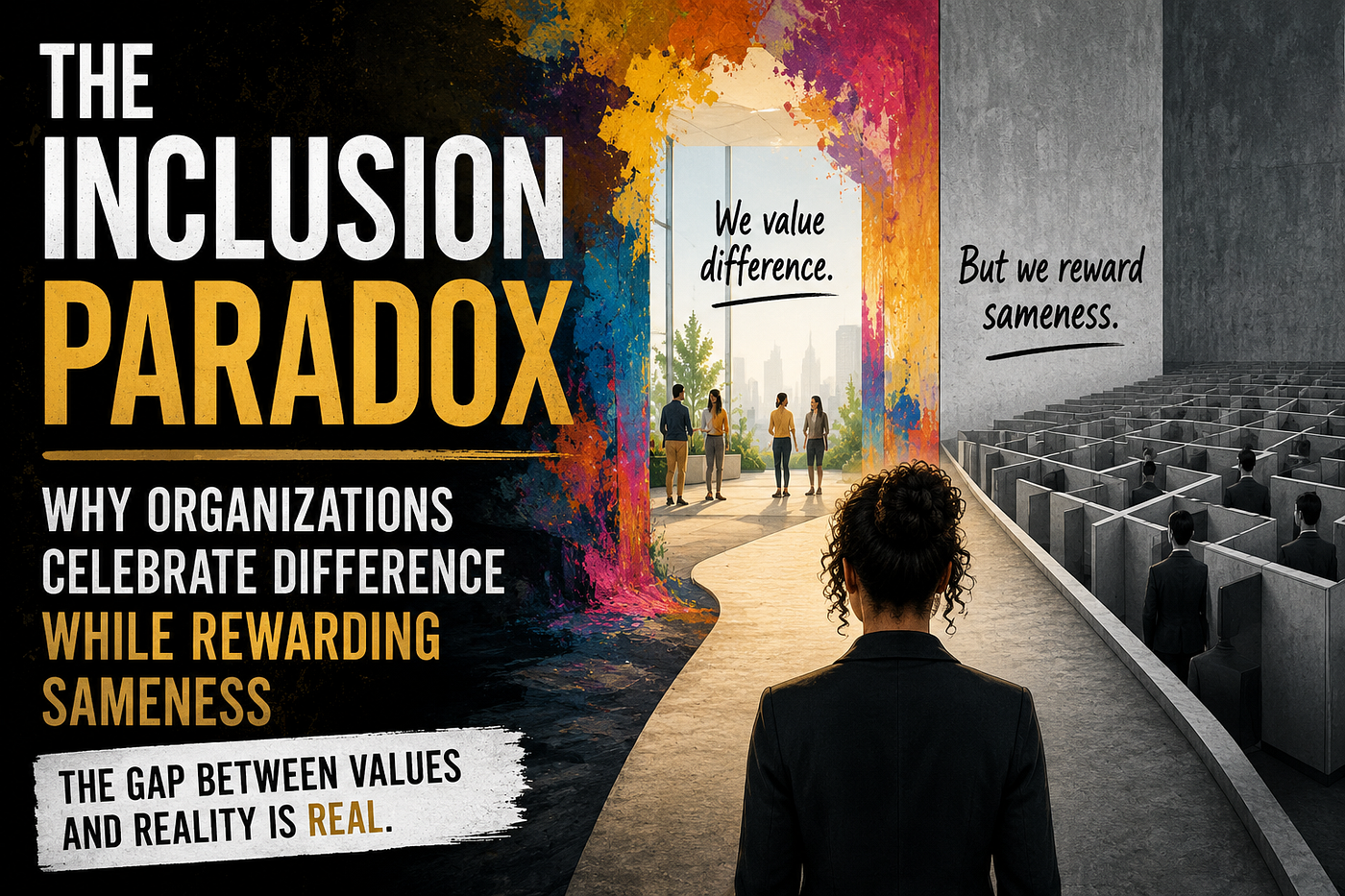
The corporation infantilizes its workforce and then complains that its workforce lacks initiative.
Permission slips for time already earned. Praise for compliance, the way you’d praise a child for finishing dinner. Sign-off requirements on decisions adults are fully capable of making themselves. Then, somewhere in the same leadership meeting, a complaint that the workforce doesn’t show ownership. Doesn’t take initiative. Lacks agency.
This is not a coincidence. It is a shadow projection, and once you see it, you cannot unsee it.
In Jungian terms, the corporation cannot see its own hand in producing the passivity it complains about. So it disowns that part of itself. It names the passivity a worker defect instead of a design output, then uses “our people lack agency” as justification for tighter control. More monitoring. More approval layers. More sign-offs. Which produces more passivity. Which gets read as more proof the workforce can’t be trusted. The loop closes on itself and keeps closing.
A system that punishes initiative will reliably produce people who stop initiating.
In Six Sigma terms this isn’t complicated. If your process rewards permission-seeking and punishes acting without approval, your process will output permission-seekers. Nobody would call that a surprising result on a factory floor. We only treat it as surprising when it happens to people, because we want to believe motivation is a personal trait instead of a designed outcome.
Think about what it actually takes to become a project sponsor, someone who makes a call and owns the outcome without checking every layer above them first. That capacity gets built, or it doesn’t, across hundreds of small decisions long before anyone hands you the title. If every one of those decisions required a permission slip, the muscle for making the call never develops. Then the organization looks at its bench of future leaders and wonders why nobody seems ready to take the risk. It built that shortage itself, one approval workflow at a time.
Autonomy is not a nice-to-have. It is a basic psychological need, the same category as food and sleep.
Deci and Ryan’s self-determination theory names autonomy as one of three basic psychological needs, alongside competence and relatedness (Self-Determination Theory). When that need is systematically blocked, research links it to increased anxiety and reduced engagement, not because people are fragile, but because autonomy is structural to how a nervous system works (Behavioral Sciences, 2024).
The most agreeable person on your team is often the most depleted, not the most secure.
SHRM’s research on paid time off keeps finding the same gap: employees leave earned time unused year after year, even under unlimited PTO policies, where usage often trails traditional accrual plans because nobody signals when it’s actually safe to take the time (SHRM, 2025). That isn’t forgetfulness. That’s a workforce trained to treat rest as something that requires defending.
Great Place to Work’s own 2026 data found sixty three percent of companies reporting a drop in employees willing to go the extra mile.
Leadership tends to read that number as a motivation problem (Great Place to Work, 2026). It is the entirely predictable output of a system that spent years training adults to wait for permission before it complained they wouldn’t act without it.
You cannot punish someone for waiting to be told what to do and then act surprised when they keep waiting.
That is the whole mechanism, closed into a loop, running in portals and badge systems and vague meeting invites across nearly every large organization right now. It doesn’t announce itself as dramatic. It moves in inches. A thank-you here. A softened request there. A justification typed into a field that never required one.
Naming the pattern does not dissolve it, but it changes what you’re standing in when it happens again.
I still filled out that form. I still said thank you. What’s different now is that I know what I’m doing when I do it. That’s not nothing. That’s the difference between a trained reflex running you and a trained reflex you can finally see happening in real time.
There’s a quieter cost underneath all of this that rarely gets named. Every time you ask permission for something you didn’t actually need permission for, you cast a small vote against your own judgment. Enough of those votes, and you start to believe the verdict, not because it’s true, but because you’ve rehearsed it so many times it starts to feel like fact. That’s the part that doesn’t show up on any engagement survey, and it’s the part worth noticing in your own week, not just in the news cycle.
The next time you catch yourself justifying a request for something that was already yours, you’ll know the feeling has a name, and the name isn’t gratitude.
───────────────────────────────────────────────I’m Dr. Tiffany Antoine, and I write about the psychology underneath ordinary workplace behavior. My book Why You Keep Playing the Same Role at Work is available on Amazon.
메타데이터
- post_id
- 73dffa0bdb1c
- slug
- why-being-professional-is-actually-trained-regression-the-shadow-of-the-corporate-employee-73dffa0bdb1c
- url
- https://medium.com/@drtiffanyantoine/why-being-professional-is-actually-trained-regression-the-shadow-of-the-corporate-employee-73dffa0bdb1c
- canonical_url
- https://medium.com/@drtiffanyantoine/why-being-professional-is-actually-trained-regression-the-shadow-of-the-corporate-employee-73dffa0bdb1c
- author_url
- https://medium.com/@drtiffanyantoine
- status
- ok
- fetched_at
- 2026-08-01 20:16:16