Exploring Modern Processing Technologies: From CPUs to Virtual GPUs
Understanding Modern Processing Units: CPUs, GPUs, and Beyond
Exploring Modern Processing Technologies: From CPUs to Virtual GPUs
Photo by Ales Krivec on Unsplash
Understanding Modern Processing Units: CPUs, GPUs, and Beyond
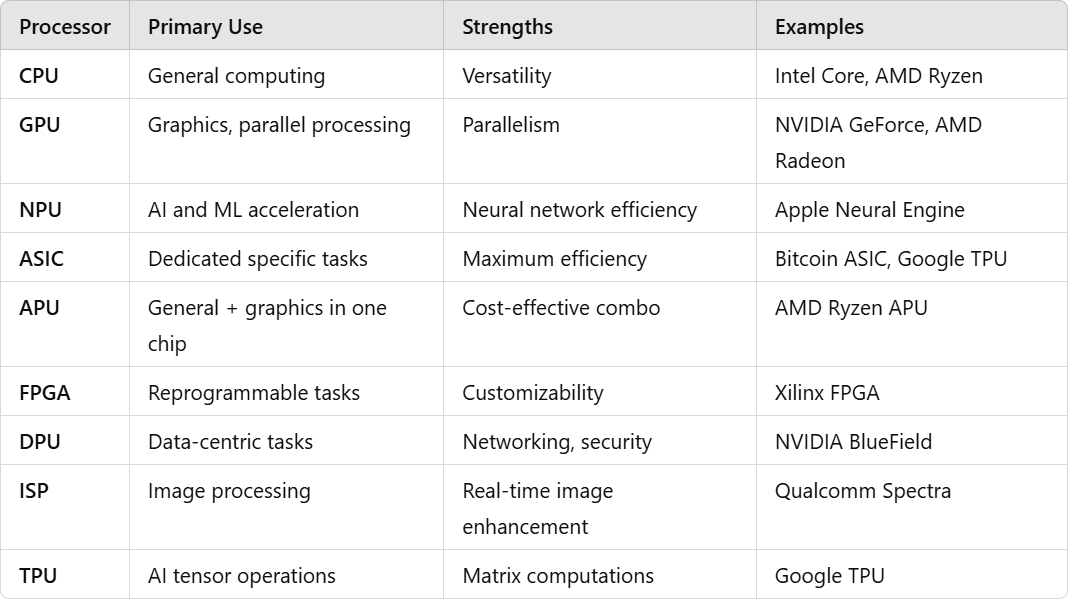
CPU (Central Processing Unit)
- Purpose: General-purpose processor for executing instructions in a computer.
- Optimized for: Versatility across a wide range of tasks (e.g., running operating systems, applications).
- Strengths: Sequential and parallel processing capabilities, good at handling diverse workloads.
- Example: Intel Core, AMD Ryzen.
GPU (Graphics Processing Unit)
- Purpose: Specialized for rendering graphics and parallel processing.
- Optimized for: Highly parallelizable tasks, such as graphics rendering or machine learning (ML) training.
- Strengths: Thousands of smaller cores, excels in vector and matrix computations.
- Example: NVIDIA GeForce, AMD Radeon.
NPU (Neural Processing Unit)
- Purpose: Designed for accelerating artificial intelligence (AI) and machine learning (ML) tasks.
- Optimized for: Neural network inference and training.
- Strengths: Handles tasks like image recognition or natural language processing more efficiently than general-purpose GPUs.
- Example: Apple’s Neural Engine, Huawei’s Ascend.
ASIC (Application-Specific Integrated Circuit)
- Purpose: Custom-designed chip for a specific task or application.
- Optimized for: One dedicated function, offering maximum performance and efficiency.
- Strengths: Extremely efficient but inflexible; not reprogrammable.
- Example: Bitcoin mining chips, Google’s Tensor Processing Unit (TPU).
APU (Accelerated Processing Unit)
- Purpose: Combines CPU and GPU on a single chip.
- Optimized for: Handling both general-purpose and graphics workloads.
- Strengths: Cost-effective and compact solution for entry-level computing and light gaming.
- Example: AMD A-Series, AMD Ryzen APUs.
FPGA (Field-Programmable Gate Array)
- Purpose: Reconfigurable silicon chip that can be programmed for specific tasks post-manufacture.
- Optimized for: Custom tasks where flexibility is needed, like prototyping or low-latency operations.
- Strengths: High customizability, useful for iterative development.
- Example: Xilinx FPGA, Intel FPGA.
DPU (Data Processing Unit)
- Purpose: Handles tasks related to data-centric processing, such as networking and storage operations.
- Optimized for: Offloading data tasks from the CPU to improve performance in data-intensive systems.
- Strengths: Efficient in networking, security, and data management workloads.
- Example: NVIDIA BlueField, Marvell OCTEON.
ISP (Image Signal Processor)
- Purpose: Processes image data captured by cameras.
- Optimized for: Tasks like noise reduction, color correction, HDR, and image sharpening.
- Strengths: Real-time image enhancement and camera optimizations.
- Example: Qualcomm Spectra, Apple ISP.
TPU (Tensor Processing Unit)
- Purpose: Google’s custom ASIC designed specifically for tensor computations in AI workloads.
- Optimized for: TensorFlow operations, particularly neural network inference and training.
- Strengths: High efficiency for matrix multiplications and AI workloads.
- Example: Google TPU versions for cloud and edge computing.
Summary Table
vGPU vs. GPU: Understanding the Differences and Use Cases
The primary difference between a vGPU (virtual GPU) and a GPU (Graphics Processing Unit) lies in their intended use cases, architecture, and how they handle computational workloads. Here’s a breakdown:
GPU (Graphics Processing Unit)
A GPU is a physical hardware component designed to handle parallel processing tasks, often used for rendering graphics, scientific computing, and machine learning.
- Hardware: A single, physical graphics card, such as NVIDIA’s GeForce, RTX, or Tesla models.
- Usage: Typically used directly in a single system for specific workloads like gaming, visualization, AI training/inference, or computational tasks.
- Access: Provides dedicated access to its resources, ensuring the entire GPU is available to the application or system using it.
- Performance: Offers the full raw power of the GPU since it’s not shared among multiple users or virtual machines.
- Scalability: Limited to the physical availability of GPUs in a system.
vGPU (Virtual GPU)
A vGPU is a virtualized version of a physical GPU, created using software and drivers to allow multiple virtual machines or applications to share a single physical GPU.
- Virtualization: Allows a single GPU to be partitioned into multiple virtual GPUs, each with a defined share of the GPU’s resources (memory, compute cores, etc.).
- Usage: Commonly used in virtual desktop infrastructure (VDI), cloud gaming, or virtualized environments for AI/ML workloads and 3D applications.
- Software Dependency: Requires software like NVIDIA vGPU Manager or other virtualization platforms (e.g., VMware vSphere, Citrix Hypervisor) to manage GPU sharing.
- Access: Resources are shared, meaning each vGPU instance gets only a portion of the GPU’s total power, depending on the configuration.
- Scalability: Ideal for environments where multiple users or VMs need GPU access, as it optimizes resource utilization.
- Cost Efficiency: Reduces hardware costs by enabling shared GPU use in virtualized environments.
Key Differences

Example Usage Scenarios
-
GPU: Training a large AI model on a single high-performance GPU.
-
vGPU: Allowing multiple users in an office to run 3D design software on their VDI systems using the same physical GPU.
메타데이터
- post_id
- 73ea91dcd352
- slug
- vgpu-vs-gpu-understanding-the-differences-and-use-cases-73ea91dcd352
- url
- https://medium.com/@charleswan111/vgpu-vs-gpu-understanding-the-differences-and-use-cases-73ea91dcd352
- canonical_url
- https://medium.com/@charleswan111/vgpu-vs-gpu-understanding-the-differences-and-use-cases-73ea91dcd352
- author_url
- https://medium.com/@charleswan111
- status
- ok
- fetched_at
- 2026-06-26 21:52:29