Boundless Identities: What it means for me to be AAPI and Hispanic, and the struggles I face as a…
I am very sure that you know, at the very least, someone who immigrated to the United States, but something you might not hear often is the…
Boundless Identities: What it means for me to be AAPI and Hispanic, and the struggles I face as a Hapa-Hispanic Immigrant in the States.
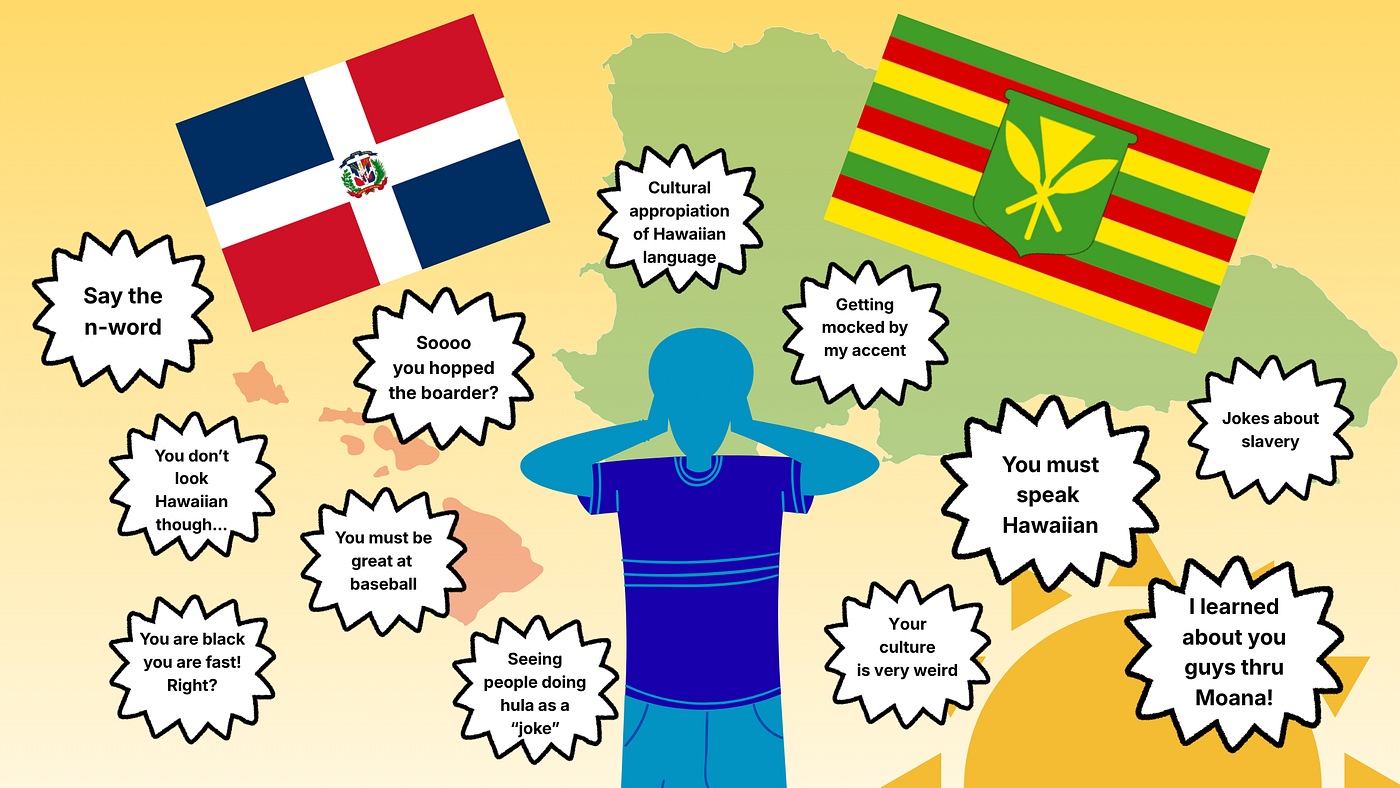
Made by me (Elias Plata Inoa) in Canva. Depicting assumptions and things I have experienced as someone who is a Hapa-Hispanic Immigrant in the United States.
I am very sure that you know, at the very least, someone who immigrated to the United States, but something you might not hear often is the experiences they face. From discrimination to welcoming with open arms, working as a janitor to working for big tech companies, every story and background is unique, shaping the story and experience of every person.
A little bit about my heritage and cultural background
I was born in Santo Domingo, Dominican Republic, in 2009. Both of my parents are mixed; my father has a lot of Spanish and African heritage, along with some Native Caribbean (Taino) lineage. My mother is also an European descendant, being mostly Spanish and Portuguese, and she also has Native Hawaiian (Kanaka Maoli) that was obtained from my grandmother’s lineage. She also possesses some Taino and African ancestry from my grandfather. I always keep wondering if I am something else, a lot of people get shocked after doing a DNA test to discover their heritage, with some unexpected ethnic groups. So I wonder if I am from somewhere in Asia, Europe, or Africa that I wouldn’t expect. I think it would be cool to find out.
Childhood
When I was six years old, I remember asking my mom about our background. She told me that to her knowledge, we were mostly Spanish descendants with indigenous heritage from Hawai’i and the Caribbean. She told me my grandmother moved from California to the Dominican Republic, where she met my grandfather. And that my great-grandmother was from the Kanaka Maoli lineage, and my great-grandfather was Spanish and Portuguese.
As a little kid, I always expressed my Dominican background. In my elementary school, I would wear a straw hat and a chacabana that would represent the colors of the Dominican flag. At my school, we always did a march to celebrate the day of independence by playing all kinds of instruments like tamboras and güiras. For me, it was a really nice way to represent my country and be proud of where I was from. However, this was not the same at my house, where we didn’t really celebrate any type of cultural events like el Carnaval, and many others. We hung a Dominican flag one time for a few days during Independence Day, but that was mostly it. As a little kid, I was always aware of my Polynesian side, and I kept asking my mom about teaching me to speak Hawaiian, how to do hula, or if we could ever visit the Pacific someday. My mom’s answers weren’t the best; she never learned Hawaiian through her mother or any cultural dances. My mom told me that my grandmother tried to introduce Hawaiian culture into their household, and cultural dishes. She experienced lots of xenophobia, and people widely rejected her for the way she was. Back at home with her parents, that wasn’t really the same, so it was a cultural shock for her to receive that type of reaction. While she knew mostly English, some Hawaiian through her mom, and was quickly learning Spanish, which she already knew a little bit of because of my grandfather and High School. She had to make the decision of committing to a new life and speaking mostly Spanish around my mom and her siblings, so she didn’t face judgment when being around my grandfather’s family or the kids at my mom’s school. Truly losing a lot of her cultural identity by being fixed to the environment there. When my mom told me this, I was sort of sad about it, but I tried to do more research on my culture and shared it with her, so to the very least, we all knew something about ourselves.
Watching Moana for the first time at the theaters
While it’s a very popular film that represents Polynesian culture, it was one of the ones that really shifted something in me. It wasn’t just me adoring how beautiful and amazing the movie was, but a feeling of representation, something I have never experienced before. Although Moana was a mix between Kanaka Maoli (also written as Kanaka ’Oiwi), Maori, Samoan, Tokelauan, and other cultural ethnic groups across Polynesia. It made me feel seen, and how beautiful our cultures are. Something about the movie made me resonate with Moana. I wasn’t sure if it was the soundtrack, the plot, or the islands, but something did. And that something led me to research my culture and dive into it a little more, searching for all the information I could about my group before sharing it with my mother, brothers, and friends.
From 2022 to now
September of 2022 marked an important time in my life, as I left the Dominican Republic and moved to the United States. A few months before that event, my mom told me the news of our move, and honestly… I was very upset and sad about it, as I had to leave all my family and friends. With no choice, I took an airplane that would get me to Rhode Island. As I settle in the States, my mom tells me I am going to start school on October 4th, which was a roller coaster of emotions.
The first day of school was not easy at all. I didn’t know anything in English, I could barely say words like juice, apple, orange, or phrases like how are you?, may I go to the bathroom?, I’m good!
While the language was a barrier and I had to use Google Translate 24/7 to communicate with others, something that I have faced and still do, are xenophobic and discriminatory comments towards my racial identity.
In seventh grade, a conversation that was brought up a good five times a day by my classmates was how bad my country was compared to the United States. Two kids in particular would randomly just come up to me and say, “The United States is better than the Dominican Republic”, and I did not understand what they wanted from me, and what reaction in particular. It wasn’t until one time in art class that I overreacted and got into a heated argument, while I had my art teacher defend my back on how my culture and country shouldn’t be something to be judged, I felt for the first time an unwelcoming feeling. One of my classmates said that she didn’t like Dominicans, which I tried to ignore. She also said that Dominicans were disgusting and even decided to throw me a ball during PE class a few minutes after she said that. I thought it was an accident, but it really wasn’t. By the time summer came around, I was super excited for eighth grade, thinking it would be my best year; it turned out to be hell.
During that time, I faced lots of struggles, and my mental health was never worse, and I didn’t experience anything like that until that time. One of my struggles was my identity and looks. I tried to change myself, not just by buying expensive clothes, but also by changing my looks. On purpose, when I went outside, I tried to wear sunscreen, long sleeves shirts, or not go out at all, so my skin was able to stay as light as possible, a struggle I personally still face to this date. I would also try to make my hair sort of longer in the front, with some kind of bangs that would resemble that fluffy and straight hair the guys at my school would wear. I tried to get that classic American accent… which I never did, LOL.
When eighth grade came around, things just got progressively worse. First of all, my accent was the new center of attention; guys at my school would mock me for not getting words right, and people I didn’t even consider my friends. Later on, it escalated to deportation jokes that would follow me into my freshman year of high school, with jokes on how I would be deported. How I hopped the border, when my country is an island. Narrowing my country’s name to words like “Mexico!” And how all my family should go back to their country of origin. All of these affected me, yet that wasn’t the end. In seventh grade, I shared how I am also Hawaiian through my mom’s side. While my Hawaiian side didn’t get as mocked, people would ask if I spoke Hawaiian, what dishes we eat, and if I could do hula. That was all embarrassing to me as someone who didn’t get that much exposure. Yet, people once mocked hula in front of me, people who again did not have a close bond with me. Things didn’t stop there as people said I should ‘go back to work’ and made jokes about slavery, if I was supposed to laugh. Later on, people asked if I could give them an N-word pass. I was disgusted as it was a racial slur committed against African Americans and people of color in the United States, which I do not tolerate at all, expecting me to tell them it was okay to say it.
My freshman and sophomore years of high school have been chaotic and very challenging. But going towards the racial struggles, people from one of my classes called me by the N-word with the hard R multiple times, and it stuck with me for a time. The moment I tried to explore my native Hawaiian culture, one girl came up to me and said that I am not native Hawaiian and that I should only go by Hawaiian. That person was someone I used to be friends with since seventh grade, but due to many things, our relationship fell apart, and we distanced each other for the best, yet I commented on it to her before, and she was aware of my ethnic identity. As “cringy” or “immature” as it sounds, I did go home sad, as it was the last period. I was exploring more about myself and sharing it with my home base teacher (basically my homeroom teacher), sharing my mixed identity and her Chicana and Guatemalan identity. I was personally disgusted, and when I opened up about that discussion in my sociology class along with one of my friends, tears didn’t stop coming out of my face. It was a moment when I was in pain, my friend gave me comfort during the class and lunch, and shared how she had met people who are part Native American and look nothing like it. I cannot forget the one time someone called me mixed breed, and I tried to report it to administrators, as they were literally comparing me to dogs, guess what happened… nothing. I told one of my teachers, and they did nothing about it.
Final perspective and what I am looking forward to
While facing these challenges in places with people who are ignorant or discriminatory, there will always be many who will appreciate your roots. Exploring one’s identity should never be something of embarrassment or judgment, as we are discovering an essential part of who we are as a person. Whether that is cooking iconic dishes, using words or phrases at home from the language your group speaks, learning the language itself, researching one’s ethnic group history, and so much more, to help fulfill that feeling of missing something in us.
I personally feel that something has been taken away from me a long time ago, and that thing is my Native Hawaiian roots that my grandmother hid to protect my family from shame. And now, I feel more empowered than ever to search for that missing piece. My Dominican nationality, being mixed and loving the rest of my roots, embraces my nationality as it gives me more strength wherever I go.
With the racial prejudice I faced from people in my school, I still love and will be forever thankful for the opportunities and all the things I’ve experienced here, whether they were good or bad, it changed me in multiple ways.
Follow me on all my socials, including THE INOA PROJECT.
📸Instagram: @mildlyinoa
📹YouTube: @mildlyinoa
📍Pinterest: @mildlyinoa
🌺THE INOA PROJECT’s Instagram: @theinoaprojectorg
🌸THE INOA PROJECT’s TikTok: @the.inoa.project
메타데이터
- post_id
- 7401ca3262bd
- slug
- boundless-identities-what-it-means-for-me-to-be-aapi-and-hispanic-and-the-struggles-i-face-as-a-7401ca3262bd
- url
- https://medium.com/@midlyinoa/boundless-identities-what-it-means-for-me-to-be-aapi-and-hispanic-and-the-struggles-i-face-as-a-7401ca3262bd
- canonical_url
- https://medium.com/@midlyinoa/boundless-identities-what-it-means-for-me-to-be-aapi-and-hispanic-and-the-struggles-i-face-as-a-7401ca3262bd
- author_url
- https://medium.com/@midlyinoa
- status
- ok
- fetched_at
- 2026-07-30 02:06:40