What comes after AARRR? 4 modern growth strategies for startups
Not a Medium member? Read this article for free on my personal website teresabeltrani.com.
What comes after AARRR? 4 modern growth strategies for startups
Not a Medium member? Read this article for free on my personal website teresabeltrani.com.
For startups, growth isn’t just a goal — it’s a necessity. But what does growth really mean? Growth includes everything that helps the company expand its reach and increase its user base and, ultimately, driving revenue.
To structure and measure growth effectively, various frameworks have been developed over the years. The AARRR funnel was one of the first and remains one of the most influential. In this article I’ll discuss some growth frameworks, from the famous AARRR model to some evolution and extensions.
The original AARRR Framework
The AARRR framework is widely known in the startup industry and was introduced by Silicon Valley investor and 500 Startups founder Dave Mcclure in 2007. It’s also known as Pirate metrics, due to its pronunciation resembling a pirate’s “Arrr!”.
This framework has since become a foundation for startups and growth marketers around the world.
What does the acronym stand for? These are the five key stages according to Mcclure:
- Acquisition: how users discover your product (website/landing page/word of mouth..)
- Activation: when users enjoy the first site visit and experience the AHA moment
- Retention: when users return to the site multiple times
- Referral: when users like product enough to refer others
- Revenue: converting users into paying customers
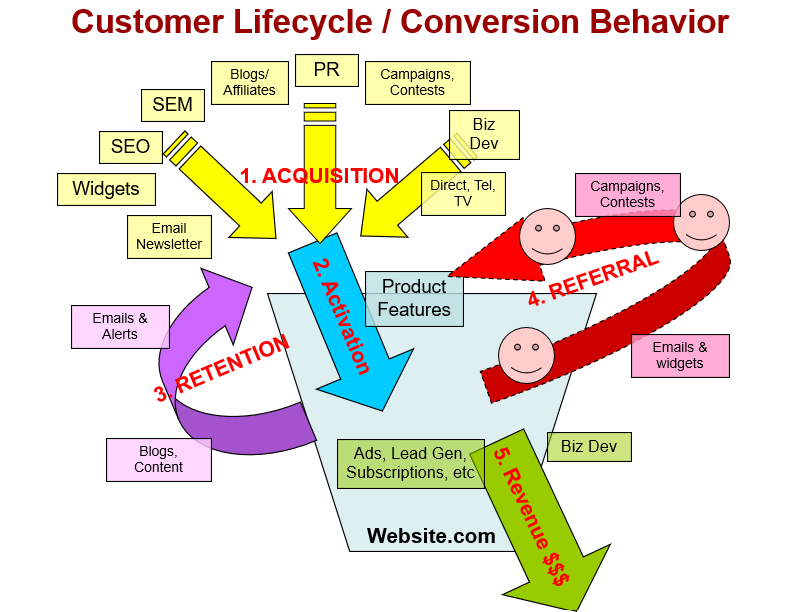
The original AARRR customer growth cycle from Dave Mclure presentation
AARRR metrics are the simplest and most efficient way to look at improving your business and measuring growth. It helps growth marketers to map the customer jouney, identify bottlenecks quickly (e.g., low activation, high churn) and check how your product is performing in each stage.
While this framework has proven incredibly useful, the digital landscape has evolved significantly since 2007. Several important extensions and revisitations of the original model have been proposed.
Extensions of the AARRR framework
The AAARRR Framework
One of the most straightforward extensions of the original framework adds “Awareness” as a preliminary stage before Acquisition, resulting in a AAARRR model (with additional A).
What is Awareness? It’s the stage where potential users first become aware of the problem or need they have (problem awareness) and the existence of solutions to that problem (solution awareness). Before the Acquisition (by taking a specific action like visiting your website), the user must first become aware that your solution exists.
The framework recognizes that significant marketing efforts occurring before the user takes their first trackable action. By measuring and optimizing Awareness, companies can better understand the very top of their funnel and make more informed decisions about brand positioning and messaging.
Key awereness metrics include brand recall, audience reach across various channels, Social Media impressions and engaments.
Growth Loops
The foundational AARRR model, often represented either as a funnel or a pyramid, doesn’t accurately reflect how the fastest growing products scale. Brian Balfour, Founder and CEO of Reforge, reinterpreted AARRR model moving away from the linear funnel concept: in his reinterpretation the framework is not a funnel anymore but it’s actually a cycle: when the user gets to Referral stage it pulls someone else who start the cycle from the beginning and so on.

As highlighted by Brian Balfour, Founder and CEO of Reforge, growth loops represent a fundamental rethinking of how growth works. In fact, the loop concept emphasizes that the output of one stage becomes the input for another stage and the actions of existing users drive acquisition of new users
A prime example is User-Generated Content (UGC) Loops, where users create content that attracts more users, who then generate additional content — platforms like TikTok, Reddit, and Pinterest thrive on this mechanism. Another well-known example is Dropbox’s referral program, which turned acquisition into a viral loop. Each new user was incentivized to invite others in exchange for extra storage, drastically reducing customer acquisition costs while scaling rapidly. By designing an incentive that benefits both the inviter and the invitee, Dropbox leveraged network effects to drive exponential growth.
Growth loops fundamentally change how we approach growth strategy, turning it into a self-reinforcing system rather than a simple funnel. Rather than optimizing isolated stages of a funnel, they encourage building self-reinforcing systems where existing users, content, or monetization directly drive new user acquisition.
The Bowtie Framework
The Bowtie framework extends the traditional funnel by adding post-purchase stages focusing on customer loyalty and expansion. The customer journey is represented as a symmetrical shape with:
- The left side representing pre-purchase stages (similar to Acquisition, Activation)
- The purchase/conversion moment in the middle
- The right side representing post-purchase stages (expanded Retention, Referral, Revenue)

The Bowtie framework stresses the fact that the customer journey doesn’t end with a conversion but rather continues through multiple post-purchase stages. This is particularly important for subscription businesses, where most revenue comes from existing customers rather than new acquisitions.
By giving equal visual importance to both sides of the “tie,” this model helps in allocating appropriate resources to post-purchase experience, preventing the common trap of focusing primarily on acquisition at the expense of retention and expansion.
The Pillar/Motions matrix
One of the common pitfall of the AARRR framework is the creation of organizational silos where different teams optimize for different metrics without considering how they interact in a complete system. Even worse, it happens that some functions are responsible only for one stage (eg. Marketing owns acquisition, Product owns retention, Sales (if B2B) owns revenue).
To address this issue, the Pillar/Motions matrix focuses on organizational structure and cross-functional collaboration rather than just customer journey stages.
Growth is organized under:
- Pillars: Acquisition, Activation, Retention, Monetization
- Motions: tipically marketing, sales, product
Such matrix (Pillars x Motions) shows how each teams (Motions) can contribute to each stage (Pillars) of product growth.

For example, marketing contributions could include both acquisition (content marketing, paid advertising) and activation (educational content, onboarding emails) while product could also work both on acquisitions (viral feature creation) and retention (feature improvement).
This approach goes beyond the AARRR funnel, which is a user-centric funnel framework that doesn’t explicitly define which teams or functional areas own which stages. The matrix clarifies that every function has an impact on each stage of the funnel, fostering responsability and collaboration.
Beyond Frameworks
The evolution from AARRR to more sophisticated models reflects the increasing complexity of digital products and customer journeys. Remember that all these frameworks are more starting points rather than rigid templates: customer journeys are unique to each business and rarely fit perfectly into any predefined model.
No single framework is universally “best.” The choice might depend on your business model (B2B vs. B2C, subscription vs. one-time purchase), product type (whether is software, physical goods, services) and current growth challenges. Many successful companies adopt hybrid approaches that combine elements from different frameworks. The key is to tailor these principles to your unique product and audience, ensuring sustainable, long-term growth.
Resources
- Original Dave McClure presentation: Startup Metrics for Pirates
- Growth Tribe’s explanation of adding Awareness: Growth Tribe Video
- Brian Balfour on Growth Loops: Reforge Blog
메타데이터
- post_id
- 74113ffb3dbf
- slug
- what-comes-after-aarrr-4-modern-growth-strategies-for-startups-74113ffb3dbf
- url
- https://medium.com/@tere.beltrani/what-comes-after-aarrr-4-modern-growth-strategies-for-startups-74113ffb3dbf
- canonical_url
- https://medium.com/@tere.beltrani/what-comes-after-aarrr-4-modern-growth-strategies-for-startups-74113ffb3dbf
- author_url
- https://medium.com/@tere.beltrani
- status
- ok
- fetched_at
- 2026-06-26 06:47:43



