The Real Reason Your Tween Can’t Put Down Their Phone (It’s Not What You Think)
You’ve asked them three times already. First nicely, then firmly, then in the voice you reserve for when things are about to get serious…
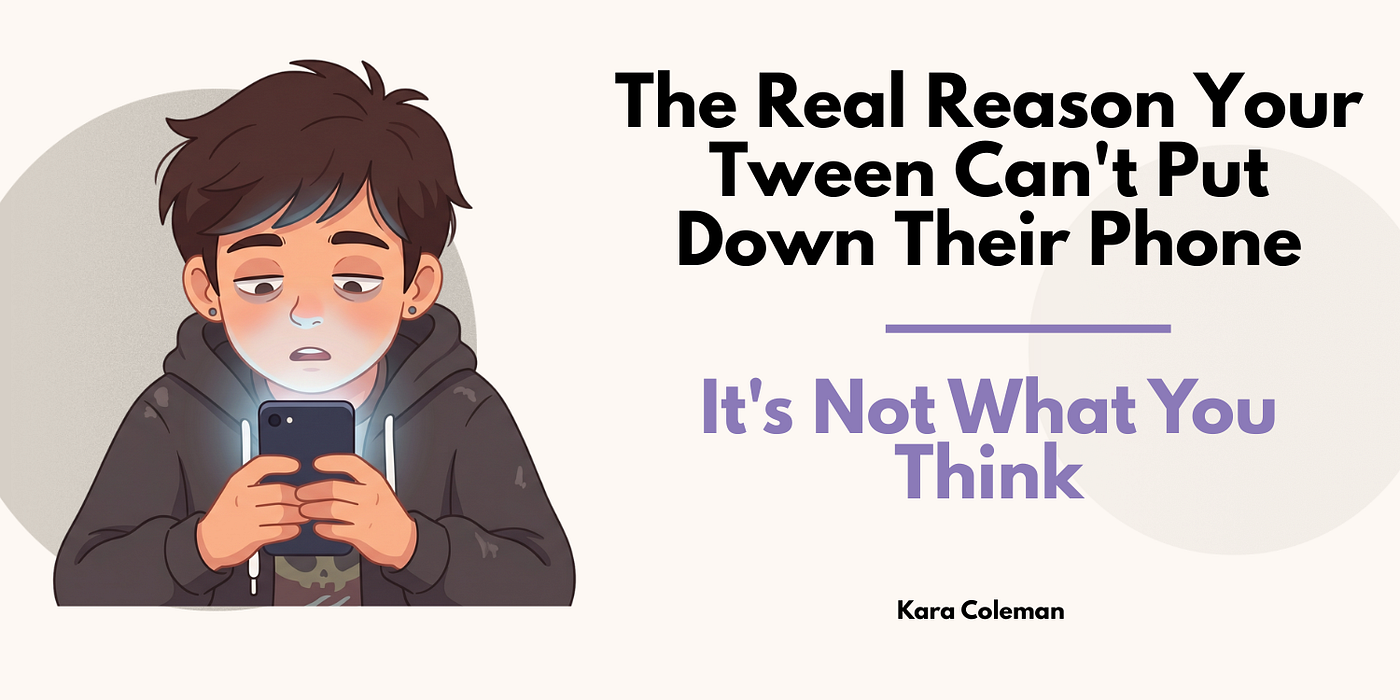
The Real Reason Your Tween Can’t Put Down Their Phone (It’s Not What You Think)
You’ve asked them three times already. First nicely, then firmly, then in the voice you reserve for when things are about to get serious. The phone is still in their hand.
Most parenting articles about screen time skip over something important. Your tween is not ignoring you because they’re being rude or defiant. They’re ignoring you because the app in their hand was built by a team of engineers whose full-time job is making it hard to stop using.
That’s a real job at Instagram, TikTok, Snapchat, and every other platform your kid is on. Those companies pay a lot of money to very smart people to design products that are difficult to close. They’re good at it.
So asking your tween to “just put it down” is asking them to out-willpower a system designed by professionals to beat their willpower. Of course it isn’t working.
The better approach is to help your tween see what’s happening to them, and to give them some concrete ways to push back. Here’s how.
1. Name the design tactics out loud
Most tweens have no idea the apps they love were engineered to hijack their attention. They think they just really like TikTok. They’ve never heard of variable reward schedules, which use the same principle that makes slot machines work. They don’t realize infinite scroll exists because someone decided to remove the “bottom” of the feed on purpose. They haven’t thought about how notifications are tuned to arrive at exactly the rate that keeps you checking.
When you name these tactics out loud, something useful happens. Your tween stops feeling like a weak person who can’t put their phone down and starts seeing themselves as someone being manipulated by a sophisticated system. The phone goes from “a thing I can’t resist” to “a thing that’s trying to trick me,” and those are very different problems.
The next time they’re stuck scrolling, try this: “Hey, did you know the reason that feed never ends is that the app removed the bottom on purpose? It’s called infinite scroll. They built it so your brain never gets the signal to stop.”

2. Make the phone less rewarding at the device level
Your tween has a phone that is trying very hard to grab their attention. You can dial that down with a few changes on the device itself.
Turn the screen to grayscale. On an iPhone, go to Settings > Accessibility > Display & Text Size > Color Filters. Once the phone is in black and white, the apps suddenly look a lot less appealing. A lot of what pulls kids in is the color.
Turn off most notifications. Keep texts from family. Snapchat, Instagram, TikTok, news alerts, shopping apps: turn all of those off. Most notifications are attention bait, not information your tween needs in the moment.
Move social apps off the home screen. The moment TikTok or Instagram is one tap away, your tween doesn’t consciously decide to open it. Tucking those apps into a folder two screens deep adds just enough friction to turn opening the app into a choice instead of a reflex.
These are quiet changes. They don’t require a power struggle. They just remove some of the hooks.
3. Teach them what’s happening in their brain
Tweens tend to respond well to real science when it’s explained to them rather than wielded at them. Social media activates the same dopamine system that makes gambling addictive. Adolescent brains are especially vulnerable to that kind of stimulation because the part of the brain responsible for impulse control is still developing well into the mid-twenties. Both of those things are true, and they’re true for every kid.
The framing matters. “The adolescent brain” is science. “Your screen addiction” is an accusation. Same content, completely different conversation.
A lot of tweens, once they have the science, start noticing the patterns themselves. “I can’t stop scrolling” becomes “I think I’m in a dopamine loop right now, let me put this down.” Once a kid has a name for what’s happening, they have something to work with.

4. Let the environment do the work
Willpower is a finite resource. Every time your tween has to actively resist opening TikTok, they’re spending some of it. By the end of the day, they have very little left. That is how willpower works for everyone, adults included.
So instead of relying on your tween’s willpower, and instead of relying on your own enforcement, set up the environment so the phone isn’t an option during certain hours.
Phones charge in the kitchen overnight. Dinner has a phone basket by the door. App timers kick in at 9pm. The family agreement is: no phones upstairs after bedtime, period.
These are not rules you have to enforce in the moment. The environment enforces them. Your tween is not mad at you; they’re mad at the charger in the kitchen. Every time the environment handles the limit, you save a little relationship capital for the bigger conversations you actually need to have later.
5. Shift the question from “get off your phone” to “are you noticing what this app is doing to you right now?”
“Get off your phone” is a command. Tweens resist commands because that’s their developmental job. But “Hey, is this app pulling you right now? Are you noticing it?” is an invitation to step back and observe, together.
A lot of tweens will actually put the phone down when the conversation sounds like that. Not because they’re told to, but because they want to be the kind of person who sees what’s happening. Nobody wants to be the sucker. Once a tween starts recognizing the manipulation, they start caring about it themselves. That version holds up when you’re not in the room.
· · ·
When awareness isn’t clicking yet
Some tweens get it the first time you explain this. Others nod, say “okay, sure,” and go right back to scrolling. That isn’t because your kid is different or worse. Understanding something when a parent explains it is a completely different experience from seeing it in yourself.
That’s a lot of why I created ***Own Your Screen Time***, a workbook for kids ages 11 to 14 to walk through this process themselves, at their own pace, without a parent over their shoulder.
One section called The Tricks They Don’t Want You to Know unpacks the design tactics from this post in language that actually lands for this age. There’s a “3-Day Phone Experiment” where they track their own usage and notice their own patterns, and that’s usually when things click for them. There’s also a “Design an App That Helps” challenge where they flip the script and imagine what a non-manipulative app would look like. Once a kid has designed something ethical, they start seeing the manipulation in their own apps clearly. That kind of seeing tends to stick.
The other thing I like about this workbook as a parent is that it only has two parent check-ins built in, not one for every section. This age wants independence, and the workbook gives it to them. Your tween does the work. You stay the supportive ally instead of becoming the enforcer.
You can check it out on Amazon here.

· · ·
None of this makes your tween’s phone use disappear overnight. That isn’t how this works. But it builds something a time limit can’t build: a kid who can recognize when an app is playing them and decide whether to let it. That’s a skill they’ll need long after any rule you set expires.
메타데이터
- post_id
- 741b4a1c6f52
- slug
- the-real-reason-your-tween-cant-put-down-their-phone-it-s-not-what-you-think-741b4a1c6f52
- url
- https://medium.com/@healthyscreenhabitsforkids/the-real-reason-your-tween-cant-put-down-their-phone-it-s-not-what-you-think-741b4a1c6f52
- canonical_url
- https://medium.com/@healthyscreenhabitsforkids/the-real-reason-your-tween-cant-put-down-their-phone-it-s-not-what-you-think-741b4a1c6f52
- author_url
- https://medium.com/@healthyscreenhabitsforkids
- status
- ok
- fetched_at
- 2026-07-15 04:11:44