How AI and Machine Learning Are Transforming Trading: The New Era of Quantitative Finance
Quantitative trading has long married mathematics and market data to find exploitable patterns. Firms such as Renaissance, Two Sigma…
How AI and Machine Learning Are Transforming Trading: The New Era of Quantitative Finance
Quantitative trading has long married mathematics and market data to find exploitable patterns. Firms such as Renaissance, Two Sigma, Citadel, and D. E. Shaw turned models into massive competitive advantages. Over the last decade, however, three forces — an explosion of alternative data, dramatic growth in compute power (GPUs, cloud) and algorithmic advances in AI/ML — have changed the rules of the game. In 2026, machine learning (ML) and AI are no longer peripheral research tools; they are central to how many quantitative funds discover alpha, manage risk, and execute trades. These technologies let firms process unstructured data, adapt to changing regimes, and scale analyses across asset classes in ways traditional models cannot.
From Rule-Based Quants to Data-Driven AI
The first generation of quant strategies relied on explicit rules and low-dimensional factor models: moving‑average crossovers, momentum, mean reversion, volatility signals, and statistical arbitrage. These methods are transparent, computationally light, and interpretable, but they depend on human hypotheses and struggle with nonlinearity and heterogeneous data.
Machine learning changes the paradigm. Rather than encode rules, ML systems learn patterns directly from data. This enables discovery of complex, nonlinear relationships across millions of observations and diverse inputs — satellite imagery, web traffic, supply‑chain telemetry, consumer spending, textual filings, on‑chain activity and more. The result is a new breed of hybrid quant strategies that combine domain knowledge with data-driven pattern recognition.
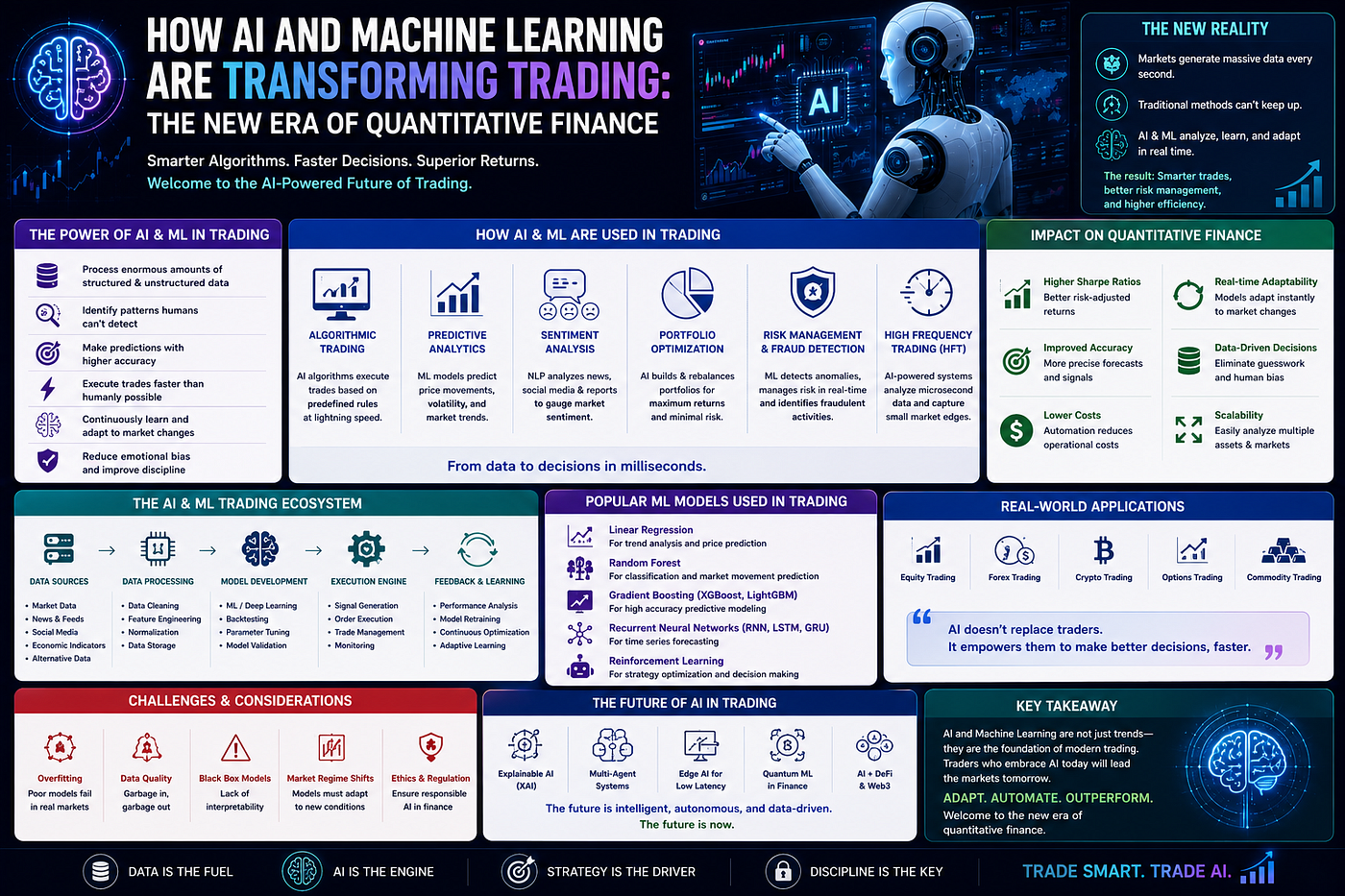
Where AI Adds Real Value
Feature discovery and nonlinear signal extraction
ML — especially deep learning — excels at discovering interactions among many variables and extracting predictive features humans may miss. Neural nets can capture nonlinear dependencies and high-dimensional patterns that classic regressions cannot.
Alternative data at scale
AI models can convert raw alternative datasets (images, audio, text, geospatial streams) into structured signals. Examples include retail-traffic estimates from satellite images, consumer sentiment from social feeds, and real-time supply-chain health from AIS ship tracking.
Natural Language Processing (NLP)
Transformer-based and domain-tuned language models now parse earnings calls, regulatory filings, analyst reports and central bank speeches to extract tone, uncertainty, forward guidance shifts and policy intent — inputs that enrich traditional factor sets.
Regime detection and adaptivity
Market behavior changes. ML systems detect regime shifts (liquidity stress, volatility regimes, structural inflections) faster than static models, enabling dynamic allocation, hedging and strategy switching.
Reinforcement learning for control problems
Reinforcement learning (RL) tackles sequential decision tasks — execution algorithms minimizing market impact, market‑making policies balancing inventory, and dynamic portfolio allocation under transaction costs. RL agents learn by simulation and live feedback to optimize long-term objectives.
Multi‑modal integration
Modern strategies fuse price/volume data, macro indicators, alternative sensors and text into unified models (multi‑modal learning), producing richer situational awareness than siloed systems.
Practical Improvements: Execution, Risk and Operations
- Execution: AI-powered smart execution algorithms optimize order slicing, timing and routing to reduce slippage and market impact — small improvements that compound for large institutional flows.
- Risk monitoring: Real‑time ML models can flag emerging exposures, concentration risk or anomalous behaviors across thousands of positions and counterparties.
- Surveillance and compliance: Anomaly detection and NLP speed fraud detection, market‑abuse surveillance and regulatory reporting.
- Research automation: AI accelerates hypothesis generation — feature engineering, signal screening and model selection — reducing researcher cycle times.
Infrastructure & Talent: The New Competitive Moat
Deploying AI in quant trading requires infrastructure and expertise:
- Compute & storage: Large-scale GPU clusters, high-throughput data pipelines, low-latency feeds and fast distributed databases are essential.
- Data ops: Ingesting, cleaning, labeling and versioning alternative datasets — often the most time-consuming work.
- Model ops & governance: CI/CD for models, robust back‑testing, out-of-sample validation, drift detection and reproducible pipelines.
- Talent mix: Modern quant teams blend quants, ML engineers, data scientists, software engineers and domain experts. Organizational processes must support scientific rigor and rapid iteration.
Key Challenges and Limitations
Overfitting and non‑stationarity: ML models risk learning spurious patterns from historical data. Market regimes change; edges degrade. Rigorous validation (walk‑forward, nested CV, adversarial testing) and conservative model deployment remain critical.
Interpretability and regulatory scrutiny: Deep models are often black boxes. Investors and regulators increasingly demand explainability, stress‑testing and documentation. Hybrid approaches that incorporate finance theory improve interpretability.
Data quality and bias: Alternative data can be noisy, biased or incomplete. Garbage in, garbage out — robust data cleaning, bias checks and provenance tracking are necessary.
Crowding and alpha decay: As ML techniques and similar datasets proliferate, signals can become crowded. Alpha sources that once were unique can dissipate as more players exploit them.
Cost and scale barriers: Developing and operating production‑grade AI quant systems is capital and talent intensive — favoring larger firms or well-funded startups.
The Hybrid Future: AI Augments, Not Replaces, Financial Expertise
Rather than replacing human judgment, the most effective implementations pair machine intelligence with financial insight. Hybrid systems use theory‑driven constraints, risk limits and human oversight to ensure models remain robust and aligned with objectives. Many firms use ML to generate signals or risk metrics that seasoned portfolio managers and traders then interpret and act upon. Human expertise still guides data selection, labeling, scenario design and the final deployment decisions.
Emerging Trends to Watch in 2026 and Beyond
- Financial foundation models: Large, pre‑trained models tailored to financial text, time-series and multi-modal inputs are accelerating transfer learning for downstream tasks.
- Federated and privacy-preserving learning: Collaboration across institutions without sharing raw data could unlock larger training sets while preserving confidentiality.
- Better explainability: Research into interpretable architectures and post-hoc attribution tools improves trust and regulatory compliance.
- Simulation fidelity and sim‑to‑real transfer: Higher‑fidelity market simulators and domain‑randomized training reduce the gap between backtests and live trading.
- Quantum and specialized hardware: Early experiments in quantum optimization and neuromorphic hardware aim to accelerate certain classes of computations.
- Democratization: Cloud-native tools, managed ML platforms and packaged financial models are lowering the barrier to entry for smaller quant teams and sophisticated retail investors.
Best Practices for Responsible AI in Quant Finance
- Start with risk-first design: Prioritize capital protection, explainability and stress scenarios over raw alpha.
- Employ robust validation: Out‑of‑sample testing, walk‑forward analysis, scenario stress tests and adversarial checks.
- Monitor live performance and drift: Continuous monitoring for model decay, regime shifts and anomalous behavior.
- Keep humans in the loop: Human oversight for strategy approval, risk overrides and ethical considerations.
- Maintain data provenance & governance: Document data sources, cleaning steps and labeling decisions.
- Design transparency: Combine theory constraints with ML to enable meaningful explanations for stakeholders and regulators.
Conclusion
By 2026, AI and machine learning have moved from promising research tools to foundational components of many quantitative trading operations. They extend human capability — processing multi-modal data, discovering nonlinear signals, adapting to evolving markets, and optimizing execution and risk in real time. Yet the transition is evolutionary, not revolutionary: the highest-performing approaches integrate financial theory, disciplined risk controls and human expertise with AI’s pattern-recognition and scale.
The winners will be organizations that combine technical excellence (data ops, compute, model governance) with deep market experience, rigorous validation and responsible deployment practices. Those who do so will define the next era of quantitative finance — one in which machine intelligence amplifies human insight to navigate more complex, faster, and data-rich markets.
Disclaimer: Parts of this content may be AI-generated or AI-assisted. All interpretations, opinions, and conclusions presented are the responsibility of the author. Kindly do not consider this information as any form of advisory. Do your own research before implementing the knowledge shared above.
메타데이터
- post_id
- 7423b2bfe9f5
- slug
- how-ai-and-machine-learning-are-transforming-trading-the-new-era-of-quantitative-finance-7423b2bfe9f5
- url
- https://medium.com/@rohanchhabra2025/how-ai-and-machine-learning-are-transforming-trading-the-new-era-of-quantitative-finance-7423b2bfe9f5
- canonical_url
- https://medium.com/@rohanchhabra2025/how-ai-and-machine-learning-are-transforming-trading-the-new-era-of-quantitative-finance-7423b2bfe9f5
- author_url
- https://medium.com/@rohanchhabra2025
- status
- ok
- fetched_at
- 2026-08-15 14:08:13