We Are Planting the Wrong Trees and Calling It a Solution
Billions of trees are being planted every year as carbon offsets. A growing body of research says many of them make things worse.
We Are Planting the Wrong Trees and Calling It a Solution
Billions of trees are being planted every year as carbon offsets. A growing body of research says many of them make things worse.

A wildfire burning in Pirque, Santiago Metropolitan Region, by Pablo Trincado.
In the last week of January 2017, the town of Santa Olga in central Chile stopped existing. About 5,000 people lived there. The fire that swept through that summer left almost nothing, and by the time the smoke thinned across the south-central regions, roughly 500,000 hectares had burned, eleven people were dead, and more than a thousand homes were gone. It was the worst wildfire disaster in Chile’s modern history.
The part worth sitting with is what fed it. The land around Santa Olga was not wild forest. It was plantation — mile after mile of non-native pine and eucalyptus planted since the 1970s for pulp and timber. Eucalyptus produces a flammable oil; Chileans call these “gasoline trees.” Pine is loaded with resin. Put millions of them in tight rows, leave them in a long drought, and what you’ve built, with subsidies and the best of intentions, is essentially a fuse.
And here’s the thing. That same kind of plantation, the one that burned Santa Olga to its foundations, is being planted across much of the world right now and counted as a climate solution. Sold as a carbon sink. Bought by corporations to cancel their emissions. We tend to treat trees as the easy answer, the fix you can’t argue with. The science keeps complicating that. A lot of what’s going in the ground is the wrong tree, in the wrong place, doing a job nobody checked it could do.
The trillion-tree dream
The instinct behind all this is sound. Forests pull carbon dioxide out of the air and bank it in wood and soil, and a planet with more real forest is better off. That logic drives some of the biggest environmental campaigns ever launched: the Bonn Challenge, aiming to restore 350 million hectares by 2030, an area larger than India; the World Economic Forum’s 1 Trillion Trees initiative; the UN’s Decade on Ecosystem Restoration. Hundreds of billions of dollars are now moving into getting seedlings into soil.
The catch is the word “restoration.” Say it to most people and they picture a wood coming back to life — birds, undergrowth, a productive mess of species. Plenty of policymakers mean something else: a plantation, one commercial species in straight lines, grown to be cut down.
In 2019, Simon Lewis and colleagues at University College London did the unglamorous thing and read the actual restoration pledges. Across 43 tropical and subtropical countries, 45 percent of the promised land was destined to become commercial plantation, against just 34 percent natural forest. Lewis didn’t soften it. “There is a scandal here,” he said. Policymakers, he argued, were relabeling vast monocultures as forest restoration while the advertised climate benefits weren’t actually there.

His team ran the numbers. Restore those 350 million hectares as natural forest and you draw down something like 42 billion tonnes of carbon by 2100. Do it with the plantation-heavy mix actually pledged and you get about 16 billion. The land is the same and the money is the same; the climate payoff is roughly a third.
Why a plantation is not a forest
A natural forest is patient. It keeps stacking carbon for decades, in the trunks, in the soil, in the roots and the fungal networks underneath. A commercial plantation is built to do the opposite. The whole point is the harvest, usually every 10 to 20 years, and when the cut comes much of the stored carbon heads back into the air. Lewis’s group put a eucalyptus plantation at roughly a fortieth of the long-term carbon a natural forest holds.
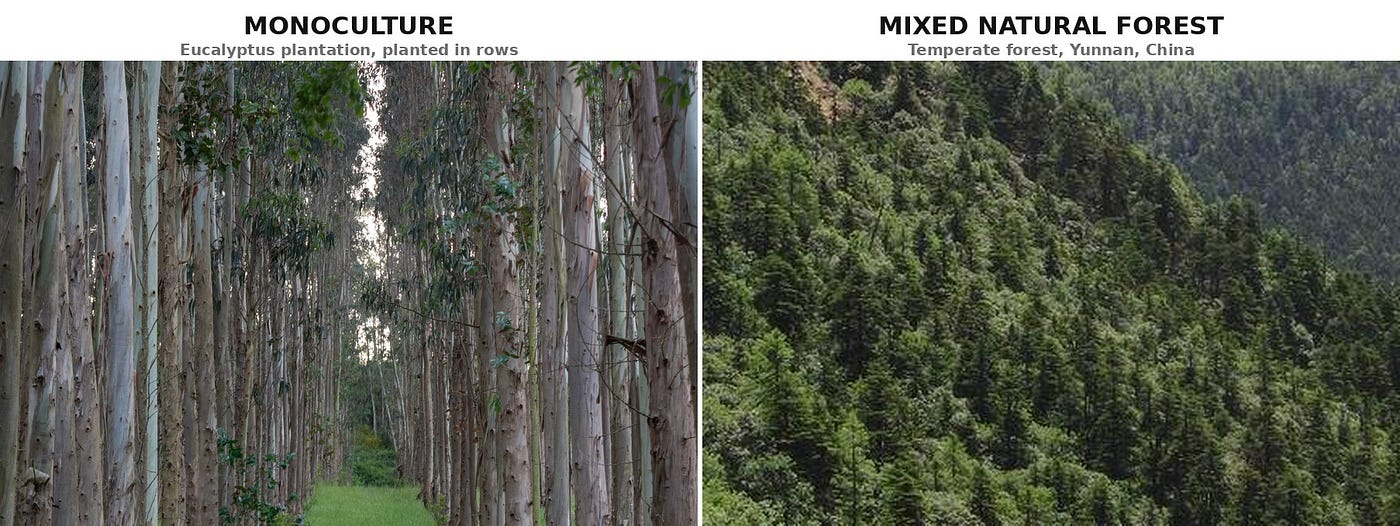
The closer you look, the worse the gap gets. A 2023 meta-analysis published in Frontiers in Forests and Global Change, which processed more than 11,000 studies, revealed that mixed-species forests held approximately 70% more carbon above ground than the average single-species plantation, and even 25% more than the best monoculture. Adding more species leads to better usage of light and space, decreases the possibility of pests and diseases spreading, and allows the forest to withstand the type of adverse year that devastates a uniform crop.
That last point isn’t abstract. In Turkey, nearly 90 percent of 11 million saplings from one planting campaign were found dead within three months, killed by drought and neglect. When a monoculture goes, it tends to go together.
The green deserts that warm the planet
Then there’s the finding that genuinely surprised me when I first read it, because it runs backward against everything tree-planting is supposed to mean. In the wrong place, planting trees can warm the world.
A lot of land being lined up for “restoration” was never forest. It’s grassland and savanna — old ecosystems that hold huge stores of carbon underground, in deep roots and soil rather than in trunks. A decade ago, Joseph Veldman and colleagues warned in Science about the “tyranny of trees” in these grassy systems, estimating that some 9 million square kilometers of them are exposed to misguided planting schemes. If you simply cover a savanna with trees, you might end up releasing more soil carbon than what the trees could absorb overall, and at the same time you will be destroying the habitat of species that are unique to that area. A research conducted in India in 2023 showed that tree planting might kill off the savanna plant communities which are home to hundreds of species found nowhere else.
And the second way is what keeps me going back to the subject: albedo, which basically is the amount of sunlight a surface reflects back. Pale grassland reflects a lot of it to space. A dark forest canopy soaks it up. Replace one with the other and you trap heat directly, and in some dry regions the math is brutal: it can take five to eight decades before the carbon stored in the new trees even offsets the warming from darkening the ground. You can plant a “carbon sink” that heats its own corner of the planet for half a century before it breaks even.
So the ways this goes wrong pile up. The Chilean plantation burns and vents its carbon in an afternoon. The Brazilian one gets harvested and rides away on a truck. The one planted on African or Indian grassland costs you soil carbon and buys you heat. Different routes, same place: a green shape on a map that isn’t doing the thing it was paid to do.
An industry built on the wrong trees
If this were only bad gardening it wouldn’t matter so much. But these plantations aren’t hobby projects. They’re financial instruments.
The voluntary carbon market — where a company buys credits to offset emissions it would rather not cut — is now a multi-billion-dollar business, and forestry and land-use projects make up more than half of the credits issued. Verra, the biggest certifier, has put out more than 1.3 billion of them. Every credit is a promise: somewhere, on your behalf, a tonne of carbon was absorbed or kept out of the sky.
In January 2023, an investigation by the Guardian, Die Zeit and SourceMaterial reported that more than 90 percent of Verra’s rainforest credits were effectively worthless — no real reductions behind them. The peer-reviewed version arrived later that year in *Science*: of the forest offset projects examined closely, 94 percent were non-performing, the climate benefits “grossly overstated.” Verra disputed it. Its CEO stepped down not long after.
And the buyers aren’t obscure. A 2024 paper in Nature Communications looked at the twenty companies retiring the most credits between 2020 and 2023 — Shell, Chevron, Delta, Eni, Boeing among them — and found 87 percent of those projects at high risk of delivering no real, additional cuts. You can see the shape of it. A plantation goes in. A credit gets sold. A company keeps burning fossil fuels and books itself as neutral. If the plantation later burns, the way the ones around Santa Olga did, the carbon it was holding simply rejoins the atmosphere and the offset quietly erases itself. The only thing it reliably offset was the pressure to cut emissions in the first place.
What a real forest is worth
What I keep returning to is the distance between the picture in our heads and the thing on the ground. We treat planting a tree as a pure good, the gesture wholesome enough to print on a water bottle. The research is asking for something harder than that — not fewer trees, but more honesty about which ones, and where, and what for.
The hopeful part is that the same studies diagnosing the failures also spell out what works, in detail. Natural forests holding forty times the carbon of plantations. Mixed woods storing 70 percent more than monocultures and riding out drought and pests instead of dying in unison. Grasslands left as grasslands, doing their slow underground work the way they have for millions of years. None of this waits on a breakthrough. It mostly waits on us planting fewer green deserts and protecting the real thing.
Some of the best restoration barely involves planting at all. In the tropics, simply stopping fire and cattle grazing, and allowing native forests to regenerate naturally, typically results in more carbon sequestration, quicker and at a lower cost than the establishment of any plantations. Nature is capable of reverting the land to a forest, only if we allow it. Lewis shared a photograph from the field of an 18-year-old forest patch in Uganda that has been regenerating naturally and it has elephants and monkeys. Nobody planted it in rows. People just got out of its way.
The trees were never really the issue. The story we built around them was. Santa Olga is being rebuilt now, slowly, and the harder question in Chile isn’t whether to plant but what to plant, and whether the gasoline trees should ever have been ringed around a town. A forest worth the name is a tangled, slow, fire-shy, crowded thing, and we already know how to grow one. We mostly need to stop confusing a crop for a cure.
Further reading: Lewis et al., “Regenerate natural forests to store carbon,” Nature (2019); Warner et al., “Young mixed planted forests store more carbon than monocultures,” Frontiers (2023); West et al. on offset performance in Science (2023); the Guardian/Die Zeit/SourceMaterial Verra investigation (2023); and “Don’t just plant trees, plant forests,” The Conversation (2026).
메타데이터
- post_id
- 7455271e7c17
- slug
- we-are-planting-the-wrong-trees-and-calling-it-a-solution-7455271e7c17
- url
- https://medium.com/southern-winds/we-are-planting-the-wrong-trees-and-calling-it-a-solution-7455271e7c17
- canonical_url
- https://medium.com/southern-winds/we-are-planting-the-wrong-trees-and-calling-it-a-solution-7455271e7c17
- author_url
- https://medium.com/@abdullahijazpublic
- status
- ok
- fetched_at
- 2026-06-20 20:29:01