AI Lowers the Cost of Action. Judgment Becomes the Bottleneck.
Why the scarcity that matters has moved — and most people haven’t noticed yet
AI Lowers the Cost of Action. Judgment Becomes the Bottleneck.
Why the scarcity that matters has moved — and most people haven’t noticed yet
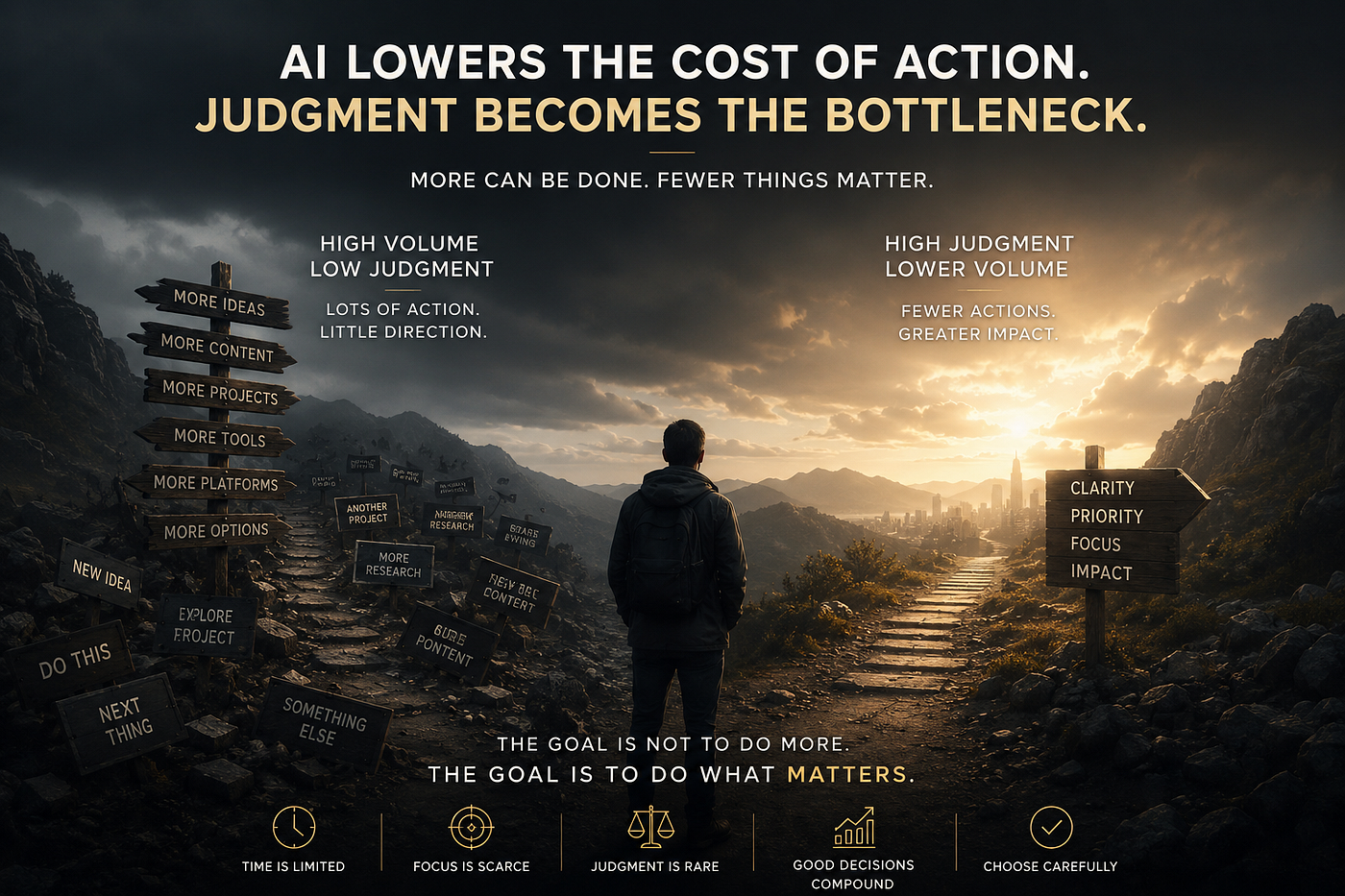
When action becomes cheap, selection becomes valuable.
FreedomWayGlobal Founder Journal — Season 3, Part 12 of 14
Something worth paying attention to happened when AI became widely available.
Most people noticed the speed. The writing. The research. The plans and decks and summaries that used to take hours and now take minutes.
What fewer people noticed was the shift underneath it.
When the cost of action collapses, the bottleneck moves.
It does not disappear. It relocates.
And in 2026, it has relocated somewhere that most people’s operating systems are not yet designed to address.
The Cost of Action Has Collapsed
This is not hyperbole. It is a structural change worth stating precisely.
Before AI became capable and accessible, producing knowledge work was expensive in time.
A research summary required hours of reading and synthesis. A well-structured plan required significant cognitive effort to develop from scratch. A first draft of almost anything an article, a proposal, a competitive analysis, a set of recommendations required sustained focused work before anything usable existed.
That time cost was not incidental. It was a natural constraint on how much could be initiated, pursued, and produced. The friction of production limited the volume of action.
AI has removed significant portions of that friction.
The research summary that took three hours takes twenty minutes. The first draft that required an afternoon exists in the time it takes to write a good prompt. The plan that needed a full day of thinking has a workable skeleton in an hour.
The cost of starting is lower. The cost of producing is lower. The cost of iterating is lower.
More can be done in less time than before.
This is genuinely valuable. It is also the source of a specific new problem.
More Action Does Not Mean More Progress
The assumption that most people carry often without examining it is that lower friction means faster progress.
It does not. Not automatically.
Lower friction means faster movement. Movement and progress are not the same thing.
A person who can now initiate five projects in the time it used to take to initiate two has not necessarily increased their rate of meaningful progress. They have increased their rate of initiation. Whether those five projects move them toward anything that matters depends entirely on the quality of the judgment that selected them.
This is the specific failure mode that AI abundance enables.
Not incompetence. Not laziness. The opposite: a kind of hyperactive capability that produces sustained movement in directions that have not been carefully chosen.
More posts published. More ideas pursued. More prompts generated. More outputs shipped.
And underneath it if someone looks honestly less clarity about what is actually compounding.
The ease of action has made it easier to mistake activity for progress. Not because the actions are wrong individually. But because the selection the prior question of which actions are worth taking has not kept pace with the capacity to take them.
The New Bottleneck Is Selection
Here is where the bottleneck has moved.
In a world where writing a document is expensive, the bottleneck is writing.
In a world where writing a document is cheap, the bottleneck is deciding what to write.
In a world where executing a project takes months of scarce resources, the bottleneck is execution.
In a world where executing a project is faster and cheaper than before, the bottleneck is deciding which projects are worth executing.
The constraint has not disappeared. It has shifted from production to selection.
And selection the capacity to decide what deserves attention, what is worth pursuing, what should be left undone is not something AI has made cheaper.
If anything, AI has made selection more expensive by producing the conditions in which it must be exercised more frequently, across more options, under more pressure.
The person operating well in this environment is not the one who has automated the most. It is the one who has developed the clearest criteria for what deserves to be done at all.
AI Creates Option Inflation
There is a specific dynamic worth naming directly.
Every AI capability that lowers the cost of production simultaneously increases the number of viable options available for action.
When writing is cheap, more things are worth writing about. When research is fast, more questions are worth investigating. When plans can be drafted quickly, more directions become worth exploring. When content can be produced at scale, more platforms become worth considering.
The options inflate.
This is not a problem with the tools. It is a structural consequence of lowering production costs. More becomes possible. More becomes tempting. More becomes the default state of the operating environment.
Option inflation is not the same as opportunity. Most of the options that AI makes available are not worth pursuing. They are merely available which is a different thing.
The value in an environment of option inflation is not the options. It is the capacity to select.
To look at an expanded field of possible actions and identify quickly, clearly, with a defensible logic which ones actually move the system toward what matters and which ones are friction disguised as possibility.
This capacity does not come from better AI tools. It comes from a clearer thinking system operating underneath those tools.
Judgment Compounds. Output Doesn’t.
Here is the asymmetry worth understanding.
Output, produced at volume, does not compound in any structural sense. More articles published does not make the next article more valuable. More projects initiated does not make the next project more likely to succeed. More prompts generated does not improve the quality of the next prompt.
Volume produces volume. It does not produce leverage.
Judgment compounds.
Every good decision saves time that would have been spent on the wrong action. Every clear prioritization preserves energy for the work that matters. Every accurate selection of what to pursue and what to leave undone accumulates into a system that operates with increasing efficiency over time.
Not because any single decision is transformative. Because the pattern of good decisions, sustained over months and years, produces a qualitatively different operating environment than the pattern of high-volume undifferentiated action.
The person with strong judgment and modest output capacity will outperform the person with weak judgment and high output capacity over any meaningful time horizon.
AI has widened this gap dramatically.
Because AI amplifies output capacity without amplifying judgment. The person with strong judgment uses AI to move faster in directions that are already correct. The person with weak judgment uses AI to move faster in directions that were never worth pursuing.
The tool is neutral. The judgment underneath it is not.
The Real Scarcity
In 2026, the things that are not scarce are well known.
Information is not scarce. It has not been scarce for years, and AI has made it less scarce still.
Content is not scarce. The volume of published material across every platform continues to increase faster than any reader can consume it.
AI access is not scarce. The tools that seemed exclusive eighteen months ago are now widely available at modest cost.
Execution capacity is not scarce. The ability to produce outputs drafts, plans, analyses, code, designs is more widely distributed than at any previous point.
What is scarce is different.
Attention is scarce the capacity to direct sustained focus toward what matters rather than toward what is most recently generated or most immediately available.
Judgment is scarce the capacity to distinguish between options that are worth pursuing and options that merely feel worth pursuing because they are easy to initiate.
Priority is scarce the clarity about what deserves the next unit of effort, not because everything else is unimportant, but because not everything can be done and the selection matters.
Clear thinking is scarce the capacity to see the structure of a problem accurately, to identify what is load-bearing and what is decorative, to reach a defensible conclusion through genuine engagement rather than through the generation of plausible-sounding output.
AI lowered the cost of action. It did not lower the cost of judgment.
The next advantage is not producing more.
It is deciding better.
What This Requires
If judgment is the bottleneck, the investment that matters most is not in better tools.
It is in the development and protection of the capacity to decide well.
This means: creating space for genuine thinking before initiating action. Not as a ritual, but as a structural practice a consistent prior step that asks whether the action being considered is worth the attention it will consume.
It means: developing clear criteria for selection. Not a static list, but a living framework the accumulated understanding of what kinds of actions have historically produced compounding value versus what kinds have produced volume without leverage.
It means: protecting attention from the option inflation that AI creates. Not by using fewer tools, but by using them with a clear gate a judgment layer that evaluates the output before acting on it, rather than treating generated output as a direct input to action.
It means: measuring progress by the quality of decisions rather than the volume of outputs. Not because output is unimportant it is how value gets delivered but because output without selection is motion without direction, and motion without direction is the specific failure mode that AI abundance enables.
Where This Season Is Going
Part 11 established that the thinking system, not the model, determines outcomes.
Part 12 has examined what that means in practice: when action is cheap and options are abundant, the bottleneck shifts to the capacity to decide what is worth doing.
The next part follows directly.
If judgment is the bottleneck and content is cheap to produce if the question is no longer whether you can create but whether what you create is worth creating then something important changes about the role of content itself.
Content stops being the goal.
It becomes the starting point.
Part 13 will examine what content actually is when it is understood correctly not as an end product, but as the visible interface between a thinking system and the people it is trying to reach.
This series is not about more output. It is about building systems that stay readable under pressure.
Calm systems don’t chase growth. They make growth inevitable.
— FreedomWayGlobal
↓ Continue the system
If this resonated, don’t stop here. This is part of a bigger system, not just an idea.
→ Start here: build your first calm system https://start.freedomwayglobal.com
Start simple. Build calm. Let the system carry the work.
— FreedomWayGlobal
메타데이터
- post_id
- 746d60afbf40
- slug
- ai-lowers-the-cost-of-action-judgment-becomes-the-bottleneck-746d60afbf40
- url
- https://medium.com/freedomwayglobal/ai-lowers-the-cost-of-action-judgment-becomes-the-bottleneck-746d60afbf40
- canonical_url
- https://medium.com/freedomwayglobal/ai-lowers-the-cost-of-action-judgment-becomes-the-bottleneck-746d60afbf40
- author_url
- https://medium.com/@freedomwayglobal1978
- status
- ok
- fetched_at
- 2026-06-13 07:35:29