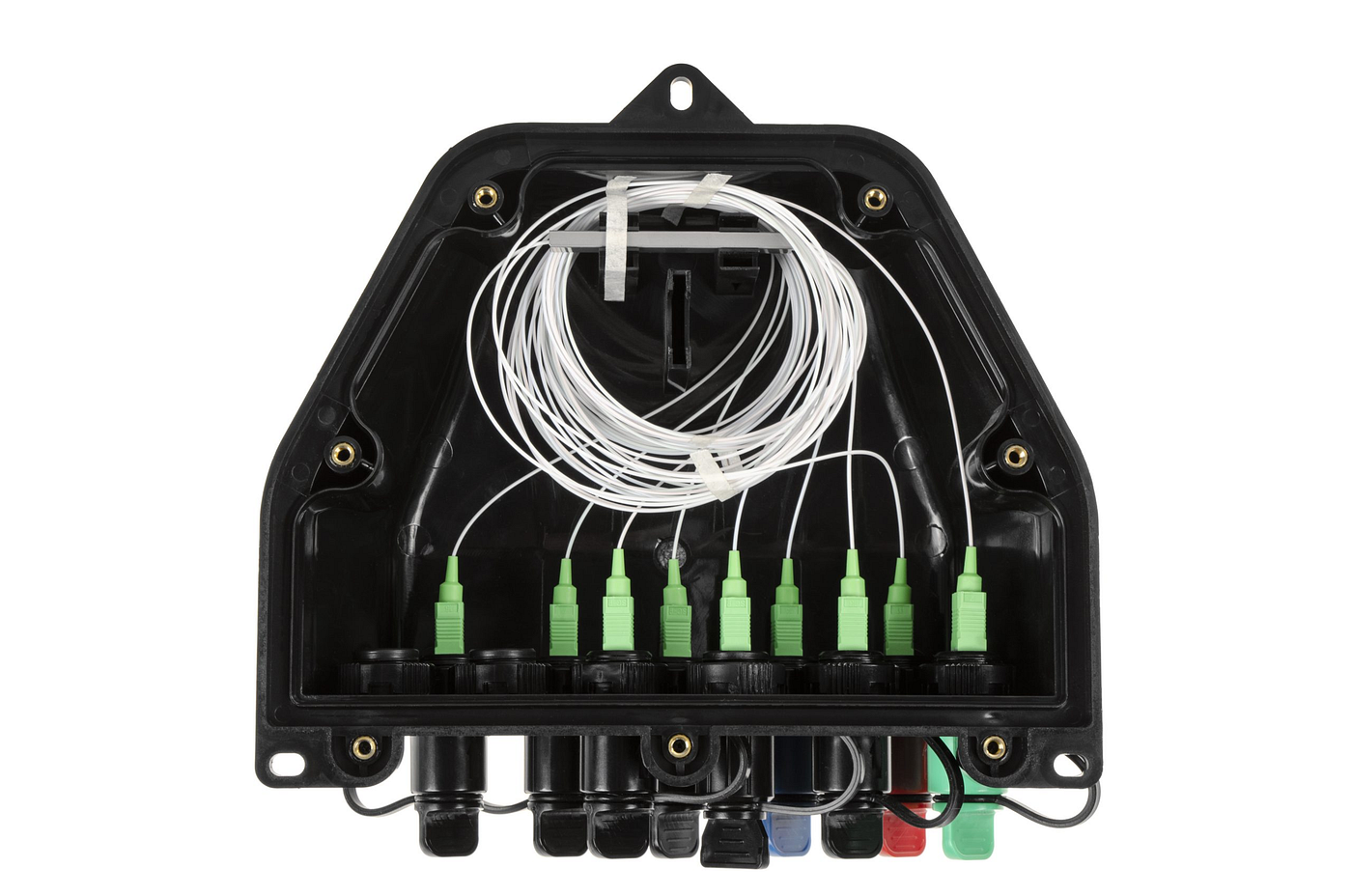
Why Many FTTH Failures Start Inside Unmanaged Terminal Box Points
You may upgrade every part of an FTTH network, yet real failures often start inside unmanaged terminal points that field teams rarely…
Why Many FTTH Failures Start Inside Unmanaged Terminal Box Points

You may upgrade every part of an FTTH network, yet real failures often start inside unmanaged terminal points that field teams rarely inspect. In dense MDU installations, technicians often struggle because drop cables pile up inside FAT units with no clear routing. After a few months, minor bends or loose adapters quietly raise losses and trigger user complaints. Many operators think the problem is the OLT or the outdoor cable — but the root cause usually sits inside a small terminal box.
1. Internal Fiber Management: Where Hidden Losses Begin
Inside an FDB or FAT, the first source of failure is almost always poor fiber management.
Common issues include:
- Bend radius violations around tight corners
- Overlapping fibers that press against the splitter output
- Unstable adapters that loosen after repeated door openings
- Drop cable routing with no fixed channels or guides
In a high-density MDU distribution point, these small stresses accumulate quickly. A splitter output that was fine on day one may suddenly add 0.4–0.8 dB IL because a technician forced an extra drop into the tray. This is why HOLIGHT’s engineering team continues to optimize internal fiber management for long-term reliability.

2. Housing & Material Science: What Fails Under Real Outdoor Conditions
**Outdoor terminal boxes and FDBs** face months of UV, heat, and impact. The material determines whether the box lasts three years or ten.
Key factors:
- ABS vs PC: PC offers stronger impact resistance for pole-mounted installations
- UV resistance: weak housings become brittle and leak at the hinge
- Aging behavior: cheap plastics deform under temperature cycles
- Structural stiffness: affects adapter stability and tray alignment
In coastal FTTH scenarios, salt mist accelerates aging and weakens seals. A box that was “IP65 rated in the lab” may fail after one rainy season if the housing material absorbs moisture.
3. Sealing Design: Moisture Enters Through the Weakest Point
Many operators assume water enters through the cable — in reality, moisture and dust often enter through gasket gaps, uncompressed seals, or poorly designed cable ports.
Important sealing factors:
- IP65/IP68 sealing structure
- Gel blocks around cable entries
- Gasket compression uniformity
- Drain paths for condensation
On pole-mounted outdoor enclosures, constant vibration slowly loosens the seal if the design is not stable. This leads to IL drift in PLC splitter outputs, especially on 1×16 units with denser routing.
4. Splitter Behavior: When a Small Component Shapes FTTH Stability
Splitters are often treated as generic components, but their behavior strongly affects long-term performance.
Key engineering realities:
- 1×8 splitters usually maintain lower IL and more stable performance under temperature changes
- 1×16 splitters pack fibers more tightly, making routing and tray stability more critical
- PLC vs FBT differences become obvious in outdoor boxes exposed to heat and humidity
- IL drift increases significantly when splitter fibers are bent or compressed inside a tray
Improper splitter placement inside an FAT can turn a stable network into a maintenance headache within months.

Real Outdoor Scenario: Pole-Mounted FDB in Rain Season
A carrier deploying FTTH in rural pole-mounted areas often finds that complaints spike after heavy rains. Technicians open the FDB and find:
Damp trays
- Splitter sleeves yellowed from moisture
- Drop cables pushed against adapters
- Gel seals are not fully engaged
The root cause wasn’t the feeder cable — it was the unmanaged internal environment of the terminal box, where sealing, material, and fiber management all failed together.
HOLIGHT’s terminal box designs focus on consistent sealing and stable fiber routing.
You can explore more solutions at **https://www.holightoptic.com**
Conclusion
In FTTH networks, terminal boxes, splitters, sealing, and fiber management ultimately determine whole-network stability — far more than most operators realize.
Learn more at HOLIGHT Fiber Optic Solutions and **FTTHFiberOptic.com. For business inquiries: Crystal@holightoptic.com**
메타데이터
- post_id
- 746e7b4fed1e
- slug
- why-many-ftth-failures-start-inside-unmanaged-terminal-box-points-746e7b4fed1e
- url
- https://medium.com/@cryatal970225/why-many-ftth-failures-start-inside-unmanaged-terminal-box-points-746e7b4fed1e
- canonical_url
- https://medium.com/@cryatal970225/why-many-ftth-failures-start-inside-unmanaged-terminal-box-points-746e7b4fed1e
- author_url
- https://medium.com/@cryatal970225
- status
- ok
- fetched_at
- 2026-07-14 19:44:39