The Loss Function Manual: Matching Your Architecture to the Right Math
In our last post, we explored how activation functions act as the mathematical gates of a neural network. But once data passes through…
The Loss Function Manual: Matching Your Architecture to the Right Math
In our last post, we explored how activation functions act as the mathematical gates of a neural network. But once data passes through those gates and a network makes its final “guess,” how exactly do we grade it?
We use a Loss Function (or error function) to measure the exact difference between the model’s predictions (hat{y}) and the actual target values (y) for a single training example.
Choosing the wrong loss function will completely break your backpropagation loop. Today, we are breaking down the standard loss functions for both regression and classification, detailing exactly when to deploy them.
Part 1: Regression Loss Functions
When your model is predicting a continuous numerical value (like a price, temperature, or coordinate), you are dealing with a regression problem. Your main options are:
- MSE (Mean Squared Error): Heavily penalizes large errors by squaring the differences, making it highly sensitive to outliers.
- MAE (Mean Absolute Error): Measures the average absolute distance, making it much more robust to outliers.
- RMSE (Root Mean Squared Error): Brings the scale of the error back to the original unit of your target data.
- Huber Loss: The best of both worlds. It acts as a hybrid combination of MSE and MAE.
Huber loss uses a threshold parameter (delta) to dynamically switch its math based on how wrong the prediction is:
If the error is small (less than delta), it uses smooth MSE math to converge cleanly. If the error is massive, it switches to linear MAE math to prevent outliers from violently disrupting the weight updates.
Part 2: Classification Loss Functions
When your goal is to sort data into distinct categories, you must switch over to entropy-based loss functions.
1. Binary Cross-Entropy (BCE)
Used strictly for Binary Classification tasks where your output layer uses a Sigmoid activation function to yield a single probability between 0 and 1.
The general equation is:
Because y can only ever be a hard 0 or 1, this equation elegantly collapses into two scenarios depending on the ground truth:
If the true label is 1 and your model predicts a 0.01, the -log(0.01) penalty scales exponentially, aggressively punishing the network during backpropagation.
2. Categorical Cross-Entropy (CCE) vs. Sparse Categorical Cross-Entropy (SCCE)
When you scale up to Multiclass Classification (more than two distinct categories), your output layer will pass through a Softmax activation function to output an array of probabilities that sum to 1.
The mathematical goal remains the same, but how you format your target data determines whether you choose CCE or SCCE:
- Categorical Cross-Entropy (CCE): Expects your true target labels ($y$) to be One-Hot Encoded (OHE) arrays.
- Sparse Categorical Cross-Entropy (SCCE): Expects your true target labels to be simple integer category indices.
The Difference by Example: > Imagine a classification problem with 5 total classes. If the correct label is the second class, here is how the data formatting differs:
- If using CCE: Your target must be formatted as an array:
[0, 1, 0, 0, 0]. The model might output class probabilities like[0.2, 0.5, 0.1, 0.1, 0.1].- If using SCCE: Your target is simply a raw integer index:
[1]. The model still outputs the identical probability array, but you save memory by avoiding massive, sparse one-hot matrices.
The Architecture Manual: What to Pair When
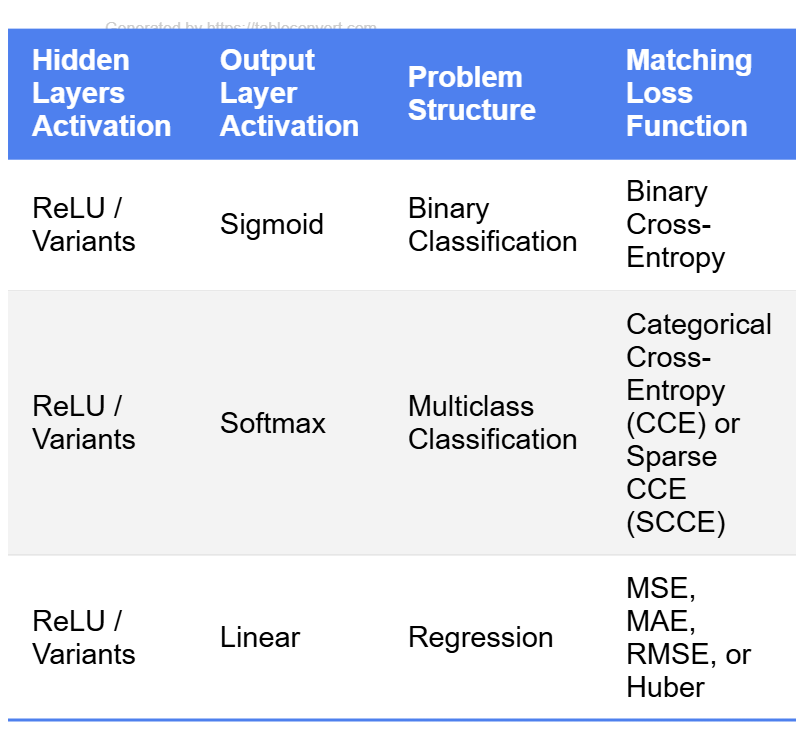
To ensure your networks can actually compute stable gradients, save this master pairing table to your layout workflow:
In the next blog we will go over optimizers and their working. stay tuned!
메타데이터
- post_id
- 74779983a7c3
- slug
- the-loss-function-manual-matching-your-architecture-to-the-right-math-74779983a7c3
- url
- https://medium.com/@mohammedsaimquadri/the-loss-function-manual-matching-your-architecture-to-the-right-math-74779983a7c3
- canonical_url
- https://medium.com/@mohammedsaimquadri/the-loss-function-manual-matching-your-architecture-to-the-right-math-74779983a7c3
- author_url
- https://medium.com/@mohammedsaimquadri
- status
- ok
- fetched_at
- 2026-06-10 08:17:25