Going public to the NYSE or NASDAQ using Reg A
Going public to the NYSE or NASDAQ using Reg A+ is a real, well-established path that more companies should understand clearly before…
Going public to the NYSE or NASDAQ using Reg A
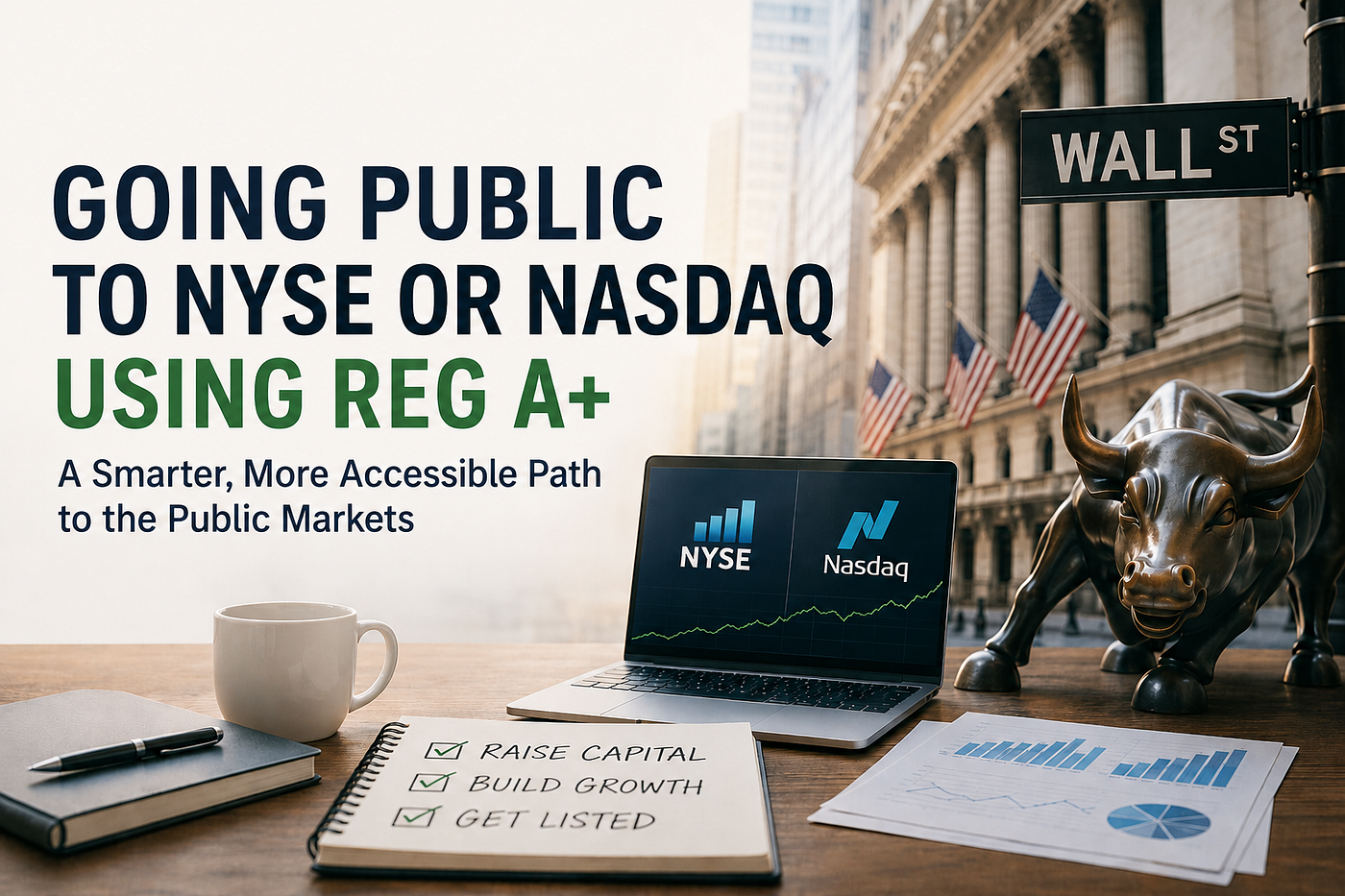
Going public to the NYSE or NASDAQ using Reg A+ is a real, well-established path that more companies should understand clearly before assuming a traditional IPO is their only option. The mechanics are specific, the sequence matters, and the cost savings s are real. Here’s what it actually takes.
What Makes a Reg A+ Listing to NASDAQ or NYSE Different
Reg A+ allows companies to raise up to $75 million in a 12-month period from both accredited and non-accredited investors. What most founders don’t know is that this same mechanism can serve as the capital-raising engine that funds a Direct Listing to the NYSE or NASDAQ. This is not a workaround. It’s a legitimate, SEC-recognized path.
In a Reg A+ Direct Listing to a major exchange, no shares are sold during the listing itself. Share sales happen as capital is raised, prior to the listing event. The listing is the outcome, not the vehicle for raising money. That distinction matters for how you plan the entire process.
The Minimum Requirements for NASDAQ or NYSE
Before anything else, you need to meet the baseline requirements to list on either exchange.
First, you need at least 2 years of operating history. A company incorporated last month cannot go to NASDAQ or NYSE via Reg A+. This is a hard requirement, not a guideline.
Second, you need PCAOB audits from the quarter before listing. If your company doesn’t yet meet these thresholds, the OTCQB or OTCQX markets are accessible via Reg A+ without the 2-year operating history requirement, and a new startup can go public to those markets after raising sufficient capital. Many companies use the OTC markets as a stepping stone.
The Service Provider Sequence
The right sequence for a Reg A+ offering is: auditor first, securities attorney second, marketing agency third.
Start with the auditor because the financial statements are the foundation of your SEC filing. A 2-year US GAAP audit for an early-stage company typically runs $25k to $40k. The securities attorney prepares and files your Offering Circular with the SEC. After filing, the average time for the SEC to Qualify a Reg A+ offering is about 50 days. Some filings have been Qualified in a matter of days when documentation is clean and complete and the offering has no unusual complications.
The marketing agency comes after the legal foundation is in place.
The Role of Broker-Dealers
For a NASDAQ or NYSE Reg A+ IPO in a strong IPO market, an underwriter can play a useful role in distribution and market support. But this is the exception, not the rule.
On standard Reg A+ offerings, broker-dealers add cost and complexity without proportionate benefit. When a broker-dealer is involved, FINRA must review the offering, and FINRA is slow. That review process routinely delays SEC Qualification. Beyond the timeline impact, broker-dealers impose severe advertising restrictions on issuers because FINRA imposes tight restrictions on the broker-dealerst, which makes it substantially harder to attract investors at scale. Advertising is usually the engine of a successful Reg A+ raise, and anything that restricts it costs you capital.
The Marketing Reality
Anyone who tells you that a Reg A+ offering to NASDAQ or NYSE can be completed without sizable advertising spend is not being straight with you. The capital raise happens before the listing, meaning you need to actually find investors, which requires paid marketing at meaningful scale. The typical Reg A+ offering runs for about 12 months for a cost-effective capital raise. Ongoing advertising costs depend on the total amount being raised and how efficiently your marketing performs.
Advertising efficiency varies significantly by platform and approach. Issuers who have used multiple platforms consistently report that advertising on some competing platforms is far less cost-effective than on Manhattan Street Capital, where the back-end software, analytics, and marketing integration are built to handle investment processing at scale with low payment processing fees.
After the offering, ongoing SEC reporting costs and continued marketing expenses are part of the operational reality. Budget for them before you start.

Secondary Market Access After Listing
One of the benefits of going public to the NYSE or NASDAQ via Reg A+ is the liquidity that comes once the listing is completed. How much liquidity you see immediately after listing depends heavily on how well-marketed your company is and how compelling your story is to public market investors. A company that has run a strong Reg A+ campaign with a broad, engaged investor base will have a substantially different listing experience than one that squeaked through with minimum capital and minimal investor awareness.
MSC introduces corporate clients to secondary markets, including ATS-type exchanges and the major exchanges, and advises on how to approach the transition from private capital raise to public market trading.
The One Actionable Step to Take Now
If you’re serious about going public to the NYSE or NASDAQ using Reg A+, start by verifying your 2-year operating history and finding a PCAOB-registered auditor now, before you do anything else. The audit is always the long pole in the tent, and starting it late is the single most common reason timelines slip. Everything else, the attorney, the filing, the marketing, flows from having clean, compliant financials in place.
MSC is not a law firm, valuation service, underwriter, broker-dealer or a Title III crowdfunding portal and we do not engage in any activities requiring any such registration. We do not provide advice on investments. MSC does not structure transactions. Do not interpret any advice from MSC staff as a replacement for advice from service providers in these professions. When Rod Turner provides advice this advice is based upon his observations of what works and what does not from a marketing perspective in online offerings. Rod does not tell the audience what to do, or how to do it. He advises the audience what is most likely to be easier to market cost effectively in the online context. The choices of all aspects of companies’ offerings are made by the companies that make offerings.
메타데이터
- post_id
- 748b327b5951
- slug
- going-public-to-the-nyse-or-nasdaq-using-reg-a-748b327b5951
- url
- https://medium.com/@iamrodturner/going-public-to-the-nyse-or-nasdaq-using-reg-a-748b327b5951
- canonical_url
- https://medium.com/@iamrodturner/going-public-to-the-nyse-or-nasdaq-using-reg-a-748b327b5951
- author_url
- https://medium.com/@iamrodturner
- status
- ok
- fetched_at
- 2026-06-20 20:29:01