Decision Trees vs Random Forest vs XGBoost vs SVM
A simple guide to understanding key machine learning models (and when to use them)
Decision Trees vs Random Forest vs XGBoost vs SVM
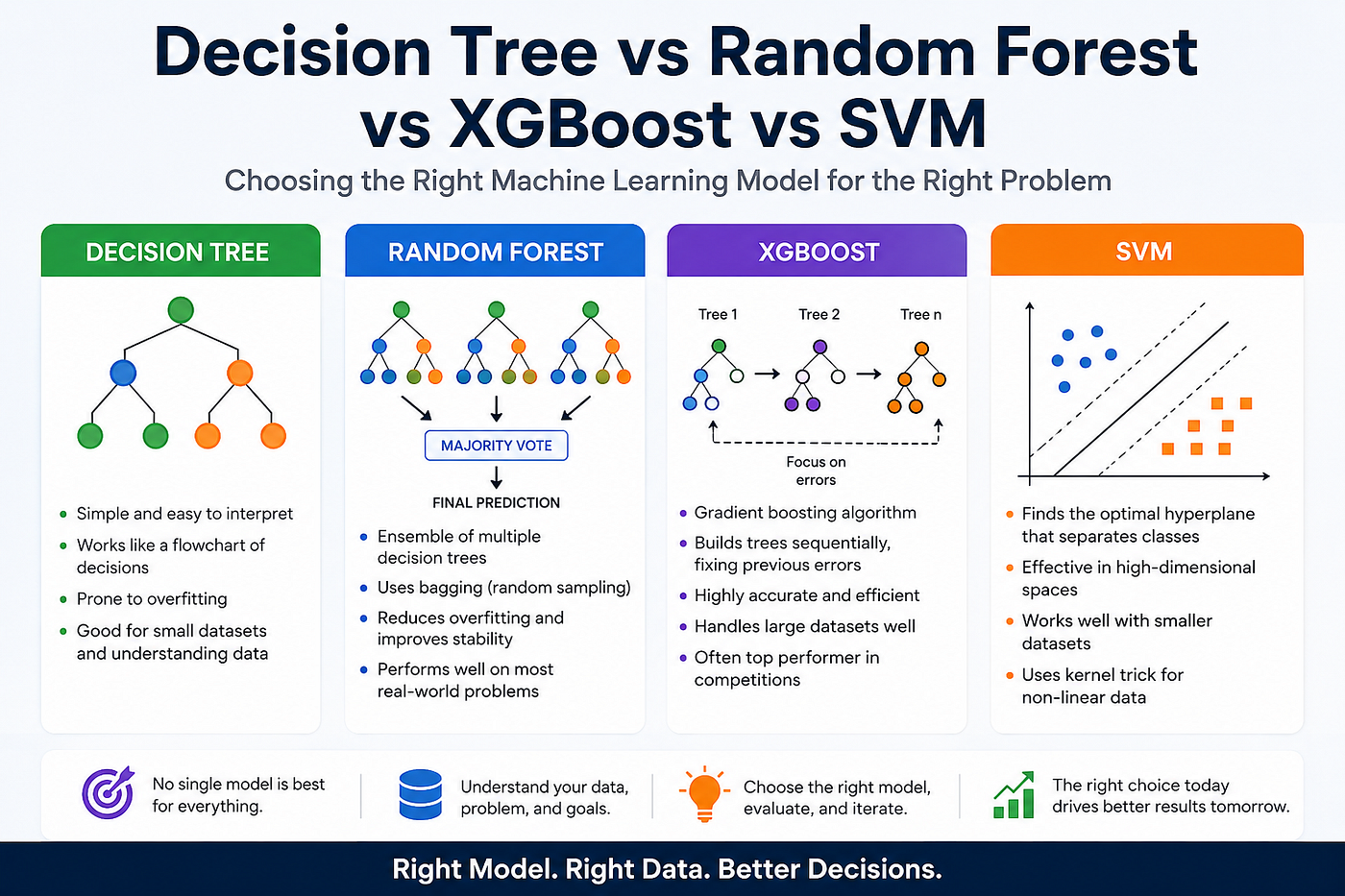
A simple guide to understanding key machine learning models (and when to use them)
Machine learning can feel overwhelming at first because there are so many algorithms that seem to do similar things. But in reality, each model has its own strengths, weaknesses, and ideal use cases.
In this article, we’ll break down four of the most important classical machine learning models:
- Decision Trees
- Random Forest
- XGBoost
- Support Vector Machines (SVM)
We’ll also briefly discuss why deep learning models like LSTM are not always necessary for simpler problems.
🌳 1. Decision Tree
A Decision Tree is one of the easiest machine learning models to understand. It works just like a flowchart made up of yes/no questions.
How it works
The model keeps splitting data based on conditions until it reaches a final decision.
For example:
- Is income > 3000?
- Yes → Buy product
- No → Don’t buy product
Why it’s useful
- Very easy to understand and explain
- Works for both classification and regression
- Doesn’t require feature scaling
Limitations
- Can easily overfit the data
- Sensitive to small changes in input
- Not very stable on its own
👉 In simple terms: a Decision Tree is like a person making decisions step by step using fixed rules.
🌲 2. Random Forest
Random Forest improves on Decision Trees by combining many of them together.
Instead of relying on a single tree, it builds multiple trees and combines their results.
How it works
- Each tree is trained on a random sample of the data
- Each tree makes a prediction
- Final result is decided by majority vote (classification) or average (regression)
Why it works better
- Reduces overfitting
- More stable and reliable than a single tree
- Handles noise and missing values better
Limitations
- Harder to interpret than a single tree
- Slower when making predictions compared to a single model
👉 Think of it as asking multiple people for their opinion and choosing the most common answer.
🚀 3. XGBoost (Extreme Gradient Boosting)
XGBoost is one of the most powerful machine learning algorithms used in industry and Kaggle competitions.
How it works
- Builds trees one after another
- Each new tree tries to fix the mistakes of the previous one
- Uses optimization techniques to reduce error step by step
Why it is powerful
- Very high accuracy on structured data
- Built-in regularization helps prevent overfitting
- Works extremely well with large datasets
Limitations
- Requires careful tuning of parameters
- Can be complex for beginners
- May take longer to train compared to simpler models
👉 In short: XGBoost learns from its past mistakes and continuously improves.
📊 4. Support Vector Machine (SVM)
SVM is a model that tries to find the best boundary between different classes.
How it works
- Finds a line (or hyperplane) that separates data classes
- Maximizes the margin between classes
- Uses kernel functions for non-linear data
Advantages
- Works well with high-dimensional data
- Effective for small datasets
- Strong theoretical foundation
Limitations
- Not suitable for very large datasets
- Requires feature scaling
- Can be slow with complex kernels
👉 Think of SVM as drawing the cleanest possible boundary between groups.
📌 Quick Comparison
ModelStrengthWeaknessBest ForDecision TreeSimple and interpretableOverfits easilyBasic problemsRandom ForestAccurate and stableLess interpretableGeneral-purpose MLXGBoostVery high performanceNeeds tuningCompetition-level MLSVMStrong in high dimensionsNot scalableSmall complex datasets
🧠 Why LSTM is not always needed
LSTM (Long Short-Term Memory) is a deep learning model designed for sequential data like time series, text, or GPS trajectories.
However, it is not always the best choice.
Why?
- It requires large amounts of data
- It is computationally expensive
- It is harder to tune compared to classical models
- Often performs worse than tree-based models on structured/tabular data
👉 So instead of being “better”, LSTM is simply designed for a different type of problem.
🎯 When to use what?
- Use Decision Tree → when you want simplicity and explanation
- Use Random Forest → when you want strong, reliable performance
- Use XGBoost → when you need maximum accuracy on structured data
- Use SVM → when data is small but complex
- Use LSTM → when working with sequences or time-based data
💡 Final thoughts
There is no single best machine learning model. Each one is designed for a different kind of problem.
A good data scientist is not someone who always uses the most complex model, but someone who chooses the right model for the right situation.
Understanding these differences is what really builds strong intuition in machine learning.
Thank you for reading !
메타데이터
- post_id
- 7490b52078ba
- slug
- decision-trees-vs-random-forest-vs-xgboost-vs-svm-7490b52078ba
- url
- https://medium.com/@kishora.r67/decision-trees-vs-random-forest-vs-xgboost-vs-svm-7490b52078ba
- canonical_url
- https://medium.com/@kishora.r67/decision-trees-vs-random-forest-vs-xgboost-vs-svm-7490b52078ba
- author_url
- https://medium.com/@kishora.r67
- status
- ok
- fetched_at
- 2026-07-09 10:05:04




