Sakana Fugu vs Claude Fable 5: Why the Future of AI Might Be About Orchestration, Not Bigger Models
Artificial intelligence has spent the last few years chasing a simple objective: build the next largest, smartest foundation model. Every…
Sakana Fugu vs Claude Fable 5: Why the Future of AI Might Be About Orchestration, Not Bigger Models
Blog Thumbnail
Artificial intelligence has spent the last few years chasing a simple objective: build the next largest, smartest foundation model. Every major release has been measured by parameter counts, benchmark scores, context windows, and reasoning capabilities.
Sakana AI is taking a noticeably different approach.
Instead of asking “How do we train an even better model?”, the company asks a more interesting question:
What if the smartest AI isn’t a single model at all?
That question led to Fugu, an AI system that behaves like a single language model while internally coordinating multiple specialized models. The result is something that looks like ChatGPT or Claude from the outside but functions more like an intelligent team behind the scenes.
Naturally, comparisons to Claude Fable 5, Anthropic’s most advanced reasoning model, started almost immediately.
This article explores what Fugu actually is, how it works, where it differs from Claude Fable 5, and why its architecture may represent one of the most significant shifts in modern AI systems.
What Is Sakana Fugu?
Unlike traditional large language models, Fugu is an orchestrator model.
It isn’t designed to solve every problem directly.
Instead, it learns how to:
- Understand the user’s objective
- Break complicated tasks into smaller problems
- Decide which specialist model should handle each step
- Verify intermediate results
- Combine multiple outputs into one final response
From the user’s perspective, it behaves like one AI.
Internally, however, it coordinates a collection of expert agents through a single OpenAI-compatible API. Sakana describes this as turning a multi-agent system into what appears to be a single foundation model. :contentReference[oaicite:0]{index=0}
Traditional LLM vs Fugu
Most frontier models follow a straightforward pipeline.
Prompt
   │
   ▼
Single Foundation Model
   │
   ▼
Final Answer
Fugu looks considerably different.
               User Prompt
                     │
                     ▼
             Fugu Orchestrator
                     │
      ┌──────────────┼───────────────┐
      ▼              ▼               ▼
 Planner        Coding Agent     Research Agent
      │              │               │
      └──────────────┼───────────────┘
                     ▼
             Verification Layer
                     │
                     ▼
              Final Response
Rather than depending on one neural network to do everything, Fugu dynamically creates an execution plan and assigns work across multiple agents before synthesizing the final answer. :contentReference[oaicite:1]{index=1}
Why This Matters
Most AI companies compete by training larger and more expensive models.
That approach has obvious drawbacks:
- Training costs continue to increase.
- Infrastructure requirements grow every generation.
- Improvements become increasingly incremental.
Sakana AI argues that intelligence can emerge not only from larger models, but from better coordination between existing models.
It’s similar to a company.
One extremely talented employee can accomplish a lot.
A well-managed team of specialists often accomplishes much more.
That philosophy is the foundation behind Fugu.
The Two Versions of Fugu
Sakana currently offers two variants.
Fugu
Designed for:
- Everyday conversations
- Coding assistance
- Interactive applications
- Lower latency
The emphasis is balancing response quality with speed.
Fugu Ultra
Built for much harder problems, including:
- Scientific reasoning
- Research workflows
- AI development
- Cybersecurity analysis
- Multi-step engineering tasks
Fugu Ultra performs deeper orchestration, coordinating a larger pool of expert agents before generating its response. :contentReference[oaicite:2]{index=2}
What Is Claude Fable 5?
Claude Fable 5 represents Anthropic’s highest-end reasoning model.
Unlike Fugu, it is one frontier foundation model trained to perform reasoning directly.
Its strengths include:
- Long-horizon reasoning
- Software engineering
- Scientific analysis
- Document understanding
- Extended autonomous task execution
Fable 5 is effectively the traditional “build a smarter model” philosophy taken to the frontier. :contentReference[oaicite:3]{index=3}
The Biggest Difference
The distinction between these systems isn’t just performance.
It’s architecture.
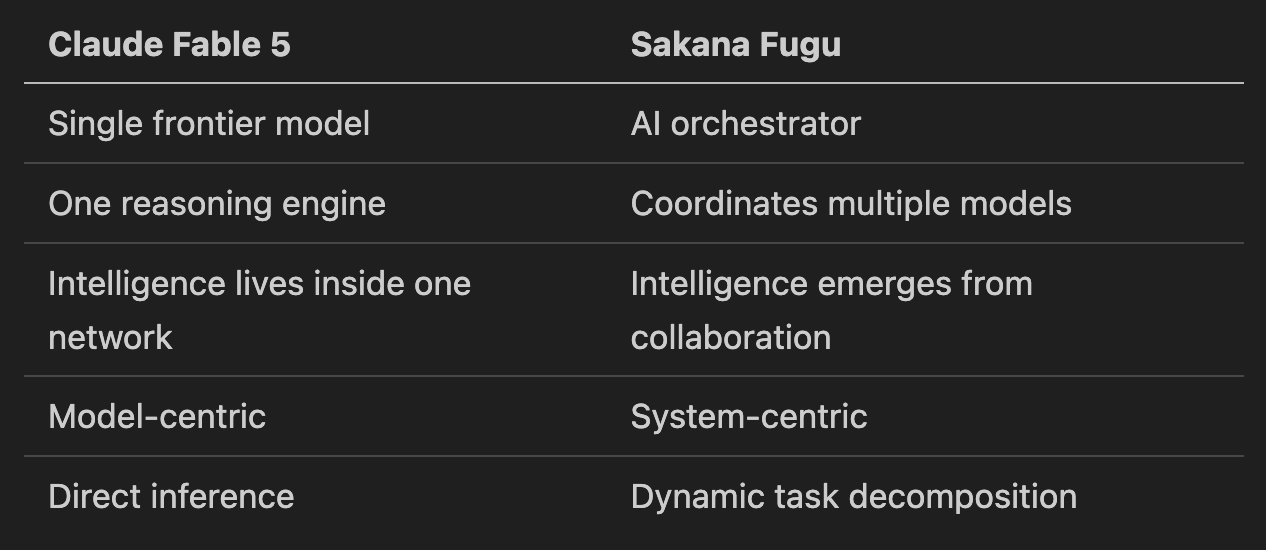
Claude Fable 5 vs Sakan Fugu
This may sound subtle.
It isn’t.
It’s comparable to the difference between:
- hiring one exceptional engineer
- assembling a high-performing engineering team with an experienced technical lead
Both can solve the same problem.
The second approach scales differently.
Benchmark Comparison
Sakana reports that Fugu Ultra reaches frontier-level performance across multiple reasoning, engineering, and scientific benchmarks. According to the company, it performs competitively with models such as Claude Fable 5 and Mythos Preview while exceeding the scores of publicly accessible models in several categories. :contentReference[oaicite:4]{index=4}
The published head-to-head comparison shows a more nuanced picture.
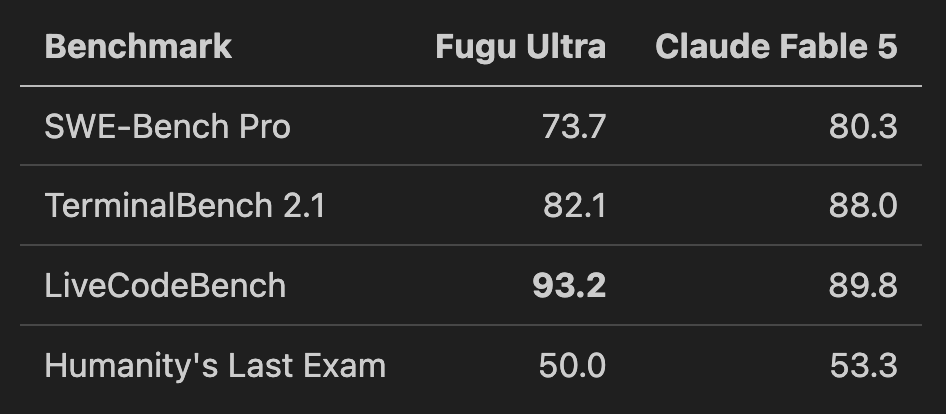
Benchmark Comparison
Based on Sakana’s published numbers:
- Claude Fable 5 leads on most reported reasoning and software engineering benchmarks.
- Fugu Ultra leads on LiveCodeBench.
- Overall performance differences are relatively small on several tasks, supporting Sakana’s characterization that the systems are “shoulder-to-shoulder,” though the comparison relies on vendor-reported results rather than independent evaluation. :contentReference[oaicite:5]{index=5}
Where Fugu Could Have an Advantage
1. Model Independence
If one underlying model becomes unavailable, newer or alternative models can potentially replace it without requiring the entire orchestration system to be retrained.
That creates flexibility that single-model systems lack.
2. Better Specialization
Different models excel at different tasks.
Some are stronger at coding.
Others perform better at mathematics.
Others produce better writing.
Instead of forcing one model to master everything, Fugu can route work to whichever specialist is most appropriate.
3. Future-Proof Architecture
As newer frontier models appear, they can theoretically be integrated into the orchestration layer.
The coordinator improves without rebuilding the entire ecosystem.
Where Claude Fable 5 Still Has Strengths
A unified reasoning model offers advantages too.
Consistency
Every response comes from one reasoning process.
There are fewer opportunities for conflicting intermediate outputs.
Predictable Behavior
Single-model systems tend to produce more stable responses because they don’t rely on coordination among multiple agents.
Mature Ecosystem
Anthropic has invested heavily in:
- alignment
- safety
- long-context reasoning
- enterprise deployment
Those areas remain major advantages for Claude’s ecosystem.
Is Fugu Really One Model?
Technically…
Not exactly.
It is itself a trained language model, but its primary job is coordinating other models rather than solving every task independently.
That distinction is important.
The innovation isn’t simply another language model.
It’s the orchestration strategy.
Think of it less as another chatbot and more as an AI operating system.
Why Researchers Are Paying Attention
For years, multi-agent systems required developers to manually create workflows:
- planner
- coder
- reviewer
- evaluator
Each role required handcrafted prompts and routing logic.
Fugu learns those orchestration strategies automatically.
Instead of programming the workflow…
…the workflow becomes part of the model itself. :contentReference[oaicite:6]{index=6}
The Broader Industry Shift
The emergence of Fugu hints at a broader trend.
The next frontier may not simply be training larger foundation models.
Instead, companies may compete on:
- orchestration quality
- agent collaboration
- dynamic routing
- intelligent verification
- adaptive execution strategies
In that world, intelligence becomes less about one giant neural network and more about how effectively many specialized systems cooperate.
Several industry observers have argued that this shift — from model-centric AI to orchestration-centric AI — could become increasingly important as organizations adopt multiple foundation models rather than relying on a single provider. :contentReference[oaicite:7]{index=7}
Final Thoughts
Claude Fable 5 and Sakana Fugu represent two very different visions of AI.
Claude Fable 5 pushes the limits of what a single frontier model can achieve.
Fugu asks whether a coordinated team of models can match — or eventually surpass — that capability.
Today, Claude Fable 5 still holds an edge on several published reasoning and software engineering benchmarks, while Fugu Ultra demonstrates competitive performance and even leads in some coding evaluations. More importantly, Fugu introduces an architectural idea that extends beyond benchmark scores: treating orchestration itself as a learned capability rather than a collection of manually designed workflows. :contentReference[oaicite:8]{index=8}
Whether orchestration becomes the dominant direction for future AI remains to be seen. But Fugu has already shifted the conversation. Instead of asking who has the largest model, researchers are increasingly asking a different question:
Can a well-coordinated team of models outperform even the smartest individual model?
That question may define the next chapter of AI development.
메타데이터
- post_id
- 74a54d068e86
- slug
- sakana-fugu-vs-claude-fable-5-why-the-future-of-ai-might-be-about-orchestration-not-bigger-models-74a54d068e86
- url
- https://medium.com/algomart/sakana-fugu-vs-claude-fable-5-why-the-future-of-ai-might-be-about-orchestration-not-bigger-models-74a54d068e86
- canonical_url
- https://medium.com/algomart/sakana-fugu-vs-claude-fable-5-why-the-future-of-ai-might-be-about-orchestration-not-bigger-models-74a54d068e86
- author_url
- https://medium.com/@yashjainio
- status
- ok
- fetched_at
- 2026-07-17 14:41:54