Squabbling Royal Families
Prince Harry, Duke of Sussex, isn’t the first royal to get into conflict with his family members
Squabbling Royal Families
Prince Harry, Duke of Sussex, isn’t the first royal to get into conflict with his family members
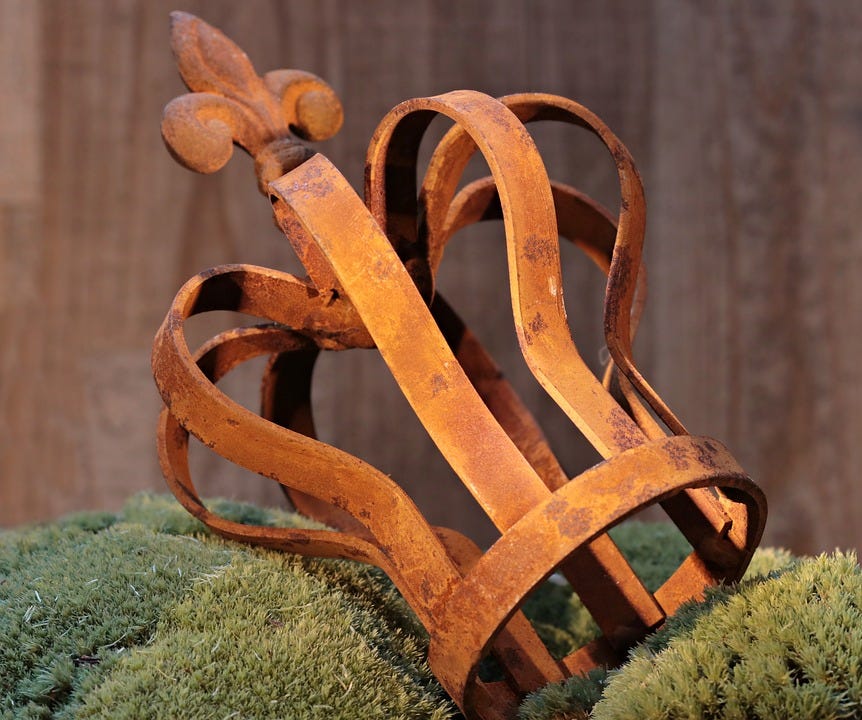
Crowns are the cause of much discord. Pixabay.
Richard I (1157–1199)
Known as Richard the Lionheart, he wasn’t much bothered about governing England; his attention was concerned mostly with looking after his possessions in France and going on a crusade against Islam.
He reigned England for 10 years but only spent six months in England.
Richard’s younger brother, John, was filled with envy and bitterness towards Richard and he unseated the king’s deputy, Chancellor William de Longchamp.
On his way home from the crusade, Richard was shipwrecked and captured by Henry VI of Austria, who demanded a ransom equivalent to $23 million in today’s money for his release.
Filled with brotherly devotion, John offered Henry about half that much to keep Richard imprisoned. The king was eventually released and forgave his brother, saying he “had evil counsellors.”
When Richard died from a wound inflicted during a battle, John succeeded him.

Richard I is glorified in a statue outside the Palace of Westminster as one of England’s greatest monarchs although he was scarcely ever in the country. Christine Matthews on Geograph.
Drowned in a Butt of Malmsey
Henry II became King of England in 1154 and established the dynasty of the Plantagenet family; but it was a house divided. On one side was the Lancastrian branch and on the other the Yorkists, and each claimed to be the rightful rulers of the country.
The rivalry culminated in the Wars of the Roses, which started in 1455 and went on for 30 years.
It was a blood-soaked affair with the Battle of Townton on March 29, 1461 leaving 28,000 men dead in a single day.
The Yorkists under King Edward IV emerged victorious but that in no way ended the family feud.
This is where Edward’s younger brother, George, the Duke of Clarence, enters the cast of characters. He persuaded himself that he was the rightful monarch and joined several plots to oust his brother; they all failed and Edward declined to have his brother charged with treason.
But, George wouldn’t give up. He accused Edward’s wife, Elizabeth Woodville, of witchcraft. He claimed that Edward communicated with the dead in casting evil spells.
Finally, Edward had enough and charged George with treason, the penalty for which was execution.
Under normal circumstances, George would have a date with the headsman but Edward allowed him to chose his own way of being put to death.
George had a great fondness for wine so he requested that he be drowned in a butt of malmsey — a butt being a 100-gallon barrel and malmsey, a Madeira wine.
We get this story from William Shakespeare and its accuracy has been challenged. However, George’s body was exhumed and his head was found to be still attached.
Who Shall Inherit the Throne?
Elizabeth I was third in line for the throne of England. Mary Tudor, as Henry VIII’s first born child should have been monarch but, well, she was a woman and her younger brother Edward was available. He became King Edward VI at the age of nine when his father died, but the lad was struck down by tuberculosis when just 15.
Mary stepped forward and claimed the crown in 1553, and that’s when religion stirred up trouble. Mary was a devout Roman Catholic and Elizabeth followed the teaching of the increasingly Protestant Church of England.
Filled with religious fervour, Mary had the pope reinstated as the religious leader of England. Almost 300 Protestant clergy who objected to this were burned at the stake, earning the new queen the title of Bloody Mary.
She upset many in England by marrying Philip II of Spain, further entrenching Roman Catholicism.
There was the issue of the continued existence of the Protestant sister Elizabeth. Mary solved this by having Elizabeth shut away in the Tower of London.
In earlier days, this problem would have been dealt with by an execution, but the sibling rivalry in this case did not go that far.
Mary died in 1558 and willed that Elizabeth should succeed her expressing the hope that the younger sister would convert to Catholicism. Elizabeth remained a Protestant.
Elizabeth also had to deal with a pesky cousin, Mary, Queen of Scots. Ousted from her Scottish throne, Mary sought refuge in England but she became the focal point of Catholic plots to get rid of Elizabeth.
That difficulty was dealt with when Mary’s head was chopped off in 1587.

Elizabeth I.
The Heir and a Spare
The man who was to become George V had two sons; Edward was born in 1894, George a year later. The brothers were very different and an unkind comment by an acquaintance summed it up: “It’s like comparing an ugly duckling with a cock pheasant.”
Edward was debonair and jaunty, George was awkward with a crippling stammer.
As children, Edward made fun of George’s stutter, and, in 1907, their tutor complained that the presence of both brothers in a room acted like a “red rag” and caused fights.
It was the arrival on the scene of the American divorcee Wallis Simpson that triggered deeper enmities.
Edward wanted to marry her but he couldn’t. As king he was head of the Church of England and not permitted to marry a divorced person.
In December 1936, Edward chose instead to abdicate, making his younger brother, King George VI.
George never wanted to be king and he deeply resented his brother dumping the role on him. The relationship soured as Edward pestered the new king for a bigger pension and to have his wife given the title of “Her Royal Highness.”
Eventually, George stopped taking Edward’s phone calls and the rift widened. There was worse, far worse, to come.
Embittered Edward started looking around for allies and found one the German dictator Adolf Hitler.
In October 1937, Edward and Wallis, now the Duke and Duchess of Windsor, visited Germany and a lavish welcome was put on for them that included a two-hour meeting with Hitler.
Edward wanted to make it clear that he admired the Führer and there was talk that if Germany defeated Britain in the coming war, he would be reinstated as king.
When war did break out, Edward was privately quite clear that he favoured a German victory and publicly called his brother “stupid.” The British government sent him off to the Bahamas to act as governor, thereby getting him away from Europe.
Following the war, the relations between the royal family and Edward and Wallis remained toxic.
[embed]
William and Harry
Now, we are given a new royal brouhaha to salivate over. Prince William is the heir to the throne and Prince Harry is the spare should something bad happen to his older brother.
Now that William has children, Harry gets pushed further down the waiting list.
Harry and his wife Meghan, the Duke and Duchess of Sussex, have given up royal duties and decamped to take up residence in California.
From their distant perch they have sniped at William and the royal family in general with allegations of racism because Megan is of mixed race.
There is a story of a princely punch up in a royal palace (it seems it was more a push than a fight), and failure of the royal family to protect Meghan for the tabloid newspaper vultures.
Harry even goes so far as to accuse the royal family of feeding scurrilous and untrue stories about him and Meghan to the press.
How much is true and how much is empty speculation borne of resentment is unknown.
Buckingham Palace does not comment publicly to the washing of dirty laundry in full view of the citizenry. It has subtler methods such a leaking juicy tidbits to chosen journalists.
Gone are the days when this sort of thing ended in time behind bars or an axe blade across the back of the neck.
Bonus Factoids
The Brits do not have a lock on sibling rivalry among royals.
In France, Louis XIII (1601–1643) had a lot of strife with his younger brother Gaston, who thought he ought to have a share of the king’s power. Louis disagreed, so Gaston set about raising rebellious armies that caused him to go into exile. No doubt Gaston spent much of his time complaining that his rightful position had been stolen from him, as certain people do.
In 1740, an infant, Ivan VI, was declared to be the Tsar of Russia. But, another branch of his family had him taken from his crib and incarcerated. The Empress Elizabeth installed herself as Tsarina and declared Ivan to be purged from memory. In 1764, the deposed tsar was murdered in prison.
Back in France, Louis XVI was being plagued by an ambitious younger brother. Louis Stanislas, Comte de Provence, fancied himself as a senior royal adviser although his brother, the king, did not see him in that role. So, Louis Stanislas embarked on a campaign of pamphlet writing aimed at undermining his brother’s wife, Marie Antoinette, accusing her of unseemly sexual escapades. This played a part in the downfall of the monarchy and a trip to the guillotine for Louis XVI and his wife. Louis Stanislas was a real survivor and, after many years of turmoil, became King Louis XVIII in 1814.
Sources
“King Richard I of England.” Melissa Snell, ThoughtCo, June 14, 2017.
“The Life of King Edward IV.” Ben Johnson, historic-uk.com, undated.
“Royal Sibling Rivalry: Henry VIII, Richard III and Other Monarchs Whose Fate Was Determined by Their Brothers and Sisters.” Sarah Gristwood, BBC History Extra, January 5, 2023.
“Bloody Mary: The Marriage, Reign, and Death of a Queen of England.” ancient-origins.net, October 9, 2015.
“Battle of the Royal Brothers: King Edward VIII, King George VI, and the Rift That Changed History.” Hadley Hall Meares, Vanity Fair, July 22, 2021.
“Harry’s Allegations Are Not Just About a Royal Fistfight — But the Very Real Dangers of Hereditary Power.” Gaby Hinsliff, The Guardian, January 5, 2023.
“Prince Harry Is not the First ‘Spare’ to Stir up Royal Unrest.” Eleanor Herman, Globe and Mail, January 5, 2023.
© Copyright Rupert Taylor 2026
메타데이터
- post_id
- 74a85aa38d7c
- slug
- squabbling-royal-families-74a85aa38d7c
- url
- https://medium.com/activated-thinker/squabbling-royal-families-74a85aa38d7c
- canonical_url
- https://medium.com/activated-thinker/squabbling-royal-families-74a85aa38d7c
- author_url
- https://medium.com/@ruperttaylor493
- status
- ok
- fetched_at
- 2026-06-20 20:29:01