Europe’s Brutal Heatwave — A Climate Emergency
The climate crisis is no longer a distant threat, it is unfolding in real time. The unprecedented heatwave sweeping across Europe has once…
Europe’s Brutal Heatwave — A Climate Emergency
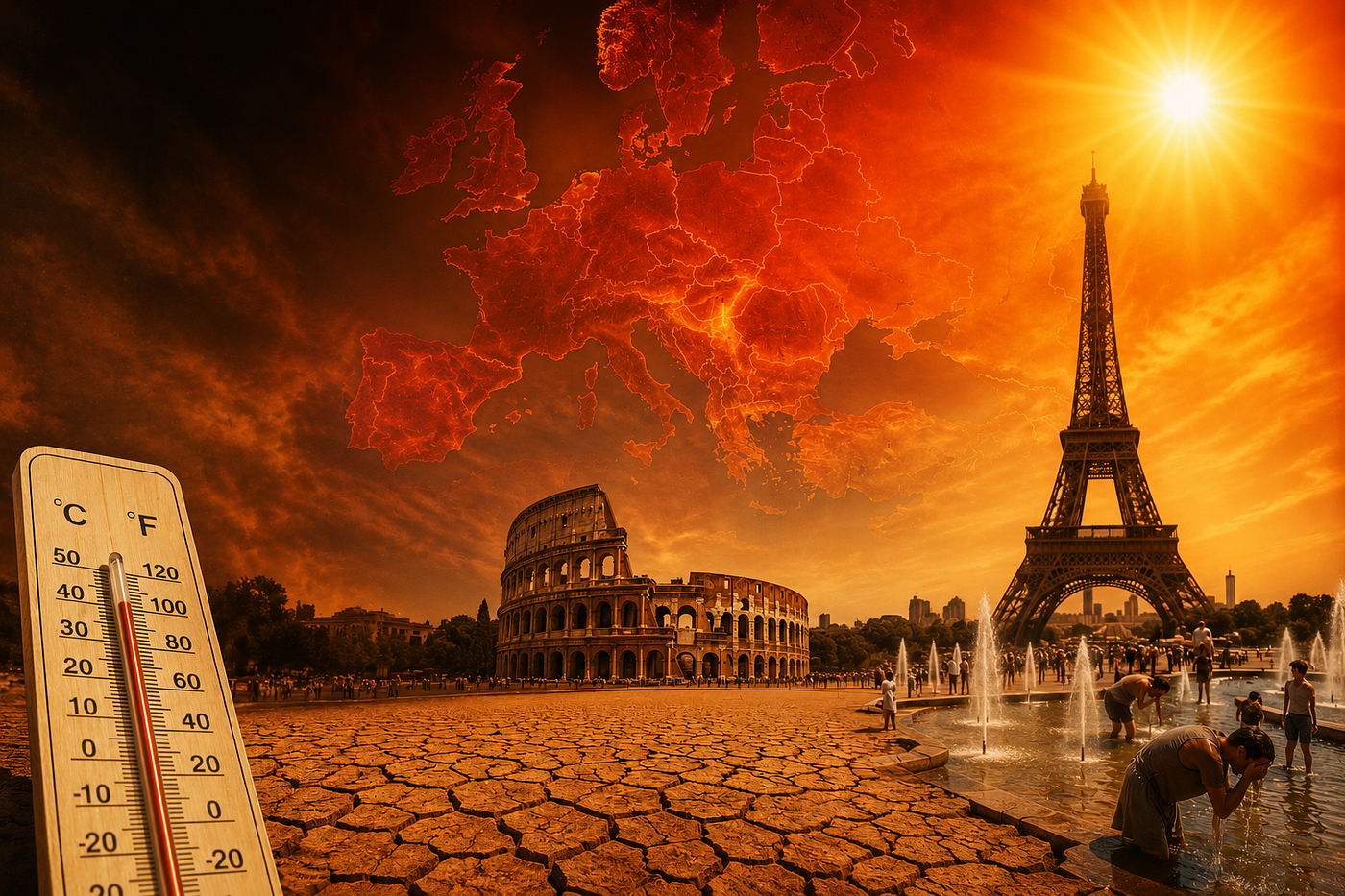
The climate crisis is no longer a distant threat, it is unfolding in real time. The unprecedented heatwave sweeping across Europe has once again underscored this reality. Countries historically known for their temperate summers are witnessing record-breaking temperatures, raging wildfires, water scarcity and mounting fatalities. Europe is witnessing one of the deadliest early-summer heatwaves in its modern history. Cities from Spain and Portugal to France, Italy and Greece have been grappling with temperatures exceeding 40°C, forcing authorities to issue health alerts, close schools, restrict outdoor work and mobilise emergency services. According to World Health Organisation (WHO) more 1300 people died within about a week in several European cities. Scientists attribute the severity of this event largely to human induced climate change, combined with a persistent atmospheric circulation pattern known as Heat Dome (Omega Block).
Understanding the Difference Between Weather and Climate
Weather refers to short-term atmospheric conditions, whereas climate represents long-term patterns observed over decades. While individual heatwaves are natural phenomena, their frequency, duration and intensity are being amplified by anthropogenic climate change.
According to the Intergovernmental Panel on Climate Change (IPCC), human-induced global warming has made extreme heat events significantly more frequent across every inhabited continent. The World Meteorological Organization (WMO) has similarly warned that heatwaves are becoming longer-lasting, more intense and more widespread due to increasing greenhouse gas concentrations.
The European heatwave therefore illustrates not an abnormal deviation from climate trends, but rather the accelerating consequences of those very trends.
A Continent Under Extreme Stress
Europe has emerged as one of the fastest-warming continents. Scientific assessments indicate that it has warmed at roughly twice the global average over recent decades, driven by factors such as Arctic amplification, changing atmospheric circulation and declining snow and ice cover.
The consequences are visible across multiple sectors:
· Public Health Crisis: Heat-related illnesses, dehydration, cardiovascular complications and respiratory disorders have increased substantially. Elderly citizens, children, outdoor workers and economically vulnerable populations remain particularly at risk.
· Wildfires: Southern European countries have experienced devastating forest fires, destroying biodiversity, settlements and critical infrastructure while releasing enormous quantities of carbon dioxide, thereby creating a vicious climate feedback loop.
· Water Scarcity: Rivers, reservoirs and groundwater levels have declined, threatening drinking water supplies, agriculture and hydropower generation.
· Agricultural Losses: Prolonged heat stress has reduced crop yields, affected livestock productivity and intensified concerns regarding European food security.
· Energy Stress: Electricity demand for cooling has surged even as hydropower generation has declined due to shrinking water availability, exposing vulnerabilities in Europe’s energy transition.
Global Implications
The significance of Europe’s heatwave extends far beyond the continent.
First, it challenges the perception that developed nations possess complete resilience against climate change. Despite advanced infrastructure and sophisticated disaster management systems, European countries continue to experience severe disruptions, highlighting that no nation is immune.
Second, recurring climate extremes threaten the global economy. Europe remains a major hub for manufacturing, tourism, finance and international trade. Heat-induced disruptions to transportation, agriculture and industrial production inevitably reverberate across global supply chains.
Third, the crisis strengthens calls for accelerated implementation of the Paris Agreement. Current global mitigation efforts remain insufficient to limit warming to 1.5°C, increasing the likelihood of more frequent and severe extreme weather events.
Finally, the European experience reinforces the urgency of climate adaptation alongside mitigation. Even if emissions decline sharply, many climate impacts are already locked into the system due to historical emissions.
Why Does 40°C Kill in Europe but Not Always in India? Understanding Climate Adaptation
One of the most striking questions arising from Europe’s ongoing heatwave is “Why does a temperature of 40–42°C bring large parts of Europe to a standstill, while many regions of India experience similar temperatures every summer?”
The answer lies not merely in the thermometer, but in long-term climatic adaptation — of people, infrastructure, architecture and public systems.
Climate Shapes Civilisation
India lies largely within the tropical and subtropical climatic zones, where high summer temperatures have been a defining geographical reality for centuries. Consequently, Indian society has evolved around living with heat. In contrast, much of Europe experiences a temperate climate characterised by mild summers, cold winters and comparatively lower annual temperature variability. Historically, the greater challenge in Europe has been retaining warmth, not dissipating it. As a result, Europe’s buildings, cities and lifestyles were designed for cold weather rather than prolonged heat.
Architecture: Designed for Opposite Climates
The most visible contrast lies in residential architecture. Traditional European houses are constructed to retain indoor heat during long winters. Thick insulated walls, double or triple-glazed windows, compact room layouts, minimal cross-ventilation and airtight construction reduce heat loss and improve energy efficiency in cold climates. While ideal for winter, these features can trap heat indoors during summer heatwaves, causing indoor temperatures to remain dangerously high, even at night. Indian architecture, by contrast, has historically evolved as a response to tropical heat.
Traditional homes across Rajasthan, Gujarat, Kerala and other regions incorporated:
- Thick earthen or stone walls that reduce heat transfer.
- High ceilings that allow hot air to rise.
- Courtyards facilitating natural air circulation.
- Verandahs and shaded spaces that minimise direct solar exposure.
- Jaalis (perforated screens), ventilators and multiple windows promoting cross-ventilation.
- Locally available materials with better thermal performance.
These passive cooling techniques often maintained comfortable indoor temperatures long before air-conditioning became common.
Urban Planning and Green Spaces
Ironically, modern urban India is increasingly abandoning many of these climate-responsive principles in favour of glass façades and concrete structures, thereby intensifying the Urban Heat Island effect. European cities were planned primarily to maximise solar gain during colder months. Narrow streets, dense construction and building orientations that conserve warmth become disadvantages during extreme heat. Many Indian cities, despite rapid urbanisation, traditionally incorporated shaded markets, tree-lined avenues, water bodies and open courtyards that moderated local temperatures.
Air Conditioning
Air-conditioning penetration illustrates another important difference. In India, although ownership varies significantly across income groups, cooling devices such as ceiling fans, evaporative coolers and air conditioners are widely recognised necessities during summer. In Europe, where summers have historically remained moderate, air-conditioning has been relatively uncommon in residential buildings. Many homes, schools and even hospitals were constructed without mechanical cooling systems because they were considered unnecessary. Consequently, prolonged heatwaves expose millions of people to dangerous indoor temperatures.
Human Adaptation and Behaviour
Generations of exposure have also shaped behavioural adaptation. In India, work schedules, clothing, dietary practices and daily routines have evolved around extreme summer conditions. Afternoon rest, hydration, loose cotton clothing and seasonal dietary adjustments are deeply embedded in social practices. European societies have had little historical need for such adaptations. Outdoor labour, public events and transportation systems were designed assuming moderate summer conditions, making them more vulnerable during prolonged heatwaves.
Yet India Cannot Be Complacent
The comparison should not create a false sense of security. India experiences some of the world’s highest heat-related mortality, particularly among outdoor workers, the elderly and economically vulnerable populations. Rising humidity, rapid urbanisation, declining green cover and climate change are pushing temperatures beyond historical norms. Moreover, scientific evidence suggests that the combination of high temperature and humidity can produce dangerous wet-bulb temperatures, beyond which the human body loses its ability to cool itself effectively.
Therefore, while Europe’s infrastructure is less adapted to heat, India faces the challenge of adapting to heat levels that are themselves becoming increasingly unprecedented.
The central lesson is that vulnerability is determined not solely by temperature, but by preparedness, infrastructure and adaptive capacity. A city built for snow can struggle at 40°C, just as a tropical city can become overwhelmed when climate change pushes temperatures beyond the limits for which it was originally designed.
The Way Forward
Addressing extreme heat requires a two-pronged strategy.
First, mitigation must remain the global priority through rapid decarbonisation, renewable energy expansion, sustainable transportation, carbon-efficient industries and protection of natural carbon sinks.
Second, adaptation must receive equal policy attention. Investments in climate-resilient cities, resilient agriculture, disaster preparedness, public health systems and climate-resilient infrastructure are no longer optional — they are developmental imperatives.
Equally important is international cooperation. Developed countries must fulfil commitments relating to climate finance, technology transfer and capacity building to enable vulnerable nations to adapt effectively.
Conclusion
Europe’s brutal heatwave is far more than an episode of unusually hot weather. It is compelling evidence that climate change has entered an era where extremes are increasingly defining everyday reality. As scientific warnings translate into lived experiences, the distinction between environmental concern and developmental necessity continues to blur.
The world stands at a critical juncture. Whether humanity views such heatwaves as isolated disasters or as urgent signals demanding systemic transformation will determine the resilience of future generations. Climate change is no longer a challenge of tomorrow; it is the defining governance, economic and humanitarian issue of our time. Recognising Europe’s heatwave as a climate emergency rather than a weather anomaly is the first step towards building a safer, more sustainable and climate-resilient future.
메타데이터
- post_id
- 74a8bff3fbd6
- slug
- europes-brutal-heatwave-a-climate-emergency-74a8bff3fbd6
- url
- https://medium.com/@nikhil-katoch/europes-brutal-heatwave-a-climate-emergency-74a8bff3fbd6
- canonical_url
- https://medium.com/@nikhil-katoch/europes-brutal-heatwave-a-climate-emergency-74a8bff3fbd6
- author_url
- https://medium.com/@nikhil-katoch
- status
- ok
- fetched_at
- 2026-07-18 10:35:12