Self-Hosted Gemma 4 on TPU v6e: Deployment & SRE with Antigravity
Measured 2026–07–21 on vllm/vllm-tpu:nightly (vLLM 0.23.1rc1.dev1076), a GCE flex-start ct6e-standard-1t (one TPU v6e chip, 32 GB HBM) in…
Self-Hosted Gemma 4 on TPU v6e: Deployment & SRE with Antigravity
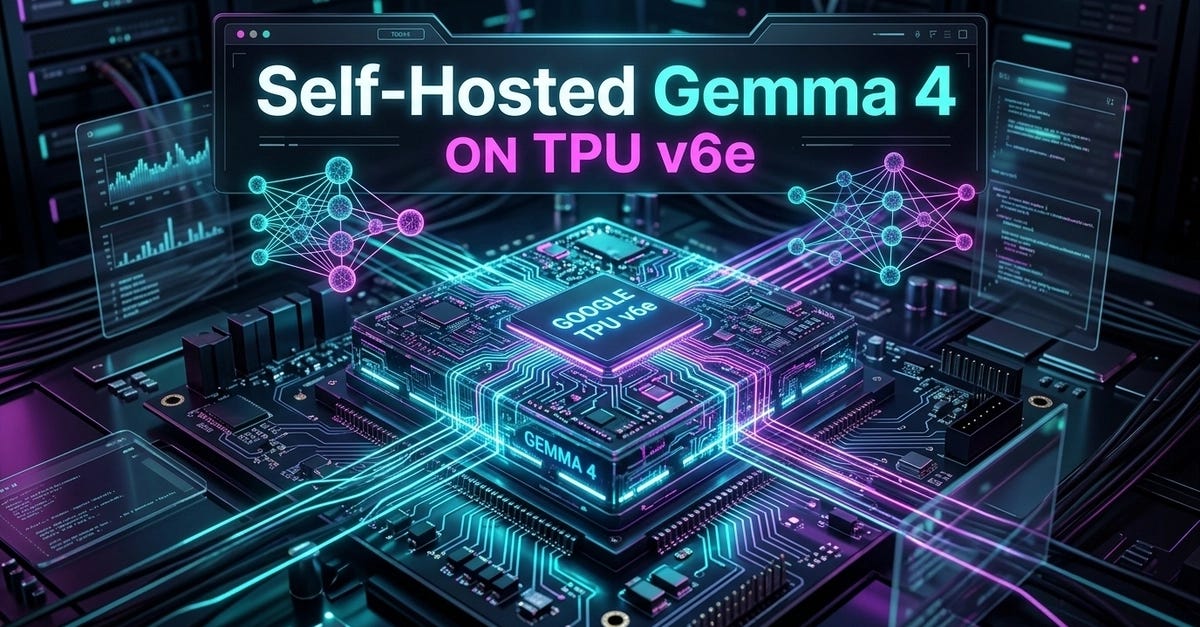
*Measured 2026–07–21 on vllm/vllm-tpu:nightly (vLLM 0.23.1rc1.dev1076), a GCE flex-start ct6e-standard-1t (one TPU v6e chip, 32 GB HBM) in europe-west4-a, managed by the *Antigravity TPU DevOps agent.
TL;DR
The plain google/gemma-4-E2B-it deployed on one v6e chip; the Antigravity TPU skill automates the entire provisioning and SRE lifecycle. The 2-billion-parameter "efficient" Gemma 4 sustains 213 tok/s for a single user, scales to ~2,200 output tok/s, and handles complex tool-calling flawlessly.
This post deep-dives into the serving performance and failure modes of the QAT checkpoints, and introduces the tpu-devops MCP server-a specialized Antigravity skill that handles zone-sweeping for capacity, vLLM orchestration, and even uses the deployed model to analyze its own system logs.
One capability coupling to know about: with a reasoning parser configured, schema enforcement only engages when thinking is enabled — thinking-off requests sail through unconstrained with a 200 status. Details on this and the agent-driven deployment below.
The host is a GCE flex-start VM — capacity granted on request, billed until deleted, hard-stopped at a 4-hour max run. Manually, this requires a massive gcloud compute instances create command with specific startup scripts and IAM scopes.
With the Antigravity TPU skill, this is a single natural-language request: “Find a v6e-1 in europe-west4 and serve Gemma 4 E2B.”
The agent’s find_tpu_vm or create_tpu_vm_instance tools handle:
- Quota Sweeping: Attempting multiple zones until capacity is granted.
- Infrastructure Setup: Attaching a 200 GB boot disk (the default 10 GB is too small for vLLM images) and configuring
cloud-platformscopes. - Secrets Management: Securely fetching the
hf-tokenfrom Secret Manager without embedding it in metadata. - Container Orchestration: Pulling
vllm/vllm-tpu:nightlyand applying the specialized serving flags:--max-model-len 65536 --gpu-memory-utilization 0.9 --max_num_batched_tokens 4096 --enable-auto-tool-choice --tool-call-parser gemma4 --reasoning-parser gemma4.
Boot timeline: VM RUNNING at t+0 → Docker installed ~t+1:00 → image pulled ~t+6:00 → weights downloaded, XLA compiled, health green ~t+8:30. The agent’s wait_for_vllm_ready tool polls the endpoint until the first 200 OK is received.
Two environment quirks the agent helps navigate:
- IAP Tunneling: Direct SSH often fails on corporate networks. The agent uses
gcloud compute ssh --tunnel-through-iapfor its diagnostic tools (get_vllm_docker_logs,manage_vllm_docker). - KV Cache Optimization: vLLM auto-selects an fp8_e5m2 KV cache on v6e — the largest memory consumer is 8-bit before any weight quantization enters the picture.
2. Three ways the QAT checkpoints fail to load
-qat-w4a16-ct · JAX
int4 compressed-tensors scheme unimplemented for E2B’s per_layer_model_projection
✕ no load
-qat-q4_0-unquantized · JAX
k_norm.weight "missing" for layers 15-34
✕ no load
-qat-q4_0-unquantized · torchax
identical missing-weights error via MODEL_IMPL_TYPE=vllm
✕ no load
gemma-4-E2B-it (plain) · JAX
loads and serves
✓ serves
The forensics point at the loader, not the checkpoint. Reading the safetensors headers of both repos: the plain export ships self_attn.k_norm for all 35 layers; the QAT export ships it only for the 15 non-KV-shared layers. Both configs are identical - including num_kv_shared_layers: 20. Layers 15-34 reuse K/V from lower layers and have no k-norm of their own, so the QAT export is the architecturally honest one; the plain checkpoint only loads because it carries those (unused) tensors anyway. Proposed fix in #3225: skip instantiating K/V-side parameters for KV-shared layers.
Until it lands: serve the plain checkpoint. At 2B parameters (~5 GB bf16 against 32 GB HBM), 4-bit weights buy little here anyway — memory pressure lives in the KV cache, which is already fp8.
3. What one chip is worth: the concurrency sweep
Same workload at every level — 1,024-token prompts, 128-token completions, vllm bench serve, random dataset.
Reading the curve:
- Prefill is effectively free at low load. A 1,024-token prompt reaches first token in 16 ms — roughly 64K prefill tok/s for a single stream.
- c=8 is nearly free concurrency: six times the throughput of a single stream for +1.5 ms/token; each of 8 users still sees ~160 tok/s.
- The knee is between 32 and 64. Going 32→64 buys +31% throughput for +45% per-token latency; 64→burst buys +3.5% for another +45%.
- Capacity-planning number: run at ≤64 concurrent streams for smooth per-user experience; the ceiling is ~17 req/s at this workload shape.
(Single run per configuration — more meaningful here than usual: a kernel study on this same stack, cited in §7, measured run-to-run cv ≤ 0.3% under greedy decoding with static shapes.)
4. Function calling at 2B scale
Served with --tool-call-parser gemma4 --enable-auto-tool-choice, probed with two OpenAI-style tools at temperature 0. Five scenarios, five clean results:
A 2B model producing well-formed tool_calls JSON, choosing correctly between calling and answering, batching parallel calls, and asking for missing arguments - at double-digit-millisecond latency. For high-volume, low-complexity agent steps, the quality floor is higher than the parameter count suggests.
5. Structured output works — but only with thinking on
The mechanism: with --reasoning-parser gemma4 configured, vLLM defers grammar enforcement until the reasoning section ends. Thinking off → no reasoning terminator → the grammar never engages, and unconstrained prose ships with a 200 status. Enable thinking ("chat_template_kwargs": {"enable_thinking": true}) and the same request is enforced exactly.
Operational guidance: pair structured output with enable_thinking: true under a reasoning parser - or drop --reasoning-parser from servers that don't need it. And keep client-side validation regardless: the silent-skip failure mode means a trusting client can't tell an enforced response from a lucky one.
6. Vision at 2B: accurate and nearly free
One restart with --limit-mm-per-prompt '{"image":4,"audio":1}' makes it a vision server. COCO validation images, base64 data URIs, temperature 0:
An image costs ~280 prompt tokens and adds almost nothing over a text request. Two notes: server-side fetching of external image URLs proved flaky (intermittent 422s) — base64 data URIs are the reliable path — and the first multimodal request after boot can 422 while the processor warms; retry once.
7. fp8 KV cache, HBM anatomy, and a related kernel result
fp8 vs bf16 KV: six greedy prompts (explanation, code, listing, translation, arithmetic, summarization — 889 completion tokens) run under the default fp8_e5m2 cache, then re-run after a restart with --kv-cache-dtype bfloat16. Result: 6 of 6 outputs byte-identical. On this (small, greedy) sample the compression is genuinely free - take the fp8 cache.
Where the 32 GB goes (bf16-KV boot, 65,536 max context): usable HBM reports as 31.24 GiB; at 0.9 utilization vLLM works within 28.12 GiB — roughly 5.5–6 GiB weights, 16.3 GiB KV cache (8,713 blocks × 128 tokens × 15 layers × 128 KiB), ~6 GiB workspace.
The interesting physics: E2B’s KV sharing is directly visible in the allocator — only 15 of 35 layers hold KV tensors, each with a single 256-dim KV head, so a token costs ~15 KiB of KV in bf16 (~7.5 KiB under fp8). That yields ~1.1 million tokens of resident KV — seventeen full 65K-context conversations on-chip — which is why the sweep saturated on compute, never memory. Also: of the 404-second engine init, 329 seconds is XLA compilation — the dominant term in the ~10-minute cold start.
Related work: a kernel-substitution study by Zimbres ( DOI 10.5281/zenodo.21404069) shows the RPA v3 kernel’s decode block-size heuristic costs 27.7–68.7% of large-batch throughput on 27B/31B models on v6e. E2B sits at the low-exposure end of that effect: at our c=64 operating point, attention is ~9% of memory traffic (vs ~41% in their regime) precisely because of the KV-sharing design above. Testing the override on E2B — smallest model, one chip, KV sharing — is a natural follow-up.
8. Cost breakdown
Rate verified against Google’s published Dynamic Workload Scheduler pricing: $1.35 per chip-hour for v6e flex-start (europe-west4, us-east1, us-east5, asia-northeast1).
- Breakeven vs. the API: against Gemini 2.5 Flash-Lite at $0.40/M output tokens, self-hosting wins once you sustain ~940 output tok/s — roughly the c=8 operating point held continuously.
- Cold start (~8.5–10.5 min, mostly XLA compile) costs $0.19–0.24 per provisioning.
- A full 4-hour session costs $5.40 and, at saturation, delivers ~30M output tokens — about $12 worth at Flash-Lite prices. Flex-start fits batch bursts, not idle always-on endpoints.
9. Self-Hosting your AI Assistant with LiteLLM
One of the most powerful ways to use this setup is to point your existing AI tools at your TPU. The Antigravity repo includes a guide for using LiteLLM Proxy to redirect standard Gemini CLI requests to your self-hosted TPU endpoint.
- Get the Endpoint: Use
get_vllm_endpointorget_tpu_vm_endpoint. - Configure LiteLLM: Map
gemini-2.0-flashto your TPU endpoint in alitellm_config.yaml. - Point your CLI: Set
GOOGLE_GEMINI_BASE_URL="http://localhost:4000"and use your self-hosted model for code analysis or chat.
This effectively gives you a private, high-performance inference engine that costs ~$1.35/hour and can handle massive context windows (65K tokens on-chip).
10. The Antigravity SRE Experience
The Antigravity TPU skill doesn’t just deploy; it operates. The analyze_cloud_logging tool uses the very model you just deployed to triage system logs.
If a deployment fails, you can ask Antigravity: “Why did the v6e-1 deployment in europe-west4-a fail?”. The agent will:
- Fetch Cloud Logging entries for the resource.
- Send them to the Gemma 4 model on a different active TPU (or a local fallback).
- Report a human-readable diagnosis (e.g., “The startup script failed because the Hugging Face token secret was not accessible to the compute service account”).
11. Reproduction with Antigravity
*Environment: vLLM 0.23.1rc1.dev1076+g5c342876a (vllm-tpu:nightly, tpu-inference backend) · TPU v6e-1 (ct6e-standard-1t, 32 GB HBM, GCE flex-start) · bf16 weights, fp8_e5m2 KV cache managed by the *Antigravity TPU DevOps agent.
# 1. Install the skill (Global or Project-specific) make skill-install-agy # 2. Deploy (Natural Language) # "Find a v6e-1 in europe-west4, serve gemma-4-E2B-it, and tell me when it's ready." # 3. Monitor (Agent Tool) # The agent will use wait_for_vllm_ready and get_vllm_docker_logs # to ensure the ~10 minute cold-start completes successfully. # 4. Benchmark # "Run a throughput sweep on the active v6e for concurrency 1, 8, and 32." # (The agent invokes run_vllm_benchmark save_result=True)Originally published at https://dev.to on July 25, 2026.
메타데이터
- post_id
- 74b603c67028
- slug
- self-hosted-gemma-4-on-tpu-v6e-deployment-sre-with-antigravity-74b603c67028
- url
- https://ai.plainenglish.io/self-hosted-gemma-4-on-tpu-v6e-deployment-sre-with-antigravity-74b603c67028
- canonical_url
- https://ai.plainenglish.io/self-hosted-gemma-4-on-tpu-v6e-deployment-sre-with-antigravity-74b603c67028
- author_url
- https://medium.com/@xbill999
- status
- ok
- fetched_at
- 2026-08-17 07:46:50