What Features Should You Look for When Choosing AI Copilot Development Services for Your Business?
In today’s rapidly evolving business environment, organizations are increasingly turning to artificial intelligence (AI) to improve…
What Features Should You Look for When Choosing AI Copilot Development Services for Your Business?
In today’s rapidly evolving business environment, organizations are increasingly turning to artificial intelligence (AI) to improve efficiency, streamline operations, and reduce the burden of repetitive tasks. Among the most powerful AI-driven solutions gaining momentum is the AI Copilot Development Services. These services offer businesses the opportunity to integrate smart, conversational AI systems into their workflows, empowering employees with enhanced productivity, smarter decision-making, and seamless automation.
In this fast-paced digital age, implementing AI copilot technology is not just a trend but a necessity for businesses aiming to stay competitive and deliver top-tier services. Whether you are looking to enhance employee productivity, provide superior customer experiences, or optimize internal processes, AI Copilot Development Services can be a game-changer for your organization.
What Are AI Copilots?
AI copilots are digital assistants powered by artificial intelligence that help users by performing various tasks or providing guidance in different contexts.
- AI Assistant Copilots: These AI copilots assist with general tasks like scheduling, email management, setting reminders, and organizing daily workflows. They help improve productivity by automating mundane tasks.
- AI Copilot for IT Support: In IT support, AI copilots can diagnose issues, suggest troubleshooting steps, and provide solutions. They help reduce human error and speed up response times by offering relevant suggestions.
- AI Copilot for Business Operations: In business environments, AI copilots support tasks like project management, data analysis, and decision-making. They help streamline operations by providing real-time insights and automating routine processes.
- AI Copilot for Customer Service: In customer service, AI copilots assist agents by handling customer queries, providing responses based on knowledge databases, and even managing ticketing systems. This helps improve customer satisfaction and reduces the load on human agents.
- AI Copilot for Marketing: AI copilots in marketing can analyze trends, manage campaigns, and optimize customer targeting. They help marketers by providing actionable insights and automating ad placements and content creation.
- AI Copilot for Healthcare: In healthcare, AI copilots assist doctors and medical staff by providing diagnostic suggestions, analyzing patient data, and even helping with administrative tasks. They contribute to more accurate and timely care.
- AI Copilot for Education: In education, AI copilots can assist students with personalized learning experiences, offering study materials, guiding homework assignments, and even suggesting improvement areas based on performance data.
Why AI Copilots Are Essential for Businesses?
AI copilots are becoming essential for businesses because they help streamline operations, enhance efficiency, and provide valuable insights.
- Increased Efficiency: AI copilots can automate routine tasks, freeing up time for employees to focus on more strategic activities. This leads to improved workflow and higher productivity within organizations.
- Cost Savings: By automating repetitive tasks and reducing the need for manual intervention, AI copilots help businesses cut down on operational costs. They help businesses achieve more with fewer resources, contributing to better financial outcomes.
- Improved Decision-Making: AI copilots analyze vast amounts of data in real-time, providing valuable insights that can support informed decision-making. By identifying trends, patterns, and opportunities, AI copilots help businesses make smarter, data-driven decisions.
- Better Customer Experience: AI copilots can assist in customer service by responding to inquiries, offering personalized support, and ensuring quicker response times. This leads to higher customer satisfaction and improved loyalty.
- Scalability: AI copilots can easily scale to meet the growing needs of a business. As the company expands, the AI copilot can handle increased workloads without the need for additional human resources, ensuring continued efficiency.
- Error Reduction: Human errors can occur in repetitive tasks or when analyzing complex data. AI copilots reduce the likelihood of errors by providing accurate, consistent, and data-backed responses or actions, leading to more reliable results.
The Need for AI Copilot Development Services
The need for AI copilot development services is growing as businesses recognize the potential of AI to enhance their operations, improve customer experiences, and drive innovation.
- Tailored Solutions: Every business has unique needs and challenges. AI copilot development services provide customized solutions that are specifically designed to address those needs, ensuring that the AI copilot aligns with the organization’s goals and workflows.
- Expertise in AI Technologies: Developing a robust and efficient AI copilot requires specialized knowledge of AI technologies such as natural language processing, machine learning, and data analytics. AI copilot development services offer this expertise to ensure that the AI copilot functions effectively and meets business requirements.
- Improved Efficiency: AI copilots automate repetitive tasks, streamline workflows, and reduce the time spent on mundane processes. With professional AI copilot development services, businesses can achieve better operational efficiency, enabling employees to focus on more strategic tasks.
- Better Decision Making: AI copilots analyze vast amounts of data and provide actionable insights. With development services, businesses can ensure that the AI copilot is equipped with the right algorithms and data sources to support accurate and informed decision-making.
- Scalability: As businesses grow, the demands on their AI systems also increase. AI copilot development services ensure that the system is scalable, capable of handling increased workloads, and adapting to future needs without compromising performance.
- Seamless Integration: AI copilots must integrate seamlessly with existing systems and workflows to be effective. Development services ensure that the AI copilot can work harmoniously with tools like CRM, ERP, and other business software, providing a smooth user experience.
How We Build AI Copilots?
Building AI copilots involves several stages, each focused on ensuring the AI is functional, efficient, and tailored to specific business needs.
- Understanding Business Needs: The first step in building an AI copilot is understanding the unique needs and goals of the business. This involves working closely with stakeholders to identify key areas where AI can provide value, such as customer service, automation, or decision-making.
- Data Collection and Preparation: AI copilots require data to learn and make decisions. The next step is to gather relevant data from various sources, including internal systems, databases, and external sources. The data must be cleaned, organized, and preprocessed to ensure it is in a usable format for AI models.
- Choosing the Right AI Models: Depending on the tasks the AI copilot is expected to perform, different AI models may be used. This could include natural language processing (NLP) models for chatbots, machine learning algorithms for predictive analytics, or decision-making models for automation. Choosing the right model is critical for the AI copilot to function as intended.
- Training the AI Model: Once the data is prepared and the AI model is chosen, the next step is to train the model. This involves feeding the model with the prepared data so it can learn patterns, make predictions, and improve over time. The model is trained until it achieves a level of accuracy and efficiency that meets the business requirements.
- Integration with Existing Systems: To ensure the AI copilot works seamlessly within the business environment, it must be integrated with existing systems and workflows, such as customer relationship management (CRM) software, enterprise resource planning (ERP) systems, or communication tools. This integration helps the AI copilot interact with other tools and provides a unified experience.
- Testing and Validation: After the AI copilot is trained and integrated, it is thoroughly tested to ensure that it performs as expected. This includes running tests to verify that the AI copilot can handle real-world scenarios, interact with users correctly, and provide accurate responses. The testing phase helps identify any issues that need to be fixed before deployment.
Our AI Copilot Development Process
Our AI copilot development process is designed to ensure that the AI solution we create is effective, tailored to business needs, and fully integrated with existing systems.
- Requirement Gathering: The first step involves understanding the specific needs of the business. We work closely with the client to gather detailed requirements, identifying key challenges, goals, and the tasks the AI copilot should assist with. This ensures that the AI copilot is designed with a clear purpose.
- Research and Strategy Planning: In this phase, we research the best AI technologies, tools, and approaches that align with the project’s requirements. We plan the strategy for how the AI copilot will function, including its capabilities, integrations, and how it will interact with the end users.
- Data Collection and Preparation: For an AI copilot to work effectively, it needs data. We help businesses collect the necessary data from various sources, clean and preprocess it, and ensure that it’s in the right format to be used by AI models. Quality data is essential for accurate predictions and outcomes.
- AI Model Selection and Development: Depending on the project’s needs, we select the appropriate AI models such as natural language processing, machine learning, or deep learning models. These models are then developed and trained to perform specific tasks, whether it’s understanding customer queries, predicting trends, or automating processes.
- Integration with Business Systems: The AI copilot needs to function within the business’s existing infrastructure. We ensure seamless integration with tools like customer relationship management (CRM) software, enterprise resource planning (ERP) systems, and other business platforms. This integration ensures that the AI copilot can work with the tools employees are already using.
- Testing and Quality Assurance: After development, the AI copilot undergoes rigorous testing to ensure it meets the required standards. We test the system in real-world scenarios to check its accuracy, performance, and reliability. This ensures that the AI copilot works as expected and delivers value to the business.
Benefits of AI Copilot Development
The development of AI copilots offers numerous benefits that can transform business operations, enhance customer experiences, and drive growth.
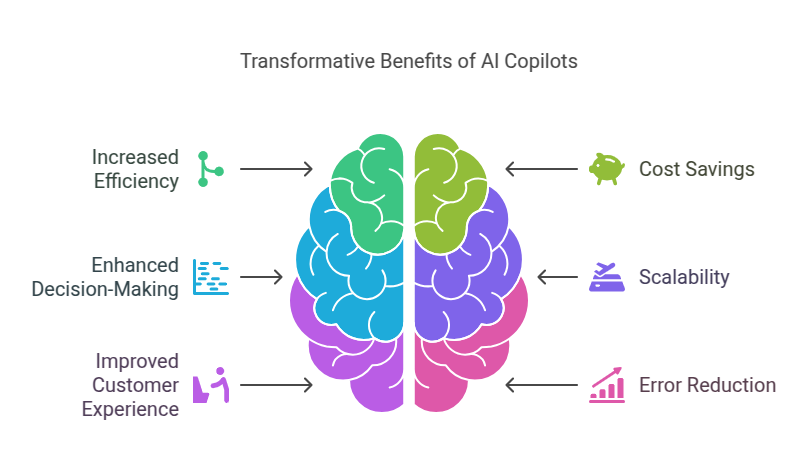
- Increased Efficiency: AI copilots automate routine tasks, which helps employees focus on more complex and strategic activities. This leads to improved productivity and allows businesses to operate more efficiently with fewer resources.
- Cost Savings: By automating repetitive tasks and reducing the need for human intervention in basic processes, AI copilots help businesses cut down on labor costs and operational expenses. This makes the overall business operation more cost-effective.
- Enhanced Decision-Making: AI copilots analyze large amounts of data to provide actionable insights and recommendations. This helps businesses make data-driven decisions quickly and with higher accuracy, improving the overall decision-making process.
- Scalability: AI copilots can easily scale to handle increased workloads as a business grows. Unlike human workers, they can efficiently manage growing data and tasks without requiring additional resources, making them ideal for businesses aiming for rapid growth.
- Improved Customer Experience: AI copilots assist in providing faster, more personalized customer service. They can handle customer queries, provide support, and recommend solutions in real time, which leads to higher customer satisfaction and loyalty.
- Error Reduction: Human errors can be costly, especially when handling repetitive tasks or analyzing complex data. AI copilots reduce errors by providing consistent, accurate responses and reducing the likelihood of mistakes, ensuring more reliable outcomes.
Key Features of Our AI Copilot Development Services
Our AI copilot development services offer a range of key features designed to ensure that businesses get the most value from their AI solutions.
- Custom AI Solutions: We develop AI copilots tailored to the specific needs of each business. By understanding your unique challenges and objectives, we create AI systems that align with your goals, ensuring maximum impact and relevance.
- Advanced Machine Learning Models: Our AI copilots are powered by cutting-edge machine learning models, including natural language processing and predictive analytics. These models enable the AI to understand and process complex data, make informed decisions, and improve over time.
- Seamless Integration: We ensure that our AI copilots integrate smoothly with your existing systems, such as customer relationship management (CRM), enterprise resource planning (ERP), and other software. This allows businesses to continue using their current tools while enhancing their functionality with AI-driven support.
- Data-Driven Insights: Our AI copilots analyze large datasets in real time to provide actionable insights. This helps businesses make data-driven decisions quickly and accurately, improving operations and outcomes in areas like customer service, marketing, and finance.
- Natural Language Processing (NLP): We incorporate natural language processing into our AI copilots, enabling them to understand, interpret, and conversationally respond to human language. This makes interactions more intuitive and improves user experience.
- Personalization Capabilities: Our AI copilots are designed to provide personalized experiences based on user behavior and preferences. They can adapt to each individual’s needs, whether it’s providing tailored customer support or recommending products and services.
Industries Benefiting from AI Copilot Solutions
AI copilot solutions are benefiting a wide range of industries by enhancing efficiency, improving decision-making, and providing personalized experiences.
- Healthcare: In healthcare, AI copilots assist doctors and medical staff by providing diagnostic suggestions, analyzing patient data, and helping with administrative tasks. They improve patient care by offering more accurate insights, reducing human errors, and streamlining operations. AI copilots also help in scheduling appointments, managing medical records, and offering personalized care recommendations.
- Finance: In the financial industry, AI copilots can assist with tasks like investment analysis, fraud detection, and risk management. They help financial advisors by analyzing market data, predicting trends, and automating repetitive processes like portfolio management. AI copilots also provide personalized financial recommendations to customers based on their behavior and preferences.
- Customer Service: AI copilots are revolutionizing customer service by automating responses to common queries, handling routine tasks, and providing instant support. In industries like retail, telecom, and hospitality, AI copilots can interact with customers via chatbots or voice assistants, improving response times, enhancing customer satisfaction, and reducing the workload of human agents.
- Retail and E-commerce: Retail and e-commerce businesses are using AI copilots to personalize the shopping experience, manage inventory, and optimize pricing strategies. AI copilots recommend products based on customer preferences, analyze consumer behavior, and handle customer inquiries. This leads to higher sales, improved customer engagement, and better stock management.
- Manufacturing: In manufacturing, AI copilots assist with predictive maintenance, quality control, and supply chain management. They analyze sensor data from machines to predict failures before they happen, reducing downtime and maintenance costs. AI copilots also optimize production schedules and help streamline logistics, making operations more efficient and cost-effective.
- Education: In education, AI copilots enhance learning by providing personalized tutoring, assisting teachers with grading, and offering tailored learning materials. They help students by adapting to their learning pace and providing relevant resources, improving overall academic performance. AI copilots also automate administrative tasks like scheduling, attendance, and communication.
Getting Started with AI Copilot Development
Getting started with AI copilot development involves several key steps to ensure that the AI system is effective, aligned with business goals, and ready for deployment.

- Define Business Objectives: The first step is to clearly define the business goals and objectives that the AI copilot needs to address. Understanding the problems the AI will solve and the value it will provide is crucial for designing an effective solution.
- Identify Key Use Cases: Once business objectives are clear, identify the specific use cases for the AI copilot. These can include automating customer support, enhancing decision-making, managing tasks, or providing personalized recommendations. This helps in focusing on the areas where AI can deliver the most impact.
- Choose the Right AI Technology: Based on the identified use cases, the next step is selecting the right AI technology. This includes deciding on machine learning models, natural language processing algorithms, or predictive analytics tools. The chosen technology should be suitable for the tasks the AI copilot will handle.
- Gather and Prepare Data: AI copilots rely heavily on data for training and decision-making. Collect relevant data from business systems, customer interactions, and other sources. Clean, organize, and preprocess the data to ensure it is ready for use in training AI models.
- Develop AI Models: With the data prepared, AI models are trained using machine learning algorithms, deep learning models, or natural language processing. These models need to be tailored to handle specific tasks like understanding text or predicting outcomes based on data.
- Integrate with Existing Systems: The AI copilot needs to integrate seamlessly with the business’s existing systems, such as CRM, ERP, and communication platforms. This integration ensures that the AI copilot can work with other tools and provide relevant support in real time.
Why Choose Us for AI Copilot Development?
Choosing the right partner for AI copilot development is crucial to ensuring the success of your AI initiative.
- Tailored Solutions: We understand that every business has unique needs. Our AI copilot development services are customized to meet your specific goals and challenges. We work closely with you to design and implement AI copilots that are aligned with your business objectives.
- Expertise and Experience: Our team consists of skilled AI experts with extensive experience in developing AI-powered solutions. We have successfully delivered AI copilot projects across various industries, ensuring that we have the knowledge and skills to tackle complex challenges.
- Cutting-Edge Technology: We leverage the latest advancements in AI, machine learning, and natural language processing to build powerful and effective AI copilots. Our solutions incorporate state-of-the-art technologies to deliver high-performance, reliable, and scalable AI systems.
- Seamless Integration: We ensure that our AI copilots integrate smoothly with your existing systems and workflows. Whether it’s CRM, ERP, or other business tools, our AI solutions work seamlessly with your infrastructure, enhancing functionality without disruption.
- End-to-End Development: From requirement gathering and data preparation to AI model development, integration, and deployment, we handle the entire AI copilot development process. Our comprehensive approach ensures that the final solution is fully optimized and meets your business needs.
- Focus on User Experience: We prioritize user-friendly interfaces and intuitive interactions. Our AI copilots are designed to provide seamless experiences for both employees and customers, ensuring ease of use and high engagement levels.
Future of AI Copilots
The future of AI copilots is promising, with continuous advancements in technology and growing adoption across various industries.
- Increased Automation: AI copilots will play a more significant role in automating various business processes, from customer service to operations and decision-making. As AI technology continues to evolve, the scope of automation will expand, allowing businesses to improve efficiency, reduce human error, and lower costs.
- Advanced Natural Language Processing: In the future, AI copilots will become even more adept at understanding and processing natural language. This will lead to more sophisticated and human-like conversations with users, enabling AI copilots to provide more personalized and accurate responses in real-time.
- Greater Personalization: AI copilots will become more capable of providing highly personalized experiences. By leveraging data from user interactions, preferences, and behavior, AI copilots will tailor their responses and suggestions, offering customized recommendations and services that align with individual needs.
- Integration with Emerging Technologies: The future of AI copilots will see increased integration with emerging technologies such as the Internet of Things (IoT), augmented reality (AR), and virtual reality (VR). This integration will enhance the capabilities of AI copilots, enabling them to interact with a wider range of devices and provide more immersive and efficient solutions.
- Enhanced Learning and Adaptation: AI copilots will continue to improve through machine learning and deep learning techniques. They will adapt to changing business needs, user preferences, and new data sources, ensuring that they stay relevant and effective over time. Continuous learning will make AI copilots smarter and more efficient.
- Collaboration with Human Teams: While AI copilots are powerful, they will continue to work in tandem with human teams. The future will see AI copilots acting as collaborative assistants, handling routine tasks while enabling humans to focus on higher-level decision-making and creative problem-solving. This collaboration will help businesses achieve greater outcomes.
Conclusion
In conclusion, AI Copilot development has emerged as a transformative force in various industries, offering an advanced solution to streamline operations, enhance productivity, and reduce the strain on human resources. By integrating AI copilots, businesses can benefit from more efficient workflows, personalized experiences, and the ability to scale operations while maintaining high standards of service and innovation.
AI copilots not only assist in automating routine tasks but also provide valuable insights and recommendations that empower decision-makers to act with more confidence and precision. With AI at their side, companies can enhance customer support, boost employee engagement, and accelerate the pace of growth. Additionally, AI copilots facilitate seamless integrations with existing systems, making them a versatile tool for businesses of all sizes and industries.
The future of AI Copilot development is full of potential, with advancements in machine learning and natural language processing enabling increasingly sophisticated capabilities. As organizations continue to adopt these AI-driven solutions, they will experience a shift toward more intelligent, automated, and adaptive business practices. Partnering with an experienced ***AI Copilot Development Company*** ensures that businesses receive tailored solutions designed to meet their specific needs, helping them stay competitive in an increasingly digital world. Whether you’re looking to enhance your customer service, improve internal operations, or explore new business models, AI copilots are the key to unlocking greater efficiency and success.
메타데이터
- post_id
- 74bfdd33d689
- slug
- what-features-should-you-look-for-when-choosing-ai-copilot-development-services-for-your-business-74bfdd33d689
- url
- https://medium.com/inoru-official/what-features-should-you-look-for-when-choosing-ai-copilot-development-services-for-your-business-74bfdd33d689
- canonical_url
- https://medium.com/inoru-official/what-features-should-you-look-for-when-choosing-ai-copilot-development-services-for-your-business-74bfdd33d689
- author_url
- https://medium.com/@inoruhq
- status
- ok
- fetched_at
- 2026-08-01 16:52:20





