Centralized vs Decentralized Exchange: Key Differences, Pros & Cons
The practice of using cryptocurrencies has evolved greatly over the recent years. Now, in 2026, besides being able to use only one kind of…
Centralized vs Decentralized Exchange: Key Differences, Pros & Cons
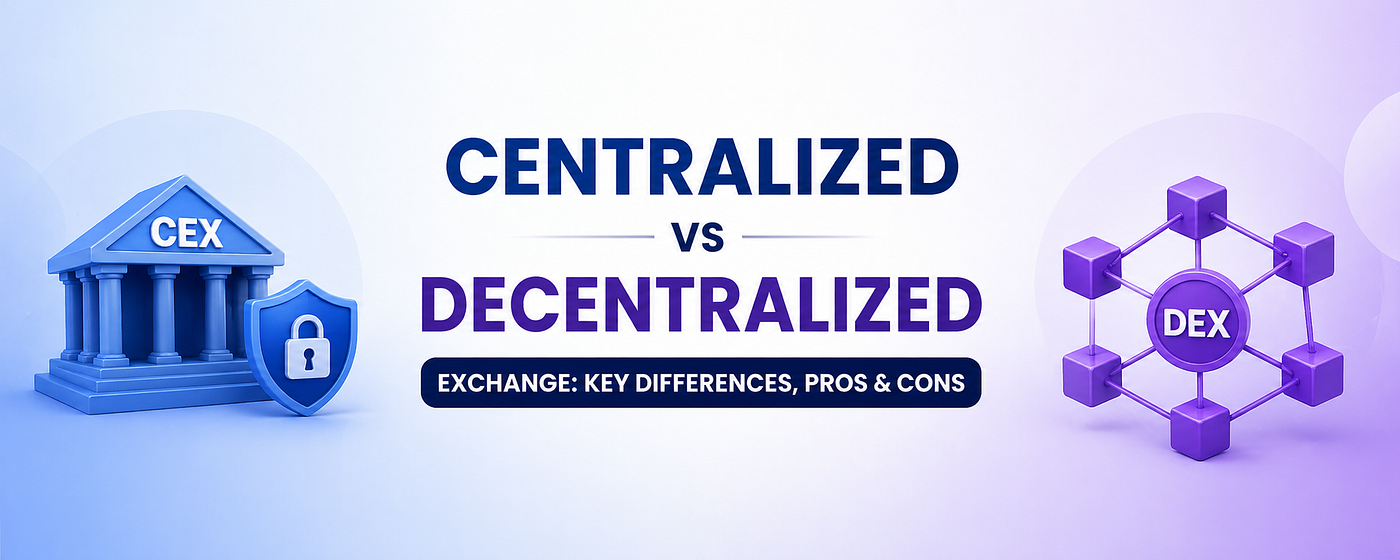
The practice of using cryptocurrencies has evolved greatly over the recent years. Now, in 2026, besides being able to use only one kind of a platform for their transactions, users may either opt for centralized exchange (CEX) or go for decentralized exchange (DEX).
Although both types of exchanges perform similarly by helping individuals buy, sell, and trade their digital currencies, they do so in very different ways. While centralized exchanges provide users with convenience, fast transactions, and a more or less familiar experience, decentralized ones are aimed at offering full control, security, and privacy to those who use their services. And here is where comes the crucial question: which type of exchange is better for crypto users?
In this guide, you will learn about what centralized and decentralized exchanges have in common, what are the benefits of each type, and which type suits you in 2026.
What Is a Centralized Exchange (CEX)?
CEX is a central exchange service where all trades take place via a company acting as a go-between for both parties to the transaction. When depositing crypto on a centralized exchange development , the service stores your funds in their own wallets. The trades are conducted from a built-in order book and take place off the chain very quickly. Services offered by CEXs include:
- Ability to buy crypto via your bank card
- Funds stored in KYC-approved accounts with customer support
- Access to advanced trading instruments such as futures, margins, and staking
- Execution of transactions quickly, less than 200ms each
When the exchange holds your funds, you are trusting a company with your assets.
What Is a Decentralized Exchange (DEX)?
The main concept of a decentralized exchange is that it is built fully on smart contracts running on the blockchain. The company doesn’t exist; there is no central server or any KYC.
Trading platforms such as Uniswap, PancakeSwap, and dYdX allow trading from one’s wallet. Mainly, decentralized exchange development depend on automated market makers and liquidity pools and not order books. One has to connect their wallet, authorize transactions, and the smart contract will automatically execute them. The key idea of DEX is the following:
You own your private keys. Always.
There is no registration, no identity confirmation, no withdrawal confirmation. In case of hacking of DEX, funds stored in your private wallet remain unaffected.
Key Differences Between CEX and DEX

Security Comparison
Security Comparison
This is an issue more complex than many realize. Security Issues With CEX: CEX present a tempting target for attackers due to the large amount of money held on behalf of users in one spot. The FTX fiasco of 2022 and numerous hackings of other exchanges are proof enough of the dangers of leaving your crypto in the hands of a third party.
Security Issues With DEX: A key advantage of DEX is that they remove all risk of custody by never moving your coins from your wallet while trading. The potential downside is that smart contract issues can occur, and there is no entity to reimburse you should that happen.
With a CEX, you trust the company, while with a DEX, you trust the software.
Control and Ownership of Funds
“No keys, no coins” is a saying that exists since the dawn of crypto and it remains relevant until today. When using a centralized exchange, technically you have an IOU. The exchange may freeze your account, restrict withdrawals, or even become insolvent. And this has already been done before.
On decentralized exchanges, your coins will always be safely kept on your personal wallet. The smart contract performs the trade and immediately sends the tokens to your wallet. Having true ownership means taking true responsibility. But if you don’t save your seed phrase, there’s nothing you can do about it.
Fees and Trading Costs
The fee structures for the two types of exchanges differ greatly. CEX Fees
- Maker/taker structure, ranging from 0.1% to 0.5% per transaction
- Discounts apply when using native tokens (such as BNB on Binance)
- Withdrawal fees depend on the type of coin
DEX Fees
- Protocol fees are distributed among liquidity providers, treasury, and governance token holders.
- Additional gas fees alongside swap fees, potentially high during network congestion.
- Layer-2 protocols like Arbitrum and Optimism have brought down DEX gas fees.
During periods of network congestion, DEX fees may be higher than CEX fees for small transactions. However, for larger transactions where privacy and asset availability are prioritized, the additional fees may be justified.
User Experience and Ease of Use
Getting an account in Coinbase and Binance will take you a few minutes. You can easily use a debit card for buying crypto and monitor your investment through their simple dashboard.
However, with DEXs, a lot is expected from you right from the start. You need to have the necessary wallet to be used for the transaction, along with some tokens needed to pay gas fees. Basic knowledge of transacting through DEXs will be handy too.
The good news is that interfaces of modern DEXs have become much better. Platforms like Uniswap are comparable to those of centralized exchanges in terms of usability.
Liquidity and Trading Volume
As of 2025, centralized exchanges continue to account for up to 80% of all crypto spot trading volumes. In Q3 2025 alone, top CEXs had total turnover worth nearly $5.1 trillion. This kind of liquidity allows users to trade large amounts without affecting the market price.
Liquidity on decentralized exchanges has greatly improved, reaching $18.6 billion per week mid-2025, indicating a year-over-year growth rate of 33%. Nevertheless, slippage due to low liquidity may affect DEX users trading large amounts.When dealing with significant amounts of money, using CEX will be safer than DEX for execution.
Regulation and Compliance
Here lies the fundamental difference between the two types of exchanges. CEXs function in a regulated environment. They comply with KYC and AML regulations, submit information to regulatory authorities, and conduct transactions according to the law. As a result, such exchanges are easily available in almost all jurisdictions and are trusted by institutional players. In most cases, regulation is an advantage.
DEXs operate outside the framework of any regulatory control. Any person having access to cryptocurrency wallets is free to trade without disclosing his or her personal information. While this may be appealing for privacy-conscious investors, it generates uncertainty in jurisdictions where cryptocurrency regulations are becoming stricter.
If you decide to create a C**EX exchange development **, you need to consider the compliance framework from the very beginning. It will cost much less compared to integrating regulatory controls into your platform after it was already launched.
Pros and Cons of Centralized Exchanges
Pros
- User-friendly platform and initial setup.
- Higher liquidity and quicker trades.
- Supports fiat currency entry (bank card/ transfer).
- Provides customer service and account recovery.
- Legal compliance in many jurisdictions.
Cons
- Do not own the private keys yourself.
- Single source vulnerability to attacks .
- Susceptible to KYC regulations and verification.
- Can freeze accounts and limit withdrawal.
- Restricted access to new tokens.
Pros and Cons of Decentralized Exchanges
Pros
- Complete self-custody of funds always.
- Not KYC, no user information needed.
- Ability to access hundreds of thousands of tokens, even the newest DeFi protocols.
- Transactions can be tracked publicly and audited.
- Inherent resistance to censorship.
Cons
- Slightly higher learning curve for beginners.
- No customer support available if you encounter an issue.
- Higher gas fees when the network is congested.
- Potential smart contract vulnerabilities if code isn’t audited.
- Limited fiat on-ramps.
When to Use a CEX vs a DEX
CEX is suitable when you are making your first purchase of cryptocurrencies with fiat.
- Deep liquidity is needed for big transactions.
- Futures, margin, and staking services are all available at once.
- Regulated and accountable trading environment is preferred.
A DEX is suitable when you have full control and custody of your assets.
- Some tokens can only be accessed through DEXs.
- You wish to take part in the decentralized finance (DeFi) ecosystem, including yield farming and liquidity mining.
- Privacy and anonymity are important to you.
Professional traders often utilize both types of exchange, storing their larger assets on self-custody wallets and resorting to CEXs for occasional purposes.
Future of Crypto Exchanges
Centralized exchanges are incorporating elements of DeFi. Binance introduced their own DEX layer. There are multiple large CEXs offering built-in access to DeFi protocols.
On the opposite side, DEXs have started developing user-friendly interfaces, integrating fiat-to-crypto gateways with external providers such as Moon Pay, as well as scaling up using Layer-2 solutions. A new generation of crypto exchanges may come from the hybrid concept of exchanges, combining high-speed CEX trading engine with non-custodial custody of assets.
To see how such platform works, hybrid exchange development might be an interesting area to consider. In the long term, starting from 2026 and moving forward, the winner may become the platform combining all the benefits of CEX and DEX ecosystems.
Conclusion
The difference between centralized and decentralized cryptocurrency exchange models means that there is no universal solution that would be appropriate for everyone. While some might prefer the benefits offered by centralized crypto exchange models, such as ease of use and quickness of transactions, others might favor decentralized solutions, which offer much more security and privacy.
However, in practice, by 2026 many users will be using both approaches simultaneously. In addition, the technological development of the cryptocurrency industry might bring new exchange options, which are able to unite the best qualities of both types of exchanges.
Until this moment, it is important to learn about the features and differences between centralized and decentralized models and choose the most suitable approach to trading and investing.
메타데이터
- post_id
- 74c842fa9f0d
- slug
- centralized-vs-decentralized-exchange-key-differences-pros-cons-74c842fa9f0d
- url
- https://medium.com/startup-insider-edge/centralized-vs-decentralized-exchange-key-differences-pros-cons-74c842fa9f0d
- canonical_url
- https://medium.com/startup-insider-edge/centralized-vs-decentralized-exchange-key-differences-pros-cons-74c842fa9f0d
- author_url
- https://medium.com/@cryptiecraft
- status
- ok
- fetched_at
- 2026-07-19 22:33:09