Why CTLA-4 was a big deal for cancer immunotherapy
CTLA-4 gets a bad rap these days. While cancer immunotherapy and checkpoint inhibitors are widely celebrated, most people like talking…
Why CTLA-4 was a big deal for cancer immunotherapy
CTLA-4 gets a bad rap these days. While cancer immunotherapy and checkpoint inhibitors are widely celebrated, most people like talking about PD-1, not CTLA-4. The critics are right though. Compared to PD-1, CTLA-4 is more toxic, less effective, and works in less cancer types.
However, in CTLA-4’s defense, it was and still is a big deal. It was the first treatment ever to increase median overall survival in metastatic melanoma, and thereafter, usher in the age of immunotherapy for cancer. To appreciate the importance of that distinction, it’s helpful to get a historical perspective.
Before 2011, nearly all metastatic melanoma patients died
Prior to 2011, the FDA approved treatment for metastatic melanoma were:
- (1) Dacarbazine (chemotherapy)
- (2) High dose IL2
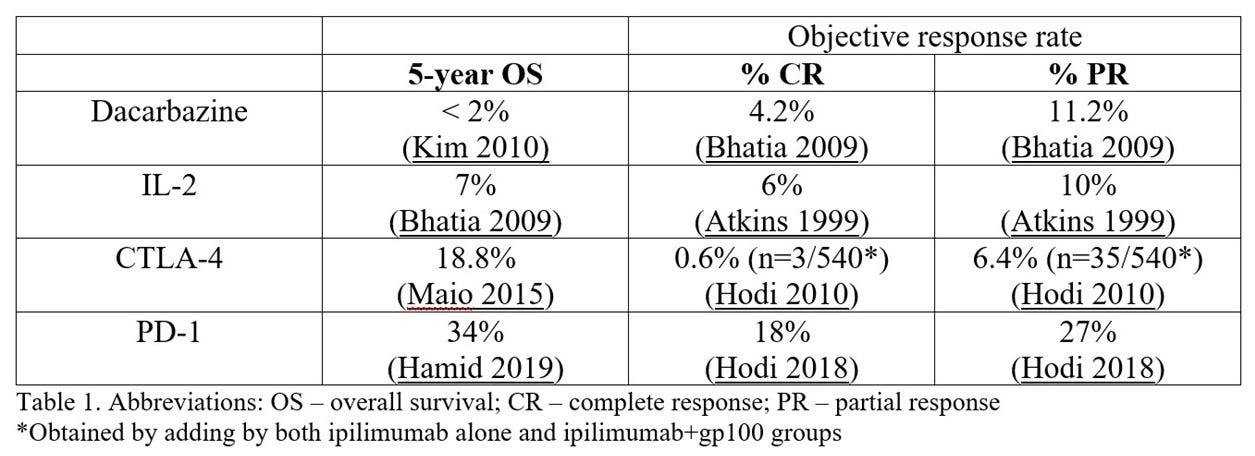
Approved in 1975 (FDA 2014 p3), dacarbazine typically had an objective response rate of 20%, with less than 5% of these being complete responses. Most of these responding patients would relapse and die and less than 2% of patients would survive longer than 5 years (Kim 2010; Gogas 2006). Furthermore, no phase III trials have demonstrated a survival benefit over a “no treatment” control (Sosman 2019; Bhatia 2009). In other words, there was no concrete evidence that someone with metastatic melanoma would live longer when treated with dacarbazine (Albertini 2018). It’s arguable that for some patients, chemo just wasn’t worth it.
Approved in 1998 (FDA 2014 p3), high dose IL2 was perhaps slightly more effective. The 5 year survival was approximately 7% (n=19/270) (Bhatia 2009). In a retrospective study of many clinical trials, IL-2 was reported to produce complete responses in 6% of patients (Atkins 1999). In contrast, complete response rates for dacarbazine ranged from 0.8 (Robert 2011) to 4.2% (Bhatia 2009). Notably, IL-2 resulted in some long term responses in which patients were disease free for over 8 years, a situation one might consider a “cure” (Rosenberg 2012). In general, however, the data around IL-2 efficacy is murky for several reasons: It doesn’t seem that:
- (1) IL-2 has been tested in a phase III trial
- (2) IL-2 and dacarbazine have been compared head to head (Petrella 2007)
- (3) IL-2 offers a survival benefit over dacarbazine or simply no treatment (Boyle 2014)
To complicate matters, IL-2 was difficult to administer and had a severe toxicity profile which made it unpopular as a drug (Rosenberg 2012).
“Stage 4 melanoma used to be a death sentence.” (*McClurg 2018*)
Therefore, for all of history up to 2011, there weren’t really any effective treatments for metastatic melanoma. While there were 2 FDA approved drugs, it wasn’t clear that they were particularly effective nor that they extended median overall survival (Finn 2012). Nearly all patients with metastatic melanoma died. It was a bleak time to be a melanoma doctor.
In 2011, CTLA-4 finally improves overall survival for patients with metastatic melanoma
This backdrop heralds the arrival of CTLA-4. In a large phase III trial, CTLA-4 in combination with vaccine antigen gp100 improved median overall survival compared to gp100 alone (Hodi 2010). Based on these results, the drug was approved for metastatic melanoma in 2011. It was an audacious move by the FDA given criticisms of the study. Why was the control arm a vaccine instead of the standard of care, dacarbazine? The FDA would approve this drug on the basis of a single study? (FDA 2011 p3) However, despite these valid concerns, the FDA did approve CTLA-4. This approval just stands to show how bad the situation was for metastatic melanoma and how important CTLA-4 was for its treatment.
To be sure though, several factors temper the excitement of CTLA-4 when taken in context. First, while CTLA-4 did increase median overall survival, it only did so by 2 months (Hodi 2010). Furthermore, the rate of complete response was 0.6% (n=3/540) (Hodi 2010), which is an order of magnitude less than the 6% reported for IL-2 (Atkins 1999). Despite this low rate of complete response, the 5 year overall survival is 18.8% (Table 1), meaning a majority of these patients have prolonged survival with tumors still present (e.g. partial response or stable disease) (Maio 2015). In fact, even the FDA notes that while the “the treatment effects on survival were statistically robust”, “the effects on tumor response rate and on progress-free survival” (which are traditional endpoints for clinical trials involving metastatic cancer) “were very modest and did not provide evidence of efficacy” (FDA, p3). Second, other drugs were hot on the heels to ipilimumab’s claim to being the only drug to increase median overall survival. Vemurafenib, the BRAF inhibitor for patients with V600E mutations was approved just a few months later in 2011 (FDA 2014 p4). It resulted in an overall survival benefit of 4 months over dacarbazine (Chapman 2011). However, “virtually every patient treated with an inhibitor of BRAF” developed resistance and had disease progression (Sosman 2019).
Immunotherapy: does it live up to the hype?
Given the modest improvements of ipilimumab, a natural question is whether the current buzz around immunotherapy is overhyped. If checkpoint inhibitors were solely CTLA-4, it is true that immunotherapy isn’t necessarily that effective. To date, CTLA-4 as a monotherapy is still only approved for one indication: metastatic melanoma (FDA 2018). However, checkpoint inhibitors also includes CTLA-4’s cousin PD-1. PD-1 is not only more effective than ipilimumab in melanoma (Wolchok 2017) (Table 1), but it has also been approved for treatment of 11 cancer types (Ribas 2018). With PD-1 also in the picture, it’s pretty clear that checkpoint inhibitors are truly remarkable. In these past hard fought decades, the once niche subject of immunotherapy has come of age, benefiting patients with a wide variety cancers who, now having spent months and years cancer free, would probably argue that checkpoint inhibitors are not overhyped. These drugs are revolutionary.

📝 Read this story later in Journal.
👩💻 Wake up every Sunday morning to the week’s most noteworthy stories in Tech waiting in your inbox. Read the Noteworthy in Tech newsletter.
메타데이터
- post_id
- 74c84ab9cdc0
- slug
- why-ctla-4-was-a-big-deal-for-cancer-immunotherapy-74c84ab9cdc0
- url
- https://medium.com/@nathansuek/why-ctla-4-was-a-big-deal-for-cancer-immunotherapy-74c84ab9cdc0
- canonical_url
- https://medium.com/@nathansuek/why-ctla-4-was-a-big-deal-for-cancer-immunotherapy-74c84ab9cdc0
- author_url
- https://medium.com/@nathansuek
- status
- ok
- fetched_at
- 2026-06-16 19:09:56