Database Normalization: A Complete Guide to Organizing Databases Efficiently
Every modern application relies on well-organized data. Whether you’re building an e-commerce platform, banking system, or student portal…

Database Normalization: A Complete Guide to Organizing Databases Efficiently
Every modern application relies on well-organized data. Whether you’re building an e-commerce platform, banking system, or student portal, database normalization is essential for maintaining data accuracy and efficiency
It is one of the fundamental principles of relational database design. It helps organize data into well-structured tables, minimizes redundancy, and ensures data integrity. Whether you’re developing a banking application, an e-commerce platform, or a student management system, normalization is a key step in building a reliable database.
What is Database Normalization?
Database normalization is the process of structuring a relational database so that each fact is stored in exactly one place. Instead of one large table trying to hold every kind of data at once, normalization splits information into smaller, purpose-built tables connected through keys. This removes duplication and prevents inconsistent data.
Normalization is applied through a sequence of rules called normal forms. Each one, 1NF, 2NF, 3NF, BCNF, 4NF, and 5NF, fixes a specific type of redundancy and builds on the form before it. Below, we explain what each normal form means, then walk through a worked example and diagram for every stage.
Think of it the same way you’d think about Branding & Identity for a company: just as a brand needs one consistent identity used everywhere instead of five slightly different logos floating around, a database needs one consistent, authoritative version of every fact instead of the same data copied and slightly altered across multiple tables.
Why is Database Normalization Important?
Poorly structured tables lead to three classic problems: insertion anomalies (you can’t add data without unrelated data existing first), update anomalies (the same fact has to be changed in multiple rows), and deletion anomalies (removing one row accidentally erases unrelated information). Normalization systematically removes all three.
This is exactly why normalization is a core part of effective schema design. By organizing data into well-structured tables and reducing duplication, normalization improves data integrity, simplifies maintenance, and makes applications easier to scale. It’s especially valuable for teams managing structured CMS Content Ops, where consistent content models keep publishing workflows efficient and reliable.
Just as important is documenting the schema itself. Clear database documentation helps developers understand relationships, constraints, and business rules without guesswork. Like well-maintained Marketing Collateral & Print guidelines, thorough documentation ensures consistency and makes onboarding new team members much faster.
Understanding Database Normal Forms
First Normal Form (1NF)
First Normal Form (1NF) is the starting point of normalization. A table is in 1NF when every column contains a single, indivisible (atomic) value, there are no repeating groups or lists crammed into one cell, and each row can be uniquely identified. In plain terms, one cell contains one fact.
In the unnormalized table below, the Subjects column stores multiple values (Math, Science) in a single cell. This breaks 1NF because the value is not atomic. The fix is to give each subject its own row. Each cell then contains only one value, bringing the table into First Normal Form.
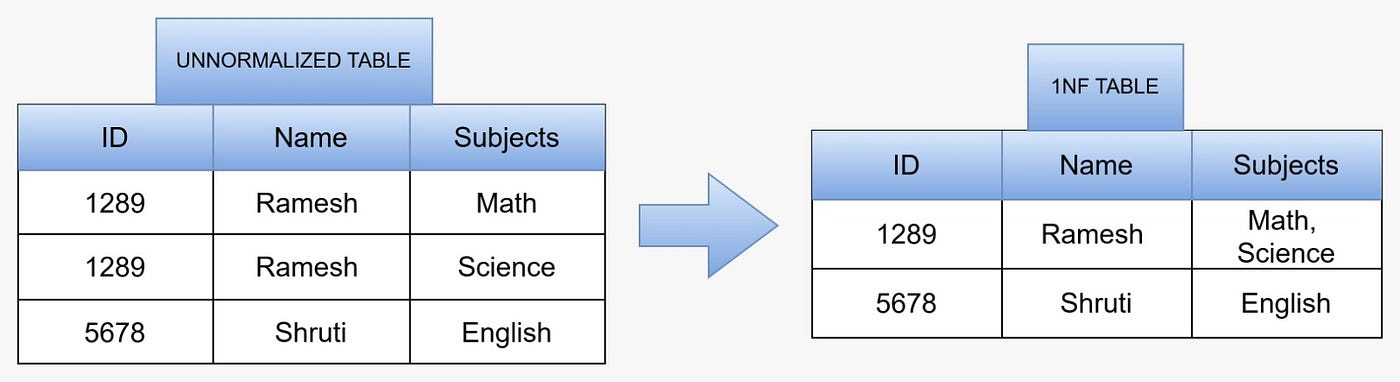
Fig. 1–1NF: the repeating “Subjects” list is split so each row holds a single subject.
- Every cell now holds one atomic value.
- Each Id/Subject combination gets its own row.
Second Normal Form (2NF)
A table is in 2NF when it’s already in 1NF and every non-key column depends on the entire primary key, not just part of it. This rule only comes into play when a table has a composite key (a primary key made up of more than one column). If some data only relates to half of that key, it doesn’t belong in this table.
In the 1NF table above, the key is (Id, Subject). However, Name depends only on Id, not on Subject. This is known as a partial dependency, which violates Second Normal Form (2NF). The fix is to split the table into a student table and a Subject table.
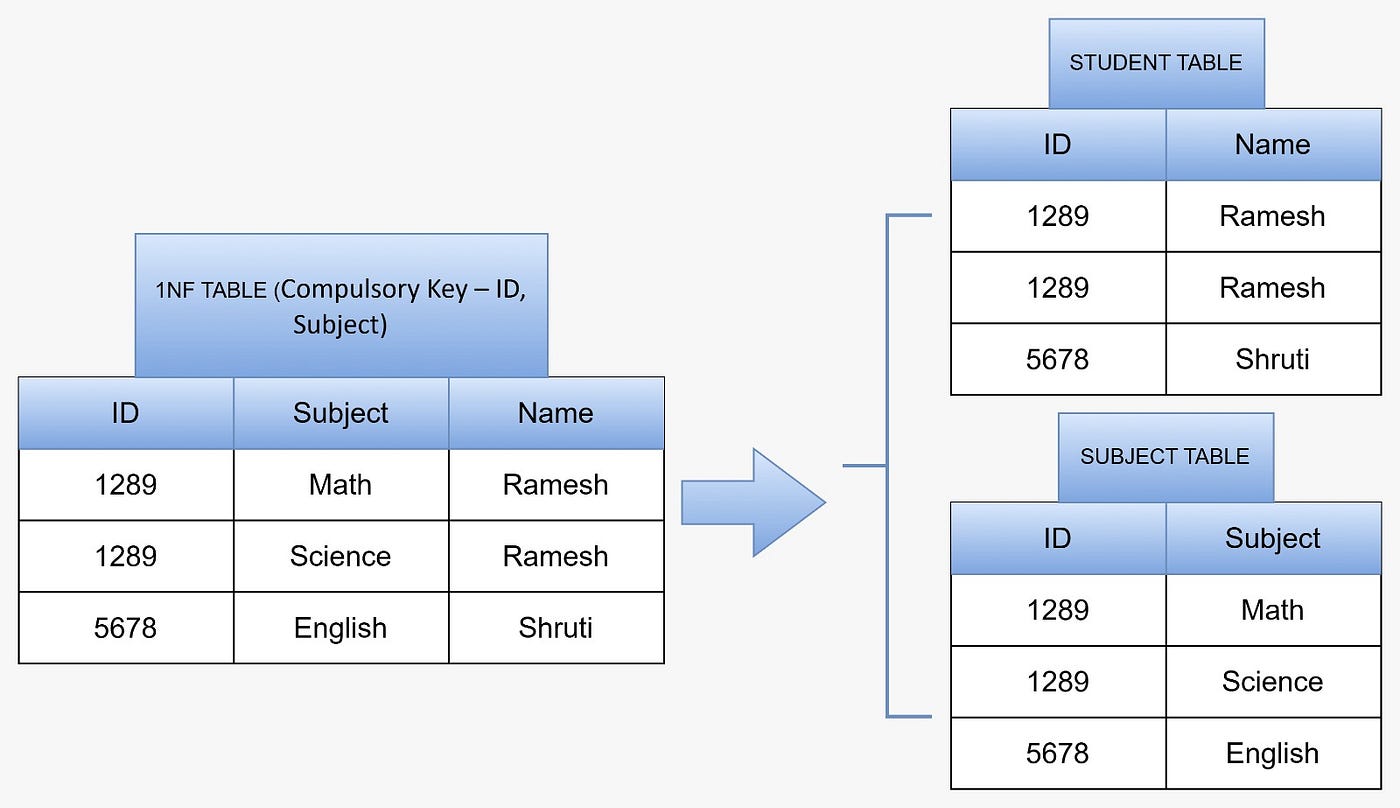
Fig. 2–2NF: the partial dependency is removed by splitting the table into Student and Subject.
Third Normal Form (3NF)
A table is in Third Normal Form (3NF) when it is already in 2NF and none of its non-key columns depend on other non-key columns. Every non-key column should depend only on the primary key. If the value of column B is determined by column A, and A is not the primary key, this is called a transitive dependency. In that case, B belongs in a separate table that is keyed on A.
In this example, DeptIncharge depends on Dept, not directly on the employee’s Id. This is a textbook example of a transitive dependency. The solution is to move the department details into their own table, using Dept as the primary key.
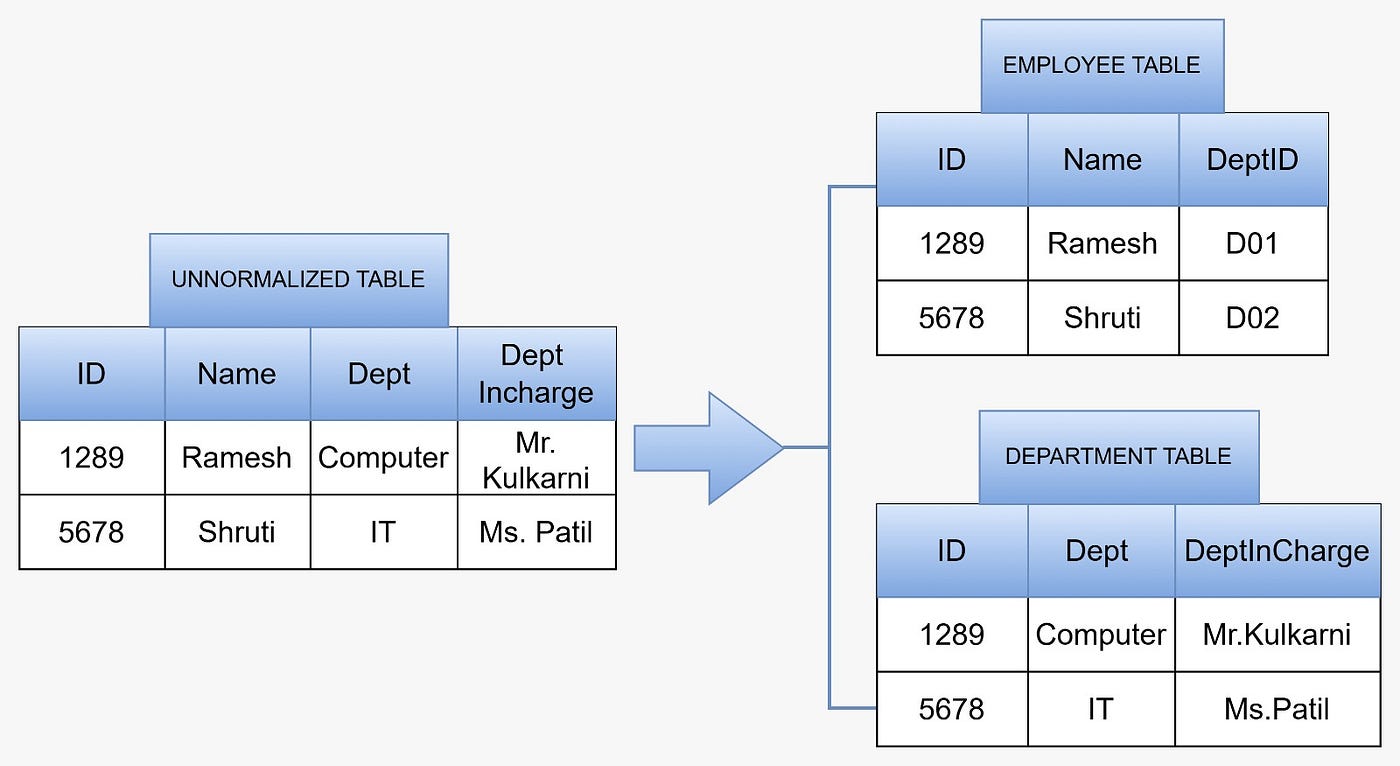
Fig. 3–3NF: the transitive dependency is removed by moving department data into its own table.
Boyce-Codd Normal Form (BCNF)
BCNF (sometimes called 3.5NF) is a stricter version of 3NF. A table is in BCNF when, for every dependency where column A determines column B, A must be a candidate key, meaning A can uniquely identify a row on its own. 3NF still allows a handful of edge cases where a non-key column determines part of a composite key; BCNF closes that gap entirely.
Below, each TeacherId determines exactly one CourseName. However, TeacherId is not the table’s primary key, so this violates Boyce–Codd Normal Form (BCNF) even though the table is already in Third Normal Form (3NF). Splitting into a Course table and a teacher table fixes it.
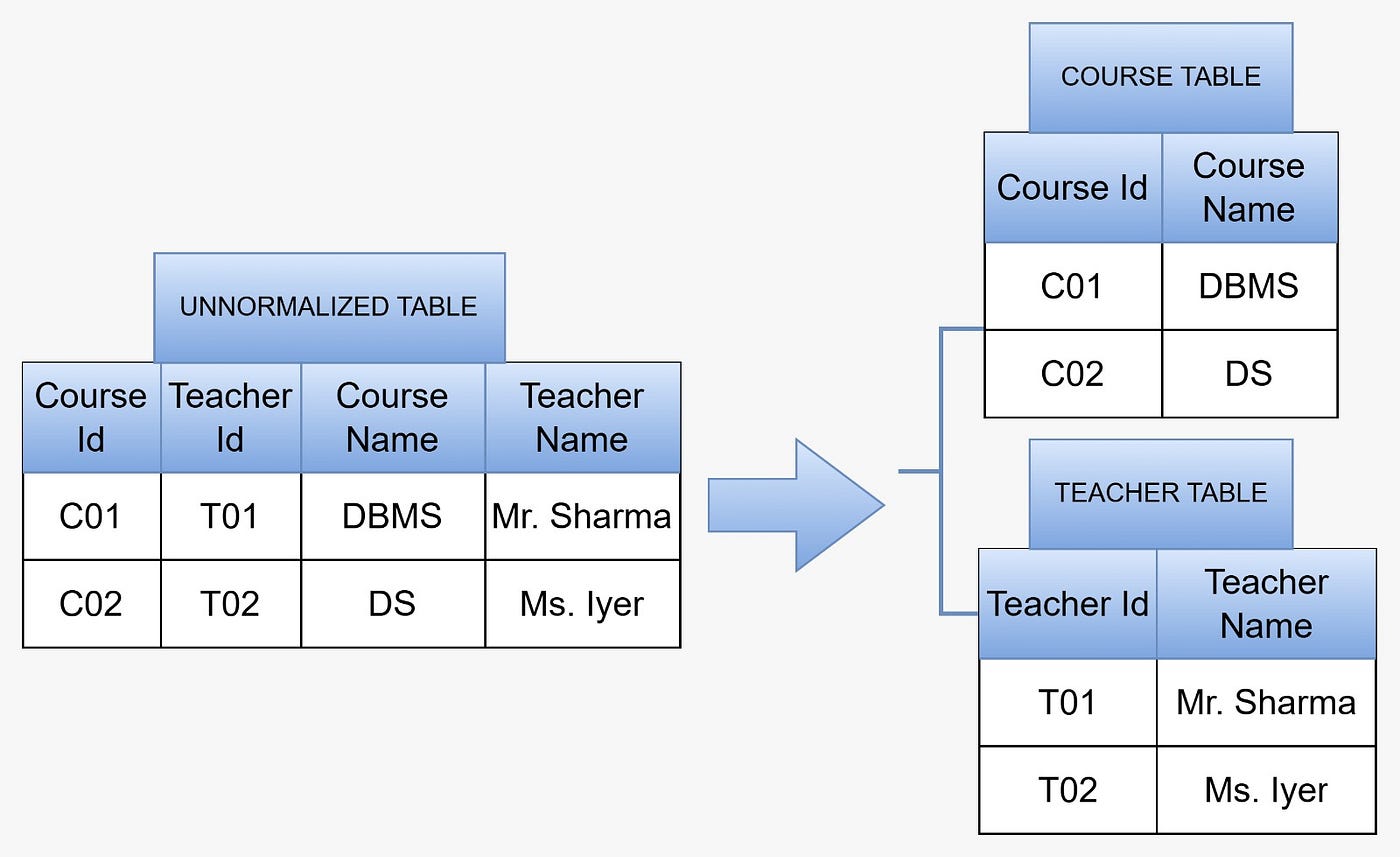
Fig. 4 — BCNF: splitting into Course and Teacher ensures every determinant is a candidate key.
Fourth Normal Form (4NF)
A table is in 4NF when it’s already in BCNF and free of multi-valued dependencies These occur when a single key is associated with two or more independent sets of values that have no relationship to each other. Storing them in the same table forces you to repeat rows unnecessarily just to represent every combination.
Below, a student’s hobbies and the languages they speak are two completely independent facts, but they’ve been crammed into one row together. The fix is to separate them into two single-purpose tables.
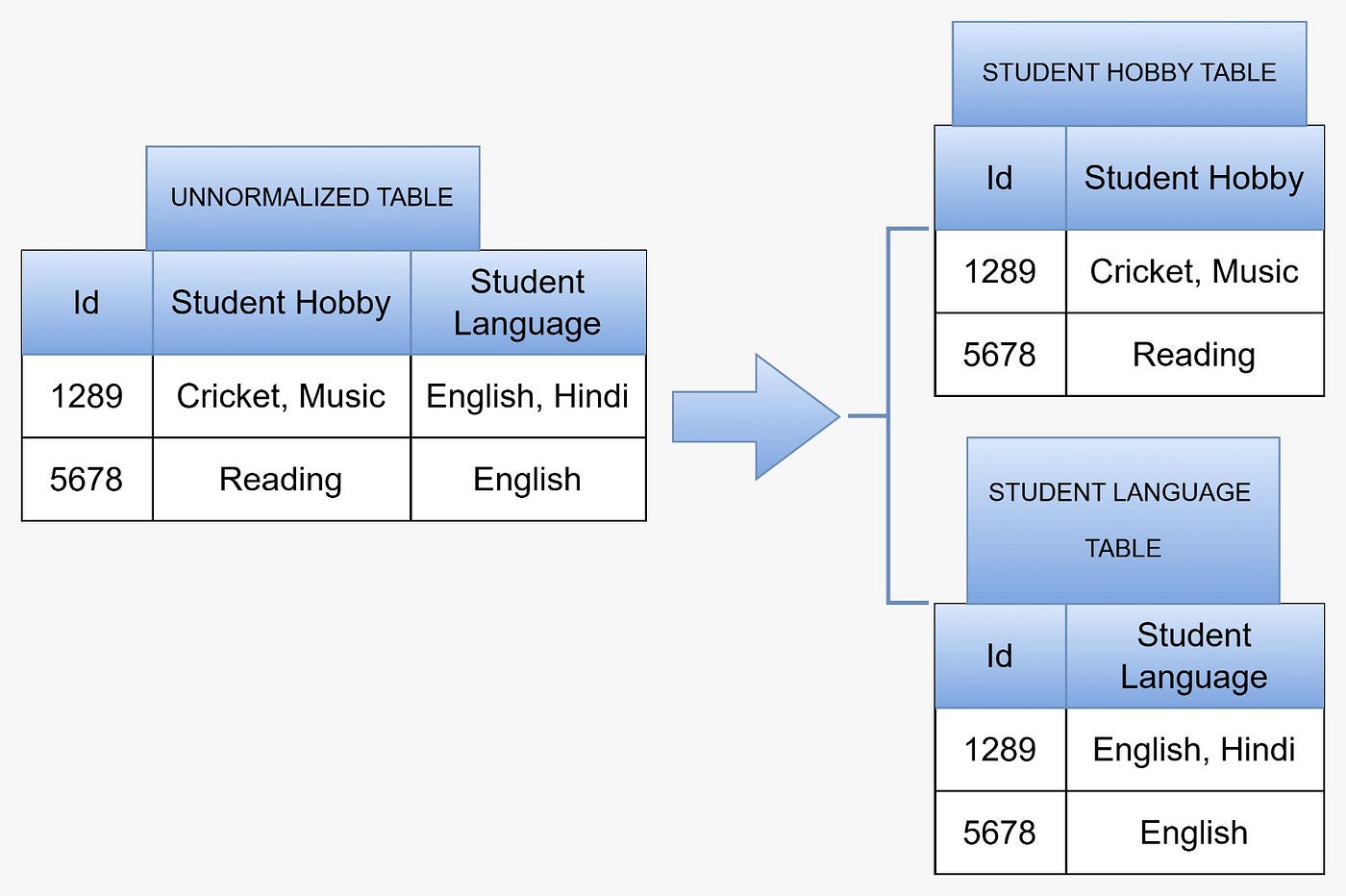
Fig. 5–4NF: independent multi-valued facts (hobbies vs. languages) are separated into their own tables.
Fifth Normal Form (5NF)
A table is in 5NF (also called Project-Join Normal Form) when it’s already in 4NF and free of join dependencies. These occur when the original table can only be reconstructed correctly by joining three or more smaller tables together. If a table like this isn’t decomposed correctly, joining just two of the smaller pieces would recreate combinations that never actually existed.
Below, Supplier–Part–Project combinations can’t be broken into just two tables without losing information or creating false combinations. The correct fix is three pairwise tables.
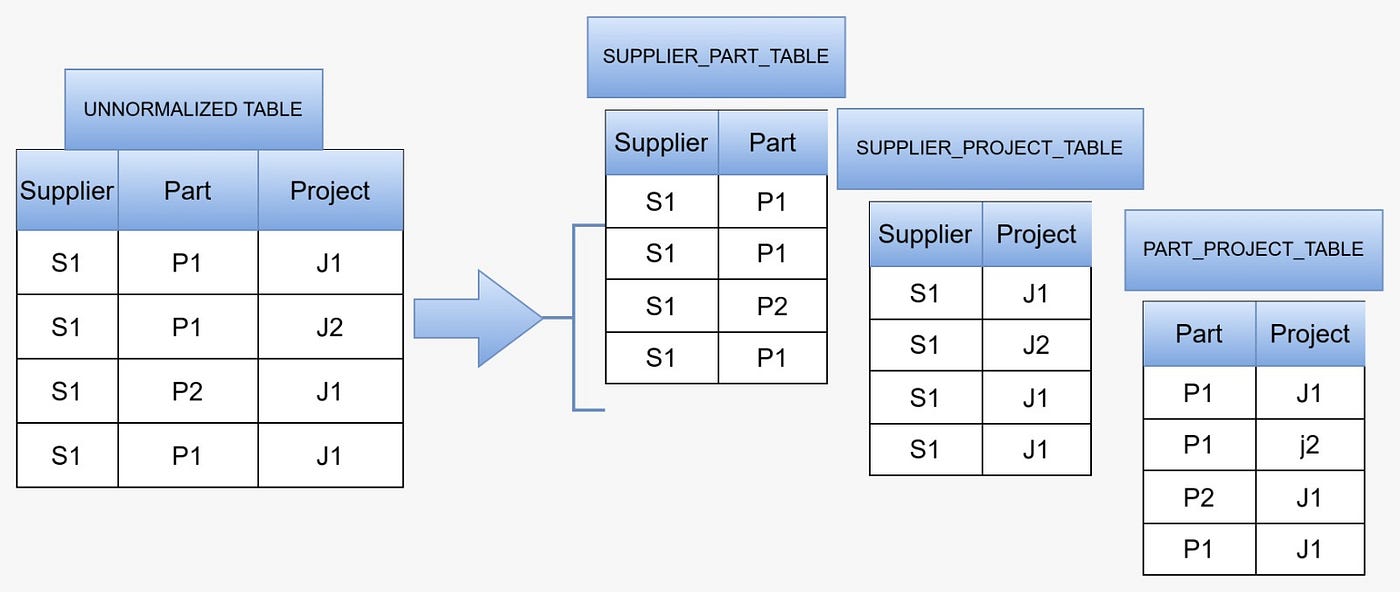
Fig. 6 - 5NF: the three-way relationship is decomposed into Supplier_Part, Supplier_Project, and Part_Project.
This is the most granular normal form and is rarely needed outside complex many-to-many-to-many scenarios. Most teams we work with through Web Design & Development stop well before 5NF. However, understanding 5NF helps you recognize when a database schema contains a hidden three-way relationship that should be decomposed into separate tables.
Which Normal Form Should You Target?
- 3NF is the practical target for the vast majority of business applications, it removes almost all redundancy without over-engineering the schema.
- BCNF is worth the extra step when a table has multiple overlapping candidate keys, common in scheduling or assignment-style data.
- 4NF and 5NF matter mainly in specialized systems with independent multi-valued attributes or complex three-way relationships (like supplier/part/project tracking).
Getting this right early avoids expensive migrations later. It’s a core part of how our Web Design & Development team scopes new builds, and it directly supports smoother CMS Content Ops and cleaner reporting for Full Marketing Campaigns further down the line. Even lighter-weight data, like the engagement metrics behind Social Media Management dashboards, benefits from the same normalize-first approach before any numbers are flattened for reporting.
Real-World Applications of Database Normalization
Database normalization is widely used across industries to improve data integrity, reduce data redundancy, and create efficient relational databases.
Banking Systems:
Banks use database normalization to organize customer, account, and transaction data into related tables, ensuring accurate records and secure financial operations.
Hospital Management Systems:
Hospitals use normalized databases to manage patients, doctors, appointments, and medical records, improving data consistency and reducing duplicate information.
E-commerce Websites:
E-commerce platforms organize products, customers, orders, inventory, and payments using normalized databases for faster order processing and better data management.
Educational Institutions:
Schools and universities rely on database normalization to efficiently manage students, courses, faculty, departments, and examination records.
Human Resource Management (HRM):
HR systems use normalized databases to store employee, payroll, attendance, and department information, making record management accurate and efficient.
Customer Relationship Management (CRM):
CRM software uses database normalization to organize customer profiles, sales records, and support interactions, helping businesses deliver better customer experiences.
Inventory Management:
Inventory management systems use normalized databases to track products, suppliers, stock levels, and purchase orders while minimizing duplicate data.
Best Practices for Database Normalization
To create an efficient and scalable relational database, follow these best practices for database normalization:
- Identify entities and their relationships before designing your database schema and creating tables.
- Use meaningful primary keys and foreign keys to accurately establish relationships and maintain data integrity.
- Avoid data redundancy by ensuring that each piece of information is stored only once within the relational database.
- Normalize your database up to the Third Normal Form (3NF) for most applications, as this provides an ideal balance between database performance and data consistency.
- Balance normalization with performance considerations, as excessive normalization can lead to more table joins and potentially slow down query speed.
- Create an Entity Relationship (ER) Diagram to visualize your database design, including tables, keys, and relationships, before implementation.
Conclusion
Database normalization is a crucial technique for designing efficient and reliable relational databases. By organizing data into smaller, related tables, normalization helps reduce redundancy, improve consistency, and enhance overall database performance. While higher normal forms offer greater data integrity, most practical applications utilize normalization up to the Third Normal Form (3NF) to strike a balance between efficiency and performance.
Understanding normalization allows developers and database administrators to create scalable systems that are easier to maintain and less prone to errors. A well-normalized database serves as the foundation for any successful information system, ensuring that data remains accurate, secure, and manageable as organizations continue to grow.
Found this guide helpful? Explore our blog for more articles on database design, SQL, software development, and web technologies to continue improving your technical skills.
Frequently Asked Questions
What’s the difference between 3NF and BCNF?
3NF removes transitive dependencies, but still allows a few edge cases where a non-key column determines part of a composite key. BCNF closes that gap by requiring every determinant to be a candidate key.
Do I really need to reach 4NF or 5NF?
Rarely. These forms address multi-valued and join dependencies that mostly show up in specialized data models. Most applications are well served by stopping at 3NF or BCNF.
What’s the quickest way to check if a table needs splitting?
Ask whether any non-key column depends on something other than the whole primary key. If it does, that dependency usually points directly to where the table should be split.
메타데이터
- post_id
- 74c8bbeb331d
- slug
- database-normalization-a-complete-guide-to-organizing-databases-efficiently-74c8bbeb331d
- url
- https://medium.com/@techloom/database-normalization-a-complete-guide-to-organizing-databases-efficiently-74c8bbeb331d
- canonical_url
- https://medium.com/@techloom/database-normalization-a-complete-guide-to-organizing-databases-efficiently-74c8bbeb331d
- author_url
- https://medium.com/@techloom
- status
- ok
- fetched_at
- 2026-08-08 17:17:50