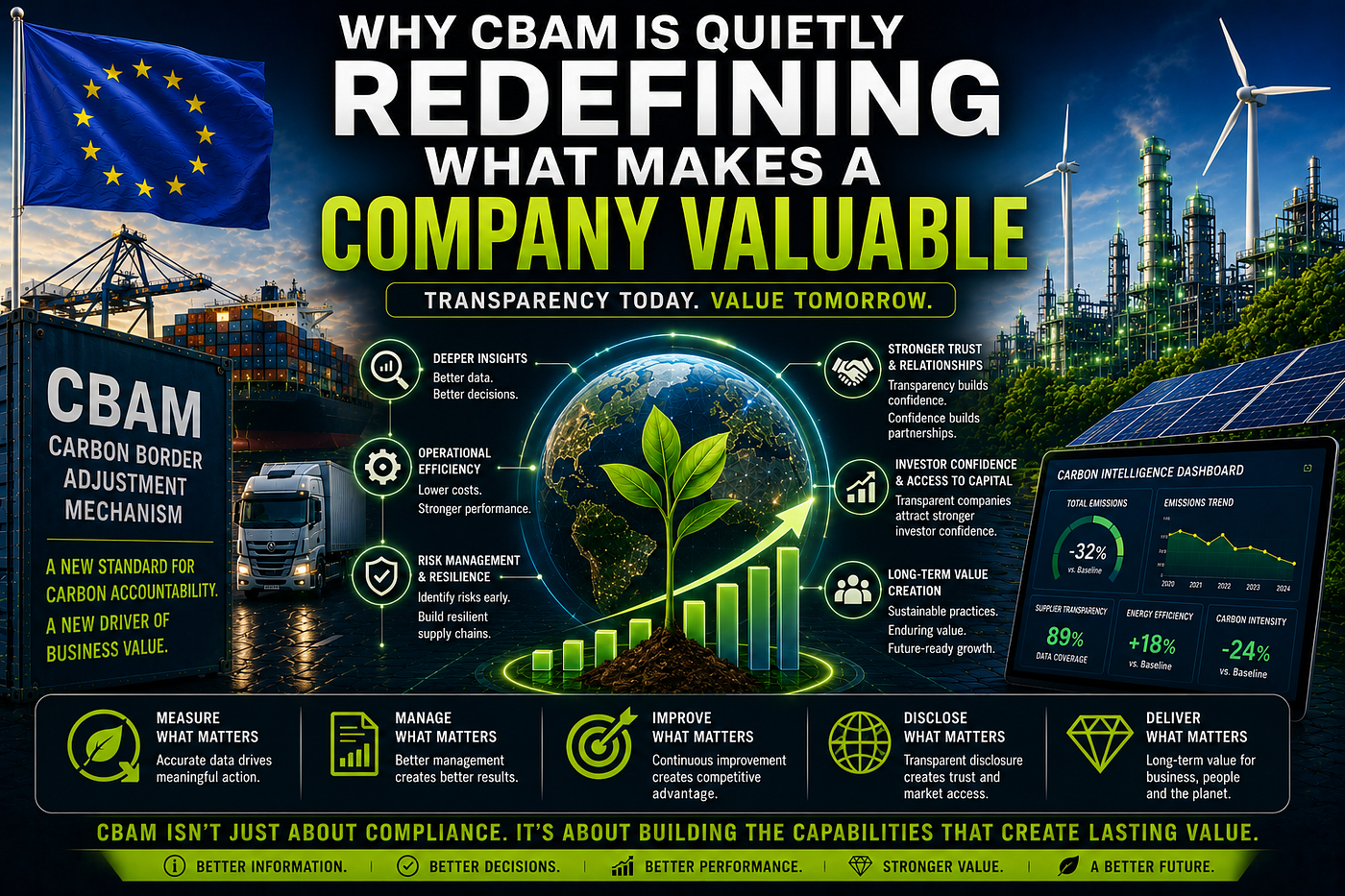
Why CBAM Is Quietly Redefining What Makes a Company Valuable
Ask most investors what determines the value of a company, and the answers are usually familiar.
Why CBAM Is Quietly Redefining What Makes a Company Valuable
Ask most investors what determines the value of a company, and the answers are usually familiar.
Revenue growth.
Profit margins.
Market share.
Customer acquisition.
Cash flow.
For decades, these metrics have dominated boardroom discussions and investment decisions.
They remain critically important.
But a new factor is beginning to enter the conversation.
Transparency.
Specifically, transparency around how products are made, how resources are consumed, and how emissions are generated across global supply chains.
The European Union’s Carbon Border Adjustment Mechanism, known as CBAM, is accelerating this shift.
While much of the public discussion focuses on carbon reporting and compliance requirements, CBAM may have a much deeper long-term impact.
It is helping redefine what investors, customers, and business partners consider valuable.
This transformation is subtle.
It is not happening overnight.
Yet its implications could reshape competitive dynamics across multiple industries during the next decade.
The reason begins with information.
Modern economies run on information.
Financial information drives investment decisions.
Operational information drives management decisions.
Customer information drives marketing decisions.
The organizations possessing the most reliable information often make the best strategic choices.
CBAM introduces a new category of information into this equation.
Carbon intelligence.
To comply with reporting requirements, companies increasingly need visibility into manufacturing processes, supplier activities, energy consumption, transportation systems, and production inputs.
Collecting this information is not easy.
Many organizations discover that critical data is fragmented across departments, suppliers, and systems.
Addressing these gaps requires significant effort.
Yet the process often generates unexpected benefits.
Companies gain a deeper understanding of their operations.
They identify inefficiencies.
They improve supplier relationships.
They strengthen governance.
They enhance risk management.
The business becomes more visible to itself.
And that visibility creates value.
Consider how investors evaluate companies.
Traditionally, strong financial performance suggested effective management.
Today, investors increasingly want additional evidence.
Can the company manage risk?
Can it adapt to changing market conditions?
Can it respond to evolving regulations?
Can it maintain resilient supply chains?
Can it demonstrate operational transparency?
These questions are becoming increasingly important.
Organizations capable of answering them effectively often inspire greater confidence.
CBAM encourages businesses to develop exactly these capabilities.
The reporting process requires discipline.
It requires measurement.
It requires accountability.
It requires systems capable of producing reliable information.
Over time, these capabilities become organizational strengths.
This is why some executives now view carbon reporting as more than a compliance exercise.
They see it as a management exercise.
The ability to measure complex operational activities accurately is valuable regardless of regulatory requirements.
Better measurement often leads to better management.
And better management often leads to stronger performance.
The same principle applies to customer relationships.
Buyers increasingly seek confidence in their suppliers.
They want transparency.
They want traceability.
They want credible information.
In many industries, environmental performance is becoming part of the overall trust equation.
When suppliers can provide accurate and verifiable data, uncertainty declines.
Reduced uncertainty creates stronger business relationships.
Stronger relationships often translate into long-term commercial opportunities.
The impact extends throughout supply chains.
Companies collecting emissions information frequently engage more closely with suppliers.
Conversations become more detailed.
Collaboration becomes more strategic.
Visibility improves.
The entire network becomes more resilient.
This creates value that extends far beyond carbon accounting.
Technology is playing a central role in this transformation.
Artificial intelligence platforms are helping companies analyze emissions data at scale.
Cloud-based reporting systems are improving accessibility.
Industrial sensors are generating real-time operational insights.
Advanced analytics tools are uncovering optimization opportunities.
The result is an increasingly data-driven approach to business management.
Organizations that embrace these technologies often gain advantages in efficiency, forecasting, planning, and decision-making.
These advantages compound over time.
What makes CBAM particularly significant is that it encourages investment in capabilities that remain valuable even if regulatory requirements evolve.
A company that improves operational visibility benefits every year.
A company that strengthens supplier transparency benefits every year.
A company that builds advanced data-management systems benefits every year.
The return on investment extends beyond compliance.
This is why many analysts believe transparency may become one of the defining business characteristics of the next decade.
Historically, competitive advantages often emerged from assets that were difficult to replicate.
Manufacturing scale.
Distribution networks.
Brand recognition.
Technical expertise.
Today, organizational intelligence is increasingly joining that list.
The ability to understand operations deeply and act on reliable information is becoming a strategic asset.
CBAM contributes to this trend by encouraging companies to collect and manage more information than ever before.
The businesses that embrace this opportunity may discover that transparency itself becomes a competitive advantage.
Investors may view them more favorably.
Customers may trust them more readily.
Partners may prefer working with them.
Employees may have greater confidence in leadership.
The benefits can extend throughout the organization.
History suggests that companies rarely become more valuable simply because they comply with regulations.
They become more valuable because they develop capabilities that improve performance.
CBAM is encouraging the development of such capabilities.
Measurement.
Visibility.
Accountability.
Operational intelligence.
Strategic transparency.
These qualities are increasingly relevant in modern markets.
The organizations building them today may be positioning themselves for tomorrow’s economy.
That economy will still reward profitability and growth.
It will still reward innovation and efficiency.
But it may also place a much greater premium on transparency than ever before.
If that happens, CBAM may ultimately be remembered for something larger than carbon reporting.
It may be remembered as one of the forces that helped redefine what makes a company truly valuable in the twenty-first century.
Here’s another premium CBAM article for your Medium paywall series:
Why CBAM Is Quietly Redefining What Makes a Company Valuable
Ask most investors what determines the value of a company, and the answers are usually familiar.
Revenue growth.
Profit margins.
Market share.
Customer acquisition.
Cash flow.
For decades, these metrics have dominated boardroom discussions and investment decisions.
They remain critically important.
But a new factor is beginning to enter the conversation.
Transparency.
Specifically, transparency around how products are made, how resources are consumed, and how emissions are generated across global supply chains.
The European Union’s Carbon Border Adjustment Mechanism, known as CBAM, is accelerating this shift.
While much of the public discussion focuses on carbon reporting and compliance requirements, CBAM may have a much deeper long-term impact.
It is helping redefine what investors, customers, and business partners consider valuable.
This transformation is subtle.
It is not happening overnight.
Yet its implications could reshape competitive dynamics across multiple industries during the next decade.
The reason begins with information.
Modern economies run on information.
Financial information drives investment decisions.
Operational information drives management decisions.
Customer information drives marketing decisions.
The organizations possessing the most reliable information often make the best strategic choices.
CBAM introduces a new category of information into this equation.
Carbon intelligence.
To comply with reporting requirements, companies increasingly need visibility into manufacturing processes, supplier activities, energy consumption, transportation systems, and production inputs.
Collecting this information is not easy.
Many organizations discover that critical data is fragmented across departments, suppliers, and systems.
Addressing these gaps requires significant effort.
Yet the process often generates unexpected benefits.
Companies gain a deeper understanding of their operations.
They identify inefficiencies.
They improve supplier relationships.
They strengthen governance.
They enhance risk management.
The business becomes more visible to itself.
And that visibility creates value.
Consider how investors evaluate companies.
Traditionally, strong financial performance suggested effective management.
Today, investors increasingly want additional evidence.
Can the company manage risk?
Can it adapt to changing market conditions?
Can it respond to evolving regulations?
Can it maintain resilient supply chains?
Can it demonstrate operational transparency?
These questions are becoming increasingly important.
Organizations capable of answering them effectively often inspire greater confidence.
CBAM encourages businesses to develop exactly these capabilities.
The reporting process requires discipline.
It requires measurement.
It requires accountability.
It requires systems capable of producing reliable information.
Over time, these capabilities become organizational strengths.
This is why some executives now view carbon reporting as more than a compliance exercise.
They see it as a management exercise.
The ability to measure complex operational activities accurately is valuable regardless of regulatory requirements.
Better measurement often leads to better management.
And better management often leads to stronger performance.
The same principle applies to customer relationships.
Buyers increasingly seek confidence in their suppliers.
They want transparency.
They want traceability.
They want credible information.
In many industries, environmental performance is becoming part of the overall trust equation.
When suppliers can provide accurate and verifiable data, uncertainty declines.
Reduced uncertainty creates stronger business relationships.
Stronger relationships often translate into long-term commercial opportunities.
The impact extends throughout supply chains.
Companies collecting emissions information frequently engage more closely with suppliers.
Conversations become more detailed.
Collaboration becomes more strategic.
Visibility improves.
The entire network becomes more resilient.
This creates value that extends far beyond carbon accounting.
Technology is playing a central role in this transformation.
Artificial intelligence platforms are helping companies analyze emissions data at scale.
Cloud-based reporting systems are improving accessibility.
Industrial sensors are generating real-time operational insights.
Advanced analytics tools are uncovering optimization opportunities.
The result is an increasingly data-driven approach to business management.
Organizations that embrace these technologies often gain advantages in efficiency, forecasting, planning, and decision-making.
These advantages compound over time.
What makes CBAM particularly significant is that it encourages investment in capabilities that remain valuable even if regulatory requirements evolve.
A company that improves operational visibility benefits every year.
A company that strengthens supplier transparency benefits every year.
A company that builds advanced data-management systems benefits every year.
The return on investment extends beyond compliance.
This is why many analysts believe transparency may become one of the defining business characteristics of the next decade.
Historically, competitive advantages often emerged from assets that were difficult to replicate.
Manufacturing scale.
Distribution networks.
Brand recognition.
Technical expertise.
Today, organizational intelligence is increasingly joining that list.
The ability to understand operations deeply and act on reliable information is becoming a strategic asset.
CBAM contributes to this trend by encouraging companies to collect and manage more information than ever before.
The businesses that embrace this opportunity may discover that transparency itself becomes a competitive advantage.
Investors may view them more favorably.
Customers may trust them more readily.
Partners may prefer working with them.
Employees may have greater confidence in leadership.
The benefits can extend throughout the organization.
History suggests that companies rarely become more valuable simply because they comply with regulations.
They become more valuable because they develop capabilities that improve performance.
CBAM is encouraging the development of such capabilities.
Measurement.
Visibility.
Accountability.
Operational intelligence.
Strategic transparency.
These qualities are increasingly relevant in modern markets.
The organizations building them today may be positioning themselves for tomorrow’s economy.
That economy will still reward profitability and growth.
It will still reward innovation and efficiency.
But it may also place a much greater premium on transparency than ever before.
If that happens, CBAM may ultimately be remembered for something larger than carbon reporting.
It may be remembered as one of the forces that helped redefine what makes a company truly valuable in the twenty-first century.
CTA
Subscribe to Genecapsule for expert insights on CBAM, ESG, sustainability, AI, climate innovation, and the future of global business.
메타데이터
- post_id
- 74d65e32a2e9
- slug
- why-cbam-is-quietly-redefining-what-makes-a-company-valuable-74d65e32a2e9
- url
- https://medium.com/@anandv_62921/why-cbam-is-quietly-redefining-what-makes-a-company-valuable-74d65e32a2e9
- canonical_url
- https://medium.com/@anandv_62921/why-cbam-is-quietly-redefining-what-makes-a-company-valuable-74d65e32a2e9
- author_url
- https://medium.com/@anandv_62921
- status
- ok
- fetched_at
- 2026-06-15 20:49:13