The History of John Belushi’s Bar on Hudson
The “John Belushi bar on Hudson Street” is usually shorthand for the Holland Tunnel Blues Bar, a semi-private after-hours space tied to the…
The History of John Belushi’s Bar on Hudson
The “John Belushi bar on Hudson Street” is usually shorthand for the Holland Tunnel Blues Bar, a semi-private after-hours space tied to the early culture around Saturday Night Live in the late 1970s. It is most often placed at 282 Hudson Street in lower Manhattan, although even that address comes from a mix of oral history, journalistic reconstruction, and people confidently repeating things they half remember at 2 a.m., which is also basically how New York works in general.
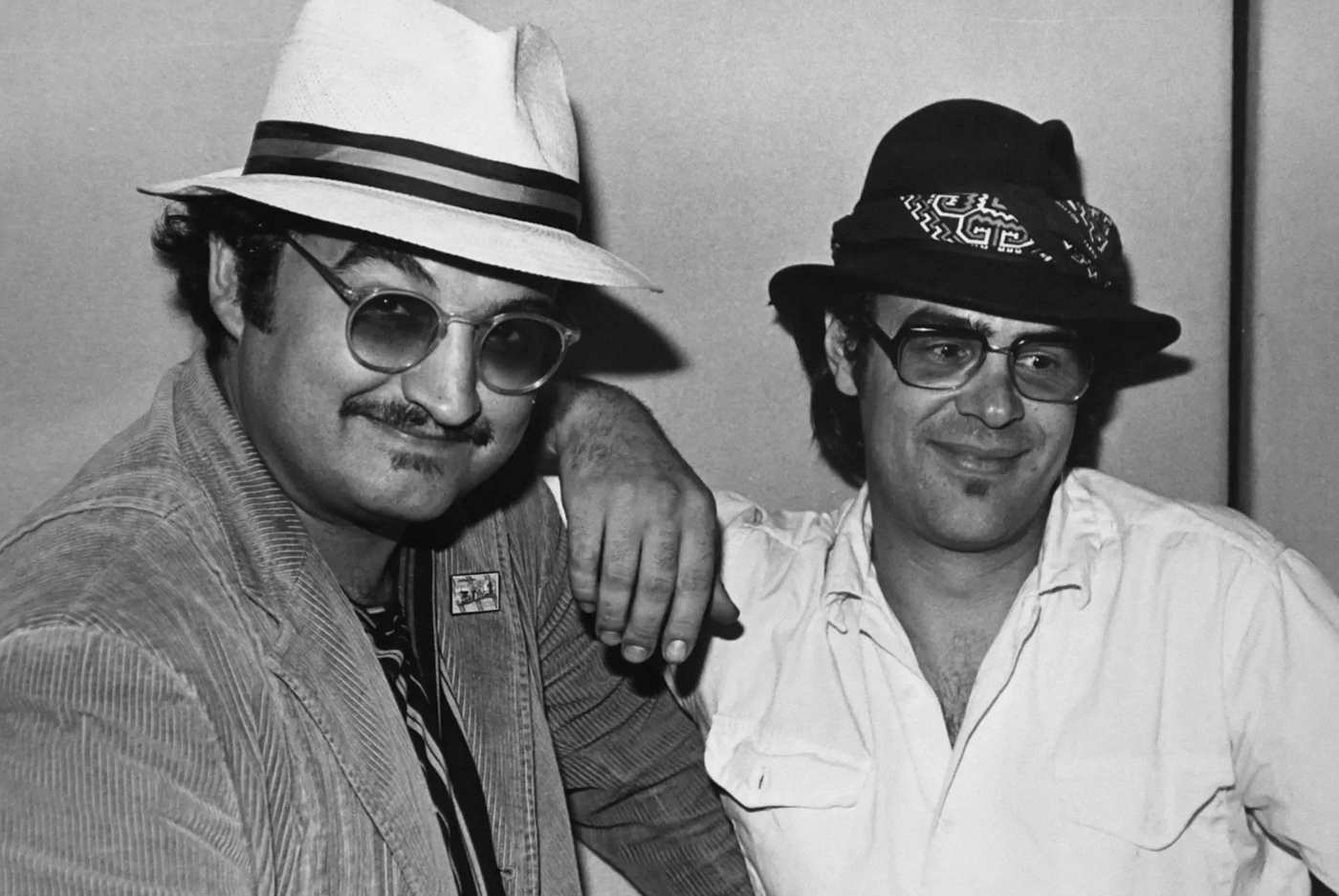
Ackroyd and Belushi (Rolling Stone)
It was not a normal bar. There was no public-facing identity in the way most bars have one, no consistent operating hours, and no real attempt to behave like a business that wanted repeat customers from the general population. Instead, it functioned as a rented room organized by Dan Aykroyd, who used it as a private gathering space for people connected to SNL after the show wrapped for the night. Think less “venue” and more “controlled chaos with a jukebox.”
The reason it existed is actually pretty practical. Saturday Night Live finished very late, usually around 1 a.m., and the people involved were in that specific post-live-broadcast state where your brain is still shouting and your body has already filed a formal complaint. Regular bars were either closing, too public, or full of people who had not just survived live television, which created a mismatch in energy that the Hudson Street space conveniently solved.
John Belushi became strongly associated with the place because he was there constantly, not as an owner or operator but as someone who treated it like a second living room with better music. Around this time, Aykroyd was actively feeding him blues records, which is important because Belushi’s relationship to blues music before this period was more general enthusiasm, while afterward it became something closer to obsession with very specific structure.
The space itself reportedly had a jukebox, some musical instruments, and a loose expectation that if the right people showed up, something resembling a performance might happen. There were no tickets, no schedule, and no real distinction between performer and audience, which meant that at any given moment you could be watching a legendary musician, a comedy writer, or someone who just wandered in because they followed the noise like a moth with questionable judgment.
Bill Murray and other SNL cast members also spent time there. Murray has described it as a necessary decompression zone, which is a polite way of saying that if you just performed live sketch comedy on national television, your nervous system is not immediately compatible with a quiet apartment and a sensible bedtime. The bar absorbed that leftover energy. Sometimes efficiently. Sometimes not.
This is where the early shape of the Blues Brothers starts to form, although it is important not to exaggerate the bar’s role as if it were some kind of magical origin chamber. The characters of Jake and Elwood Blues already existed as sketches on Saturday Night Live. What changed in places like the Hudson Street space was that those sketches started getting repeated, extended, and tested in front of people who were not being paid to sit through them.
Aykroyd and Belushi would perform informally, often with musicians who were either already part of the professional blues world or just happened to be in the orbit of New York nightlife at the time. These sessions did not have structure in the formal sense, but they did have repetition, and repetition is where “a joke” slowly becomes “a thing people can book,” which is usually the point where comedy starts getting nervous.
When the Blues Brothers eventually became a touring act and later a film, resulting in The Blues Brothers, the scale and organization were entirely different. What had been informal late-night sessions turned into rehearsed choreography, studio recording, and full production logistics involving large budgets and even larger destruction bills, mostly for police cars.
Here is where a bit of devil’s advocate honesty helps. The romantic version of this history says the Hudson Street bar “created” the Blues Brothers, as if one night someone spilled beer on a harmonica and American culture changed forever. That is clean, satisfying, and not really how anything works.
A more accurate version is that the Blues Brothers were already structurally inevitable inside the SNL ecosystem. You had Aykroyd’s deep interest in blues music, Belushi’s performance instincts, access to professional musicians through the show’s network, and a television format that actively encouraged character development through repetition. Under those conditions, something like the Blues Brothers was probably going to happen somewhere, even if Hudson Street had been occupied by accountants and very serious paperwork.
So the skeptical argument is that the bar is overcredited. It is a good story, but it is also a convenient container for a process that was already happening across multiple spaces: studio rehearsals, television sketches, backstage conversations, and touring experiments. In that reading, the bar is not the cause, it is just the most photogenic chapter heading.
But the counterargument is less tidy and, honestly, more interesting. Even if nothing “began” there in a strict sense, environments like that still matter because they change probability. They increase the number of repetitions, lower the friction between idea and performance, and allow something half-formed to survive long enough to become stable. Most ideas die quietly because they never get that chance.
The Hudson Street space, then, was not the birthplace of the Blues Brothers in a clean narrative sense. It was more like a pressure chamber where certain elements of the SNL world kept colliding often enough that a specific configuration of comedy, music, and character stopped being hypothetical and started becoming repeatable. And once something becomes repeatable, it is already halfway to becoming real, whether or not anyone intended it to.
Sources and Further Reading
메타데이터
- post_id
- 74d866bafd69
- slug
- the-history-of-john-belushis-bar-on-hudson-74d866bafd69
- url
- https://medium.com/@maya.l.hazarika/the-history-of-john-belushis-bar-on-hudson-74d866bafd69
- canonical_url
- https://medium.com/@maya.l.hazarika/the-history-of-john-belushis-bar-on-hudson-74d866bafd69
- author_url
- https://medium.com/@maya.l.hazarika
- status
- ok
- fetched_at
- 2026-06-15 20:49:13