Micron Just Reported $41 Billion in Revenue and Beat Estimates by $5.77
Micron's Record $41.5B Quarter and $50B Guidance Just Proved That Tuesday's Chip Selloff Was Nothing But Noise
Micron Just Reported $41 Billion in Revenue and Beat Estimates by $5.77 Billion. The AI Memory Thesis Is Very Much Alive.
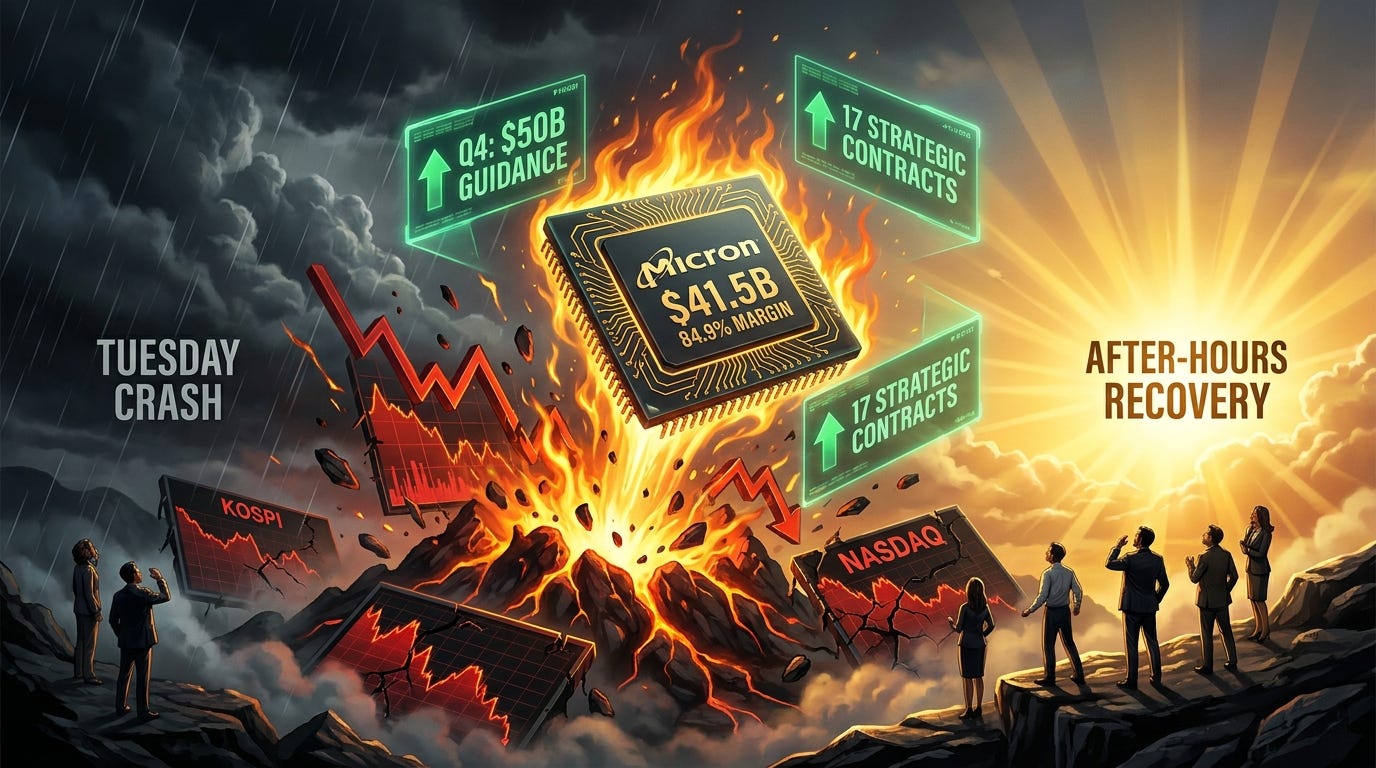
Yesterday the chip sector was in freefall. Today Micron changed everything. Micron Technology posted adjusted earnings of $25.11 a share on revenue of $41.46 billion, both well above Wall Street expectations. Shares rose 13.1% after hours to $1,185.90, moving closer to their 52-week high after ending the regular session at $1,047.20. For context on how extraordinary that beat actually is: EPS topped forecasts by $4.62 a share and revenue beat by $5.77 billion. Revenue reached a record $41.5 billion, Micron’s fifth straight quarterly sales record. A $5.77 billion revenue beat on top of already elevated expectations, after a week of brutal selling in chip stocks, is the kind of earnings report that resets the narrative for an entire sector. Yesterday people were asking whether the AI memory trade was over. Tonight Micron answered that question directly. What the Numbers Actually Say About AI Demand The headline beat is impressive. The details underneath it are even more telling. Gross margin climbed to 84.9%, a company record, helped by higher pricing and a favorable product mix. For a company that spent most of its history fighting brutal commodity pricing cycles where margins swung wildly, a gross margin approaching 85% is not just a good number. It is a structural statement about how fundamentally the AI buildout has changed Micron’s business. Management said that market tightness is "locked in to persist beyond calendar 2027" amid the AI buildout. In its commentary, Micron focused heavily on Strategic Customer Agreements, or SCAs. The company has signed 17 of these contracts with customers, providing guaranteed revenue for Micron and guaranteed compute for customers. Seventeen long-term contracts with set pricing, a market that is tight through at least 2027, and record margins. This is the opposite of the commodity memory business that investors spent decades being cautious about. Micron guided for fiscal fourth-quarter revenue of about $50 billion, plus or minus $1 billion. It also forecast adjusted EPS of about $31, plus or minus $1, on gross margin of roughly 86%. Q4 guidance of $50 billion is the number that will drive tomorrow’s pre-market trading more than anything else in the report. That is a sequential increase from $41.5 billion to $50 billion in a single quarter. It implies the AI memory demand that investors were questioning this week is not just holding steady. It is still accelerating. Why Tuesday’s Selloff Now Looks Like a Buying Opportunity Micron Technology made an unbelievably strong quarterly showing in its Q3 2026 earnings report, while providing even more unbelievable guidance for its current quarter. It’s up over 12% in after-hours trade, bolstering semiconductor-related names and ETFs, and possibly even supporting the staying power of the AI-fueled stock market rally. Tuesday’s 13% drop in Micron looked scary in real time. It always does when stocks fall that fast. But looking at it now, that drop happened because South Korea’s KOSPI crashed 10%, regulatory fears about overheating spread globally, and forced liquidations created a cascade of selling that had very little to do with Micron’s actual business performance. The stock has delivered a remarkable 725% return over the past year, though investors should note its high beta of 2.17 indicates significant volatility. A beta of 2.17 means Micron moves more than twice as much as the broader market in both directions. On a bad day for tech, it falls harder. On a good earnings day, it recovers faster. The investors who bought the Tuesday dip right before this earnings report just made back most of those losses in a single after-hours session. That is not luck. That is the result of understanding that Micron’s fundamentals had not changed between Monday’s close and Tuesday’s low. Only the price had changed. The Strategic Customer Agreement Angle That Most Coverage Is Missing The headline numbers are getting all the attention, but the SCA structure Micron introduced tonight is arguably the more important long-term story. The company says that SCAs create certainty for customers while also justifying their bigger capital expenditure investments. Management noted these are "take-or-pay" agreements, where customers put down money for guarantees. They can walk away if the market softens, but they lose the commitments that were paid for. Micron says that SCAs are eventually expected to cover 50% or more of company revenue. Half of Micron’s future revenue locked in through long-term take-or-pay agreements is a completely different business model than what memory chip companies have historically operated under. It changes the risk profile fundamentally. In past memory cycles, a demand slowdown caused revenue to collapse because prices fell and volumes dropped simultaneously. Under the SCA structure, a portion of revenue is contractually committed regardless of spot market conditions. The company also raised fiscal 2026 capital spending to about $27 billion and said fiscal 2027 capex will rise above the mid-$40 billion range, with most of that including new facilities in Idaho, New York, and Virginia, along with an increased international footprint. Committing $40-plus billion in capital spending for 2027 is only rational if you have the long-term revenue visibility to support it. The SCA structure is exactly that visibility. What This Means for the Broader Market Tomorrow Micron’s after-hours surge is not just good news for Micron shareholders. It ripples through the entire semiconductor sector and arguably through tech broadly. TheStreet contributor James DePorre called Micron "the most important single event of the week and arguably the most important in the next month" heading into today’s report. That assessment looks accurate now. A 13% after-hours gain in a $1 trillion company after a week of brutal selling across the chip sector changes the tone for what Thursday’s session looks like. Expect semiconductor ETFs to open sharply higher tomorrow. Names that got hit hardest in Tuesday’s selloff, including Sandisk, Western Digital, and Arm Holdings, will likely see strong bounces as Micron’s results provide direct evidence that AI memory demand is not only intact but still accelerating. The broader market read is also constructive. One of the biggest concerns driving this week’s tech selloff was the idea that AI spending might be topping out. Micron said the market should remain tight beyond 2027 and that memory will stay central to AI infrastructure. Coming from a company with signed contracts and real delivery schedules, not just aspirational projections, that statement carries genuine weight. Watch how markets open Thursday morning. If the Micron bounce holds and extends into regular trading, this week’s selloff will look exactly like what it was: a technically driven overreaction to Korean regulatory fears rather than a fundamental reassessment of AI demand. The earnings said the demand is real, the contracts are signed, and the next quarter is going to be even bigger.
메타데이터
- post_id
- 7514ff0c047a
- slug
- micron-just-reported-41-billion-in-revenue-and-beat-estimates-by-5-77-7514ff0c047a
- url
- https://medium.com/@Fanigee/micron-just-reported-41-billion-in-revenue-and-beat-estimates-by-5-77-7514ff0c047a
- canonical_url
- https://medium.com/@Fanigee/micron-just-reported-41-billion-in-revenue-and-beat-estimates-by-5-77-7514ff0c047a
- author_url
- https://medium.com/@Fanigee
- status
- ok
- fetched_at
- 2026-07-11 12:05:32