The SaaS Sales Compensation Reset: How AI Is Changing OTE, Splits, and SPIFs
Most of the comp plans your sales team is working against today were designed in a world where SDRs spent their mornings manually…
The SaaS Sales Compensation Reset: How AI Is Changing OTE, Splits, and SPIFs
Most of the comp plans your sales team is working against today were designed in a world where SDRs spent their mornings manually researching prospects in LinkedIn, AEs spent their afternoons building decks no one asked for, and “activity metrics” meant something. That world is gone. If your comp plan still rewards the number of calls made or emails sent — without caring about quality, fit, or downstream retention — you’re essentially paying people to be busy, not to drive revenue.
Welcome to the 2026 SaaS Sales Compensation Reset. AI isn’t just changing how your team sells. It’s fundamentally changing what you should be paying them to do.
Why the Old Model Is Breaking
The modern SaaS sales playbook — hire specialized reps, give each one a quota, stack roles like SDRs, AEs, and CSMs in a linear funnel — was built on a predictable revenue formula that worked beautifully in the ZIRP era. It worked until it didn’t.
Here’s what’s changed:
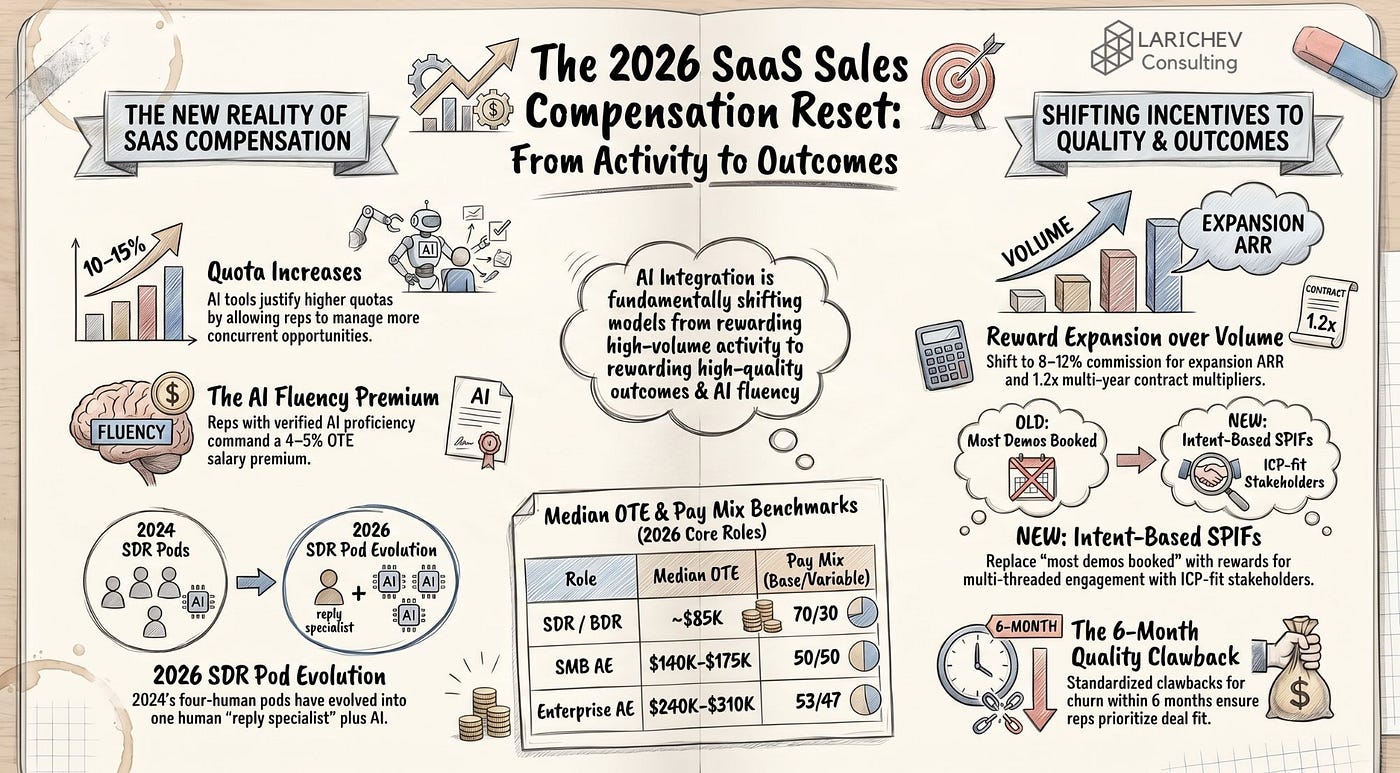
- AI is eating the top of the funnel. Autonomous AI SDR tools now handle list-building, enrichment, first-touch sequencing, and follow-up cadences at scale. Volume is up 6.4x; cost per qualified opportunity has fallen 54% in hybrid pods. The 2024 SDR pod of four humans plus a manager has evolved into a 2026 pod of one “reply specialist” human, two to four AI SDR seats, and a RevOps owner.
- Quotas are being raised — and reps know it. With AI tooling, companies are justifying 10–15% quota increases, arguing that reps can handle more concurrent opportunities. Fair? Debatable. Happening? Absolutely.
- The productivity baseline has shifted permanently. An AE with good AI tooling in 2026 runs more parallel opportunities than that same AE did in 2022. This is the new normal — not a competitive edge, but table stakes.
The result? Comp plans designed around activity volume now create the wrong incentives. You end up paying reps for work that AI can do for $0.04 on the dollar instead of for what only humans can do: navigating complex stakeholder dynamics, building trust, and ensuring customer success post-close.
2026 OTE Benchmarks: The New Reality Check
Let’s look at the numbers, because they’re telling a story that too many leaders are ignoring.
OTE by Role — 2026 Benchmarks:

A few things jump out here:
- The clean 50/50 AE split is drifting to 53/47 as mid-market and enterprise candidate scarcity forces base inflation. If you’re hiring senior closers in 2026 and still offering a pure 50/50, expect candidates to push back.
- SDR OTEs are flat to slightly declining in real terms as AI absorbs a significant chunk of the role’s workload. This is not a trend — it’s a structural shift.
- Sales Engineers saw an 11.1% median salary increase as product complexity grows and SE roles become critical in AI-powered sales motions. If you’re not compensating your SEs competitively, you are hemorrhaging deals.
- Reps with verified AI fluency or experience in ML infrastructure sales are commanding 4–5% salary premiums above the industry average. Some CROs with demonstrable AI GTM skills command 20–30% comp premiums over peers.
One more number that deserves your full attention: 71% of B2B sales teams have switched to AI-driven, pay-for-performance compensation in 2026, up from 49% in 2023. This is the sharpest comp model change in two decades. If your plan is still static — annual quotas, fixed activity targets, quarterly SPIFs with no intelligence behind them — you are in the minority, and not the good kind.
The Great Rebalancing: From Activity to Outcomes
This is where the real transformation is happening, and it’s not subtle.
Over 60% of SaaS companies now prioritize outcomes like renewals, upsells, and multithreaded deals as key compensation drivers. Let me unpack what that means in practice:
New Logo vs. Expansion: Closing the Commission Gap
For the past decade, most comp plans paid AEs a healthy commission for new logos and a pittance — if anything — for expansion. The logic was: “CS owns the relationship, AEs should hunt.” That logic is now causing NRR cannibalization at scale.
The 2026 best practice for expansion-first organizations:
- Standard renewals: 2–4% commission (low effort, passive renewal)
- Expansion ARR (upsells, cross-sells): 8–12% commission (active selling required)
- Multi-year contracts: 1.2x commission multiplier on top of base rate
- NRR-linked comp: 10–20% of AE variable tied to the NRR of their book of business
That last one — NRR-linked AE comp — is the most sophisticated model and requires clean NRR attribution by rep in your CRM. If your CRM isn’t set up for this, that’s the first RevOps project to prioritize in H2 2026.
Clawbacks Are Back (And They Should Be)
Clawback provisions tied to retention are now a standard plan feature. The rule of thumb: churn within 6 months triggers a clawback. Why? Because AI-powered pipeline tools have made it easier than ever to push deals through that have no business being closed — “spraying and praying” now has a very low marginal cost. Clawbacks create a financial stake in deal quality, not just deal volume.
The Deal Quality Incentive Layer
One of the most interesting 2026 comp innovations: multi-year and expansion kickers are the highest-leverage plan terms for reps willing to use them. Reps prioritizing multi-year deals and account expansion are earning 20–30% more on identical attainment versus those ignoring these mechanics.
Translation: the rep who understands deal structure is out-earning the rep who just cranks volume. This is the comp plan rewarding judgment over activity — exactly the human skill AI cannot replicate.
SPIFs in 2026: From Activity Bonuses to Revenue Intelligence Tools
The humble SPIF has grown up. In 2026, SPIFs are no longer ad-hoc cash rewards scribbled on a whiteboard by a motivated VP in Q4. They’re software-managed incentive compensation tools with real-time visibility, auditability, and governance.
What’s Dead
- “Most demos booked” SPIFs → inflates low-quality pipeline, makes your SDRs look busy, and leaves AEs dealing with garbage opps
- Activity-volume SPIFs without ICP qualification criteria → creates the appearance of momentum while deal quality collapses
- SPIFs paid via spreadsheet 45 days after the fact → reps don’t connect the behavior to the reward, so the SPIF does nothing
What’s Winning in 2026
Intent-based SPIFs reward ICP-fit pipeline with genuine buying committee engagement — not raw demo counts. Examples in the wild:
- “ICP-fit discovery with multi-threaded engagement” SPIF: pays when a rep books a discovery call with 2+ stakeholders from the target buying committee (verified via CRM), not just a single contact
- “AI-adoption accelerator” SPIF: early-stage experiment but worth tracking — some companies are paying bonuses for demonstrated use of internal AI tools (conversation intelligence for call prep, intent data for prioritization, automated CRM hygiene)[⁴]
- “Marketplace first deal” SPIF: $1,000–$2,000 cash + 2x quota credit for the first deal closed via cloud marketplace — a powerful activation mechanic
- “Expansion signal referral” bonus: CSMs who identify and pass expansion signals to AEs earn a referral bonus or percentage of closed expansion ARR
The governance model matters as much as the incentive itself. Best practices for 2026 SPIF design:
- Payout within 7–14 days of qualification (speed builds trust and links behavior to reward)
- Pre-allocated SPIF budget as a core STI lever, not ad-hoc spend
- Mid-stage SaaS companies allocate $10,000–$50,000 per quarter in SPIF programs — typically $200–$500 per rep per quarter in incremental incentives
- Use non-cash rewards strategically: cash SPIFs cost $0.12 per incremental sales dollar; non-cash costs only $0.04
- Organizations using intent-based SPIFs with clear tracking systems see 15%+ lift in short-term sales performance
The AI Fluency Premium: What It’s Worth in 2026
Let’s talk about the single biggest comp lever that most plans are not yet capturing: AI fluency as a compensable skill.
Gartner found that sellers who effectively partner with AI tools are 3.7x more likely to meet quota. Despite this, most comp plans still treat AI tool usage as a “nice to have” soft behavior with no direct financial incentive.
The forward-thinking comp plans in 2026 are changing this:
- AI fluency hiring premium: 4–5% OTE bump for reps who bring verified AI sales certifications or ML infrastructure knowledge
- AI-adoption SPIFs: Small bonuses for completing AI certification programs, demonstrating tool usage in call reviews, or maintaining CRM hygiene via AI automation
- AI-augmented quota expectations: Reps using the company’s AI stack are expected to carry 10–15% higher quotas, but get comped at the same OTE — meaning those who don’t adopt AI face harder attainment math
The CROs commanding 20–30% comp premiums right now are those who can demonstrate an AI-led GTM strategy in practice. This isn’t hype. If you’re a sales leader building your personal brand and comp negotiation power, AI fluency is the new enterprise sales certifications (MEDDPICCR still matters — but your ability to automate MEDDPICCR data capture in CRM is what separates premium comp from average comp).
The SDR Question Nobody Wants to Answer Honestly
Is the SDR role dying? Here’s the honest answer: entry-level, high-volume cold-calling SDR roles are shrinking; AI-augmented pipeline strategist roles are growing.
The new SDR job description, circa 2026:
- Configure and manage AI outbound workflows (ICP targeting, intent-signal filtering)
- Interpret enrichment data and prioritize accounts based on buying signals
- Own the human-judgment layer: nuanced objection handling, strategic account navigation, cold calls (regulation still keeps AI off the phone)
- Serve as the “reply specialist” — triaging the AI-generated pipeline and converting qualified responses into discovery calls
Fully autonomous AI SDRs (think Artisan, 11x, early SalesboxAI) produced mediocre reply rates and high churn in 2025. The model that works is AI prospecting agent + human judgment: AI handles list-building, enrichment, scoring, and first-draft sequencing; humans write the first email and own the discovery call. This hybrid model is producing cost-per-qualified-meeting benchmarks that beat pure-AI stacks in every reported comparison.
Comp implication: SDR plans in 2026 are shifting from pure activity metrics (calls/emails) toward qualified pipeline contribution, with bonuses for the pipeline that converts past the first AE meeting. This is the right incentive because it makes SDRs care about quality — the one thing AI can’t optimize for in isolation.
Practical Use Cases: What to Change in Your Comp Plan Right Now
Here are five changes revenue leaders are making in their 2026 comp plans. Pick the ones that apply to your current growth stage.
Use Case 1: Add an Expansion ARR Kicker for AEs (Growth-Stage, $5M–$50M ARR)
The problem: Your AEs close new logos, drop the account to CS, and never think about it again. Your NRR is suffering. The fix: Add a tiered expansion commission — 8–12% of expansion ARR closed by AE within their named accounts, vs. the lower new-logo commission rate. Add a 1.2x multiplier for multi-year expansions. You’ll see AEs engage in QBRs they previously ghosted.
Use Case 2: Restructure Your SDR SPIF Around Pipeline Quality, Not Volume
The problem: Your SDRs are booking demos that waste AE time. Your pipeline is full, your win rate is collapsing. The fix: Kill the “demos booked” SPIF. Replace it with an SPIF tied to SQL-to-Opportunity conversion — SDR gets paid when their meeting converts to a qualified opportunity that reaches Stage 2 in the CRM. Suddenly, SDRs care about ICP fit. Pair this with an AI enrichment tool so SDRs can pre-qualify accounts before booking the demo.
Use Case 3: Introduce NRR-Linked Variable for CSMs Carrying Renewal Quotas
The problem: CSMs are focused on support tickets and renewals rather than expansion. Your existing customers are undertapped. The fix: Restructure CSM comp to 75/25 (base/variable), with the variable tied to 60% logo retention rate and 40% expansion ARR generated. Add a referral bonus for CS-sourced expansion signals passed to AEs. This creates a “revenue team” mindset across the CS-Sales boundary.
Use Case 4: Add an AI Fluency Accelerator to Your Comp Plan
The problem: You’ve invested in Gong, 6sense, and Clay, but reps aren’t using them consistently. The fix: Create a quarterly SPIF that pays reps $500–$1,000 for completing your AI tool certification (internal or vendor-provided) AND demonstrating tool usage (tracked in CRM and call intelligence platform). Budget: $200–$500/rep/quarter. ROI: 3.7x higher quota attainment for reps who actually use the tools.
Use Case 5: Implement Dynamic Quota Reviews (Quarterly, Not Annual)
The problem: Your static annual quotas become irrelevant by Q2 as market conditions shift — leaving reps either sand-bagging an easy number or demoralized by an impossible one. The fix: Shift to AI-powered quarterly quota reviews using deal health, territory performance, and close rate data. Teams using flexible, AI-adjusted quotas missed targets 18% less often in Q1 2026 vs. teams on static annual quotas. Tools like CaptivateIQ, Xactly, and Everstage support dynamic quota models with CRM integration.
Summary of Action Items
Think of this as your sales comp audit checklist for H2 2026:
For CROs and VP Sales:
- [ ] Audit your current plan: are you rewarding activity metrics or revenue outcomes?
- [ ] Add expansion ARR kicker (8–12%) and multi-year multiplier (1.2x) for AEs in named accounts
- [ ] Introduce NRR clawback provisions for deals that churn within 6 months
- [ ] Shift SDR SPIFs from demo volume to SQL-to-Opportunity conversion rate
- [ ] Pilot a quarterly AI fluency SPIF ($500–$1,000/rep/quarter) tied to verified tool usage
- [ ] Move to quarterly quota reviews using AI-powered territory and deal-health data
For Account Executives:
- [ ] Understand your plan’s expansion and multi-year kicker mechanics — this is where the 20–30% earnings premium lives in 2026
- [ ] Get credentialed in your company’s AI sales stack — AI fluency is now a comp negotiation lever worth 4–5% OTE premium
- [ ] Build your NRR narrative: track the health of your book of business, because it’s increasingly affecting your variable comp
For SDRs and BDRs:
- [ ] Embrace the AI-augmented role: own the workflow design, not just the activity execution
- [ ] Focus energy on human-judgment tasks: complex objection handling, strategic account navigation, cold calls
- [ ] Understand how your meetings are being quality-scored — pipeline quality is increasingly what drives your variable comp
For RevOps:
- [ ] Configure CRM for NRR attribution by rep — this is the prerequisite for AE NRR-linked comp
- [ ] Automate SPIF tracking and payouts (commit to 7–14 day payout SLA)
- [ ] Build AI-powered quota modeling dashboards before annual planning — your CRO needs scenario simulation, not spreadsheets
- [ ] Instrument AI tool usage tracking in your CRM so fluency-based SPIFs can be governed accurately
Final Thought
Here’s what I’ve seen across 20+ years of building and managing SaaS sales organizations: the comp plan is always a lagging indicator of your GTM strategy. If your GTM has moved toward product-led growth, expansion-first revenue, and AI-augmented selling — but your comp plan still rewards raw call volume and new logos only — you’re pulling in opposite directions, and the reps will follow the money, not the strategy.
The good news? The data is clear. Teams using AI-aligned comp models are attaining quota more consistently, reducing rep turnover (from 36% to 19% in the benchmarks), and spending their variable comp budget on outcomes that actually move the business. The 2026 reset isn’t a threat to your best reps — it’s an opportunity for them to earn more by doing smarter work.
The question is: is your comp plan smart enough to let them?
🎯 CTA: How has your sales comp plan changed in the last two years?
Are you still running the same activity-based plan you had in 2024? Have you added expansion kickers, NRR clawbacks, or AI-fluency bonuses? Have you restructured your SPIF budget around intent and quality instead of volume?
Share what you changed and why in the comments — I read every one. The best real-world example gets featured in my next blog post. Let’s build the playbook together.
Follow Yury Larichev on LinkedIn and Medium for weekly SaaS GTM insights. Fractional CRO available for PE-backed SaaS portfolio companies — DM for details.
메타데이터
- post_id
- 75282fc7404e
- slug
- the-saas-sales-compensation-reset-how-ai-is-changing-ote-splits-and-spifs-75282fc7404e
- url
- https://medium.com/@yurylarichev/the-saas-sales-compensation-reset-how-ai-is-changing-ote-splits-and-spifs-75282fc7404e
- canonical_url
- https://medium.com/@yurylarichev/the-saas-sales-compensation-reset-how-ai-is-changing-ote-splits-and-spifs-75282fc7404e
- author_url
- https://medium.com/@yurylarichev
- status
- ok
- fetched_at
- 2026-07-29 20:22:19