The Tokenization That Matters for SMEs Is the One That Fits Within the Law
Recent news has referred to Token Trust and to the possibility of opening capital markets to SMEs through the tokenization of financial…
The Tokenization That Matters for SMEs Is the One That Fits Within the Law
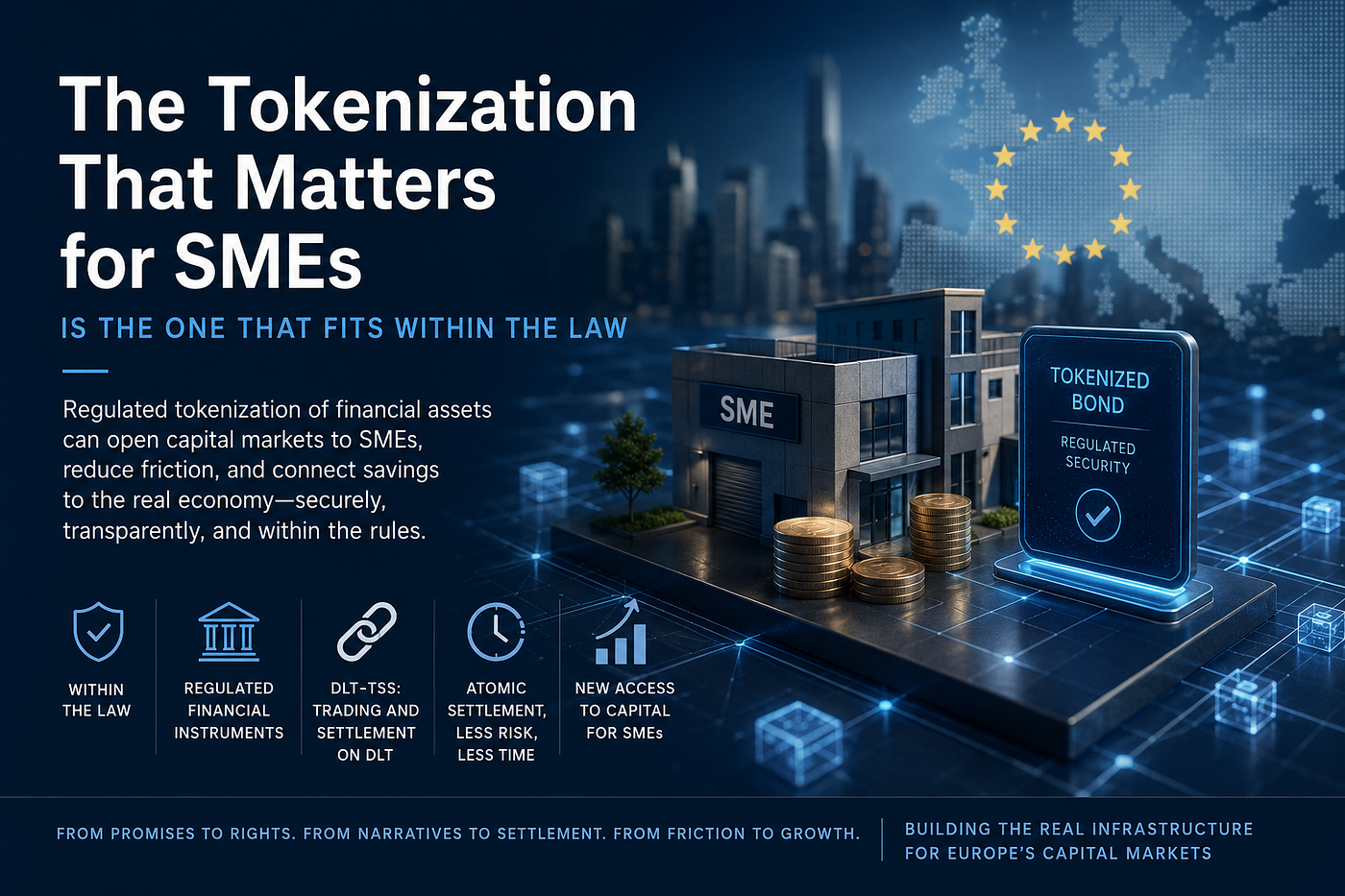
Recent news has referred to Token Trust and to the possibility of opening capital markets to SMEs through the tokenization of financial assets. As one of the company’s founders and CTO, I write this article with an added responsibility: to explain rigorously what is at stake, what is not yet at stake, and why this evolution may become strategic for the Portuguese and European economy. Let us begin with an essential point. Token Trust is not yet carrying out regulated activity. The company is currently in the authorization process with the CMVM to operate as an investment firm and as a DLT trading and settlement infrastructure, within the framework of the European Union’s DLT Pilot Regime, under Decree-Law №109-H/2021 and Regulation (EU) 2022/858. Until the CMVM issues its formal decision, which includes a non-binding opinion from ESMA, no regulated activity is under way. This distinction matters because, in serious financial markets, words create rights, obligations, and responsibilities. What is at stake is the meaning of the word tokenization when it enters the domain of financial regulation. For years, tokenization has been associated with crypto-assets, DeFi, virtual currencies, NFTs, or rather vague promises about real-world assets. Some of those experiments were interesting. Others were dangerous. But all of them remained outside the regulated financial system. Tokenizing a regulated financial asset is something else entirely. It is not about issuing a crypto-asset that “represents” some economic promise. It is about issuing, trading, and settling financial instruments such as shares, bonds, or UCITS funds, with the rights that belong to those instruments, always within the applicable European rules, namely MiFID II. The difference may appear subtle, but it is decisive. MiCA, the Markets in Crypto-Assets Regulation, regulates tokens exclusively when they take the form of crypto-assets. It also regulates tokenized electronic money, namely e-money tokens, or digital euros issued by retail banks. By definition, however, MiCA excludes from its scope all financial instruments as understood under MiFID II. This is why tokens of regulated financial instruments, such as shares, bonds, or funds, can never be crypto-assets for MiCA purposes. MiCA has, in fact, given rise to several proposals for tokens allegedly backed by real-world assets. But the fact that these tokens are framed as crypto-assets under that regime does not make them equivalent to regulated financial instruments. Quite the opposite. Whoever acquires one of these crypto-assets, even when it is allegedly referenced to real-world assets, does not have the rights, protections, or legal status of someone who holds the share, bond, or fund unit that the asset claims to represent. Under MiCA, this kind of token is no more than an investment in the form of crowdsourcing, which is entirely different from investing in regulated financial instruments. The two regimes therefore rest on completely different legal foundations and offer completely different levels of investor protection. It was the DLT Pilot Regime that made it possible to convert financial assets into book-entry form on DLT. As clarified by Decree-Law 66/2023, this type of token, and only this type of token, may have the book-entry value of securities under Article 50 of the Portuguese Securities Code, for shares, bonds, and UCITS funds. DLT means distributed ledger technology, of which blockchain is the best-known and most widely used example. In simple terms, it is a way of recording transactions and positions on a shared technological base that is auditable and resistant to improper alteration. A DLT-TSS infrastructure, meaning a trading and settlement system, integrates the trading and settlement of regulated financial assets into that same technology, rather than relying on the traditional databases of the conventional financial system. In Token Trust’s DLT-TSS design, transaction settlement is atomic. This means that, unlike what has traditionally happened in the financial system, the moment at which the security passes to the buyer and the money passes to the seller becomes immediate. This may sound like a technical detail. It is not. It is a radical reduction in friction, operational risk, and time. Friction is today one of the great invisible barriers of capital markets. For a large company, issuing bonds is a normal financing instrument. For an SME, it is almost always a mirage. Not because there is no need. Not because there are no good projects. But because the traditional architecture of capital markets has enormous fixed costs, intermediaries, and a complexity that only make sense for large-scale issuances. In practice, the fixed-cost structure of the traditional bond market tends to favor issuances above ten million euros. But an SME that typically needs between 500,000 and one million euros cannot bear the same structure designed for transactions many times larger. For SMEs, the alternative is therefore usually the bank. Bank credit is indispensable today, but it does not serve every case in the same way. In a traditional bank loan, after a possible grace period, the company starts amortizing capital during the life of the loan. This means that part of the project’s cash flow is consumed before the project has reached its economic maturity. By contrast, a large company can issue a coupon bond, that is, a credit instrument that pays periodic interest to investors, and repay the capital only at the end. Technically, when there are periodic interest payments, this is a coupon bond with bullet repayment, meaning that capital is amortized only at maturity. This is a very concrete difference. Imagine an SME with an industrial expansion project or a real estate investment project. The project may create value, but it needs time. If it is financed through classic bank debt, the company starts carrying the full debt service early. But if it can issue a coupon bond and repay the capital only at the end, it gains a financial structure that is better aligned with the economic cycle of the project because it pays only interest to investors during the agreed period and returns the capital when the asset has had time to support the return. Let us consider an example. An SPV, or special purpose vehicle, wants to raise five million euros to develop a construction project. An SPV is a structure created to legally isolate a project, its risks, its assets, and its financial flows. Instead of mixing everything into the balance sheet of a larger company, a dedicated vehicle is created for that specific purpose. That SPV could issue a tokenized bond, complying with the applicable rules and benefiting from the prospectus exemptions available for smaller offers. An SPV is not financial magic. The project risk remains and the investor must still assess the issuer, the quality of information, the guarantees, the term, the rate, the governance, and the liquidity. Regulation and supervision also remain indispensable, and rightly so. What changes is that the new infrastructure can make smaller projects economically viable. This is why the regulated tokenization of financial assets matters for SMEs. Not because it turns every project into a good investment. Not because it eliminates risk. Not because it replaces banks, investors, regulators, or financial analysis. Its importance lies in opening the capital market in a more granular, faster, more transparent, safer, and more proportionate way to the real size of the European economy. For years, the European Union has spoken about the Capital Markets Union, about the need to channel savings more effectively into the real economy, and about the excessive dependence of European companies on bank financing. It has also spoken about the difficulty SMEs face in accessing market instruments. All of this is true. But the answer will not come from political proclamations alone. It will come from new financial infrastructure because, without the right architecture, strategy remains on paper. This is where DLT-TSS matters. Not as fashion. Not as marketing. Not as a crypto promise. It matters because it reduces fixed costs, shortens settlement cycles, increases auditability, facilitates the traceability of rights, and allows smaller issuances to be handled with economic efficiency. Technology alone does not create trust, but it can execute more effectively the trust that is already embedded in law, supervision, and contracts. Portugal has a unique opportunity here because it can innovate precisely where traditional scale has always been a limitation. It is a country with many SMEs, considerable entrepreneurial talent, and insufficient capital market depth. It therefore has everything to gain from infrastructures that connect savings and productive investment in a regulated and secure way. The question is not whether we want more tokens. The question is whether we want capital markets that are more useful to the real economy. Once Token Trust’s formal authorization is concluded, the company will offer its DLT-TSS. But the most relevant point goes beyond one specific company. What is at stake is the movement of tokenization from the crypto margin to the regulated center of financial markets. It is the difference between merely promising rights and guaranteeing rights. Between selling narratives and settling transactions within the law. Between simply imagining a digital economy and building the real architecture that makes it legally possible. In short, the tokenization that matters for SMEs is not the one that escapes regulation. It is precisely the one that fits within it. Only that kind of tokenization can transform the capital market from a club reserved for large issuances into an infrastructure accessible to the economy that creates jobs, innovation, and growth. In the end, we are not replacing trust with computer code. We are using code to execute trust with far less friction. And that is what will truly change the market.
메타데이터
- post_id
- 753b3205f3ee
- slug
- the-tokenization-that-matters-for-smes-is-the-one-that-fits-within-the-law-753b3205f3ee
- url
- https://medium.com/@PauloCardosoAmaral/the-tokenization-that-matters-for-smes-is-the-one-that-fits-within-the-law-753b3205f3ee
- canonical_url
- https://medium.com/@PauloCardosoAmaral/the-tokenization-that-matters-for-smes-is-the-one-that-fits-within-the-law-753b3205f3ee
- author_url
- https://medium.com/@PauloCardosoAmaral
- status
- ok
- fetched_at
- 2026-07-20 11:39:40



