What Is a Blockchain Bridge and Are Bridges Safe? (2026)
Bridges connect blockchains that cannot talk to each other. They are also where some of the largest hacks in crypto have happened. Both…
What Is a Blockchain Bridge and Are Bridges Safe? (2026)
What is a blockchain bridge and are bridges safe. Useful infrastructure, and one of crypto’s most attacked surfaces.
Bridges connect blockchains that cannot talk to each other. They are also where some of the largest hacks in crypto have happened. Both things are true, and both matter.
In 2022, cross-chain bridge exploits accounted for 69% of all cryptocurrency stolen that year, roughly $2 billion across 13 separate hacks, according to Chainalysis. That statistic is the single most important context for anyone using a bridge: the tool is genuinely useful, and it is also one of the most attacked surfaces in the entire industry.
A blockchain bridge is a tool that lets you move assets or data between different blockchains, which otherwise cannot communicate directly. Most bridges work by locking an asset on one chain and issuing a matching token on another, or through liquidity pools. Bridges are essential for cross-chain interoperability. They are also one of the highest-risk areas in crypto, because several of the largest hacks have been bridge exploits. The risks include smart-contract exploits, validator or custodian compromise, and the large pools of locked value bridges hold. You can reduce risk with established, audited bridges and caution, though bridges are not risk-free.
Bridges are among the most attacked systems in crypto. Treat them accordingly.
What is a blockchain bridge?
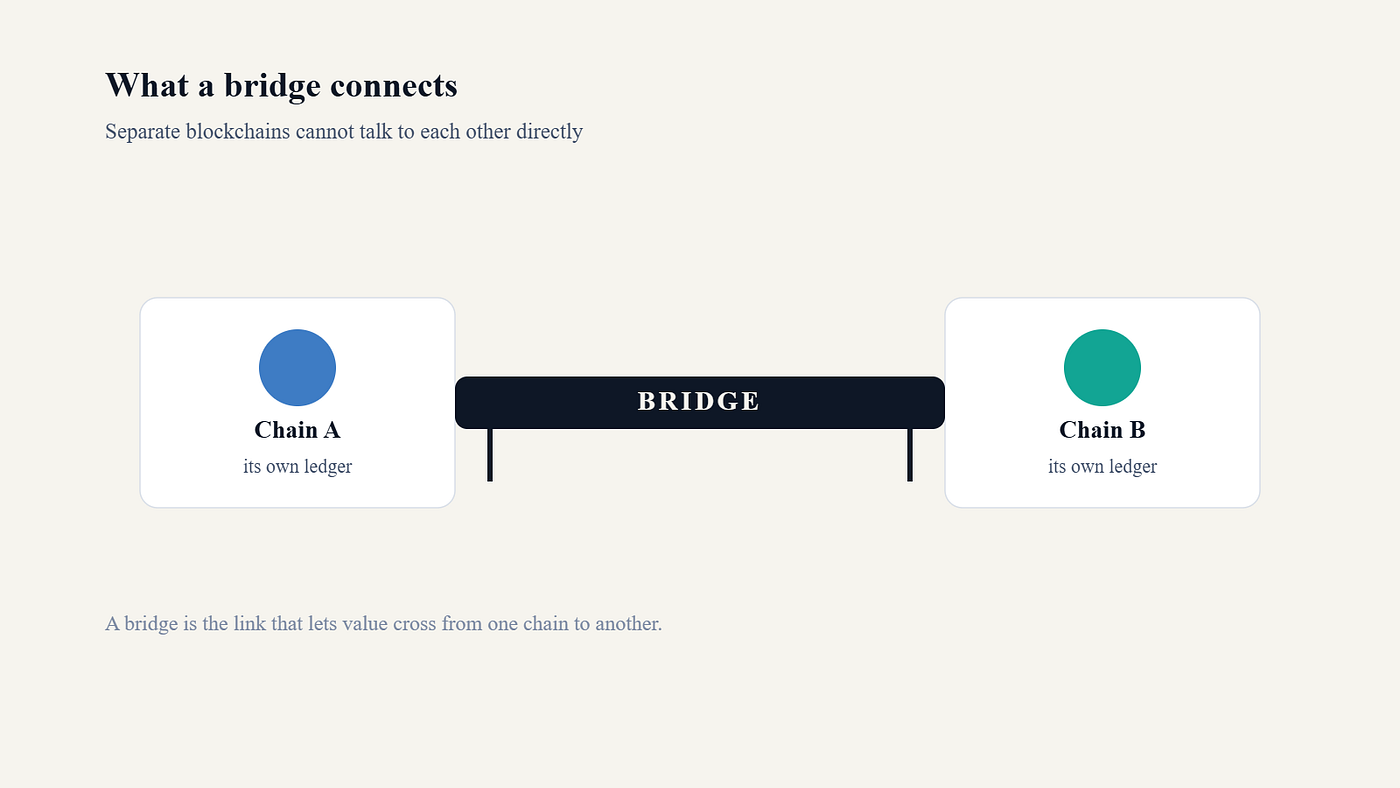
Diagram: a bridge connects Chain A and Chain B, two separate ledgers that cannot talk to each other directly.
A blockchain bridge is a protocol that connects two otherwise separate blockchains so you can move assets or information between them. Different blockchains do not natively talk to each other, so a bridge is the link that lets value cross from one to another. Without a bridge, a token on one network cannot simply appear on another; the two ledgers have no shared language.
That is the core function, and it explains why bridges exist at all. As soon as there is more than one blockchain, someone needs a way to move value between them, and bridges are the connective infrastructure that fills that gap.
How do blockchain bridges work?
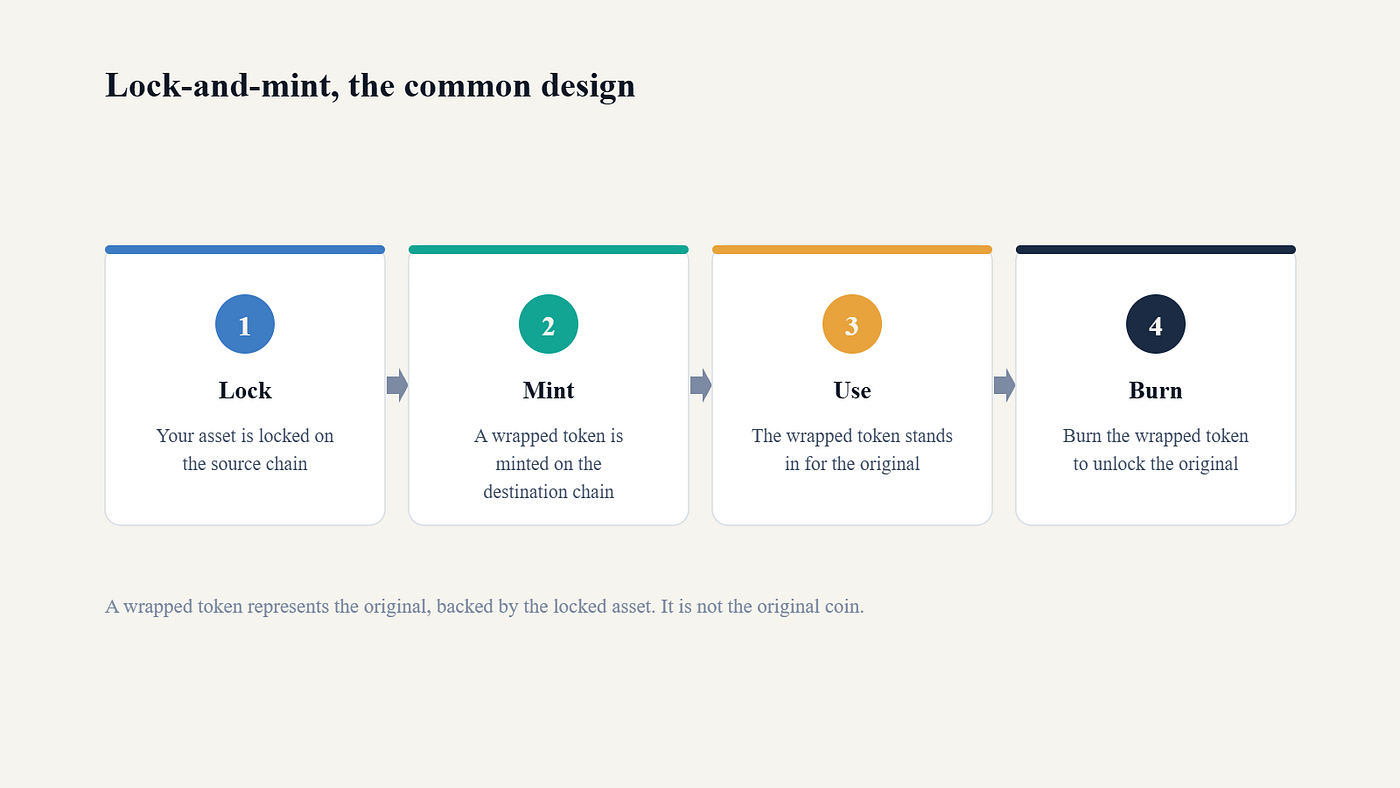
A four-step lock-and-mint flow: lock the asset on the source chain, mint a wrapped token on the destination chain, use it, then burn it to unlock the original.
Most bridges use a design called lock-and-mint: the bridge locks your asset on the source chain and mints a matching wrapped token on the destination chain, which you can later burn to unlock the original. Some bridges use burn-and-mint instead, and others rely on liquidity pools on both sides that pay out the equivalent asset.
A wrapped token is a representation of the original, backed by the locked asset, not the original coin itself, which is a common point of confusion. Many bridges also depend on a set of validators or a custodian to secure the process and confirm that the lock really happened before the mint occurs. That reliance on outside parties and complex code is exactly where the trust assumptions and the risks, live.
Why do we need bridges?
Bridges exist because blockchains are separate systems that cannot natively share assets. Each chain is its own self-contained ledger, so bridges provide interoperability, letting assets and activity move across chains rather than trapping users on a single network. A plain example is moving a token from one chain to another so you can use an application that only exists on the destination chain.
That value is real, which is why bridges remain widely used despite their risks. The same interoperability that makes multi-chain activity possible, moving to a chain with lower fees or a specific app, is covered from a scaling angle in this explainer on Layer 2 networks, and the Chainalysis analysis of bridge hacks sets out why this connective layer is so heavily targeted.
Are blockchain bridges safe?
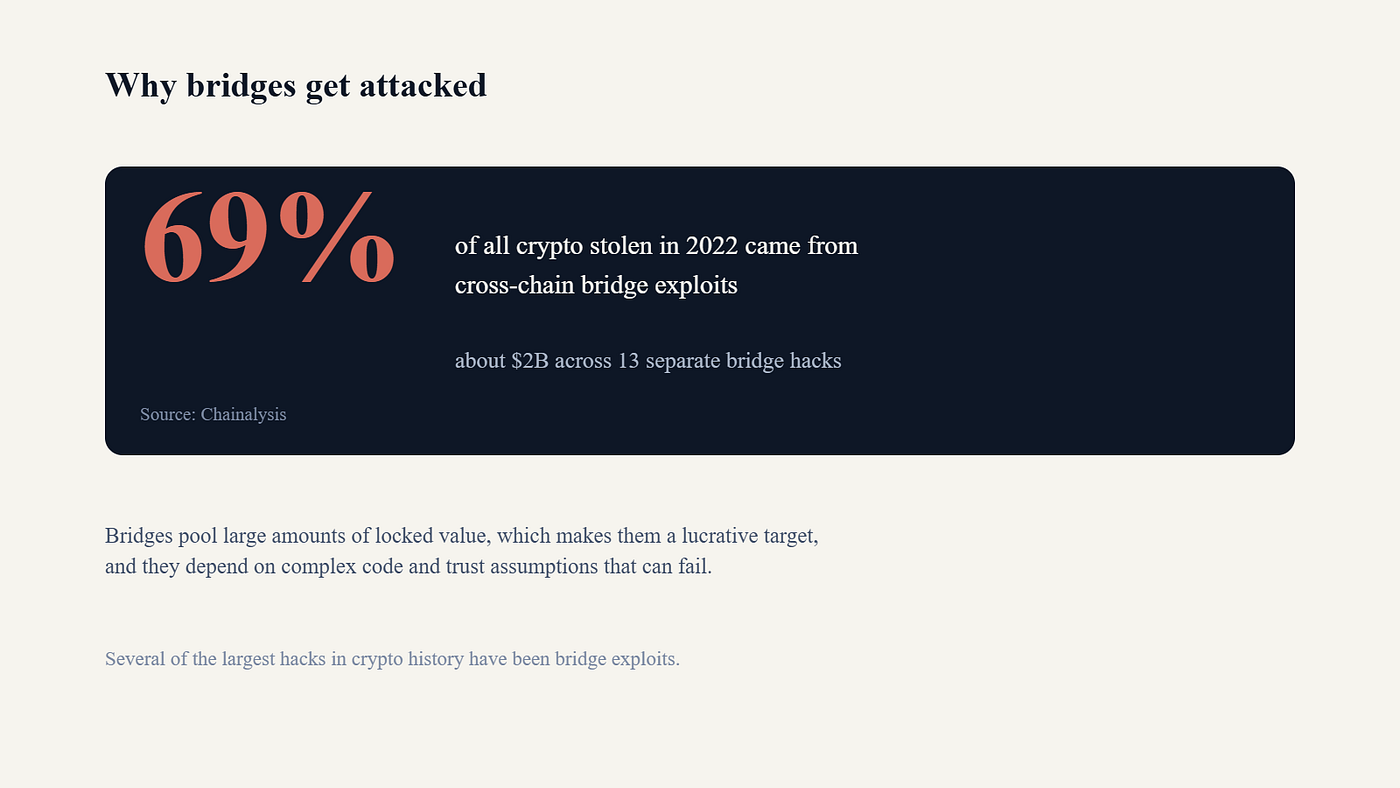
A stat block: 69% of all crypto stolen in 2022 came from cross-chain bridge exploits, about $2B across 13 bridge hacks, per Chainalysis.
Bridges are a high-risk area, and several of the largest crypto hacks have been bridge exploits, so they are not safe by default. The reason is structural: bridges hold large pools of locked value, which makes them an attractive target, and they depend on complex code and trust assumptions that can fail. When they fail, the losses are large: the 2022 Ronin bridge exploit alone lost more than $600 million, as Cointelegraph reported, and the Wormhole bridge lost around $321 million the same year, per CoinDesk.
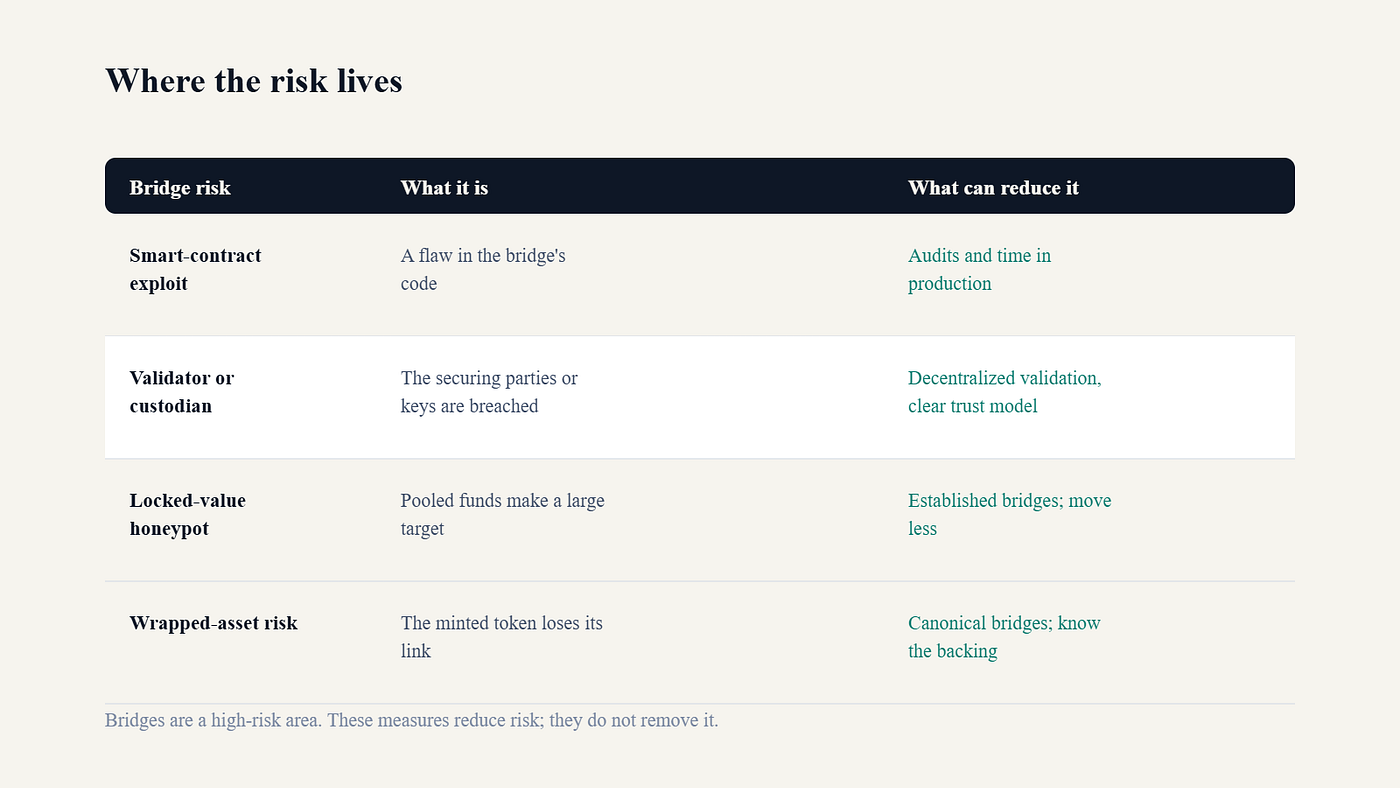
A table of bridge risks and what reduces each: smart-contract exploit, validator or custodian compromise, locked-value honeypot, and wrapped-asset risk.
The risk falls into a few categories. A smart-contract exploit is a flaw in the bridge’s code, reduced by audits, a track record, and time in production. A validator or custodian compromise is when the parties or keys securing the bridge are breached, reduced by robust, decentralized validation and a clear trust model. A locked-value honeypot is the simple fact that bridges pool large funds, making them a big target, mitigated by using established bridges and limiting how much you move. Wrapped-asset risk is when the token minted on the destination chain loses its link to the original, reduced by canonical bridges and understanding how the asset is backed.
Bridging is useful, and it carries real, well-documented risk. Do not treat it as safe by default.
How to reduce bridge risk
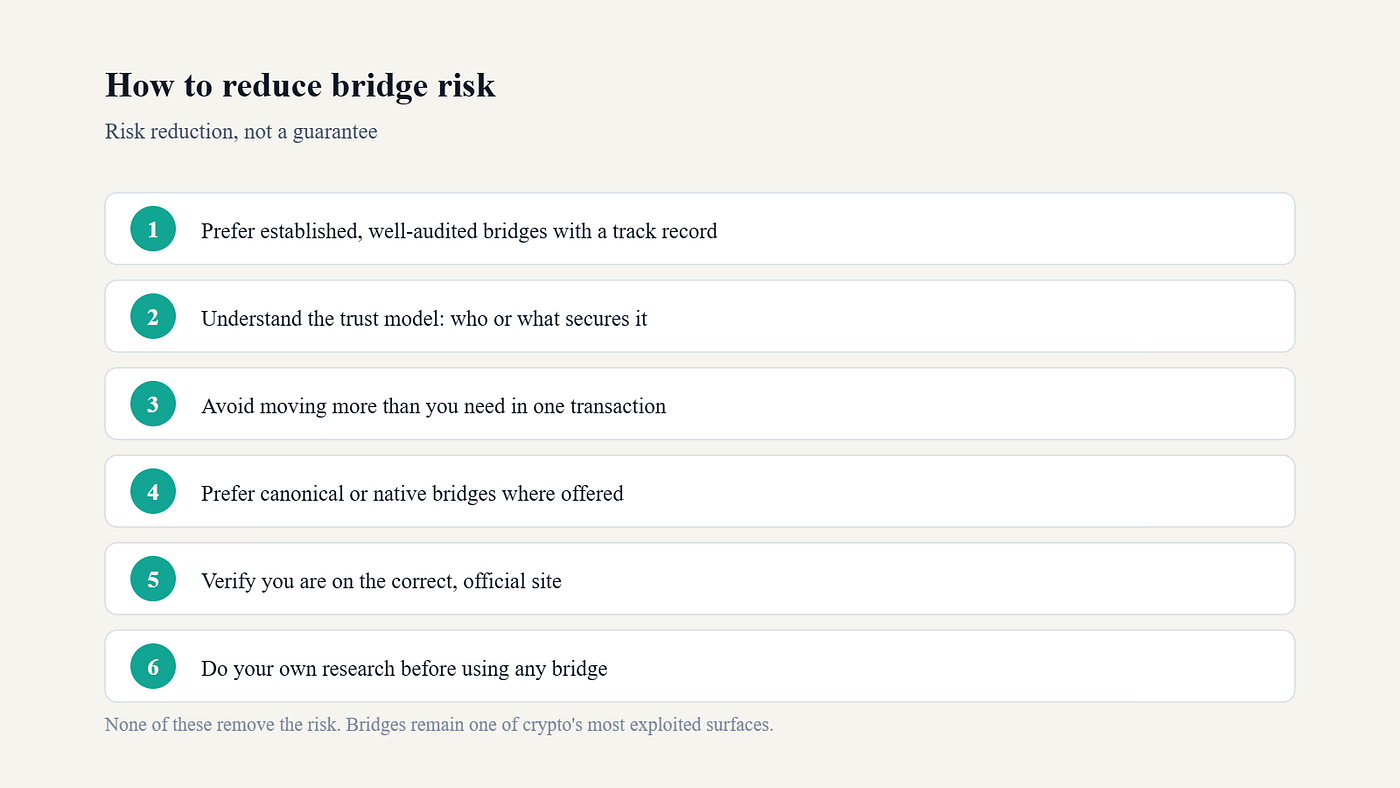
A six-step checklist to reduce bridge risk: prefer audited bridges, understand the trust model, move less, prefer canonical bridges, verify the official site, and do your own research.
You cannot make bridging risk-free, but you can reduce it with a few habits. Treat this as risk reduction, not a guarantee.
- Prefer established, well-audited bridges with a track record rather than new, unproven ones; neutral dashboards like DefiLlama’s bridges page help you compare size and history.
- Understand the trust model, meaning who or what actually secures the bridge.
- Avoid moving more than you need in a single transaction.
- Prefer canonical or native bridges where a chain offers one.
- Verify you are on the correct, official bridge site before connecting a wallet.
- Do your own research on any bridge before using it.
None of these steps remove the risk, and bridges remain one of the areas where large losses have happened. The goal is to lower your exposure and go in with clear eyes.
Final thought
Bridges are a good example of a hard tradeoff in crypto: the thing that makes a multi-chain world usable is also one of its weakest security points. That is not a reason to never bridge, but it is a strong reason to bridge deliberately. Use the well-worn, audited routes, move what you need rather than everything at once, and always confirm you are on the real site before you approve anything. The convenience is real, and so is the history of losses. Holding both facts at the same time is what using bridges responsibly actually looks like.
Have you bridged assets across chains? What do you check before you do? Share your process in the responses.
Frequently asked questions
What is a blockchain bridge? A tool that lets you move assets or data between different blockchains that cannot communicate directly with each other.
How do blockchain bridges work? Often by locking an asset on one chain and minting a matching wrapped token on another, or through liquidity pools that pay out the equivalent asset on each side.
Are blockchain bridges safe? They are a high-risk area. Several of the largest crypto hacks have been bridge exploits, so they are not safe by default and should be used with caution.
Why are bridges targeted by hackers? They hold large pools of locked value and rely on complex code and trust assumptions, which makes them both lucrative and vulnerable.
What is a wrapped token? A token on the destination chain that represents an asset locked by the bridge on the source chain. It is a stand-in for the original, not the original itself.
How can I reduce bridge risk? Use established, audited bridges, understand the trust model, limit the amounts you move, prefer canonical bridges, and verify the official site before connecting.
메타데이터
- post_id
- 755fd2cd7dcc
- slug
- what-is-a-blockchain-bridge-and-are-bridges-safe-2026-755fd2cd7dcc
- url
- https://blog.blockmagnates.com/what-is-a-blockchain-bridge-and-are-bridges-safe-2026-755fd2cd7dcc
- canonical_url
- https://blog.blockmagnates.com/what-is-a-blockchain-bridge-and-are-bridges-safe-2026-755fd2cd7dcc
- author_url
- https://medium.com/@ky.cheung.0806
- status
- ok
- fetched_at
- 2026-08-03 03:34:50