Terminal Value in a Net-Zero Economy: Are We Valuing the Future Correctly?
Most DCFs assume tomorrow looks like today. In a net-zero economy, that assumption may be your biggest valuation risk.
Terminal Value in a Net-Zero Economy: Are We Valuing the Future Correctly?
Most DCFs assume tomorrow looks like today. In a net-zero economy, that assumption may be your biggest valuation risk.
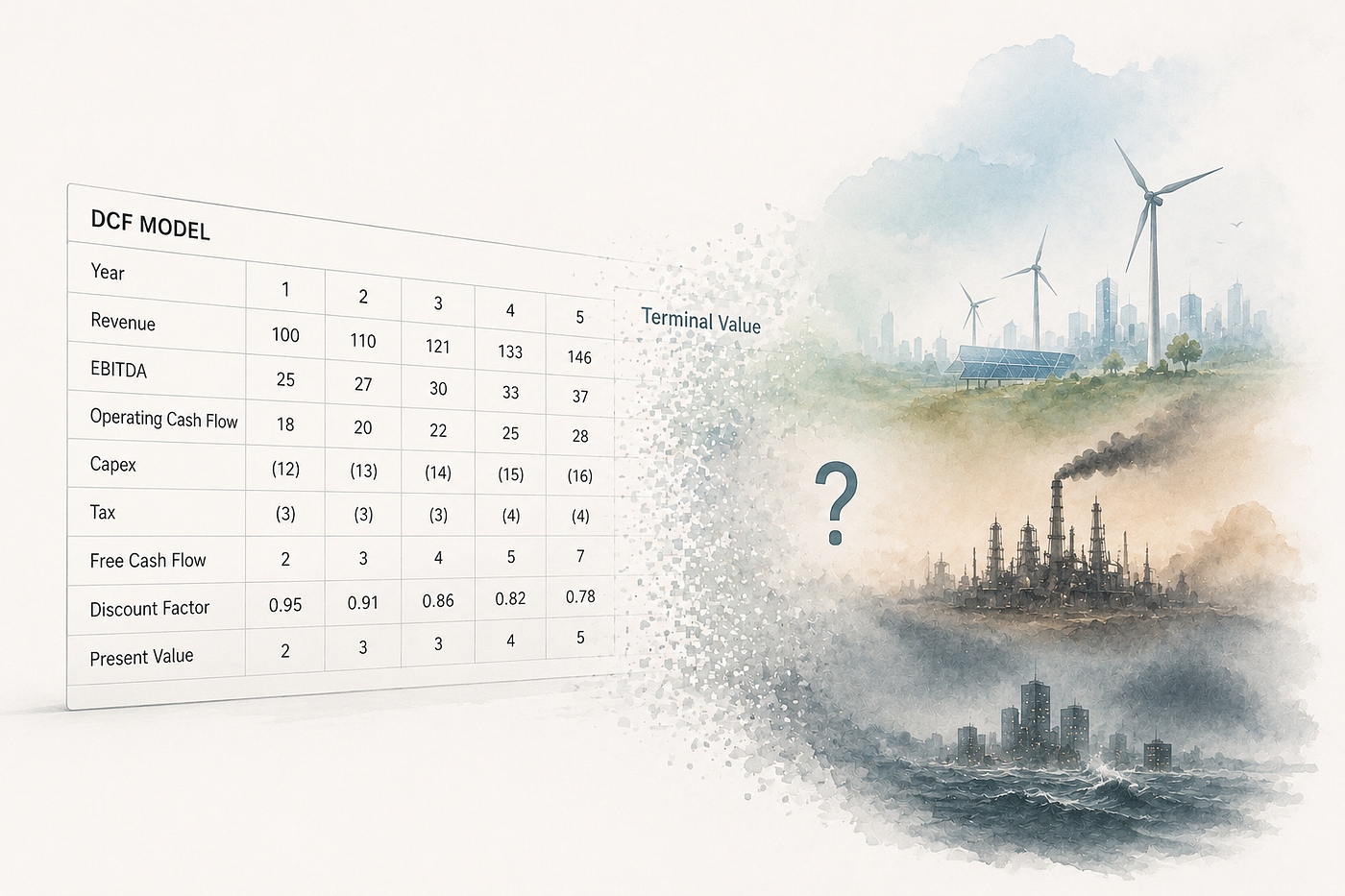
Here is something that should bother anyone who builds financial models for a living. In a typical discounted cash flow valuation, more than half of a company’s entire worth — often 60, 70, sometimes 80% — sits in a single number at the end of the forecast: the terminal value. It represents everything the business is assumed to earn from the end of the explicit forecast period, usually five or ten years out, into perpetuity. And that number rests almost entirely on one quiet assumption: that the business will still, broadly, be doing what it does today, at similar margins, more or less forever.
I started thinking about this because of a strange contradiction I kept running into while reading about energy markets. In 2025, global energy investment reached a record $3.3 trillion, and clean energy pulled in roughly $2.2 trillion of it — twice what flowed into fossil fuels. Solar alone, at around $450 billion, is now the single largest line item in the entire global energy investment inventory, outpacing spending on oil production. If you had to describe the direction of travel in one sentence, it would be that the economy is being rewired.
And yet the terminal value assumptions embedded in most valuations of long-lived, carbon-intensive businesses seem to assume that the rewiring either won’t happen, won’t matter, or won’t arrive within the timeframe that terminal value actually captures. That is a peculiar bet to be making with the majority of a company’s estimated worth. It raises a question that I don’t think finance has properly confronted: if the economy is changing structurally, why do the assumptions behind terminal value so often stay the same?
What Terminal Value Actually Assumes
It’s worth being precise about what we’re dealing with. Terminal value comes in two flavours. The perpetuity growth method grows the final forecast year’s cash flow at a modest constant rate forever — usually close to long-run GDP or inflation — and discounts it back. The exit multiple method applies a valuation multiple, say EV/EBITDA, to a terminal-year figure, on the logic that the business could be sold at that price. Both are, in effect, a confession: we cannot forecast individual years beyond a certain horizon, so we compress everything after it into one lump. And because those distant cash flows are so large in aggregate — perpetuity is a long time — even heavy discounting leaves that lump as the majority of enterprise value. The least forecastable part of the model carries the most weight.
For most of financial history this was defensible. A cement company in 1990 looked much like a cement company in 2010; the assumption that tomorrow’s economy resembles today’s was empirically sound. Terminal value reflects assumptions about tomorrow’s economy, not today’s — and for a long time those coincided closely enough that nobody had to notice the distinction. The net-zero transition is what pulls the two economies apart.
Why Net Zero Is a Cash Flow Problem, Not a Reporting One
The ESG conversation has spent a decade obsessing over disclosure — what companies report, in what format, verified by whom. That framing has always struck me as slightly beside the point for an investor. Climate risk is not fundamentally a reporting question. It is a cash flow question. And cash flows are exactly what terminal value is made of.
Consider the channels through which a serious transition reshapes the far-future cash flows that terminal value depends on. Carbon pricing raises operating costs for emitters, directly compressing the margins that perpetuity assumes will persist. Regulation can shorten the economic life of an asset — a coal plant with a nominal 40-year life becomes worthless the moment policy forces its closure at year 20, and the residual value baked into the model evaporates. Technological disruption changes the demand curve itself: every electric vehicle sold is a permanent, not temporary, reduction in future oil demand. Shifting consumer and industrial preferences erode pricing power. Physical climate risks raise capex and insurance costs and threaten the continuity of operations. Litigation adds a tail of liabilities that no steady-state margin assumption reflects.
Each of these does something specific to a DCF. It slows terminal revenue growth, or compresses terminal margins, or raises the capex needed just to stay in business, or shortens asset lives, or raises the cost of capital as the market prices in elevated risk. Any one of them dents terminal value. Together, in a genuine transition, they can hollow it out. The Allianz Trade analysis that ran three NGFS transition scenarios through standard DCF and interest-coverage models found that a disorderly, delayed transition produces the most violent repricing of all — a sudden, disorderly devaluation of carbon-heavy assets when policy finally arrives, precisely because markets had been assuming continuity for too long.
That last point is the one worth sitting with. The danger is not only that terminal value might be wrong. It’s that it might be wrong all at once.
The Legacy Business Model Problem
Where this bites hardest is in the industries whose entire economic logic is built on long-lived, carbon-intensive assets: oil and gas, coal, steel, cement, aviation, parts of the automotive and utility sectors. These are the businesses where terminal value assumptions are simultaneously the largest share of valuation and the most exposed to structural change.
Take oil. The IEA’s own analysis suggests demand for oil from combustible fossil fuels — stripping out petrochemical feedstock — may peak as early as 2027, with Chinese demand, which drove 60% of global oil demand growth over the past decade, on track to peak this decade after an extraordinary surge in EV sales. If you are valuing an upstream oil business and your terminal value assumes flat or growing volumes into perpetuity, you are assuming away the single most consequential fact about the industry’s trajectory.
And here is where the story gets genuinely interesting, because the picture is not one-directional. In its World Energy Outlook 2025, the IEA reintroduced a Current Policies Scenario and, in what analysts described as a “return to realism,” projected oil demand actually rising by nearly 13 million barrels per day above 2024 levels by 2050 under current policies. Fossil fuels still supplied around 81% of primary energy in 2024, barely changed in a decade. So the transition is real in investment flows and real at the margin, but slower in aggregate consumption than the net-zero scenarios assume.
For a valuation analyst, this is not a comfortable “so it’s fine” conclusion. It’s the opposite. It means the terminal value of a carbon-intensive business now depends entirely on which scenario you believe — and those scenarios diverge enormously. Under the IEA’s net-zero pathway, oil falls to $25 a barrel by 2050 and high-cost projects strand early. Under current policies, it rises past $100. That is not a rounding error. That is the difference between a business being worth a great deal and being worth very little. When the spread of plausible terminal outcomes is that wide, a single-point terminal value estimate isn’t a forecast. It’s a guess dressed up as one.
Shell makes the point concrete. In 2021 it committed to cutting oil production and framed itself around the energy transition; by 2023–2024, under a new chief executive and pressure from a valuation gap with US peers trading on undiluted fossil economics, it walked much of that back — slowing emissions targets, reaffirming upstream investment, retreating from parts of its renewables push. What’s striking for a valuation analyst is that the underlying reserves barely changed; what moved was the market’s implied view of which future those reserves would be sold into. The same barrels are worth one number in an orderly transition and quite another under current policies, and Shell’s oscillating strategy is, in effect, management trying to price that ambiguity in real time. The terminal value was never really about the oil. It was about the world the oil gets sold into.
Stranded assets are the sharp end of this. The concept is simple: an asset that loses its economic value well before the end of its expected life because the world changed around it. The IEA has warned that under a genuine net-zero pathway, global LNG capacity utilisation could fall to 50% by 2035, leaving a trail of stranded infrastructure. Whether that happens depends on policy and technology paths nobody can predict with confidence. But a terminal value that ignores the possibility entirely is not being conservative. It is taking a strong directional view — that continuity wins — while pretending to be neutral.
And this is not only a listed-equity problem. If anything, it is more acute for the investors whose horizons stretch furthest: infrastructure and pension funds, sovereign wealth funds, private equity, and project finance lenders underwriting assets over 20-, 30-, even 50-year lives. A pension fund matching liabilities decades out, or a project financier lending against a toll road, a port, or a gas pipeline, is making an even purer bet on the far-future economy than an equity analyst is — their entire return depends on terminal-period cash flows that the transition could reshape. It is telling that some of the most serious climate stress-testing now comes not from equity desks but from central banks and long-duration lenders: the Bank of England, the ECB, and other regulators have run climate scenario exercises through bank and insurer balance sheets precisely because the mispricing of long-dated, carbon-exposed assets is a financial-stability question, not merely a stock-picking one. The longer your horizon, the more of your value sits in the part of the future that is hardest to predict.
The Other Side: Are We Also Underpricing the Winners?
It would be lazy to make this a story only about downside. If structural change threatens the terminal value of incumbents, it should, symmetrically, create terminal value for the businesses positioned to absorb the transition. And markets may be as slow to price the upside as they are to price the downside.
The businesses on this side of the ledger are the ones building the electrified economy: renewable generators, grid and transmission infrastructure, battery and storage manufacturers, and, more speculatively, green hydrogen and carbon markets. The IEA now describes an “Age of Electricity,” with electricity-sector investment running roughly 50% higher than the total spent bringing oil, gas and coal to market, and low-emissions power, grids and storage making up nearly 90% of total power investment.
What’s changed even since most current models were built is that decarbonisation is no longer the only structural force acting on these cash flows. Artificial intelligence has become a second one, and the two interact. After two decades in which advanced-economy electricity demand was essentially flat, data-centre load is now bending the demand curve upward, forcing utilities and forecasters to revise long-run consumption assumptions that had barely moved in a generation. That revision cascades: more demand means more transmission and grid investment, a larger and more durable role for battery storage in balancing intermittent supply, and — most visibly — a striking revival of nuclear power, with technology companies signing long-term agreements to fund small modular reactors precisely to secure firm, low-carbon supply. A terminal value for a nuclear or grid operator written off as structurally declining a decade ago may now need rethinking in the opposite direction. The point worth holding onto is that terminal value is being reshaped by the collision of two structural shifts at once — one decarbonising the supply of energy, the other massively expanding demand for it — and a model calibrated to neither is doubly exposed.
But I’d caution against simply flipping the error. The temptation with transition “winners” is to assign heroic terminal growth rates and generous exit multiples, which is how you build a bubble rather than a valuation. The grid bottleneck is real — solar and wind projects sit in interconnection queues worldwide — and green hydrogen, as we’ll see, has a wide gap between ambition and delivery. Transition beneficiaries may be structurally undervalued in terminal terms if markets underweight the durability of their tailwind, but “may be undervalued” is not “cannot lose.” The discipline that questions an incumbent’s rosy continuity assumption should question a challenger’s rosy growth one.
There is, though, a subtler reason these businesses may be undervalued, and it’s one a standard DCF handles badly: optionality. An investment in carbon capture, battery storage, a transmission network, an electrolyser, or an industrial decarbonisation retrofit is not only a claim on a forecastable stream of cash flows. It is also a strategic option — a foothold in a technology or an asset base whose value expands enormously in some future states of the world and quietly expires in others. A transmission network built today becomes far more valuable if electrification accelerates; a hydrogen pilot is a cheap call option on a scaled hydrogen economy that may or may not arrive. Traditional DCF, which discounts a single expected path, systematically underprices this kind of contingent value, because the payoff is asymmetric and path-dependent rather than smooth. The finance discipline has known since real-options theory that flexibility under uncertainty has value; what the transition does is make that insight suddenly central rather than academic. If terminal value is where the deepest uncertainty lives, it may also be where optionality matters most — and where a purely deterministic model is least equipped to see it.
India: Valuing Companies That Are Expanding and Decarbonising at Once
Nowhere is the terminal value question more genuinely difficult than in India, because Indian industrial companies are doing two contradictory-seeming things at once: expanding capacity rapidly to serve a growing economy, and beginning to decarbonise that same capacity. How do you assign a terminal value to a business that is simultaneously scaling up and being structurally transformed?
Steel is the sharpest example. India plans to reach 300 million tonnes of crude steel capacity by 2030, and most of the new capacity is being built via the coal-intensive blast furnace route. Around 90% of the country’s metallurgical coal is imported, and 182 million tonnes of planned blast furnace capacity could add roughly 140 million tonnes of annual coal demand — a large, lengthening exposure to both carbon transition risk and coal price volatility, embedded in assets with 30- to 40-year lives. A terminal value for an Indian steelmaker built on today’s blast furnace economics is making an implicit bet that neither carbon costs nor green steel competition materially bite over the assets’ lifetimes. That’s a bet, not a given.
Green hydrogen, the technology meant to decarbonise that steel, illustrates the opposite valuation trap — over-optimism. India’s National Green Hydrogen Mission set a 5-million-tonne annual production target for 2030. As of early 2026, commissioned capacity stood at roughly 8,000 tonnes. That gap — between 8,000 tonnes and 5 million — is the whole story. Green hydrogen in India costs around ₹397–560 per kilogram against ₹150–200 for the grey, fossil-based equivalent, and a major SECI hydrogen hub tender was cancelled in mid-2025. Analysts now expect India to land closer to 3 million tonnes than 5. If you were valuing a green hydrogen pure-play on the headline target, your terminal value would be a work of fiction. If you were valuing it on today’s 8,000 tonnes, you might miss a genuine structural opportunity. Neither the optimistic nor the pessimistic single-point estimate is honest.
What India forces you to confront is that “expanding” and “decarbonising” pull terminal value in opposite directions, and the net effect depends on execution paths that are genuinely uncertain. The renewable side offers more solid ground — installed renewable capacity has nearly tripled to over 263 GW by January 2026, and India hit 50% non-fossil generation capacity ahead of its 2030 target — which is part of why NTPC Green and similar developers can raise capital at scale. But even there, distribution companies owing more than $9 billion to renewable generators is a reminder that cash flow, not capacity, is what terminal value ultimately rests on.
Why Markets Miss This for So Long
If transition risk is visible in IEA reports, academic papers, and central bank stress tests, why does it stay underpriced until it doesn’t? The puzzle has bothered me more than any other part of this, and the answer turns out to be more behavioural than technical.
Start with the structure of how equities are actually analysed. The analyst’s year is organised around quarterly earnings; career risk comes from missing next quarter, not from being wrong about 2040. A risk that is nearly certain to matter eventually but unlikely to move the stock this year is, in practice, everyone’s problem and therefore no one’s. Status quo bias compounds this: the path of least resistance in any model is to extend current margins forward, because “the business continues broadly as it is” requires no defence, while assuming structural change requires justifying a specific alternative future that a client or portfolio manager can dispute. Continuity is the assumption you never have to argue for.
Then there is the genuine difficulty of the risk itself. Policy timing is unknowable — carbon prices could tighten sharply in 2030 or drift for another decade — and a risk you cannot date is a risk you can defer. Markets are, on the whole, better at pricing discrete events with known catalysts than slow structural drifts with uncertain arrival. So the carbon premium that researchers like Bolton and Kacperczyk document starts near zero and stays there through long stretches of complacency, then repriced abruptly when a catalyst — a policy shock, a demand inflection, a wave of impairments — forces the future into the present. What this really reveals is uncomfortable: the underpricing of transition risk is not primarily an information failure. The information is available. It is a behavioural failure, an unwillingness to act on slow-moving information until it becomes fast-moving. And terminal value, being the most deferred part of the model, is exactly where that unwillingness accumulates.
Rethinking the Number
So what does one actually do? It’s worth saying plainly at the outset that no valuation model eliminates uncertainty — that isn’t the goal, and anyone selling a clean methodological fix for climate risk is overselling. What better tools can do is stop a model from disguising uncertainty as precision. With that caveat, three adjustments seem to me to follow naturally from everything above, moving from the crudest to the most fundamental.
The first move is to stop treating terminal value as a single point and start treating it as a distribution across scenarios. The NGFS transition scenarios — orderly net zero, disorderly delayed transition, current policies — already exist and are being run through DCF and interest-coverage models by institutions like Allianz Trade precisely because a single estimate can no longer carry the weight. Probability-weighting a terminal value across an orderly transition, a disorderly one, and a slow-continuity path produces something less precise but far more honest than one confident number. In a world where oil at 2050 could plausibly be $25 or $104, scenario weighting isn’t sophistication for its own sake. It’s the minimum required to not be fooling yourself.
There’s an irony here worth naming. Scenario analysis is not exotic — it is already standard practice across much of the financial system. Central banks run climate stress tests; insurers model physical-risk pathways as a matter of course; prudential regulators require banks to assess their balance sheets under multiple transition trajectories. The institutions responsible for financial stability have largely accepted that the future is plural. Equity valuation, oddly, has not caught up. The same analyst who accepts that a bank’s regulator demands a three-scenario climate assessment will still hand a client a single-point target price built on one terminal value. If the systemic view of the future is a distribution, it is hard to justify why the valuation of the individual companies inside that system remains a single guess.
The second is the discount rate. There is now a substantial body of empirical work — Bolton and Kacperczyk’s research on the global pricing of carbon-transition risk among the most cited — finding that carbon-intensive firms already carry a measurable “carbon premium” in their expected returns, meaning markets do demand extra compensation for transition risk. Interestingly, that premium tends to start near zero and grow as policy tightens, which tells you something important: the market prices this risk late, and then suddenly. That argues for thinking carefully about whether a carbon-heavy business’s cost of capital should carry a transition risk premium in the terminal period, even if it doesn’t obviously today.
The third, and least glamorous, is to interrogate the assumption of continuity directly. Rather than defaulting to “the business continues at current margins forever,” the analyst might ask: what has to be true about the economy of 2040 for this terminal value to hold? For an oil major, that the transition stalls. For a coal utility, that carbon policy stays weak. For a green hydrogen developer, that costs halve on schedule. Making the embedded bet explicit doesn’t resolve the uncertainty, but it stops the model from hiding a directional view inside a supposedly neutral number.
Underneath all three lies a deeper shift we are only beginning to name. For most of the history of DCF, terminal value rested on the idea of a single, broadly knowable economic future — one long-run growth rate, one steady-state margin, one continuation of the world as it is. That premise is quietly dissolving. What analysts increasingly face is not one future to estimate but several plausible ones, each internally coherent and each implying a materially different terminal value. The more useful question, then, is not “what is the terminal value?” but “what is the distribution of terminal values, and how are the probabilities shifting?” That reframing sounds like a technicality. It isn’t. It changes terminal value from a point estimate into something closer to a probability-weighted claim on which future actually arrives — and it quietly concedes that the old confidence in a single knowable future no longer holds.
The Real Question
Markets rarely price slow-moving structural risks until they become fast-moving financial ones. That is the through-line connecting everything above. The transition to net zero is precisely such a risk: visible for years, easy to defer, and dangerous mostly because the repricing, when it comes, tends to arrive all at once rather than gradually.
So — are we valuing the future correctly? For the parts of the economy the transition leaves untouched, probably. For the long-lived, carbon-exposed businesses where terminal value is both the largest and the most fragile part of the valuation, I don’t think we are. Not because analysts are careless, but because the standard tools were built for an economy that changed slowly, and we are now in one that may not. The biggest valuation error of this decade may not be a mistake about next year’s earnings. It may be the quiet assumption that today’s business model survives, unchanged, into a perpetuity that the economy itself has already started to leave behind.
The more I sat with this, the more I came to think that terminal value was never really a modelling assumption at all. It was a statement of confidence — a measure of how sure we were that tomorrow would look like today. For decades that confidence was well founded, and the number could be a single figure grown at a constant rate. What the net-zero transition takes away is not our ability to forecast cash flows; it is that underlying confidence in a single, knowable future. The next generation of valuation, I suspect, will be judged less on the precision of its point estimates and more on the honesty with which it holds several futures at once.
There is a quiet assumption buried in traditional valuation that the transition exposes. We tend to assume that uncertainty narrows over time — that as information improves, the range of plausible outcomes converges toward a single expected future, and the analyst’s job is to estimate it ever more precisely. Climate transition breaks that assumption. Instead of converging, the credible futures are diverging: an orderly net-zero world, a disorderly late-transition world, and a slow-continuity world are all internally coherent, all defensible, and further apart the longer the horizon. When that happens, the central question of valuation quietly changes. It is no longer only “what is this company worth?” It becomes “under which future is this company worth this amount — and how likely is that future?” A valuation stops being an answer and becomes a conditional statement. That is a different intellectual activity from the one most of us were trained to perform, and pretending otherwise is how confident-looking models end up being precisely wrong.
Which leaves finance with an unfamiliar task. The discipline has always sold itself on the promise of putting a number on the future. The transition doesn’t take that promise away — it changes its nature. The work is no longer forecasting one future with ever-greater precision; it is valuing several plausible futures with intellectual honesty, and being explicit about which one a given number assumes. Terminal value is where that reckoning lands first, because it is where we have always hidden the most assumptions behind the fewest words. Build a DCF and you are not just estimating what a company is worth. You are declaring, whether you admit it or not, which future you believe in. The least we can do is say so out loud.
The ESG Lens is a blog series examining environmental, social, and governance themes through the lens of finance, capital markets, and risk management, with a focus on India and emerging markets.
메타데이터
- post_id
- 758bced1fc16
- slug
- terminal-value-in-a-net-zero-economy-are-we-valuing-the-future-correctly-758bced1fc16
- url
- https://medium.com/@nidhibhat2504/terminal-value-in-a-net-zero-economy-are-we-valuing-the-future-correctly-758bced1fc16
- canonical_url
- https://medium.com/@nidhibhat2504/terminal-value-in-a-net-zero-economy-are-we-valuing-the-future-correctly-758bced1fc16
- author_url
- https://medium.com/@nidhibhat2504
- status
- ok
- fetched_at
- 2026-08-10 14:37:49