Episode 7: VR/Spatial Consultancies: The Rise and Fall of the Metaverse Industrial Complex
Link to the free Audiocast.
Episode 7: VR/Spatial Consultancies: The Rise and Fall of the Metaverse Industrial Complex
Link to the free Audiocast.
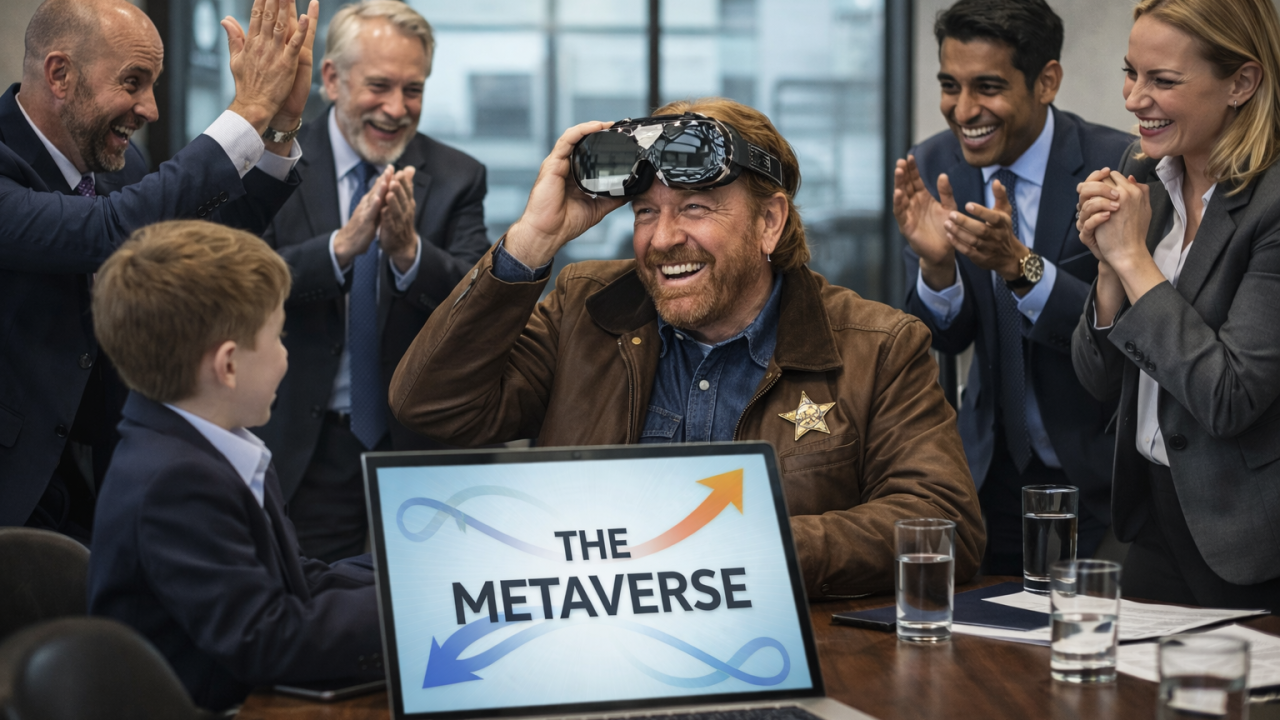
“And they thought nothing could kill him” AI Generated ©2026 Rocinante Research
Once upon a keynote, somewhere between a fog machine, loud pulsating music, and a consultant gripping a clicker like it conferred executive authority, Enterprise VR officially became transformational.
Not because it worked. Not because it scaled. Not because anyone could articulate a viable operating model, governance structure, or path to production.
But because it appeared on a slide titled THE METAVERSE, in a font large enough to suggest confidence, framed by infinity loops and at least one gradient arrow implying momentum. The voice-over promised to reimagine how we’ll work in the future.
Because defining the present would require accountability.
Executives nodded in perfect alignment. Not because they understood what they had just seen, but because they recognized the moment. The slide said transformation. And in modern consulting culture, transformation isn’t something you question. It’s something you fund.
No one asked why. They only wondered how much. Not because the metaverse made sense, but because asking the question risked something far worse than confusion: being the only executive in the room who looked like they didn’t already know.
Even though none of them did.
Welcome to Episode 7 of Why Enterprise VR Failed.
In the previous episodes, we established that Enterprise VR had real value, particularly in training, simulation, and collaboration. Then hardware vendors slapped “enterprise” stickers on consumer headsets and doubled the price. We peeled back the curtain on VR software development, only to discover that most enterprises were not equipped to build VR applications. We fought the beast known as Enterprise IT, where most pilots were quietly canceled during the security review. We examined how Learning & Development fused immersive learning with compliance instead of capability. And finally, we handed headsets to employees, whose bodies revolted, brains overloaded, and dignity quietly exited the building.
If your body is numb, your brain is spinning, and your eyes are sagging after this eleven-month guided tour through the wreckage of Enterprise VR, take a breath. This is the final episode devoted to crushing those immersive dreams of working in the metaverse before we gently guide you back toward the light.
At this point, any reasonable person might ask: if the hardware buckled, the software struggled, IT blocked it, L&D misused it, and users rejected it, why did the money keep flowing? Who kept approving these programs? Who kept insisting this was “strategic”?
Finally, there is just one last dungeon boss to face: the Metaverse Industrial Complex.
WARNING: This episode contains scenes of consulting theater. Exposure may cause strategic disorientation, compulsive head-nodding during presentations, and slides featuring arrows that point to nothing. Side effects may include budget leakage, pilot purgatory, transformation fatigue, and the creeping realization that this entire program will be rebranded under the AI umbrella next quarter.
Of course, we’ll break this episode into four scenes with limited commercial interruption.
Scene 1: The Metaverse Industrial Complex: We define an ecosystem of consultancies, vendors, analysts, innovation labs, and keynote culture that thrives not on outcomes, but on momentum. This scene explains how VR entered the enterprise not through operational need, but through vision decks and applause.
Scene 2: How Consulting Fell in Love with the Metaverse: By the late 2010s, Big Consulting could see another $1.5 trillion consulting wave ending, and the industry was searching for the next trillion-dollar re-architecture opportunity. Enter the metaverse: visual, emotional, and easy to demo. The difference? This wasn’t organic. Clients weren’t demanding it. It was manufactured.
Scene 3: The VR Hype Machine: We reveal a few of the dirty little secrets behind many enterprise VR programs. Many weren’t funded because they survived ROI scrutiny; they were funded because they hid inside innovation carve-outs buried in massive MSAs. Pilots multiplied, studies were misused, metrics were inflated, and marketing and PR fed the hype train. Once the results started coming back, ownership evaporated and budgets tightened. VR wasn’t canceled. The money just pivoted to the next shiny technology.
Scene 4: The Pivot and the Fallout: The final scene examines what happened when the funding ran out. Boutique studios collapsed, “metaverse leaders” quietly updated their LinkedIn profiles, and the consulting machine pivoted seamlessly to AI. VR didn’t die with a post-mortem; it vanished, leaving behind dusty headsets, abandoned careers, and a familiar silence. The kind that settles in just long enough for the same machinery to reset, rename itself, and start promising transformation all over again.
Scene 1: What Is the Metaverse Industrial Complex?
Before we can talk about what really happened to Enterprise VR, we need to clear something up. By the time the word metaverse made its way into corporate vocabulary, it had already stopped meaning anything specific.
In consumer culture, the metaverse was pitched as a persistent digital universe. Part video game. Part social network. Part digital economy. A place where people would work, play, shop, and apparently thrive as legless avatars. Ready Player One.
Enterprises never wanted that. What the enterprise meant by the metaverse was something far less cinematic, and yet seductively vague.
Inside corporate walls, the metaverse became shorthand for a loose collection of ideas:
- immersive training environments
- virtual collaboration spaces
- 3D simulations and digital twins
- spatial visualization of assets and data
- a future-facing story about how work might evolve
It wasn’t a product. It wasn’t a platform. It wasn’t even a roadmap.
The metaverse was a container concept — big enough to hold everyone’s ambitions, and vague enough that no one had to define success.
That vagueness wasn’t accidental. It was the feature. Because once an idea becomes abstract enough, every organization can project its own goals onto it and still claim alignment.
Consulting firms saw opportunity first.
By the late 2010s, digital transformation was starting to feel mature. Cloud migrations were stabilizing. ERP modernization was no longer headline material. Boards were asking awkward questions like, “Why are we still working on this?”
VR and the metaverse offered something priceless: a fresh transformation narrative. One large enough to justify new strategy work, operating model redesigns, innovation programs, and multi-year roadmaps without being tied to measurable delivery outcomes.
For large consultancies, this mattered.
By that point, consulting had grown into a multi-hundred-billion-dollar global industry, with much of its momentum driven by transformation work rather than operational delivery. And the more abstract the transformation, the harder it is to measure and the longer it can run.
The metaverse checked every box.
Technology vendors saw a different opening.
Consumer hardware margins were razor-thin, in some cases nearly nonexistent. The enterprise, meanwhile, still paid premiums.
If you could convince companies that VR was strategic rather than experimental, you could sell:
- enterprise SKUs
- enterprise licensing
- enterprise support contracts
- enterprise device management layers
Often at three to ten times consumer pricing. The hardware itself didn’t change much. It was basically “build some software and put a new sticker on the box,” because enterprise buyers weren’t paying for silicon. They were paying for reassurance.
Analyst firms saw something else entirely: a new category.
And categories are currency. New categories mean new reports, new quadrants, new briefings, and new reasons for CIOs to schedule expensive advisory calls.
Once a technology appears on a “Top Strategic Technology Trends” list, it becomes self-fulfilling. Executives don’t want to fall behind analysts. Analysts don’t want to miss trends.
Everyone reinforces everyone else.
Innovation labs were no longer playing budget defense and had re-entered strategic conversations.
By the late 2010s, many corporate innovation teams were under pressure. Years of pilots had produced few scalable outcomes, and leadership was starting to ask uncomfortable questions about value.
VR gave them something visual again. Something demoable. Something you could walk an executive through in five minutes and say, “Imagine this at scale.” No one asked when scale would arrive. That question could always be answered later.
Executives, meanwhile, faced their own challenge. Boards don’t reward stability. They reward vision.
Saying “we’re optimizing operations” doesn’t capture attention. Saying “we’re reimagining the future of work” does.
The metaverse offered a way to signal modernity without committing to structural change. You could sponsor innovation without disrupting the core business. You could appear bold without taking operational risk.
None of these groups coordinated. They didn’t need to. The incentives lined up naturally. When enough organizations benefit from belief, belief stops being optimism and starts becoming policy.
That’s when the system finally formed: a system that didn’t require outcomes, only momentum.
If the technology succeeded, it became a case study. If it failed, it was early. If adoption stalled, the market wasn’t ready. If pilots collapsed, the vision remained intact.
No one was wrong. No one was accountable. Everyone kept ramping up the hype because hype got attention, accessed funding, and generated invoices.
Each group benefited independently, and their actions reinforced the others:
- vendors productized it
- analysts validated it
- innovation labs showcased it
- consultants legitimized it
- executives sponsored it
This phenomenon had a name.
The Metaverse Industrial Complex: a self-reinforcing incentive loop in which consulting firms, technology vendors, analysts, innovation labs, and executives all benefited from selling transformation. The more it was declared inevitable, the more money flowed toward proving it.
This is why Enterprise VR didn’t enter companies through operations or engineering. It didn’t emerge from warehouse managers demanding immersive tools. It didn’t rise because IT was begging for a new device class.
It arrived through imagination. Through vision decks. Through executive briefings. Through roadmaps filled with the future, vague timelines, and verbs like unlock, reimagine, and transform.
VR didn’t have to work. It just had to represent the future. And nothing signals to the board and the press that “we’re future-ready” faster than a senior executive wearing a VR headset while corporate communications capture the moment from three flattering angles.
Don’t get me wrong: innovation theater has existed for decades. VR simply gave it a prop — one you could put on your head, photograph, and remove before anyone asked how it would be governed, secured, or supported at scale.
Scene 2: How Big Consulting Fell in Love with the Metaverse
By the late 2010s (back when we still talked about digital transformation instead of global pandemics or AI)something curious began happening. Every major consultancy suddenly had a metaverse practice.
Not because clients were lining up demanding immersive platforms. Not because anyone had a production use case. And definitely not because IT was asking for more headsets.
The truth was both simple and structurally inevitable: in consulting, failure to deliver the future is often forgivable. Failure to sell it is not.
Let’s pause there, because we’re getting ahead of ourselves.
Consulting Economics
Throughout this series, consulting refers specifically to Advisory Services and Systems Integration (SI), not assurance work like tax or audit. Those disciplines exist to explain outcomes. Consulting focuses on manufacturing futures.
Consulting firms can be organized in countless ways. Some slice the business by geography, others by industry, others by practice area or capability. These structures matter internally, but economically they all collapse into three revenue phases built around “technology waves.”
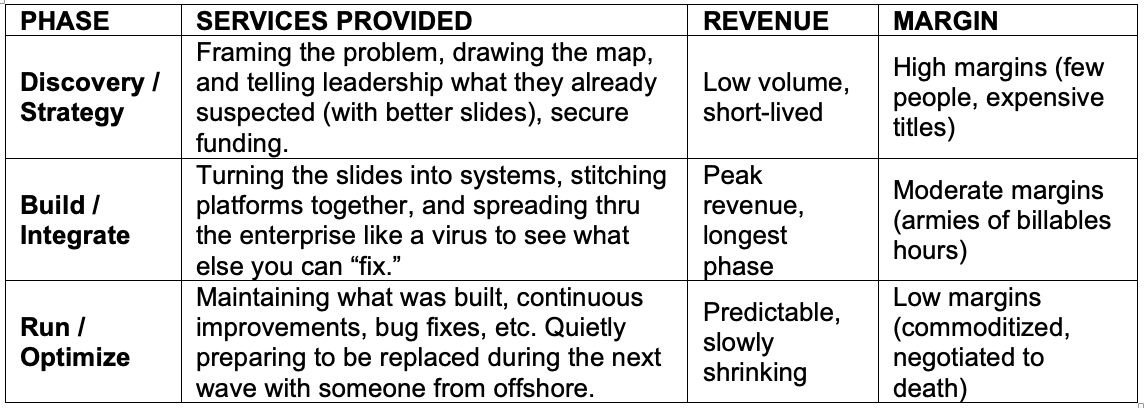
Only technology waves that force enterprises to repeatedly re-architect their core systems create trillion-dollar lifetime markets. That, my friend, is the holy grail consultants are always hunting.
This is not cynicism; it is pattern recognition. And it is precisely the pattern consultants are trained (often unconsciously) to seek.
Consultant Waves 1990–2020
Since 1990, consulting growth has shadowed major technology waves, but never smoothly. It grew in bursts, spiking when a new wave created a defensible story to sell and a large system to rebuild. These moments rewarded firms that could define the future early, name it convincingly, and staff for it at scale.
Consulting waves also do not map cleanly to technology waves. They overlap by necessity. Skills, delivery models, and headcount don’t reset when narratives change; they carry forward, often long after the original promise has faded. This overlap isn’t accidental. It’s structural.
The table below defines the key consulting waves from 1990 to 2020.
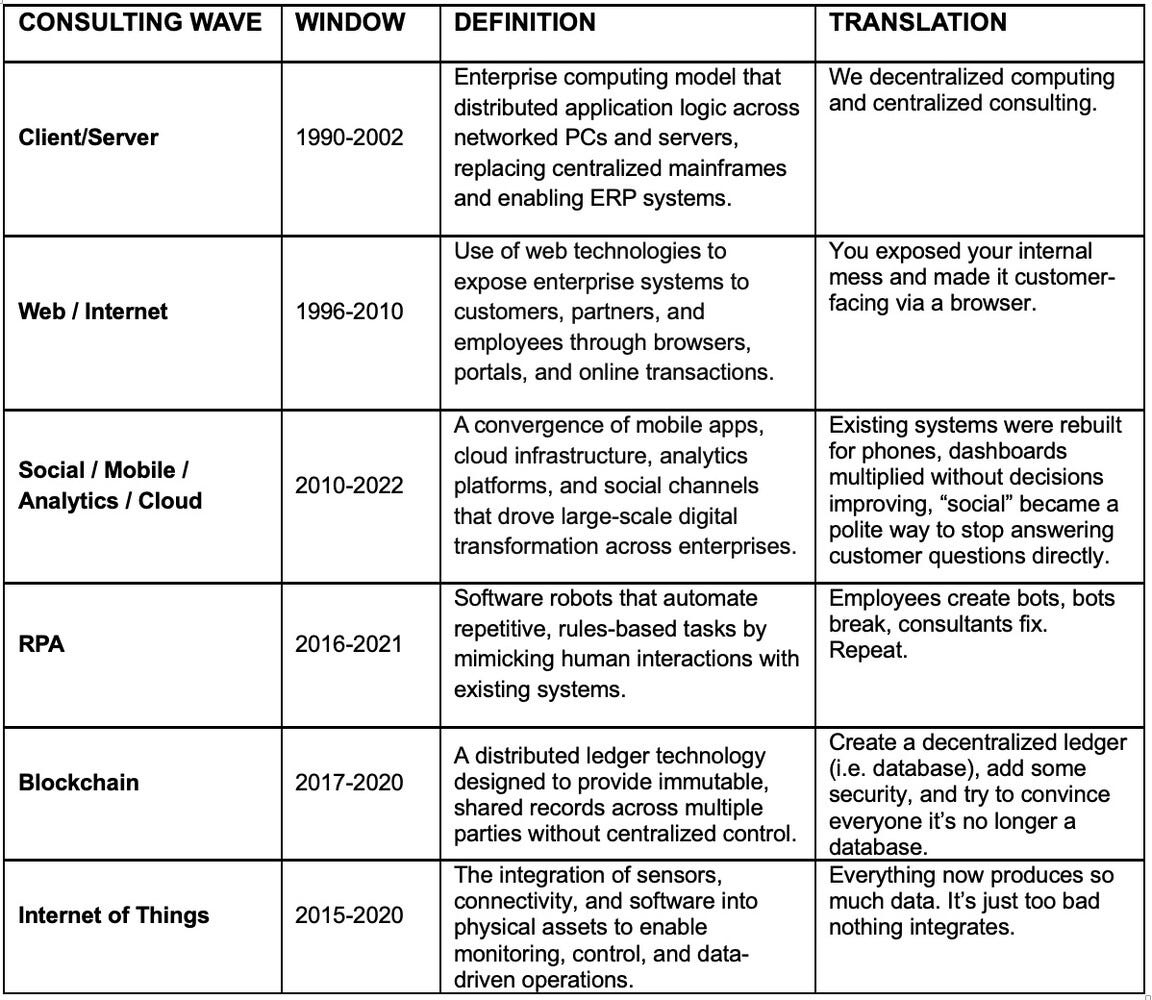
Consulting firms, if nothing else, are smart (especially the ones led by people with accounting degrees). Note: if you find a consulting firm led by an ex-lawyer, you should ask yourself, “WTF, and why?”
Inside every major firm sits a small, well-incentivized group whose job is not to predict the future, but to identify which version of it can be most reliably monetized. These are the people who recognized client/server, then the internet, then mobile, social, analytics, and cloud — not because they saw the future clearly, but because they understood which changes would force enterprises to repeatedly re-architect their core.
Below is a graph of estimated consulting revenue by year for these waves.
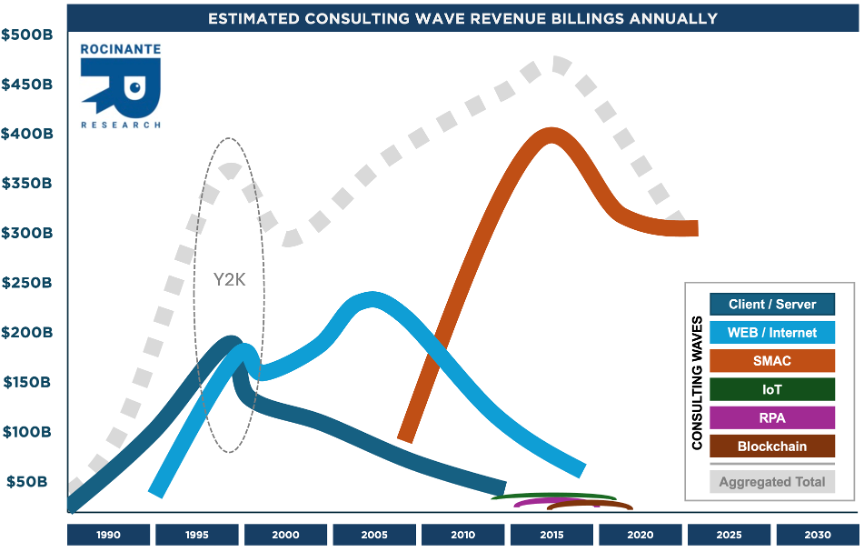
Estimated Consulting Revenue by Year by Technology Waves ©2026 Rocinante Research
As the chart shows, Client/Server peaked just before Y2K, but Web/Internet was already in the pipeline. The post-Y2K dip wasn’t a technology failure. It was billing fatigue, compounded by the fact that most business leaders resented paying to fix a problem they insisted wasn’t their fault (even though they were the same leaders who never properly funded IT in the first place).
SMAC arrived in overlapping waves. Web development teams pivoted almost overnight into mobile app development after the iPhone arrived. Mobile and social naturally traveled together, and because of that (and a few other things) analytics was finally promoted to the front of the line. Obviously, cloud became the place to put everything once nothing fit on-prem anymore.
By the time these waves had been harvested, the industry could see the end of the SMAC runway approaching. SMAC was a roughly $1.5 trillion consulting wave (over a period of years), and it was coming to an end. Consulting needed a new wave to keep things going.
Several candidates were elevated to keep the narrative alive. RPA, IoT, and blockchain each enjoyed a period of prominence — credible technologies with legitimate use cases and just enough ambiguity to justify roadmaps, pilots, and discovery work. None of them, however, forced wholesale re-architecture. At best, they were point solutions that optimized around the edges. Consultants had thrown technologies at the wall, but nothing stuck. They needed a conceptual expansion large enough to justify total reinvention rather than incremental integration. It also had to be broad enough to make re-architecture feel inevitable, not optional.
They were looking for the metaverse. A metaverse that could only be accessed through a VR headset. The metaverse was the perfect storm in many ways. It was visual, futuristic, and emotional. It was an experience, and experiences are easy to pitch.
And believe me, the metaverse was consulting catnip because it checked every box:

So, innovation labs appeared overnight. Immersive Centers of Excellence were announced. Executives were flown in for guided demos. Consulting firms spent heavily getting ready. They needed new skill sets. New hardware. People with “experience.” Entire practices were stood up on PowerPoint and optimism.
And this wasn’t isolated to a single firm. Consulting is an ego-driven culture. If your competitor has an Oracle practice, you need an Oracle practice. If they build an innovation lab, you build an innovation lab. If they’re showing holograms, you can’t be showing spreadsheets. You’re showing holograms too.
This isn’t arrogance. It’s survival. Consulting relevance is a competitive sport, and appearing behind is far more dangerous than being wrong
The pattern was familiar, because we’ve seen it before. But this time it happened fast. And in the rush, everyone missed one inconvenient detail:
They forgot to ask their clients whether they needed any of it.
Then something unexpected happened: a manufactured global pandemic. Overnight, everyone moved to remote work, mostly from home. And suddenly those same clients heard a different pitch.
They were told that the metaverse was now the answer to remote collaboration, connection, and training. This would fundamentally change their business — and if they didn’t act now, they’d fall behind.
Sometimes waves happen organically. This one didn’t.
The metaverse was a manufactured wave, and every consultancy in sight was suddenly very eager to sell you a surfboard.
Scene 3: The VR Hype Machine
Every hype cycle needs a moment of legitimacy. VR had one, and it started with the study that launched a thousand decks.
Yes, that study: “The Effectiveness of Virtual Reality Soft Skills Training in the Enterprise,” published by PwC on June 25, 2020.
What made it different wasn’t that it was the first VR study. It wasn’t. What made it different was that it compared three learning modalities (classroom, e-learning, and VR) deployed in an enterprise setting, to an enterprise audience. And instead of using a proven VR training topic like safety procedures or equipment repair, they built a soft-skills training course focused on leadership and human interaction. The squishy, uncomfortable stuff that Gen X politely avoids.
And because this was PwC, they also built a cost model comparing all three approaches. Because no consulting deliverable is complete until someone proves in Excel that if you agree with the assumptions, you’ll agree with the outcome.
Which, if you think about it, is either incredibly bold or incredibly reckless.
The PwC study asked two very specific questions: Is VR more effective than traditional training? And is it more cost-effective at scale?
Those questions mattered more than people realize. Because before this, VR in the enterprise had credibility in exactly one place: simulation (flight training, safety procedures, and equipment repair). Only a few companies, like Walmart, Verizon, and UPS, had seriously explored using it to teach leadership, influence behavior, or train human interaction in a headset.
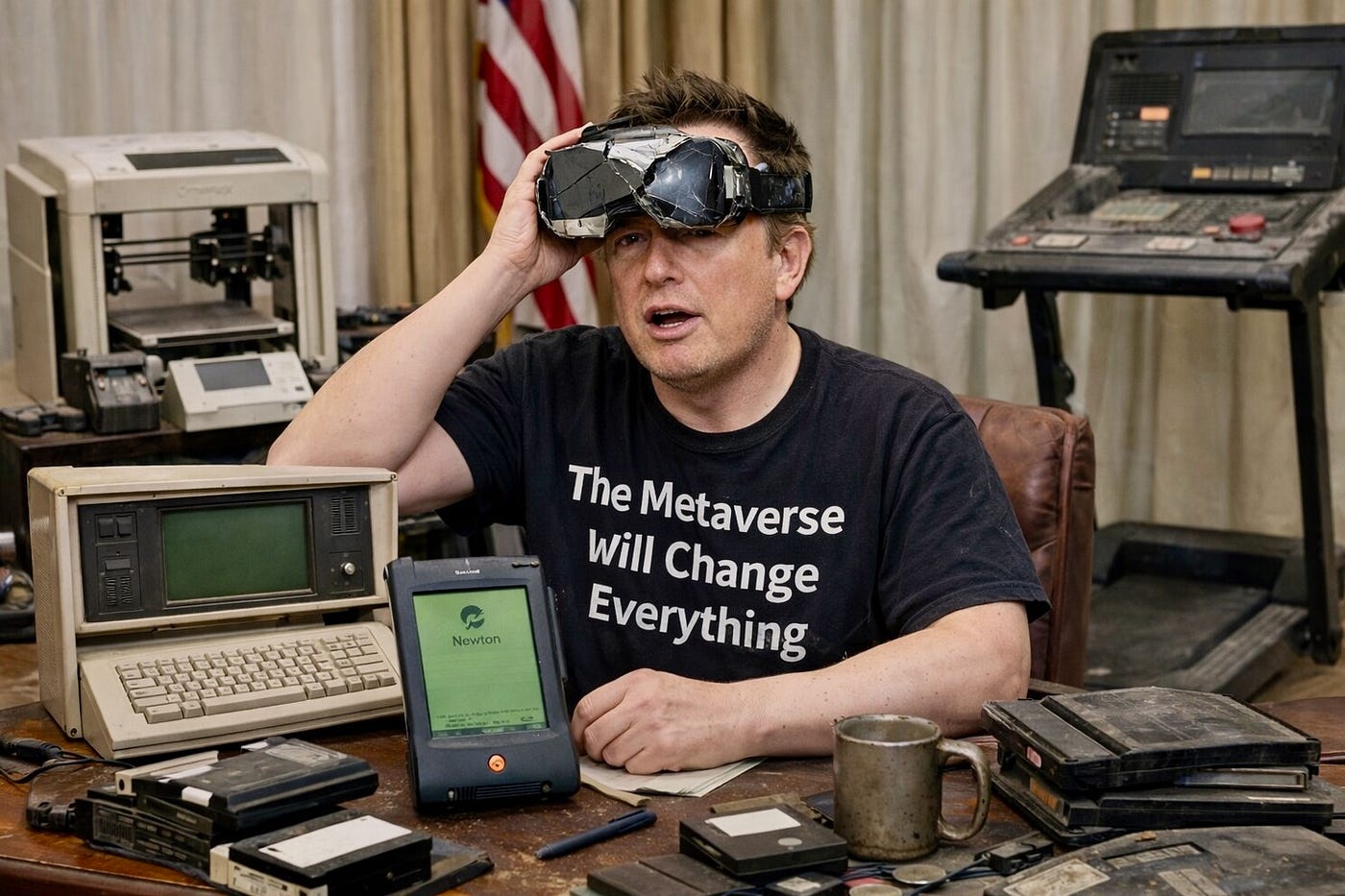
“The Metaverse Will Change Everything” AI Generated ©2026 Rocinante Research
The Headline Findings from the study (the stats everyone quotes, and few understood):
- up to 4x faster learning vs. classroom
- 275% more confidence to act on training
- 4x more focused than e-learning
- 3.75x more emotional connection than classroom
- cost-effective at scale
Those are insanely good numbers in enterprise learning terms.
Reach / Influence
Yes, the study was highly publicized. But it didn’t spread because it was viral. It spread because it was usable. It translated immersion into metrics — speed, confidence, and cost — the kind executives can fund.
According to Google Scholar this study has been cited or formally referenced approximately 420 times in academic literature and professional reports. That’s the clean number.
The real number (the one that matters) never shows up in a citation index:
- hundreds, probably thousands, of vendor decks
- hundreds of major consulting proposals
- analyst briefings across the Gartner/Forrester ecosystem
- LinkedIn posts from every “future of work” evangelist
But those five headline stats, they took on life of their own.
They didn’t just circulate; it colonized the narrative. They became shorthand, became proof, and became justification. They turned into the kind of metrics you drop into a slide and watch budgets unlock without anyone asking a second question.
What remained were headlines: clean, portable, and perfectly optimized for PowerPoint. It wasn’t just influential. They became the single most weaponized stats in enterprise VR — stripped of context, polished for impact, and deployed like consulting accelerant.
The use case didn’t matter. It didn’t have to. Because in consulting, once a metric becomes usable, it becomes truth adjacent. No one lied. The hype simply metabolized faster than reality.
The goal of the study was never to prove VR was the future of enterprise training. If you read it, PwC was trying to answer a much narrower question: in a controlled environment, for a specific type of learning modality, does immersion change outcomes.
That’s it. No grand vision. No metaverse roadmap. No “future of work” narrative.
And the answer, under those conditions, was yes.
- learners completed training faster
- they were more focused
- they felt more confident
- they had a stronger emotional connection to the material
Those results weren’t surprising once you understood the mechanics. VR removes distraction. It forces participation. It simulates consequence. So of course it works — in the right context.
PwC deserves both credit and cautionary blame. Their VR learning research was legitimate. The data was real. The conclusions were defensible. Under controlled conditions, VR training showed measurable improvements in speed, confidence, and engagement.
The problem wasn’t the research. The problem was what happened next.
And just like that, Enterprise VR crossed a line it had never crossed before. It stopped being interesting and became fundable.
Accenture and the Business Model of Hype
If the Metaverse Industrial Complex had a finance department, a global sales force, and a choreography team for executive demos, it was called Accenture. Accenture didn’t just join the metaverse conversation. It industrialized it.
They are exceptionally good at taking a technology that might matter someday and making it sound like a board-level imperative today.
In the early stages of a hype cycle, that matters more than engineering. It is narrative control. And once you control the narrative, you control the funding.
That is the business model of hype.
Here’s the uncomfortable truth people like to dance around: when it comes to advanced technology, Accenture is not just an execution firm. It is also a marketing machine with extraordinary enterprise reach. That is not an insult. It is structural.
Accenture excels at narrative construction, vision selling, executive alignment, and global amplification. When it decides something matters, the market hears about it.
When Accenture announced it had deployed 60,000 VR headsets, the industry erupted. LinkedIn celebrated. Headlines followed. The metaverse, we were told, had arrived.
That is how hype works. You do not have to prove the technology works at scale. You only must make it feel important enough that no executive wants to be the one who ignored it.
That is why firms like Accenture thrive in hype cycles. They are not betting the company on whether the technology works. They are monetizing the gap between what is possible and what can be shipped. That gap is where the margin lives. And metaverse-era VR had a big, beautiful gap.
It was visual. Emotional. Futuristic. Easy to demo. Hard to measure. Immature enough to excuse failure but polished enough to photograph. In consulting terms, that is premium-grade fuel.
You could put an executive in a headset for six minutes, trigger just enough awe and confusion to make them feel late, then walk them into a room and explain why this now required a roadmap, a pilot, a workforce strategy, an operating model redesign, a governance workstream, a vendor selection exercise, a change management plan, and, naturally, a global implementation partner.
Which is a hell of a lot of revenue for something that may still not survive the procurement process or the bloodshot eyes of Enterprise IT.
That is why Accenture matters here. Not because it was alone. Not because it was uniquely malicious. But because it was the cleanest expression of the system.
The Metaverse Industrial Complex needed a study to legitimize the category, vendors to productize it, analysts to validate it, and executives to sponsor it. But it also needed someone to convert hype into enterprise spend. That was Accenture’s role in the machinery.
Accenture did not wait for a seat at the table. It bought one.
First, it purchased 60,000 Meta Quest 2 headsets and handed them to new employees, enough to make the signal impossible to miss.
Then it put the program on a stage: the Nth Floor / One Accenture Park, a virtual campus for onboarding, collaboration, and just enough immersion to make it feel as if something much bigger was already underway.
It was not just adoption. It was optics at scale.
At the time, it became one of the most cited examples of “enterprise metaverse at scale.” More than 150,000 employees passed through it, and it was repeatedly used as proof that this was already happening.
In one sense, it was happening. Just not in the way the narrative implied.
What went mostly unsaid was that the experience was largely event-driven, not persistent work. It still relied heavily on 2D desktop access. It was not integrated into real enterprise workflows. And the 60,000 headsets were consumer devices, not secure enterprise hardware, not managed through standard enterprise controls, and not deployed in a way most Fortune 100 companies could realistically replicate. They were not even on the corporate network.
This was internal enablement plus signaling, not operational transformation.
And then the foundation cracked.
The Nth Floor, the award-winning onboarding solution, was built on AltspaceVR, a platform launched in 2015, acquired by Microsoft in 2017, and shut down in March 2023.
So, the poster child for enterprise VR was built on a platform that used legacy code, and no longer exists. That detail tells you almost everything you need to know about how “foundational” the stack really was. The Nth Floor was eventually moved to Microsoft Mesh.
Still, the story sounded better than the truth. And the story won.
Then came the moment that was supposed to change everything: Mark Zuckerberg, Satya Nadella, and Julie Sweet appearing together at Meta Connect 2022 on October 11, 2022.
The promise was intoxicating enterprise VR headsets managed by Microsoft Intune, hardware and management software from Meta, and Accenture there to deploy it all into the enterprise.
A match made in Enterprise VR heaven.
This was supposed to be the bridge from demo to deployment. Instead, it was mostly vapor. Very little of consequence shipped until late 2023, and Teams and MESH did not arrive until late 2025. The partnership lived far more convincingly in press releases than in production environments.
How does that happen? Because applause is not a delivery model.
Microsoft’s VR (immersive) teams were being repurposed as HoloLens faded and talent was redirected elsewhere. Meta’s enterprise product managers left or were reassigned. Accenture had less and less to implement, and within months had rumored significant cuts to its Metaverse Continuum Business Group. By February 2026, Meta had canceled its enterprise VR efforts, including Horizon Workrooms.
Not because anyone needed to be evil. Just because large organizations are remarkably good at losing interest once the cameras leave. Entropy is the strongest force in enterprise innovation.
All the hype, all the money, all the internal hope — it evaporated the moment the market stopped buying the metaverse story.
To be fair, this model does sometimes produce real capability. That is part of what makes it dangerous. If you throw enough money, people, pilots, and PowerPoint at an immature technology, eventually some of it becomes useful. A few use cases stabilize. A few tools improve. A few clients even get real value.
But hype does not require proof. It requires pressure. And Accenture understands pressure better than almost anyone on earth. In a normal delivery model, value precedes revenue. In the business model of hype, revenue precedes value. Value is treated as a downstream possibility: maybe it arrives, maybe it doesn’t. Either way, invoices are generated.
And when the thing finally stalls (when pilots do not scale, users do not come back, IT starts asking adult questions, and the business quietly loses interest) Accenture does what firms like Accenture always do.
It pivots.
The old decks disappear. The practice name changes. The machine spins up again around the next inevitability.
Because the product was never really Enterprise VR. The product was billable hours.
Scene 4: The Pivot and the Fallout
The final scene begins the way most hype cycles end: not with a crash, but with a quiet pivot. Boutique studios folded. “Metaverse leaders” quietly updated their LinkedIn profiles. The consulting machine, never sentimental, shifted gears and pointed its spotlight at AI.
VR didn’t die with a post-mortem. It simply vanished. No apology. No reckoning. Just dusty headsets, abandoned roadmaps, and the familiar silence that settles over every innovation program once the funding disappears.
Here’s the part nobody likes admitting: Most enterprise VR initiatives were never funded because they passed an ROI review. They were funded because the money to fund them was hidden.
Inside massive Master Services Agreements lives a small, magical line item (usually one to two percent) labeled something like innovation, exploration, or strategic experimentation.
Translation: “We’re already billing tens of millions for this transformation project, let’s take 1–2% and carve it out and do something interesting.” And this is where many Enterprise VR projects lived.
Not owned by operations. Not sponsored by IT. Not accountable to a business unit. It existed in budget limbo. And if money flowed freely, this arrangement worked perfectly. Innovation budgets absorb curiosity. They tolerate failure. They rarely demand operational proof.
But when budgets tighten, curiosity is the first casualty. Innovation money disappears. And without that protective carve-out, VR had nowhere to stand.
It wasn’t cancelled. It was simply no longer tolerated — like that obnoxious friend who always shows up with beer. If the cooler’s full, everyone puts up with him. The moment it’s empty, you’re quietly hoping he takes the hint and heads home.
Metrics didn’t help as pilots were counted as deployments, demos became adoption, and headsets purchased stood in for usage. But wait… usage invites uncomfortable questions. Like, “how often are employees actually using it?” “What business process improved?” “What system does this replace?” and “Who owns it?”
Those are operational questions. And operational questions have a nasty habit of killing innovation theater. So, the industry did what industries do best. It postponed reality and everyone assumed scale would come later.
Unfortunately, later never arrived.
Then AI showed up, sucked up all the money in the room, and suddenly the same people who had “Metaverse Strategist” in their titles became “GenAI Transformation Leads.” Same decks. New headlines or even new logos.
The Metaverse Industrial Complex didn’t mourn VR. It pivoted.
The Casualties
Not everyone involved in this was cynical. Many boutique firms genuinely believed. Game developers, Unity engineers, Unreal studios and Creative technologists who knew how to build extraordinary immersive experiences.
They built beautiful things, but enterprises don’t buy experiences; they buy systems. Systems require security. Governance. Identity. Lifecycle management. Support models. Procurement pathways. Long-term ownership.
Most immersive studios were never built for that. They were built to create magic. And magic doesn’t survive enterprise security reviews.
Some studios adapted. Many didn’t, and a surprising number simply disappeared. If you want to see the aftermath, open LinkedIn, search for “metaverse,” and filter: “Open to Work”.
The industry didn’t slowly wind down. It evaporated.
The Closet
Scene 1 gave us the mythology. Scene 2 exposed the incentives. Scene 3 revealed the machinery and Scene 4 delivered the result.
The Metaverse Industrial Complex didn’t build the future, it rented it, hourly.
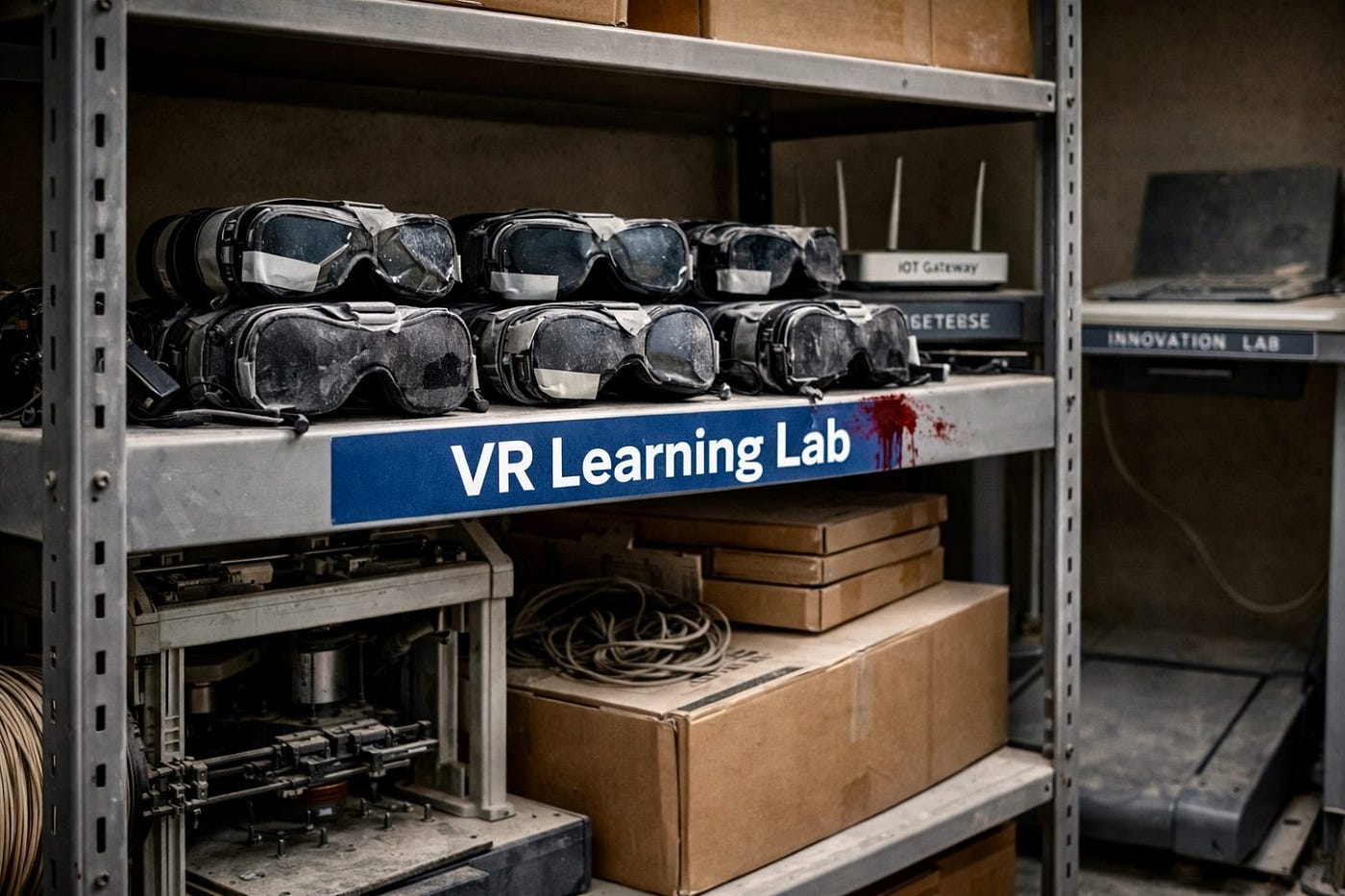
“The Closet” AI Generated ©2026 Rocinante Research
Enterprise VR never really got a fair trial. It got a marketing campaign, delivered by a complex structure of consulting firms, analysts, and vendors. It didn’t fail because no one believed in it. It failed because belief was easier to scale than delivery.
And somewhere in a supply closet — next to the unused 3D printer, the abandoned IoT gateway, and the “innovation lab” treadmill desk — a stack of dusty headsets sits quietly.
Not waiting for the future to return. Just waiting for someone to finally throw them out.
It’s time to start over.
Conclusion
This series has overturned more than a few stones in this sad little archaeological dig.
Over seven episodes we’ve interrogated the usual suspects at the Enterprise VR crime scene: hardware that showed up in a business suit but was still a gamer at heart; software that promised platforms and delivered prototypes; IT, Legal, HR, and L&D — each doing exactly what they were incentivized to do, even when it quietly strangled adoption. Users, of course, bore the brunt of every awkward rollout and half-finished experiment. And finally, the Metaverse Industrial Complex — the ultimate transformation theater at enterprise scale, distributing confidence long before capability arrived.
None of these actors were individually malicious. Most were rational. Many were even well-intentioned. But systems rarely fail because of villains. They fail because incentives align in ways that reward motion more than outcomes.
And when the money dried up, the machine did what the machine always does. It pivoted — without shame.
We’ve presented the evidence: the artifacts, the incentives, the timelines, the wreckage. All laid out in plain view.
Now, as a member of the jury, it’s time for a verdict.
The prosecution argues that Enterprise VR is dead — or at least on life support. Was it murdered? Or was it slowly suffocated by procurement cycles, governance frameworks, immature platforms, consulting narratives that outran engineering, and innovation budgets that demanded excitement but not accountability?
Or do you side with the defense: that Enterprise VR is a viable technology… simply not ready for the enterprise.
The choice is yours.
Published March 23, 2026

Note: There is a rather lengthy epilogue coming focused on the interesting question of what should we do differently next time? Because, of course, there will be a next time. There is always a next time.
It may take me a while to finish it as I’m in the middle of relocating the family estate from South Texas to Southern California, which turns out to be its own kind of enterprise transformation program — complete with logistics, governance, unexpected costs, and very little engagement as everyone seems to be going the other way. That’s a story for another day.
In the meantime, if you enjoyed these essays, feel free to share them with your friends — especially the ones who recently added “AI” somewhere in their job title.
I have a feeling they may find themselves in a very familiar situation before long.
“AI will fix it!” AI Generated ©2026 Rocinante Research
About the Author
Daniel Eckert escaped consulting in late 2023 after 29 years spent deep inside enterprise boardrooms, PowerPoint war rooms, and strategy offsites that somehow produced neither strategy nor offsites worth remembering. He survived budget committees, vendor bake-offs, and executive steering meetings that made The Hunger Games look like a team-building exercise.
Eight of those years were spent in the Enterprise VR trenches, where he helped design, pilot, debug, defend, and eventually euthanize immersive technology programs held together with hope, caffeine, and duct tape.
He also co-authored the now-collectible academic artifact The Effectiveness of Virtual Reality Soft Skills Training in the Enterprise — a paper so confidently positioned it briefly convinced several Fortune 500s that the next generation of management training would be delivered through VR while an AI wrote the case studies proving it worked.
Daniel is now a Principal at Rocinante Research. Semi-retired from selling the future, he now documents it instead — usually right before it collides with reality, budgets, or basic ergonomics.
When not writing snark-laden essays about enterprise delusion, Daniel can be found coaching youth soccer, over-analyzing technology roadmaps, or watching each new AI and spatial computing hype wave promise salvation while quietly checking his notes from the last four times this already happened.
More dispatches from the front lines of digital optimism, executive groupthink, and innovation theater can be found on Medium — where the sarcasm is free, but the lessons were expensive.
Articles in the “WHY ENTERPRISE VR FAILED” series:
Why Enterprise VR Failed — The Prologue (April 1, 2025)
Episode 1 — Overpromising and underdelivering? The Benefits of Enterprise VR. (April 8, 2025)
Episode 2: Strapped-in and Let Down: How Enterprise VR Got Duped by Consumer Tech April 22, 2025)
Episode 3: Enterprise VR Software Tools? What development tools? (May 8, 2025)
Episode 4: The IT Problem, or How the middle finger can be used as a pointing device (July 18, 2025)
Episode 5: Corporate Learning and Development: Where good ideas and dreams go to die. (October 12, 2025)
Episode 6: User Experience: “You want me to wear this clunky thing on my head for HOW long?”(December 22, 2025)
Episode 7: VR/Spatial Consultancies: The rise and fall of the Metaverse Industrial Complex (March 23, 2026)
Why Enterprise VR Failed — The Epilogue, or WTF can I do now to turn this all around? (TBD)
메타데이터
- post_id
- 758f7bc7d9c3
- slug
- episode-7-vr-spatial-consultancies-the-rise-and-fall-of-the-metaverse-industrial-complex-758f7bc7d9c3
- url
- https://medium.com/emergingtech/episode-7-vr-spatial-consultancies-the-rise-and-fall-of-the-metaverse-industrial-complex-758f7bc7d9c3
- canonical_url
- https://medium.com/emergingtech/episode-7-vr-spatial-consultancies-the-rise-and-fall-of-the-metaverse-industrial-complex-758f7bc7d9c3
- author_url
- https://medium.com/@deckert
- status
- ok
- fetched_at
- 2026-06-09 15:37:30