Motor Current: Why Motor hp Alone Is Not Enough to Size Electrical Equipment
A motor nameplate can look simple.
Motor Current: Why Motor hp Alone Is Not Enough to Size Electrical Equipment
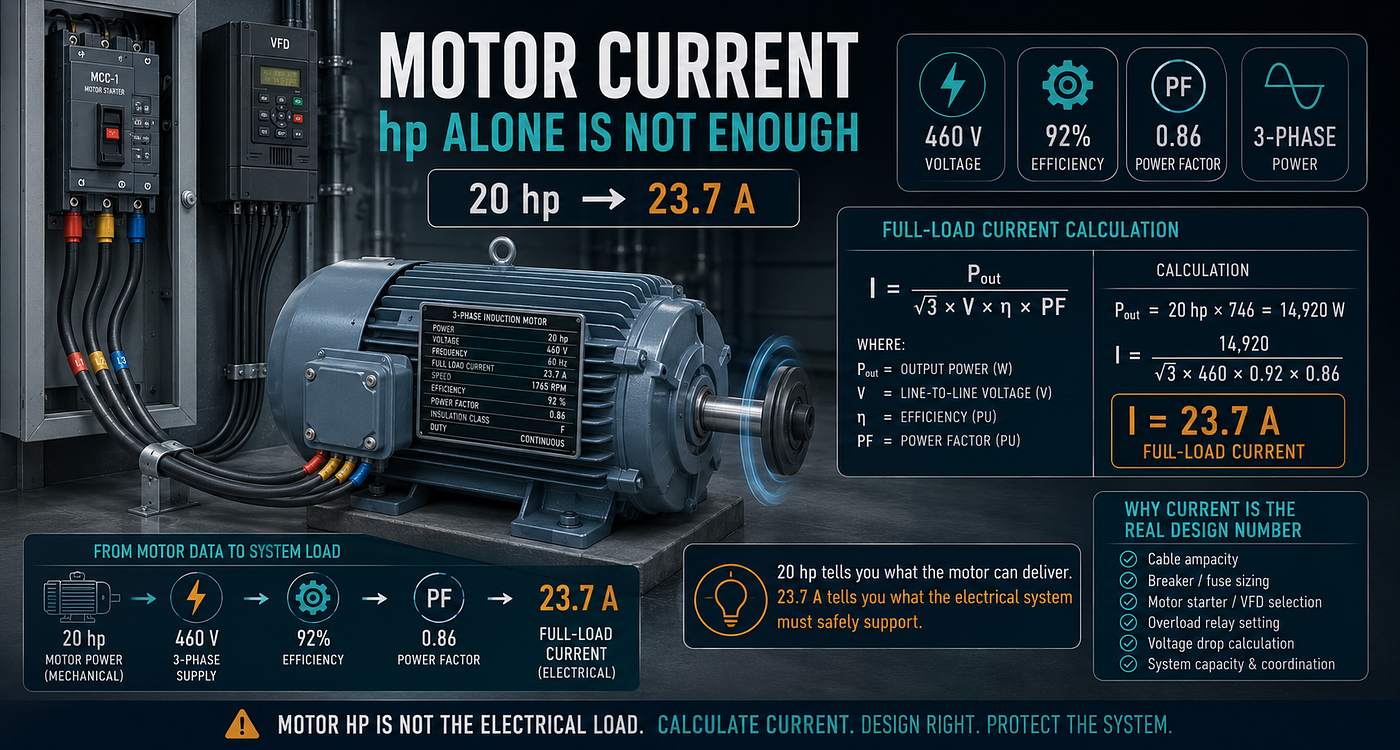
Motor current check showing how horsepower, voltage, efficiency, power factor, and phase configuration determine full-load current.
A motor nameplate can look simple.
Horsepower. Voltage. Phase. Maybe efficiency and power factor.
But if you only look at motor hp, you are missing the number that often drives the electrical side of the design:
full-load current.
That is the number that affects conductor checks, starter selection, overload settings, VFD sizing, feeder review, and protection coordination.
A motor is mechanical equipment from one point of view.
But from the electrical side, it is a current demand that has to be calculated correctly.
What motor current really means
Motor current is the current required to deliver the motor’s output power at a given voltage, efficiency, and power factor.
That last part matters.
A motor does not convert electrical input into mechanical output perfectly.
Some power is lost inside the motor.
And because AC motors also operate with power factor, the apparent electrical burden is not the same as the useful shaft output.
So motor current is not just:
hp divided by voltage
That shortcut misses the real electrical relationship.
The practical formula
For a three-phase motor, the full-load current model is:
I = Pout / (√3 × V × η × PF)
For a single-phase motor:
I = Pout / (V × η × PF)
Where:
- I = motor current
- Pout = motor output power
- V = supply voltage
- η = motor efficiency
- PF = power factor
This is why two motors with the same hp rating can produce different current values.
If one motor has lower efficiency or lower power factor, it can draw more current for the same useful output power.
That is the part people often underestimate.
Why horsepower alone can mislead you
Horsepower tells you the mechanical output rating.
It does not fully describe the electrical input burden.
That burden depends on:
- voltage
- phase
- efficiency
- power factor
- motor type
- nameplate data
- operating condition
So when someone says:
“It is only a 20 hp motor.”
That is not enough.
The better question is:
What current does this motor actually require at the selected voltage and power factor?
That is the number the electrical design has to live with.
Real example
Let’s check a practical three-phase motor case:
- Motor output power = 20 hp
- Voltage = 460 V
- Efficiency = 92%
- Power factor = 0.86
- Phase = three-phase
First convert horsepower to watts:
20 hp × 746 = 14,920 W
Now apply the three-phase current formula:
I = 14,920 / (1.732 × 460 × 0.92 × 0.86)
The denominator is approximately:
1.732 × 460 × 0.92 × 0.86 = 630.5
So:
I ≈ 14,920 / 630.5 = 23.7 A
That is the useful result.
At first glance, “20 hp” sounds like the complete motor size.
But electrically, the more practical number is:
about 23.7 A full-load current
That is the number you start comparing against conductor ampacity, overload settings, starter ratings, and VFD current capacity.
The engineer mistake I see most often
The common mistake is treating motor power as if it directly determines current.
It does not.
Motor current depends strongly on the full set of nameplate assumptions.
Typical mistakes include:
- ignoring efficiency
- ignoring power factor
- mixing hp and kW without converting correctly
- using three-phase math for a single-phase motor
- assuming voltage changes do not affect current
- using estimated values when nameplate data is available
That last point matters.
For real design and commissioning, nameplate FLA is usually the stronger reference when available.
A calculator is useful for screening, comparison, and sanity checks.
But manufacturer nameplate data still matters.
Why power factor matters
Power factor is easy to ignore because it feels abstract.
But it directly affects current.
For the same useful mechanical output, a lower power factor means more apparent power must flow through the electrical system.
That means higher current.
So a motor with poor power factor may create more electrical burden than expected, even if the mechanical hp rating looks ordinary.
This is why motor current is not only a mechanical sizing issue.
It is also a power-system loading issue.
What this calculation is actually good for
This kind of motor current check is useful when:
- estimating full-load current before detailed equipment selection
- checking whether a starter rating looks reasonable
- comparing single-phase and three-phase motor loads
- screening VFD current capacity
- reviewing panel schedule assumptions
- explaining why two motors with the same hp may not draw the same current
It is a first-pass calculation.
It does not replace NEC motor tables, manufacturer nameplate data, overload selection rules, conductor sizing, voltage-drop checks, or short-circuit protection review.
But it does stop one common mistake:
assuming motor hp alone is enough to understand the electrical load.
Why the calculator is useful
That is why the Motor Current Calculator is useful.
It takes motor output power, voltage, efficiency, power factor, and phase configuration, then turns those inputs into a practical full-load current estimate.
Use it **Motor Current Calculator**
The value is not just the formula.
The value is that it forces the right question:
What current does this motor actually place on the electrical system?
That question is much more useful than simply saying the motor is 20 hp.
Related reads from my latest Medium posts
If you want two recent posts to read next, start with:
- **Power Quality Analyzer Fit: Why the Wrong Logger Can Ruin a Perfect Measurement Plan**
- **Motor Acceleration Time: The Startup Number That Can Trip a Perfectly Good Motor**
Different systems, same lesson:
The equipment rating is only the beginning.
The real design question is what the system actually has to carry, measure, start, or survive.
Motor horsepower tells you what the machine can deliver.
Motor current tells you what the electrical system has to support.
메타데이터
- post_id
- 759599c8cb48
- slug
- motor-current-why-motor-hp-alone-is-not-enough-to-size-electrical-equipment-759599c8cb48
- url
- https://medium.com/@probizi13/motor-current-why-motor-hp-alone-is-not-enough-to-size-electrical-equipment-759599c8cb48
- canonical_url
- https://medium.com/@probizi13/motor-current-why-motor-hp-alone-is-not-enough-to-size-electrical-equipment-759599c8cb48
- author_url
- https://medium.com/@probizi13
- status
- ok
- fetched_at
- 2026-08-16 15:30:06