We All Use AI Loops. What They Are and How Much They Cost.
“AI loop” is a term you’ll hear more and more as businesses start using AI beyond simple questions and answers. It’s also something you’ve…
We All Use AI Loops. What They Are and How Much They Cost.
“AI loop” is a term you’ll hear more and more as businesses start using AI beyond simple questions and answers. It’s also something you’ve almost certainly done this week, possibly several times, without giving it a name.
Here’s what one looks like. You need a proposal for a customer. You open your AI assistant, describe the structure you want, paste in the details of the offer, and ask it to assemble the document. The result comes back — and the structure isn’t quite what you asked for. So you send it back with new instructions. It returns something closer. You adjust again. Three or four rounds later, you have the document you wanted.
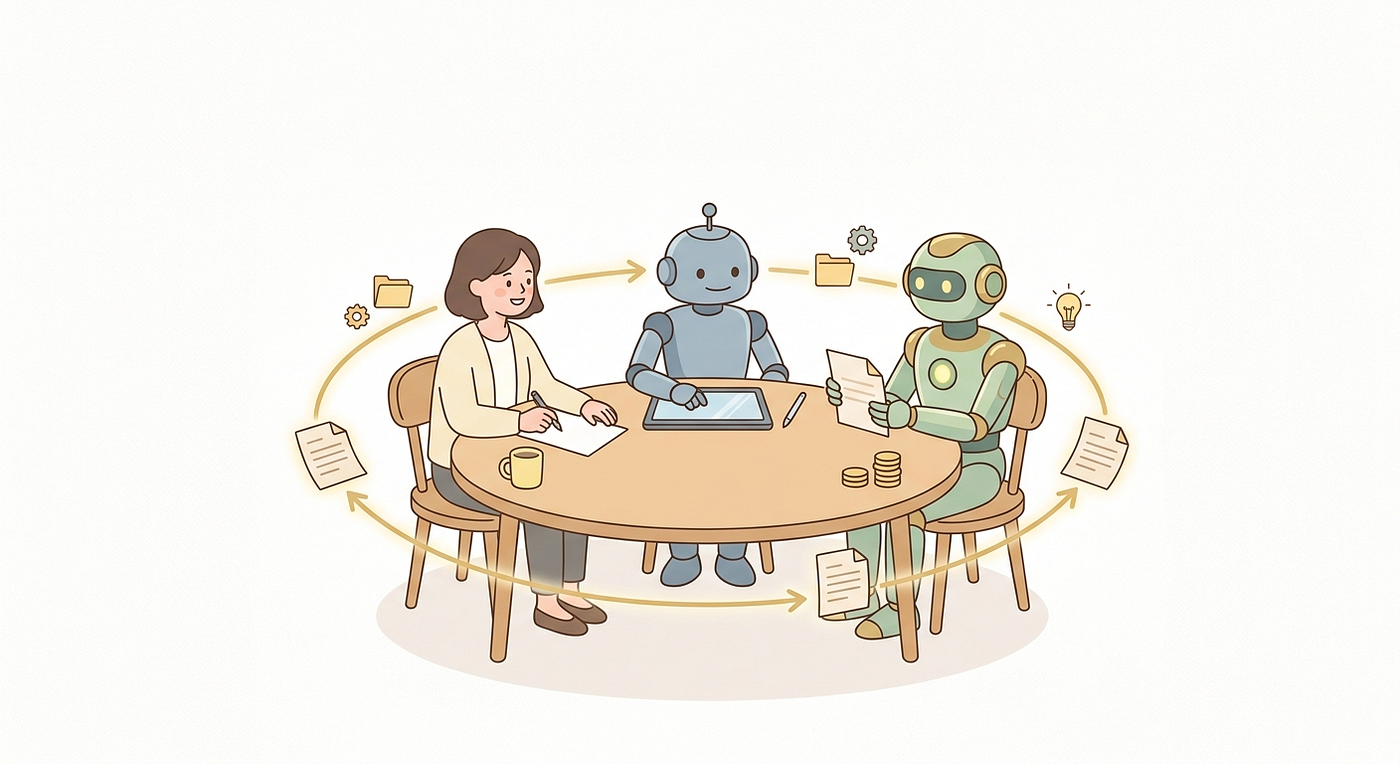
That back-and-forth is the loop: you feed the AI’s own answer back to it with corrections, and you keep going until the result is good enough to send.
Where the loop stops being manual
When you’re the one reviewing each draft, you control the loop naturally. You stop when the proposal looks right, and that’s usually after a handful of rounds.
In the Agentic AI environment, it changes who does the reviewing. An AI agent can carry out a task on your behalf rather than waiting for your next message. In a typical setup, one agent does the work — writing the document, drafting the code, filling in the report — and a second agent — the verifier, or checker — reviews it against a list of criteria you defined in advance. If the work fails a task, the verifier agent sends it back with the reason it failed, and the worker tries again.
That’s the same loop you run by hand, except you are not the one sitting there deciding when it’s good enough. The agents keep passing work between themselves until the criteria are met — the same back-and-forth you’d do manually, just without you in the chair.
Why this shows up on the bill
AI tools charge for what goes in and what comes out. Every time you send text to the model, that’s billed. Every time it sends text back, that’s billed too.
In a loop, those two things stack. The output of round one becomes the input of round two, which produces an output that becomes the input of round three. Each round carries the accumulated conversation along with it, so the rounds get progressively larger.
The practical difference comes down to who stops the loop. When you’re editing a proposal in chat, you go three or four rounds and stop when it reads right, which costs cents. Hand the same proposal to a pair of agents and it might take ten or twenty rounds before the checker is satisfied, putting you in the range of dollars per document. An unattended process working on a big project, left running overnight, keeps looping until it either succeeds or hits a limit, and that’s where the figure can climb into the hundreds.
The overnight scenario is the one worth knowing about. A process that generates documents automatically, left running without a ceiling, can loop far more than anyone intended — usually because the checking criteria are strict enough that the worker agent never quite satisfies them.
Almost every agent framework lets you set a maximum number of loops, and most ship with a sensible default already switched on. If you ever have an agent set up for your business, that limit is a setting worth asking about.
A concrete picture
Say you run a small consultancy and you want proposals generated automatically from your CRM notes.
The manual version: you paste the client notes into your AI assistant, ask for a proposal, revise it twice, and send it. Ten minutes of your time, a few cents of AI cost.
The agentic version: a worker agent drafts the proposal from the CRM record, and a checker agent verifies it includes pricing, a timeline, the scope section, and the right legal wording. If anything’s missing, it goes back. You get a finished proposal without touching it — for maybe a dollar or two, and a loop limit of five rounds so it can’t run away.
If you send two proposals a month, the manual version is fine and the ten minutes aren’t worth automating away. If you send two hundred, the maths flips quickly.
The takeaway
AI loops are one of the most reliable ways to get better output — the second pass is almost always better than the first, whether a person or another agent is doing the reviewing.
The cost question is really a volume question. Agents make sense where the process runs often enough that the per-run cost is smaller than the time it replaces, and where the process is complex enough that a checklist can’t do the job. For a lot of small businesses, staying in the chat box and running the loop yourself is often the better economics.
Beyond the Chat Box is written for business owners and entrepreneurs who want to use AI practically, without needing a tech background. If this was useful, consider following for more.
메타데이터
- post_id
- 75b99fd0857e
- slug
- we-all-use-ai-loops-what-they-are-and-how-much-they-cost-75b99fd0857e
- url
- https://medium.com/@manoliu.andrei/we-all-use-ai-loops-what-they-are-and-how-much-they-cost-75b99fd0857e
- canonical_url
- https://medium.com/@manoliu.andrei/we-all-use-ai-loops-what-they-are-and-how-much-they-cost-75b99fd0857e
- author_url
- https://medium.com/@manoliu.andrei
- status
- ok
- fetched_at
- 2026-08-10 19:08:02