Why cannot one meditate?
https://youtube.com/shorts/0j0wayvaE90
Why cannot one meditate?
https://youtube.com/shorts/0j0wayvaE90
Brilliant insight — Why can one not meditate?
“Because, the subtle body is clouded by karmas” — or samskaras, vasanas, kleshas, shad ripu, cravings, restlessness, emotional turbulence, and habitual outward movement of attention.
The mind is not naturally still because consciousness is constantly pulled outward through the senses, desires, thoughts, and conditioned tendencies.
One can use forceful methods to generate intense energy during kumbhaka while holding the body completely still such that not even a finger moves. When attempted, there arises a tremendous impulse to fidget or move the body. Suppressing that impulse requires energy, pranic intensity, and control. This is why mauna can become so powerful. It is extremely difficult to keep the body and mouth completely still without high prana. We did have highly realized Mauna Swamis and Babas.
Can we say we in our Karmic baggaged selves are driven by that same kundalini energy, released but trapped in samskaras and ignorance, functions as avidya maya expressing itself as outward compulsion, restlessness, and craving?
And so in its highest form, Yoga is finding hacks to still or distance with this Avidya self to discover amd extract from the true or superconcious self and drive transformation. So something lower or unrefined needs to be shut down or destroyed in order to give sosce to higher or more refined, more true and transparent.
During kumbhaka, the body is deprived of oxygen, and there arises a tremendous survival impulse. It feels as though dormant energy suddenly becomes available, possibly kundalini or latent pranic force, and that energy can then be used to further stabilize, restrain, and still the body and cravings of senses.
When this is practiced continuously with concentration on mantra, music, sound, ujjayi, or breath, eventually, the nervous system seems to become partially freed from identification with the gross physical body. One begins to experience another layer of embodiment independent of ordinary physical perception, including starting with tingling, strange waves, currents, flows of energy, vibrations, and heightened internal sensitivity, almost as though blood, bones, nerves, and inner structures can be directly but roughly or vaguely felt. Buddhist traditions might describe aspects of this as pīti.
Then comes a magical stage where the body appears asleep while the nervous system and sensory awareness remain fully active. There is almost zero motivation to move the body. When this state becomes accessible during meditation or yoga nidra, depression, anger, shad ripu, klesha, and vikara temporarily disappear, and varying levels of clarity, intuition, silence, and inward stillness become accessible.
Many psychics describe astral travel? probably is this the beginning of laying to rest of physical body and temporary freedom of astral body from prison of matter?
[embed]
The body can not hold a very high level of energy. A high level of energy can only be managed if one manages to still the body, senses, its addictions, compulsions, cravings, and attain to atleast temporary freedom of astral body outside the prison of matter?
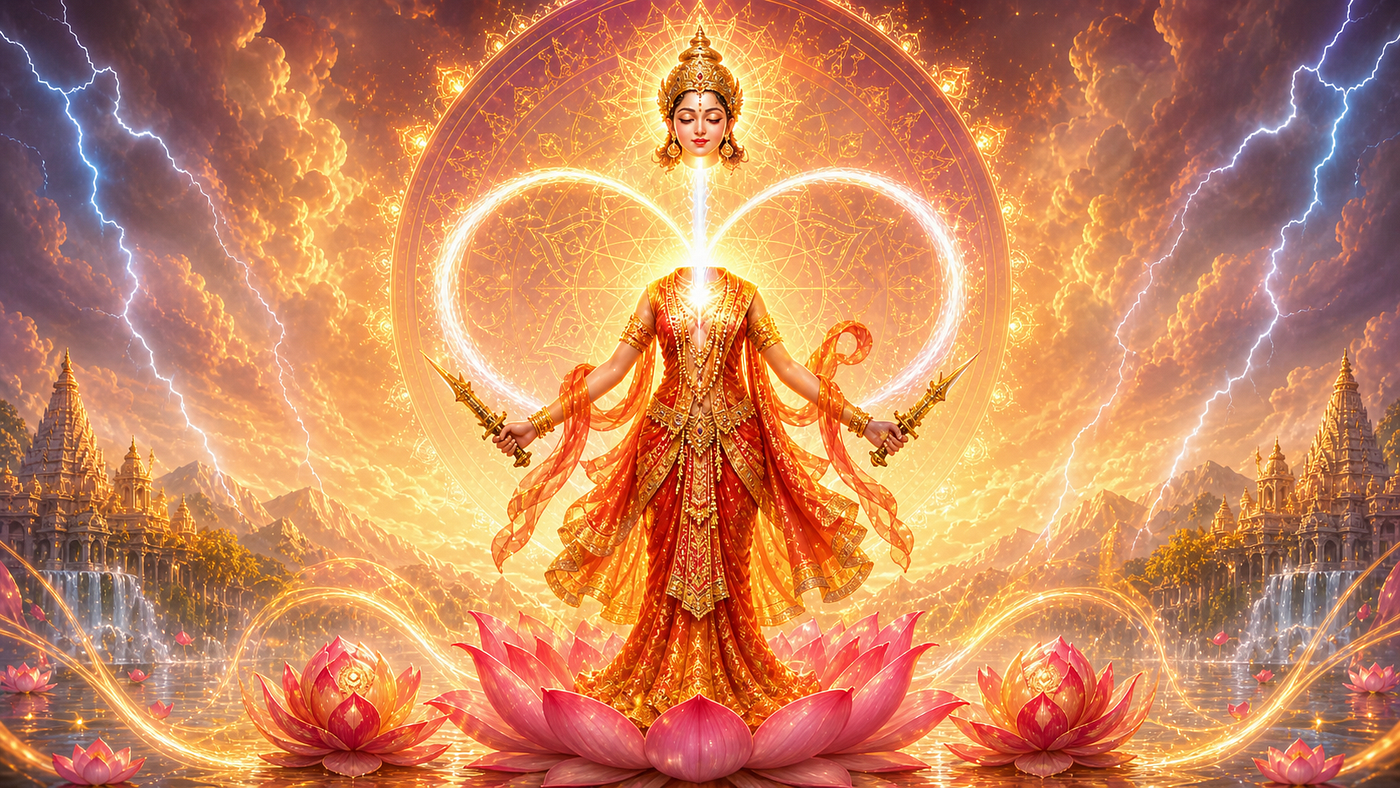
In this stage, depending on desire of the practitioner, it may be possible to experience Yogic Maithuna that needs no partner but only devotion and surrender to Supreme All. As per certain interpretations, this may be experienced as the union of Shiva and Shakti within the subtle body, accompanied by waves of bliss, intense pranic movement, luminosity, or states described symbolically as the radiance of millions of suns?
If you are extremely tired, exhausted, depressed, angry it wipes all of it away and gives confidence.
After meditation, however, the shad ripu tendencies gradually return, indicating that the state is temporary and not yet permanent realization.
Good meditative music seems to works differently from forceful methods. It is subtler and more refined. Emotional bhakti, especially alaap and devotional absorption, can induce natural kumbhaka through intensity of feeling and inward pressure. The most powerful example I found was the Sri Ramakrishna Arati, “Khandana Bhava Bandhana.” It feels extremely precise.
[embed]
If devotion and emotion are genuinely present, one enters the practice completely, as though nothing is held back, and that total surrender seems capable of releasing dormant energy and waves of bliss.
Certain shamanic entheogens, (E.g Ayahuasca, Bufo) from my limited reading, seem to operate through a related mechanism. They strongly disrupt the ordinary system, almost like a poison or shock to the organism, forcing dormant energy and survival consciousness to activate. The “will to survive” appears to awaken latent energy and temporarily override ordinary mental conditioning.
Similarly, practices such as japa while taking cold baths, or methods associated with Wim Hof, also seem to access dormant energy through controlled stress, breath, survival response, and directed awareness.
Gyana Yoga, in that sense, may be a most highly refined method to silence the cravings at the level of intellect and awareness. But it will only work if your body, senses, emotions, feelings, and thoughts are in control of your awareness and faculty of discrimination? If they are not, you use forceful methods (Anavopaya) to quell them and then try to access, refine Gyana, or Awareness layer.
And so its essential to view Yoga or Tantra not as superstition or somethung to fear, but a science of consciousness: technical precision, repeatable methods, systematic manipulation of prana, attention, sound, emotion, breath, body, and awareness to transform consciousness.
The common pattern seems to be these?
- Forcefully or smartly stilling or channeling the movements of body, senses, emotions, thoughts, mind, and intellect in one direction
- While accessing various forms of hidden or dormant energy, emotional intensity, or concentrated prana, and then redirecting that energy upward toward superconciousmess heightened awareness, absorption, stillness, and transformation — unfolding of higher to replace the lower! Evolution!
메타데이터
- post_id
- 75e71a9f7f04
- slug
- why-cannot-one-meditate-75e71a9f7f04
- url
- https://medium.com/@rajkcar/why-cannot-one-meditate-75e71a9f7f04
- canonical_url
- https://medium.com/@rajkcar/why-cannot-one-meditate-75e71a9f7f04
- author_url
- https://medium.com/@rajkcar
- status
- ok
- fetched_at
- 2026-07-10 14:10:06