Stablecoins Won’t Eliminate Remittance Companies—They’ll Rewrite the Economics of Moving Money
Stablecoins Won’t Eliminate Remittance Companies—They’ll Rewrite the Economics of Moving Money
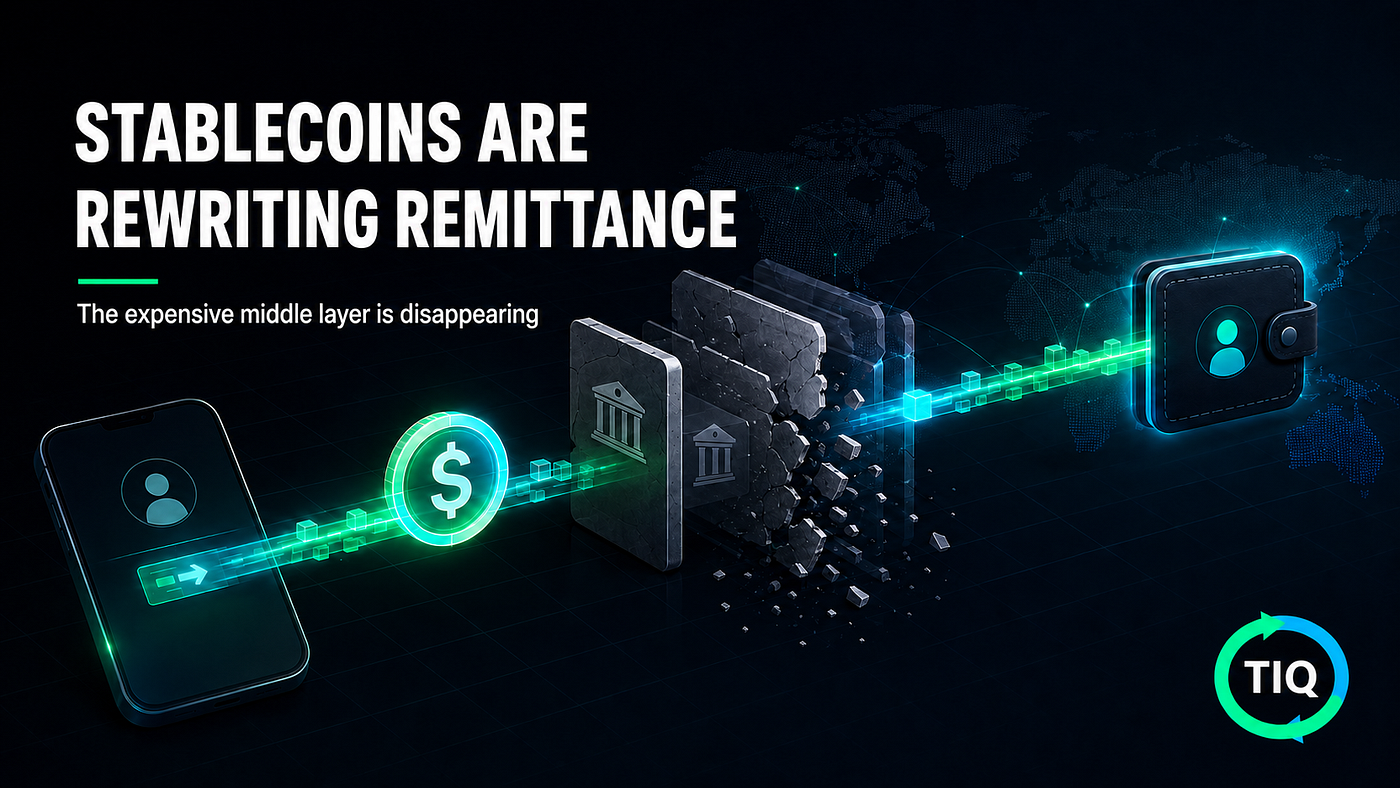
International money transfer is a strange industry.
We can send a message, document, or video to the other side of the world instantly. Yet sending $200 across the same border can still take days and consume a meaningful percentage of the money.
While building TransferIQ, a platform for comparing remittance and crypto transfer routes, I began looking more closely at why payment companies, exchanges, and financial networks are investing so aggressively in stablecoins.
The obvious answer is speed and lower blockchain fees.
The more important answer is liquidity.
The expensive part of remittance is not simply “sending money”
A traditional international transfer may pass through a remittance provider, FX partner, correspondent bank, prefunded foreign account, and local payout institution before reaching the recipient.
Every participant introduces another potential fee, operational delay, or exchange-rate margin.
Providers also need sufficient liquidity in destination countries. To guarantee payouts, they may have to keep capital parked in multiple accounts and currencies before customers even initiate transfers.
That system is expensive to operate.
According to the World Bank, the global average cost of sending $200 was still 6.36% in the third quarter of 2025. Brazil was one of the most expensive G20 countries from which to send money, with an average cost of 11.91%.
That means nearly $24 can disappear while sending only $200.
The problem is not that financial institutions are physically moving banknotes across borders. The problem is that different institutions, currencies, ledgers, regulations, and operating hours must be coordinated before the transaction can be completed.
Stablecoins create an internet-native settlement asset
A dollar stablecoin turns a dollar-denominated claim into an asset that can move across a blockchain.
The simplified route becomes:
Local currency → stablecoin → blockchain transfer → destination currency
The blockchain section can operate around the clock and, depending on the network, settle within seconds or minutes.
For consumers, this can mean faster access to money.
For payment companies, the more important benefits may include:
- Less capital sitting idle in multiple markets
- Shorter settlement and FX exposure windows
- Payments outside traditional banking hours
- Automated reconciliation
- A common asset that can move between wallets, exchanges, and payment platforms
Visa has been testing stablecoin prefunding through Visa Direct for precisely this reason. Instead of relying entirely on fiat balances parked in advance, eligible businesses can use stablecoins to fund cross-border payouts closer to the moment the liquidity is needed.
This is the real advantage.
Stablecoins do not merely make an existing transfer slightly cheaper. They can replace part of the infrastructure used to settle it.
Why remittance companies cannot ignore them
Stablecoins present remittance companies with a defensive choice.
If they ignore the technology, exchanges and digital wallets may take over part of the international transfer relationship.
A user could buy a stablecoin, send it directly to another wallet, and let the receiver convert it through a local exchange. If the receiver prefers to hold dollars, the traditional payout provider might not be needed at all.
But established remittance companies still possess valuable assets:
- Financial licenses
- Compliance systems
- Local banking relationships
- Customer support
- Fraud prevention
- Cash collection and payout networks
This explains why incumbents are adopting stablecoins instead of simply opposing them.
In May 2026, Western Union launched USDPT, a dollar stablecoin issued by Anchorage Digital Bank on Solana. The company is combining the token with its Digital Asset Network and existing global payment infrastructure.
One month later, Bybit became the first major exchange to integrate USDPT through its fiat channels.
Western Union’s strategy reveals the likely direction of the industry: use blockchain for settlement while keeping compliance, distribution, and local cash access under the incumbent’s control.
Why exchanges want the same market
For a crypto exchange, a stablecoin is not merely another asset to list.
It can become:
- The quote currency for trading markets
- Collateral for derivatives and lending
- A settlement asset between platforms
- A digital dollar balance for users
- The foundation for cards, payments, and remittances
Stablecoins also help exchanges retain customer funds. A user holding a digital dollar inside an exchange ecosystem can be offered trading, payments, savings, credit, and international transfers without returning to a traditional bank.
There is also a powerful issuer business model.
The assets backing a stablecoin are commonly held in cash and short-term government securities. Interest generated by those reserves can become a significant source of revenue.
Tether reported more than $10 billion in net profit for 2025. Its scale is exceptional, but its profitability demonstrates why so many financial companies want to issue, distribute, or control a widely used stablecoin.
The competition is not just about transaction fees.
It is about controlling the digital dollar, its liquidity, and the financial services built around it.
Adoption is already moving beyond crypto trading
Stablecoins are increasingly being used inside mainstream payment infrastructure.
Visa reported that its stablecoin settlement pilot had reached a $7 billion annualized run rate by April 2026 and expanded to nine blockchain networks.
Stripe reported that stablecoin payment volume doubled to approximately $400 billion during 2025. An estimated 60% of that volume represented B2B payments, while the volume processed by Bridge—Stripe’s stablecoin infrastructure business—more than quadrupled.
This suggests that stablecoin adoption may develop faster in business payments than in everyday consumer purchases.
Global supplier payments, contractor salaries, platform payouts, treasury transfers, and merchant settlement all suffer from delays and liquidity constraints. Businesses have a strong financial incentive to improve those processes.
The middle mile is being disrupted, not the entire journey
It is tempting to conclude that stablecoins will make remittance companies obsolete.
That conclusion ignores the most difficult part of the transaction.
Recipients usually do not want a token on a blockchain. They want money in a bank account, mobile wallet, or their hands.
A complete stablecoin remittance may still require the user to:
- Buy the stablecoin with local currency.
- Select the correct token and blockchain.
- Pay the network fee.
- Find sufficient destination-market liquidity.
- Sell the stablecoin.
- Withdraw the destination currency.
Each step can introduce trading fees, spreads, withdrawal charges, and operational risk.
The Bank for International Settlements warned in its 2026 Annual Economic Report that once on-ramp and off-ramp costs are included, the total cost of a stablecoin transfer can be as high as—or higher than—a bank transfer.
This is particularly relevant for small remittances and markets with limited exchange liquidity.
Cheap blockchain settlement does not automatically create cheap cash delivery.
The unresolved challenges
Stablecoins still face several obstacles before they can become a universal remittance layer.
Regulation is fragmented. A transaction can cross borders instantly, but licensing, AML requirements, sanctions screening, consumer protection, and capital controls remain national.
The technology is also fragmented. USDT, USDC, PYUSD, USDPT, and other stablecoins exist on different networks with different fees, liquidity, and wallet support.
Sending the correct token over the wrong network can result in lost funds. Private-key management and irreversible transactions also remain difficult for ordinary consumers.
Stablecoins introduce issuer and reserve risks as well. A token designed to equal one dollar is not a banknote or central bank liability. Its reliability depends on the issuer, reserve assets, redemption process, and applicable regulation.
Finally, local liquidity remains essential. A stablecoin has limited remittance value if the recipient cannot convert or spend it at a reasonable price.
What stablecoins are most likely to destroy
Stablecoins may not destroy remittance companies.
They are more likely to destroy the economic justification for slow settlement, unnecessary intermediaries, and opaque FX margins.
The competitive advantage is shifting away from the act of transferring a digital asset. That part is becoming increasingly commoditized.
The more durable advantages will be:
- Regulatory access
- Local currency liquidity
- Reliable on- and off-ramps
- Cash and bank distribution
- Fraud prevention
- Simple user experience
- Accurate calculation of the final amount received
Western Union may not disappear because of stablecoins. It may evolve into a stablecoin-powered company with a global cash network.
Crypto exchanges may also stop looking like trading venues and begin looking more like international dollar accounts.
This is one of the reasons I am building TransferIQ.
Comparing the token price or blockchain fee alone does not tell a user which route is cheapest. The purchase spread, trading fee, network cost, exchange rate, and local withdrawal charge must all be included.
The most important question is not:
“Which stablecoin is the cheapest to send?”
It is:
“After every cost, how much money will the recipient actually receive?”
That is where the real competition in cross-border payments will take place.
메타데이터
- post_id
- 75f2e0937549
- slug
- stablecoins-wont-eliminate-remittance-companies-they-ll-rewrite-the-economics-of-moving-money-75f2e0937549
- url
- https://medium.com/@jkim1285brazil/stablecoins-wont-eliminate-remittance-companies-they-ll-rewrite-the-economics-of-moving-money-75f2e0937549
- canonical_url
- https://medium.com/@jkim1285brazil/stablecoins-wont-eliminate-remittance-companies-they-ll-rewrite-the-economics-of-moving-money-75f2e0937549
- author_url
- https://medium.com/@jkim1285brazil
- status
- ok
- fetched_at
- 2026-08-02 07:06:13